Login
Register
By clicking Login or Register, you agree that the images of Nazi symbols shown on alexmp.com are not propaganda of fascism, Nazism and are shown solely for historical, cognitive and scientific purposes.
Order a free call and our specialist will contact you shortly!
Contact us and we will get back to you shortly.
Contact us and we will get back to you shortly.
Contact us and we will get back to you shortly.
Contact us and we will get back to you shortly.
Error: Contact form not found.
We will get back to you shortly.
В честь запуска Энциклопедии мы рады предложить вам бесплатный доступ до 01.10.2036.
Будем рады вашим комментариям и предложениям!
Inspected and guaranteed by Alex Warstory.
For more details on AlexMP Guarantee, click [HERE]
Item guaranteed by a verified dealer.
Click [HERE] for full seller guarantee terms.
Sold without expert review or guarantees. No claims accepted post-sale.
Learn more [HERE]


Showing 97–112 of 120 results
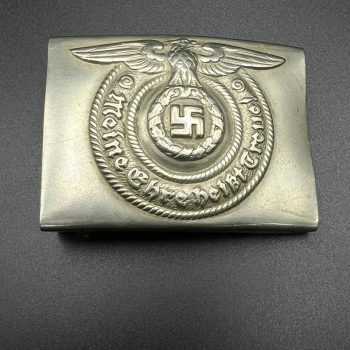
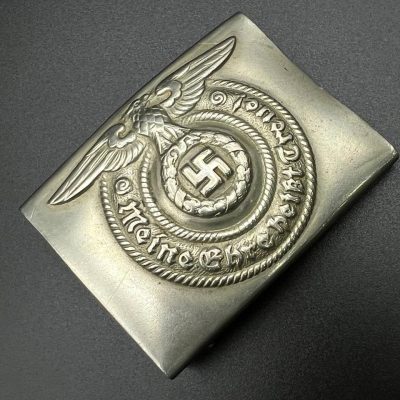
FiltersOriginal early-type SS belt buckle made of nickel silver (Neusilber). The front features a detailed depiction of the SS eagle clutching a wreath with a swastika, surrounded by the motto: “Meine Ehre heißt Treue” – “My honor is loyalty.”
Nickel silver buckles are among the earliest and highest-quality variants, primarily issued to members of the Allgemeine-SS before the outbreak of World War II. They are known for their sharp detail and durability.
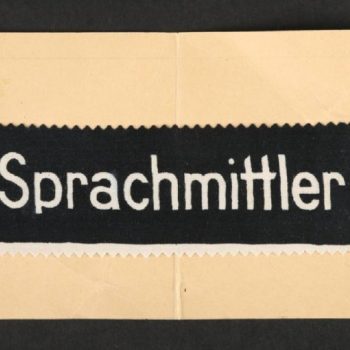
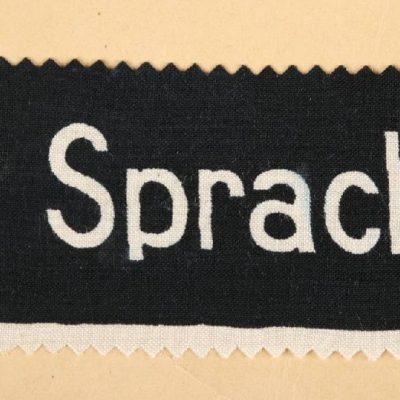
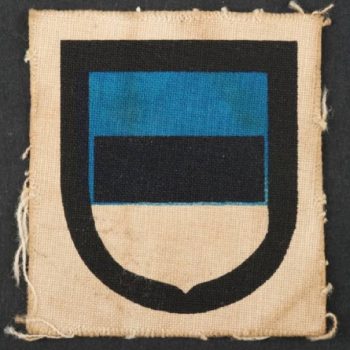
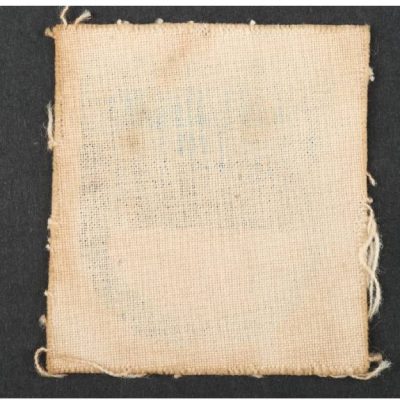
An incredibly rare cuff title “Sprachmittler” Interpreter for the Staff of the RAO, Russian Liberation Army. This is also a manufacturer’s proof by Genzsch & Heyse in Hamburg. The common literature shows only a graphic interpretation of the actual offered cuff title in “Foreign Legion of the Third Reich” Volume 4, by David Littlejohn, 1987, Page 342.
Printed in black on cotton and adhered to the manufacturers proof card.
The Russian Liberation Army (German: Russische Befreiungsarmee; Russian: Русская освободительная армия, Russkaya osvoboditel’naya armiya, abbreviated as РОА or ROA) was a collaborationist military force primarily made up of Russian soldiers that fought alongside Nazi Germany during World War II. It is also known as the Vlasov Army (Власовская армия, Vlasovskaya armiya) after its leader, Andrey Vlasov, a former Red Army general who defected to the German side. The soldiers of this army were often referred to as Vlasovtsy (Власовцы). In 1944, the group became formally known as the Armed Forces of the Committee for the Liberation of the Peoples of Russia (Вооружённые силы Комитета освобождения народов России, Vooruzhonnyye sily Komiteta osvobozhdeniya narodov Rossii, abbreviated as ВС КОНР or VS KONR). From January 1945 onward, the army was commanded by Vlasov himself.
White cotton backing, printed shield of balue, black and white with black surrounding.
UV negative and unissued.
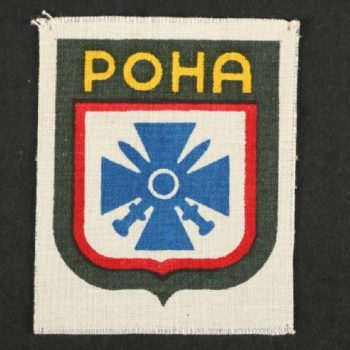
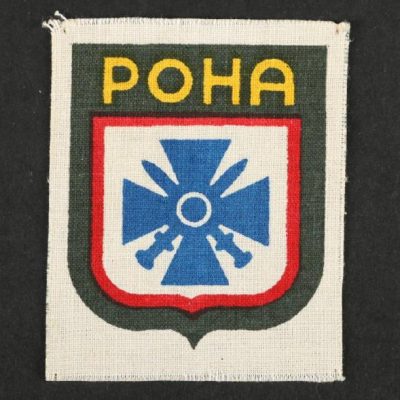
White cotton backing, printed shield of green, red, with the blue cross of St. George with swords and “POHA” in yellow lettering.
Unissued and eceedindly rare.
The Russian Liberation People’s Army (Русская освободительная народная армия, Ruskaya osvoboditelnaya narodnaya armiya, abbreviated as RONA) was established in late 1941 as an auxiliary police force with around 200 personnel. By mid-1943, it had expanded to 10,000–12,000 men, equipped with Soviet tanks and artillery captured by the Germans. Led by Bronislav Kaminski, the unit was initially called the Russian People’s Liberation Army (Русская освободительная народная армия), and it became a semi-independent militia. In 1942, Kaminski enforced a forced mobilization of local civilians into his militia, transforming it into a regular fighting force within the Lokot Autonomy, a self-proclaimed “republic” under Nazi control, and a private army that answered directly to him.
After the German defeat at the Battle of Kursk in August 1943, RONA retreated to the Byelorussian region, particularly around the Lepel area in Vitebsk. There, they participated in security operations alongside German forces, committing numerous atrocities against the local civilian population. In June 1944, RONA was formally incorporated into the Waffen-SS. Following the Soviet counteroffensive in Operation Bagration (June to August 1944), the remnants of the Kaminski unit retreated further west. By the end of July 1944, between 3,000 and 4,000 men (some sources estimate up to 6,000 or 7,000) regrouped at the SS training camp at Neuhammer (now Świętoszów). Using the Kaminski unit as a base, SS leaders planned to form the 29th Waffen Grenadier Division of the SS RONA (1st Russian).
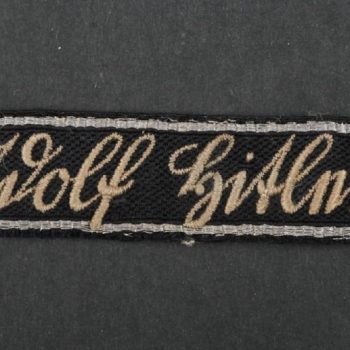
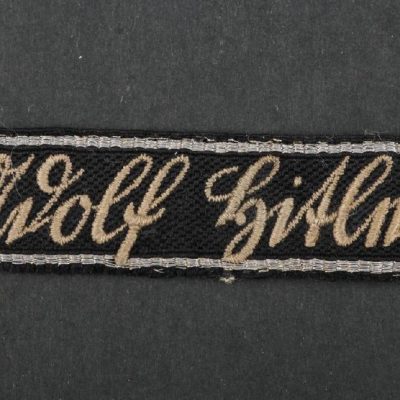
Uniform removed partial cuff title. Enlisted version with aluminum thread edges and light brown, machine woven embroidered Sütterlin script as introduced in 1940.
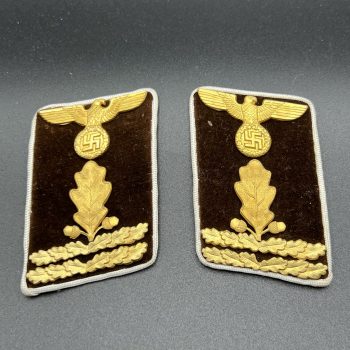
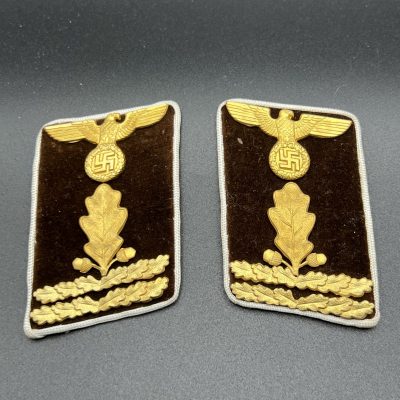
Original collar tabs for a Bereichsleiter — one of the higher ranks within the structure of the National Socialist German Workers’ Party (NSDAP), introduced as part of the 1939 reforms to party ranks and uniforms. The title “Bereichsleiter” (Sector Leader) was held by senior party officials responsible for administrative and organizational functions at the district, regional, and even Reich levels.
The tabs are made of brown velvet with a prominent gold border. The central design features a stylized embroidered oak wreath containing three horizontal chevrons — a symbol denoting the high rank of the wearer. The embroidery is done in gold bullion thread, emphasizing the prestige of the position.
These collar tabs are of particular historical and collectible value as part of the official political insignia of the Third Reich. Especially prized are well-preserved, authenticated examples.
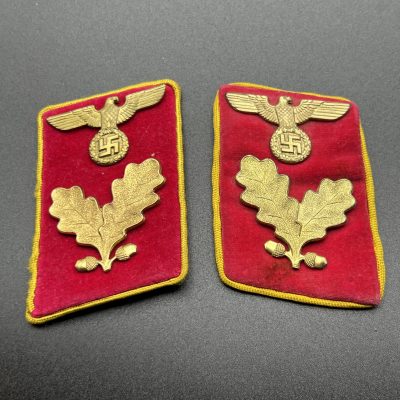
Original collar tabs for a Haupt-Abschnittsleiter — a mid-to-senior rank within the hierarchy of the National Socialist German Workers’ Party (NSDAP), used by officials of the district-level (Kreisleitung) party leadership. These represent the new pattern introduced in 1939 as part of the standardization of NSDAP uniforms.
The tabs are made of brown velvet with a distinctive gold border and embroidered oak leaves and chevrons indicating rank. A notable feature of the new pattern is its simplified design and strict regulation, reflecting efforts to unify party symbolism across all levels.
These tabs hold high historical and collectible value as a rare component of the political uniform system of the Third Reich. Especially sought after in original, undamaged condition.
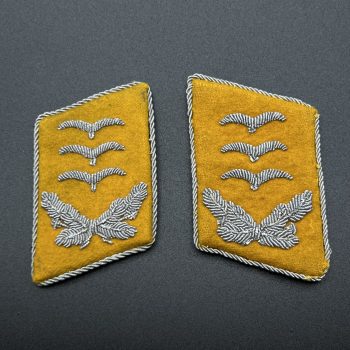
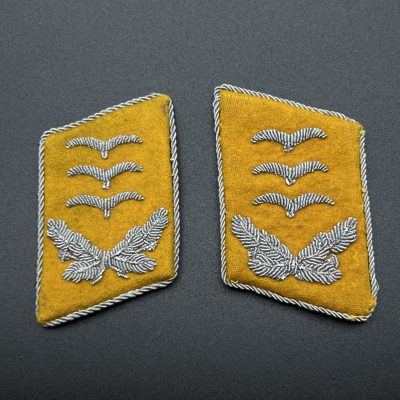
Original collar tabs for a Hauptmann (Captain) of the Luftwaffe — the air force of Nazi Germany during World War II. These insignia were worn on the uniform collar and signified the rank of a mid-level officer.
The tabs are made from dark blue (or gray-blue) wool, featuring the characteristic silver piping and two vertically aligned oak leaves embroidered with metallic thread. The craftsmanship reflects the high standards of Luftwaffe officer uniforms, often produced by hand or in limited quantities.
This uniform element holds significant historical and collector value, especially when well-preserved. It is of particular interest to collectors, reenactors, and researchers of the Third Reich and World War II military history.
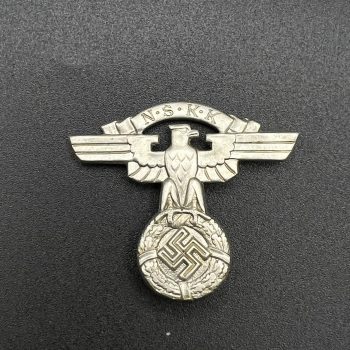
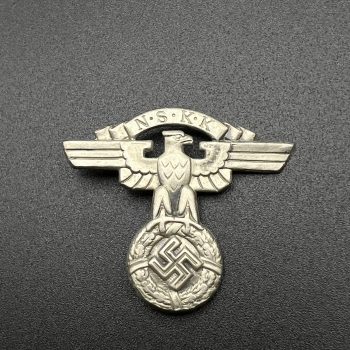
Authentic aluminum cap badge used by members of the NSKK (National Socialist Motor Corps) during the era of the Third Reich. This lightweight, stamped metal insignia was standard issue for wear on NSKK headgear.
Features a finely detailed oak leaf wreath with a swastika at the center—representative of the organization’s distinctive uniform style. The reverse side has its original mounting prongs intact and functional.
The piece shows light wear consistent with age but remains in solid, untouched condition. No repairs or replacements.
A genuine and increasingly hard-to-find item from NSKK uniforms—perfect for WWII militaria collectors or anyone interested in period insignia.
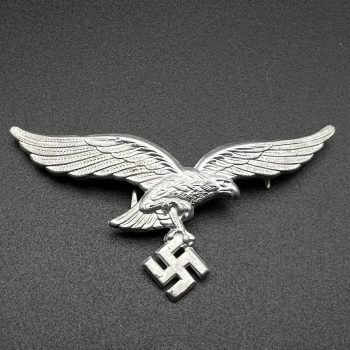
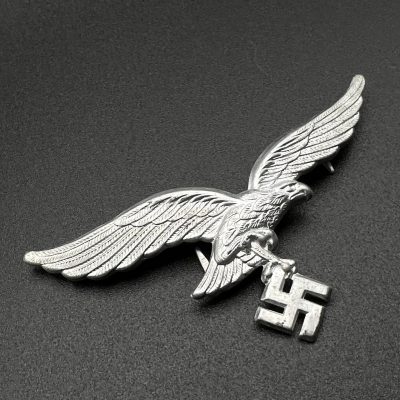
It is an authentic Luftwaffe cockade made of stamped aluminum, originally worn on visor caps and other headgear by personnel of the German Air Force during the Third Reich period.
Classic design featuring an oak leaf wreath with the national tricolor roundel (black-white-red) in the center. Lightweight construction typical of pre-war and wartime production.
The reverse retains its original attachment prongs, undamaged. Well-preserved condition with sharp details and no repairs.
A genuine piece of Luftwaffe uniform insignia—ideal for collectors.
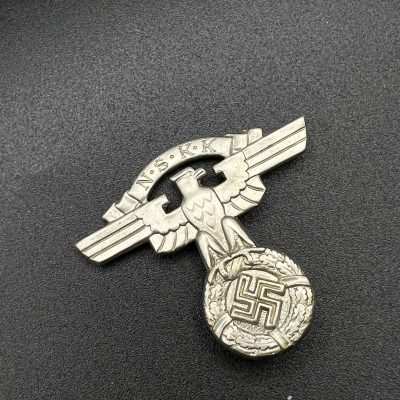
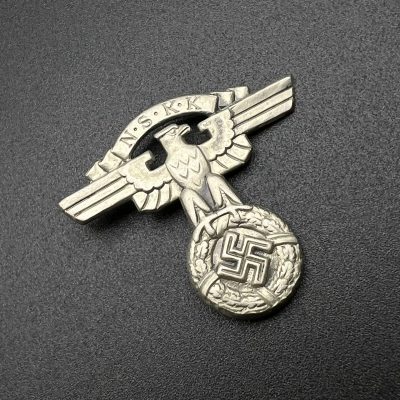
Genuine NSKK (National Socialist Motor Corps) cap cockade, manufactured from lightweight stamped aluminum. This type was worn on the headgear of NSKK personnel during the Third Reich era.
Classic design featuring a detailed wreath with central swastika, typical of paramilitary insignia from the 1930s–1940s. Reverse side retains the original attachment prongs, undamaged and complete.
Well-preserved condition with minor age-related wear, no repairs or replacements. Clean details and solid shape throughout.
A scarce and authentic piece of NSKK uniform insignia—ideal for collectors of WWII German militaria or period headgear accessories.
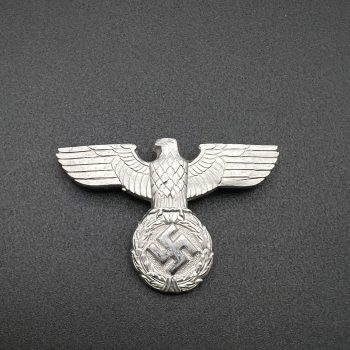
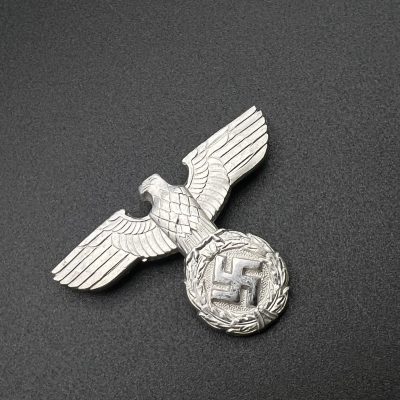
This is an original aluminum NSDAP cockade, used on peaked caps and headgear worn by members of the National Socialist German Workers’ Party during the Third Reich period.
Made from lightweight aluminum, without enamel, featuring detailed design with a wreath and central swastika. The reverse side retains its original prongs, intact and undamaged.
The piece is in good collectible condition, with light wear consistent with age—no repairs or replacements. A genuine item from the 1930s–40s.
A historical and authentic artifact, ideal for collectors of Third Reich political insignia or uniform components.
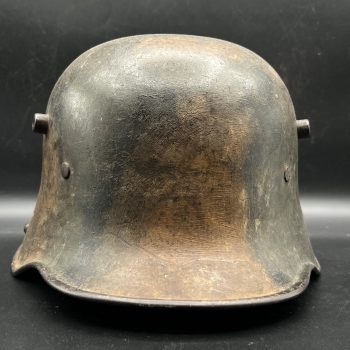
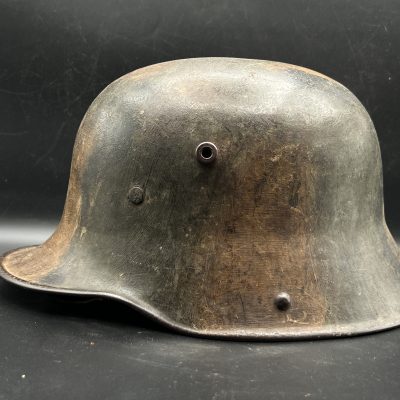
Excellent overall condition on this helmet. Features a standard camo pattern with colors of brown, green ad dark yellows. No dents and heavy damage, just expected wear for a helmet of this age. Interior is even better with all three liner pads intact which is quite rare as the tend to rot and fall out. Has a size stamping to the one side which is faint, but can just make it out. Nice WWI helmet with a great look about it.
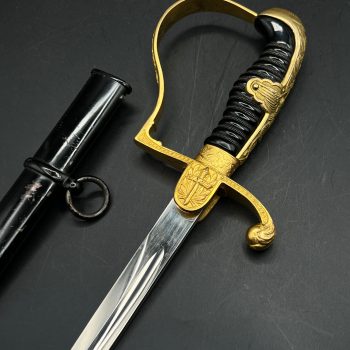
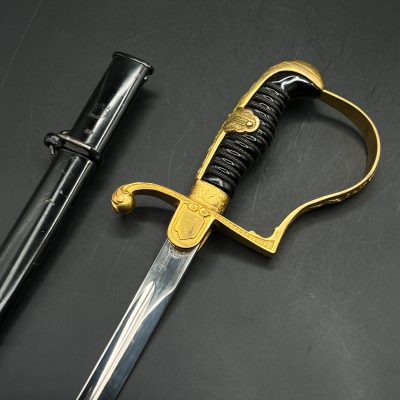
Officer parade weapons, revived following the restoration of the German armed forces, continued the proud traditions of the Imperial Army and the Reichswehr. Unlike the Army dagger model 1935, officer sabers were produced in numerous design variations by various Solingen manufacturers. Production of this type of weapon was discontinued in May 1943 due to wartime industrial demands; however, examples already in service continued to be worn with parade uniforms. In late 1944, the wearing of parade edged weapons was completely abolished, and officers were ordered to carry a pistol instead of a saber or dagger.
The blade bears the mark of the renowned Solingen firm F. W. Höller Waffenfabrik, founded in 1866 and officially registered with the Solingen authorities on 5 June 1883. From its founding, the company specialized in the production of edged weapons and cutlery. Throughout the late 19th century and during the First World War, the firm manufactured a wide range of military products, including bayonets, sabers, and swords. In 1905, the company registered its well-known trademarks: the thermometer image, as well as the figure of a man tipping his hat with the inscription “Hut ab!” (“Hats off!”). From 1914 to 1939, the firm was managed by Julius Küller. During the Third Reich period, Höller became one of the largest and most prolific edged weapons manufacturers in Solingen, specializing in a broad range of military products. In 1935, the company was located at Sonnenstraße 8, Solingen, and that same year received RZM license M7/33. Products were actively advertised in specialized journals and catalogs, showcasing an extensive assortment that included NSDAP and Wehrmacht daggers, swords, and bayonets. The firm also produced parade bayonets with high-quality etched blades. In 1941, Höller celebrated its 75th anniversary, promoting the Höller Model 21 sword as its flagship model. In June 1941, the company was assigned the K98 bayonet manufacturer letter code (fze). Following the end of the Second World War, under the ownership of Herr Grah, the firm continued operations, producing cutlery, kitchen and professional knives, swords, and scissors through the 1970s. The company was officially liquidated in December 1974. Particular collector value is added to this example by a rare decorative detail: an additional eagle on the grip backstrap, distinguishing this saber from standard production specimens.
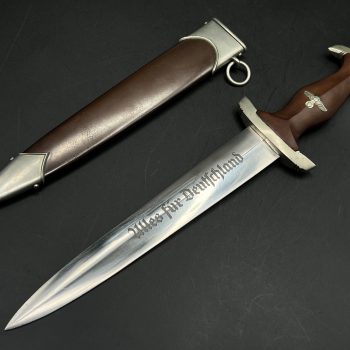
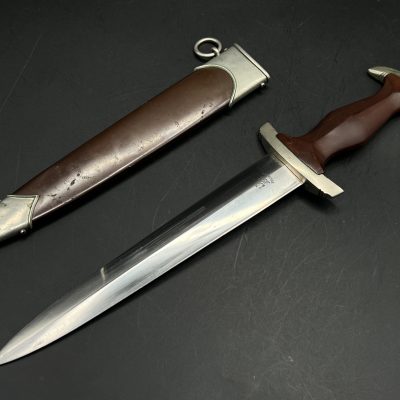
A service edged weapon of the SA (Sturmabteilung) storm troopers, adopted in 1933. The distinctively shaped blade with double-sided sharpening bears the legendary motto “Alles für Deutschland.” The handle is made of brown-colored wood and decorated with the SA emblem featuring an eagle; the metal scabbard is finished in the same brown tone.
The early type of SA/NSKK daggers was produced between 1933 and 1936 and is distinguished by a number of characteristic design features. The scabbard and handle fittings are made of nickel silver (German silver), which, combined with the high quality of component fitting and the anodized scabbard coating, sets these examples apart from later production runs. This dagger was manufactured by Stöcker & Co. SMF. Early examples are particularly prized by collectors due to their impeccable craftsmanship and historical significance as the first service daggers of the storm troopers.
A rarity rating of 5 out of 10 according to the Ralf Siegert classification indicates that such examples are relatively uncommon on the antiques market.
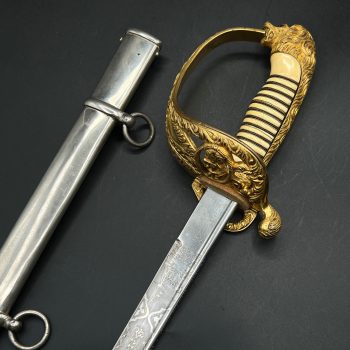
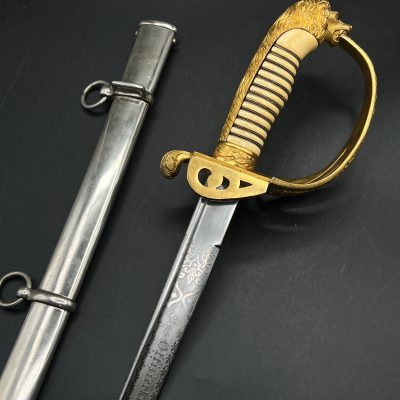
The naval saber was a mandatory attribute of the dress uniform of officers in the Kaiserliche Marine. During the period of Kaiser’s Germany, the imperial anchor beneath the Kaiser’s crown was characteristic in the design of the hilt. The classical variant featured a brass hilt, ivory grip, and a lion’s head with eyes of red and green color. The scabbard was typically made of black leather with brass fittings; steel scabbards are considerably rarer. Sabers were purchased by officers at their own expense, which resulted in numerous variations of execution. Standard and Damascus blades can be found, various hilt designs and decorative scabbard finishes, as well as several sizes ranging from light and elegant to large Grosse Pattern models. It is precisely this diversity of execution that makes naval sabers a particularly interesting independent field of collecting: collections can be built according to manufacturers, sizes, hilt types, blades, and finishing variations. Along with the dirk, the saber remained a symbol of officer status and the continuity of German naval weaponry traditions of the nineteenth century.
E. & F. Hörster, one of the largest Solingen manufacturers of naval edged weapons, operated from the nineteenth century and continued production during the Weimar Republic and the Third Reich. The firm produced high-quality naval sabers and dirks in various execution variants. Already before World War I, Hörster products were supplied not only for the German market but were also exported to other European countries, including the Russian Empire. Thanks to its long operational period, Hörster products allow one to trace the development of naval edged weapons from the Kaiser era to the Kriegsmarine.
Seebataillone represented naval infantry units of the Kaiserliche Marine. There were several marine battalions, and the custom-made edged weapons associated with them constitute a separate field of collecting German naval weaponry. A characteristic feature of such items is the combination of naval and infantry attributes. For example, an officer’s saber could feature a traditional naval hilt and blade but be equipped with steel infantry-type scabbards. Custom specimens frequently bear personal dedications from one officer to another or from the officer corps to a specific serviceman of a Seebataillon. In addition to officer sabers and other custom edged weapons, this group includes infantry-type bayonets for Mauser system rifles with Seebataillone designations and symbols. Most such items bear unit designations; however, named specimens also occur, representing particular collecting interest.
This saber features a characteristic openwork pierced hilt, presented in the catalogs of several manufacturers; however, it did not correspond to the established standard for Kaiserliche Marine edged weapons and was subsequently prohibited from being worn. It is precisely this unusual feature that makes such sabers particularly desirable among collectors today. Such specimens were predominantly ordered as presentation weapons, for example upon an officer’s transfer to another unit or upon his retirement from service, and served as an object of special pride for the owner. The present specimen is entirely original; the factory riveting of the hilt remains intact, the saber has not been disassembled, and retains its original configuration.