ABOUT US
ALEX MARKETPLACE (Military Antiques Auction) – is a trading platform, where you can buy antique items from the period of the first and second world wars.
The auction lots are structured into a catalog with categories and filters that you can use to find the items you are interested in.
Each auction is a selection of military antiques, with limited time bidding opportunities. Registered users are allowed to bid.
Read about our guaranties: https://alexmp.com/guarantee/
Last auctions
-
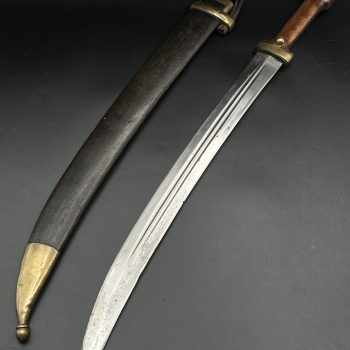
Russian Model 1907 Soldier’s Dagger (Bebut) Russian Empire [Weapons Factory Zlatoust] Matching numbers 1912 (Lot: 1479)
Starting bid: $ 1,455Soldier’s dagger of the 1907 model, known as the ‘bebut’, manufactured in 1912 at the Zlatoust Arms Factory. The characteristic curved blade and recognizable silhouette make this specimen of cold steel one of the most interesting items in the history of weapons of the Russian Imperial Army.
The Zlatoust Arms Factory, which was one of the leading manufacturers of cold steel weapons in the Russian Empire, produced bebuts for army use in accordance with approved standards. The manufacturer’s mark confirms the authenticity and provenance of this specimen.
Particular collector’s value is represented by the presence of matching serial numbers on the weapon’s components. The coincidence of numbers testifies to the preservation of the complete set in its original configuration and significantly enhances the significance of this item for collectors of military antiques from the late Russian Imperial period.
-
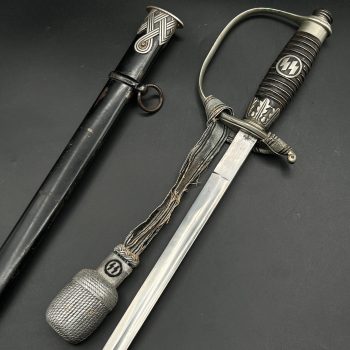
SS Officer’s Sword. [Peter Dan Krebs]. Personalization (Lot: 1478)
Starting bid: $ 8,150A blade produced by the workshop of Peter Dan Krebs, one of the recognized manufacturers of cold weapons for SS officer personnel, distinguished by impeccable quality of execution and characteristic features inherent to this firm’s products.
A personalized specimen executed to individual commission, which significantly enhances the collectible value of the item and testifies to the sword’s ownership by a specific officer. Such named examples are encountered considerably less frequently than standard serial productions and represent particular interest for collectors of military antiques from the Third Reich period.
-
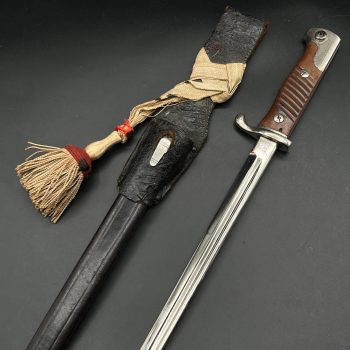
Bayonet, Model 1898. [Clemen & Jung]. (Lot: 1477)
Starting bid: $ 545Adopted by the German Army in 1898 alongside the legendary Mauser rifle system, this bayonet became one of the most widespread and recognizable examples of edged weapons at the turn of the nineteenth and twentieth centuries. The blade bears the hallmark of the renowned Solingen firm Clemen & Jung, which specialized in the production of military blades and established itself as a reliable supplier to the German armed forces. The characteristic construction of the Model 1898 bayonet with its distinctive profile and mounting system for the Gewehr 98 rifle makes it a desirable acquisition for collectors of German military antiques and First World War history.
-
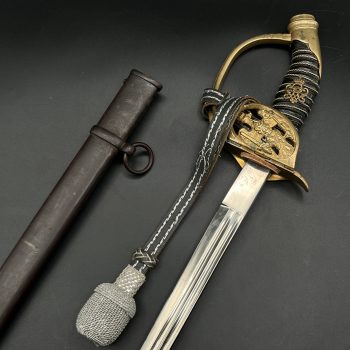
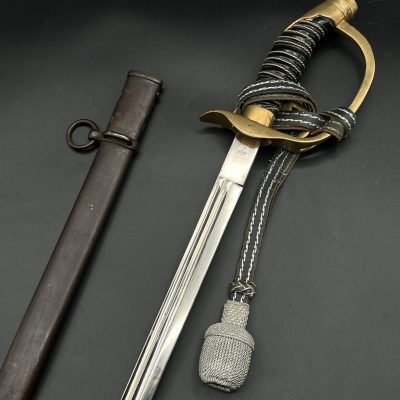
German Sword, pre-1918 Infantry. (Lot: 1476)
Starting bid: $ 975Officer’s cold weapon of the German Empire prior to 1918, belonging to infantry units. Land sabers of this period were distinguished by characteristic structural features dictated by the specific requirements of service in foot troops. Infantry officers carried sabers of a somewhat different pattern than cavalrymen; their blades typically had less curvature and were adapted primarily for parade and everyday wear rather than for mounted combat.
German sabers of this period bear the imprint of the military tradition of numerous German states united in 1871 into a single empire. Each kingdom, duchy, or principality contributed its own elements to the decoration of hilts and scabbards, making the attribution of such specimens a particularly engaging task for the collector. Infantry sabers of Prussian, Bavarian, Saxon, or Württemberg origin may differ substantially in details while maintaining overall similarity in silhouette.
Weapons of this type served as an integral part of officer’s equipment for decades, up until the end of World War I, when the German Empire ceased to exist. The collectible appeal of such objects is determined by their historical significance, quality of execution, and relative rarity on the contemporary antique market.
![Russian Model 1907 Soldier’s Dagger (Bebut) Russian Empire [Weapons Factory Zlatoust] Matching numbers 1912](https://alexmp.com/wp-content/uploads/2026/09/1790361073532-hja8jtnway6-400x400.jpeg)
![SS Officer’s Sword. [Peter Dan Krebs]. Personalization](https://alexmp.com/wp-content/uploads/2026/09/1790361012656-28w5sagyp3w-400x400.jpeg)
![Bayonet, Model 1898. [Clemen & Jung].](https://alexmp.com/wp-content/uploads/2026/09/1790286189125-wquu9s9l8ym-400x400.jpeg)