Login
Register
By clicking Login or Register, you agree that the images of Nazi symbols shown on alexmp.com are not propaganda of fascism, Nazism and are shown solely for historical, cognitive and scientific purposes.
Order a free call and our specialist will contact you shortly!
Contact us and we will get back to you shortly.
Contact us and we will get back to you shortly.
Contact us and we will get back to you shortly.
Contact us and we will get back to you shortly.
Error: Contact form not found.
We will get back to you shortly.
В честь запуска Энциклопедии мы рады предложить вам бесплатный доступ до 01.10.2026.
Будем рады вашим комментариям и предложениям!
Inspected and guaranteed by Alex Warstory.
For more details on AlexMP Guarantee, click [HERE]
Item guaranteed by a verified dealer.
Click [HERE] for full seller guarantee terms.
Sold without expert review or guarantees. No claims accepted post-sale.
Learn more [HERE]


Showing 1–16 of 21 results
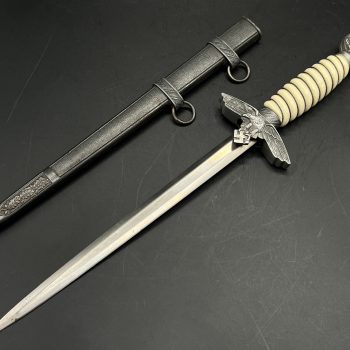
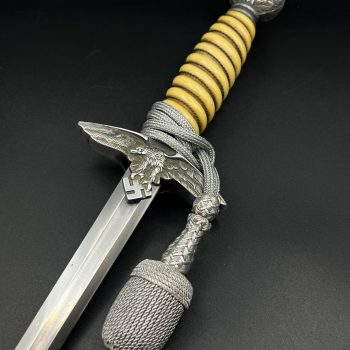
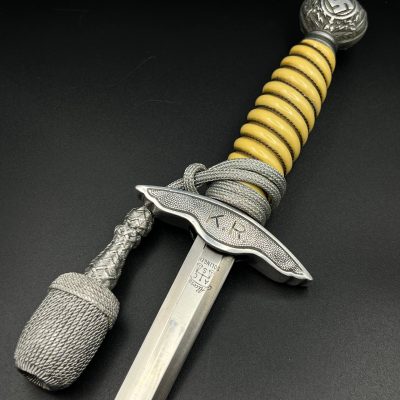
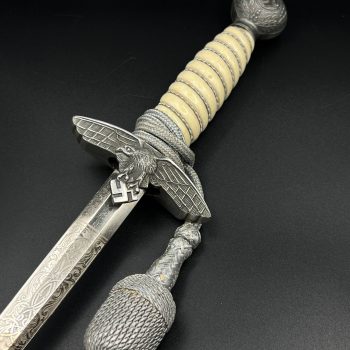
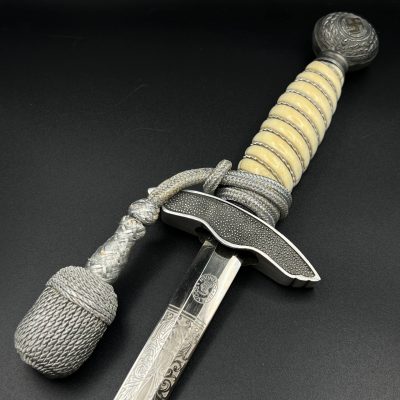
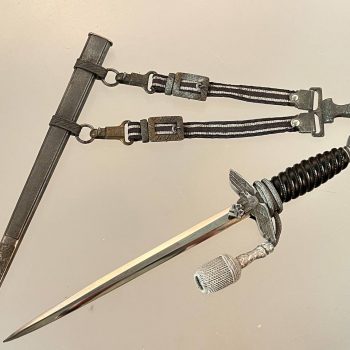
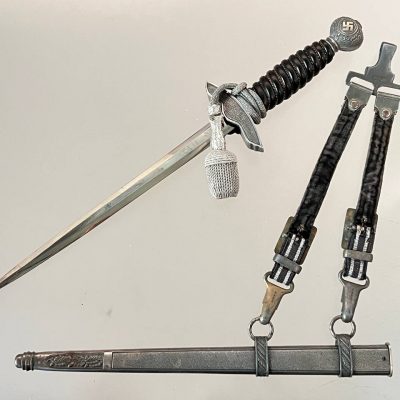
FiltersLuftwaffe officer’s dagger, second model (1937 pattern), complete with metal scabbard and officer’s sword knot. The handle is made of celluloid with characteristic spiral wrapping of aluminum wire. The spherical pommel is decorated with relief plant ornament featuring oak leaves and a swastika in yellow metal. The crossguard is fashioned as a spread eagle grasping a swastika in its talons. The blade bears an oval maker’s mark of F.W. Höller, Solingen, with a thermometer motif. The metal scabbard features characteristic shagreen texture and is adorned with metal fittings decorated with relief ornament of oak leaves.
The sword remains in completely original factory condition. The early nickel silver fittings retain their original natural patina and show only minor signs of honest age and use. Matching “12” assembly marks are present on both the crossguard and the scabbard, confirming that they have remained together as an original factory-matched set. Horster swords are encountered less frequently than those of many other manufacturers, making this example particularly desirable for collectors.
A historically significant example of Luftwaffe officer’s edged weapon, introduced in 1934 as an honorary sword (Ehrenschwert), established by Hermann Göring for a select circle of “Fliegerschaft” members personally chosen by him. Following the official proclamation of the Luftwaffe in March 1935, the sword became standard officer’s equipment under the designation Offizierschwert, although it was more commonly referred to as Fliegerschwert. The sword was mandatory for officers and senior non-commissioned officers when wearing service, parade, and walking-out uniforms.
The nickel silver (German silver) fittings are characteristic of early examples, generally produced prior to 1936. Due to limited production runs, high manufacturing quality, and distinguished appearance, such pieces are traditionally valued by collectors more highly than later variants. This particular specimen derives additional appeal from its personalization, indicating a custom order and enhancing its collectible value.
The sword was manufactured by E. & F. Hörster, a German arms manufactory from Solingen, founded in 1850, which became one of the largest producers of edged weapons for the armed forces of the Third Reich. The company produced daggers and dirks for the DLV, NSFK, and Luftwaffe, as well as for combat, political, and paramilitary organizations.
The stamp bearing the numeral “5” present on the piece is a military acceptance inspection mark. It was applied following examination of the item and confirmed its compliance with established quality requirements. The presence of the “5” stamp is a characteristic feature of a number of original early period Luftwaffe items and serves as one of the additional indicators of authenticity during comprehensive evaluation of the piece.
The sword remains in completely original factory condition. The leather on the grip, scabbard, and hanger is entirely original and has never been replaced. All metal fittings retain their original natural patina. The early nickel silver mounts are preserved in exceptional collector’s condition for their age, showing only minor signs of honest use. The piece is free from hidden restorations, replaced parts, or other issues that could affect its authenticity or collector value.
Honorary weapon, introduced in 1934 personally by Hermann Göring for a select circle of “Fliegerschaft” members, originally held the status of Ehrenschwert. Following the official proclamation of the Luftwaffe in March 1935, the sword acquired the status of a standard officer’s weapon under the designation Offizierschwert, although in common usage it was more frequently referred to as Fliegerschwert. Wearing this sword was mandatory for officers and senior non-commissioned officers with service, parade, and walking-out uniforms.
The fittings made of nickel silver (German silver) are characteristic of early examples, typically manufactured prior to 1936. Due to limited production runs, high manufacturing quality, and distinguished appearance, such specimens are traditionally valued by collectors considerably higher than their later counterparts.
The manufacturer of this example is Stöcker & Co. SMF, a German metalworking company from Solingen that specialized in the production of edged weapons for aviation organizations of the Third Reich. The enterprise manufactured daggers for the DLV, NSFK, and Luftwaffe, distinguished by the high quality of their blades and fittings. The company’s products were marked with the “SMF” stamp.
The stamp bearing the numeral “5” present on this item represents a military acceptance inspection mark. It was applied following examination of the piece and confirmed its compliance with established quality requirements. The presence of this mark is a characteristic feature of a number of original early period Luftwaffe items and serves as one of the additional indicators of authenticity during comprehensive evaluation of a piece.
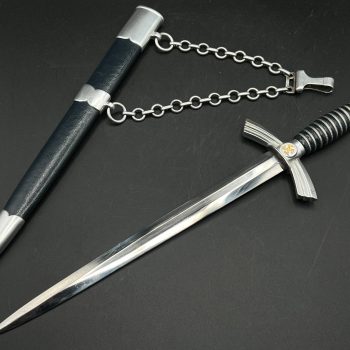
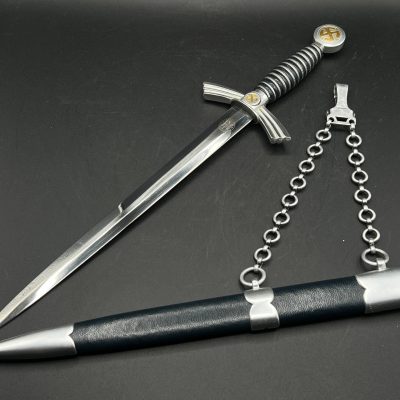
Officer’s Dress Dagger Model 1937 was introduced as the new pattern of ceremonial edged weapon for the officer corps of the German Air Force. It replaced the Model 1935 and remained the standard Luftwaffe officer’s dagger until the end of World War II.
The aluminum version represents a distinct variety of edged weapons of the DLV, NSFK, and Luftwaffe organizations, where this lightweight metal was used for manufacturing hilt components, scabbards, or decorative elements. The use of aluminum was dictated by both aesthetic considerations and the conservation of strategic materials under wartime conditions.
The Carl Eickhorn company, whose maker’s mark is present on the example offered here, was founded in Solingen in 1865 and became one of the largest manufacturers of edged weapons in Germany. The trademark featuring a squirrel (Eichhörnchen) served as a guarantee of the highest quality products. During the Third Reich period, the firm produced a wide range of regulation edged weapons: daggers for all branches of the armed forces, SA and SS daggers, NPEA, NSFK, and TeNo daggers, as well as dress daggers, sabers, and swords. Carl Eickhorn products are distinguished by superior steel quality and meticulous finishing, and they are highly valued by collectors today.
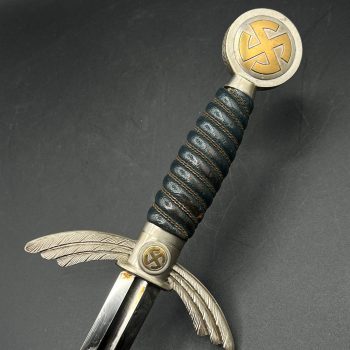
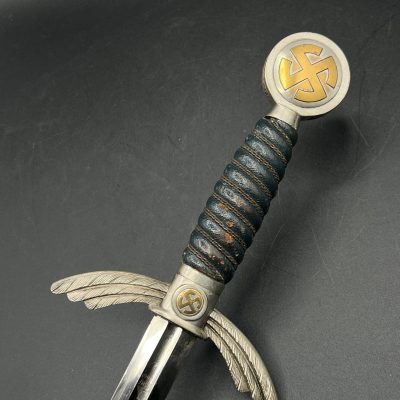
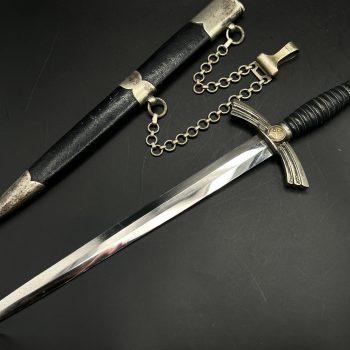
Officially established on 10 March 1935 alongside the creation of the German Air Force, this dagger was intended for Luftwaffe career personnel in accordance with the established uniform regulations and represented the first official edged weapon of the new branch of the armed forces. Notably, the dagger’s design was based on the earlier Deutscher Luftsportverband (DLV) dagger, the German Air Sports Association, which in the early 1930s effectively served as a cover organization for training future Luftwaffe personnel. For this reason, the early Luftwaffe dagger retained many features of the DLV dagger and is considered a transitional model in the development of German aviation edged weapons.
The fittings made of nickel silver (German silver) are characteristic of early examples, typically manufactured before 1936. Due to limited production runs, high manufacturing quality, and distinguished appearance, such pieces are traditionally valued by collectors more highly than later variants.
The manufacturer was Stöcker & Co. SMF, a German metalworking company from Solingen that specialized in producing edged weapons for aviation organizations of the Third Reich. The firm produced daggers for the DLV, NSFK, and Luftwaffe, distinguished by the high quality of their blades and fittings. The blade bears the characteristic “SMF” mark, confirming the item’s origin.
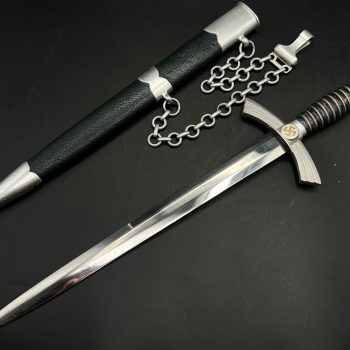
Officially established on 10 March 1935 concurrently with the creation of the German Air Force, this dagger was intended for Luftwaffe career personnel in accordance with the established uniform regulations and represented the first official edged weapon of the new branch of the armed forces. Notably, the dagger’s design was based on the earlier Deutscher Luftsportverband (DLV) dagger, the German Air Sports Association, which in the early 1930s effectively served as a cover organization for training future Luftwaffe personnel. For this reason, the early Luftwaffe dagger retained many features of the DLV dagger and is considered a transitional model in the development of German aviation edged weapons.
Manufactured by Stöcker & Co., a German metalworking company from Solingen that produced edged weapons for aviation organizations of the Third Reich. The company specialized in the production of daggers for the DLV, NSFK, and Luftwaffe, distinguished by the high quality of their blades and fittings. Items were marked with the “SMF” stamp; this specimen belongs to the first model of daggers produced by this manufacturer.
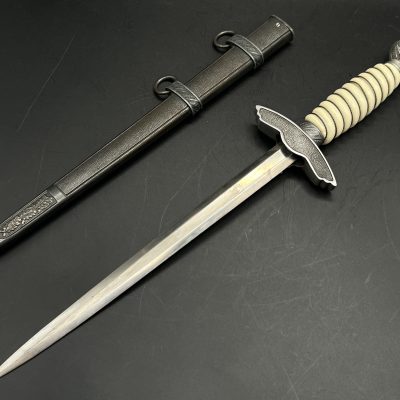
A Luftwaffe officer’s dagger, Model 1937, complete with metal scabbard. The grip is crafted from white plastic featuring characteristic spiral fluting wrapped with twisted wire. The spherical pommel is adorned with a relief depiction of oak leaves with a gilded swastika at the center. The crossguard is designed in the form of a flying eagle clutching a swastika in its talons. The blade is steel, double-edged, with a diamond-shaped cross-section. The metal scabbard is fitted with two hanging bands with suspension rings, decorated with an oak leaf ornament. The scabbard tip is embellished with a relief depiction of oak leaves.
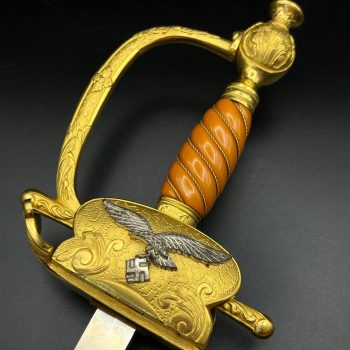
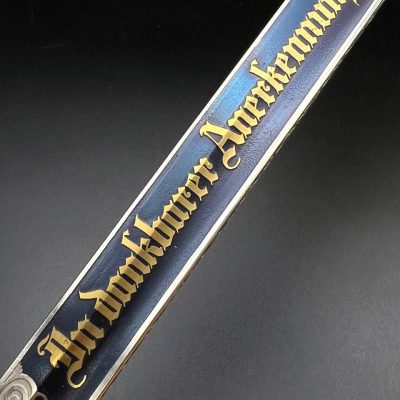
This is the classic version manufactured by Carl Eickhorn Solingen. The hilt fittings in fire-gilt non-ferrous metal, the grip mounts hand-decorated. On the obverse quillon, the separately applied silver-plated Luftwaffe national eagle, triple-riveted. The grip in amber color with gilt wire wrap. Straight nickel-plated and etched blade with fullers on both sides, gilt dedication on the obverse “In dankbarer Anerkennung” (In Grateful Recognition), on the reverse “Der Oberbefehlshaber der Luftwaffe – Hermann Göring” (The Commander-in-Chief of the Luftwaffe – Hermann Göring), each gilt with blued background. On the ricasso with maker’s mark “Original Eickhorn Solingen”. Black leather scabbard with gilt mounts, reverse side clamped.
Only very lightly worn, the original gilding of the fittings over 95% intact, the blade in mint condition. A very well-preserved piece.
Generalleutnant Walter Heling, born 1887 in Belgrad and missing since May 12, 1942 at Kharkov, was Luftwaffe commander in Stade, Jütland, Flensburg from the beginning of the war. Later Commander of Luftwaffe Construction Brigade VI during Operation Barbarossa.
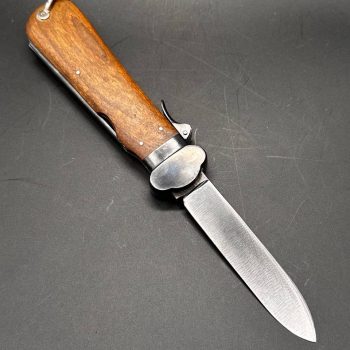
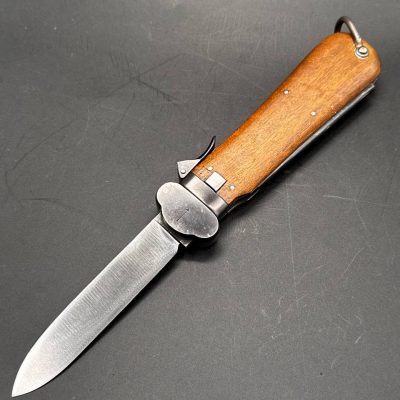
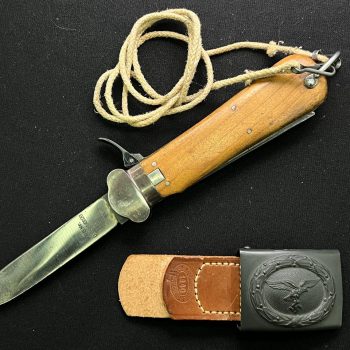
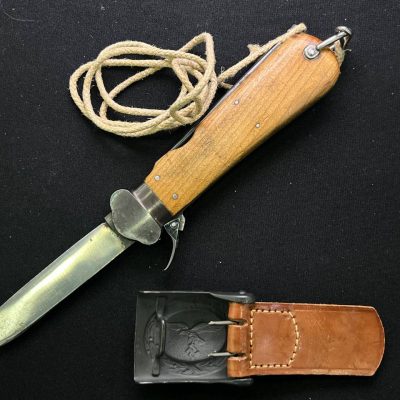
Luftwaffe paratrooper gravity knife, 2nd model (take-down type). Wooden handle. Blade retains rare factory polish with no corrosion spots. Spine stamped ‘R.B.NR. 0/0561/0019’. Marlinspike matching numbered 341 — pristine example.
This engraved dagger is perfect in every way. The blade is stunning with deep engraving, nice burnishing, bright finish and original washer. The grip is an ivory model and the original knot is still tied. Scabbard shows 100% finish with dents or scratches. It would be hard to find a nicer one out there.
Extremely rare version with a black plastic grip. Intact wire wrapping; crossguard and pommel made of aluminum, with traces of original gilding still visible on the sunwheel swastikas. Clean blade by “Robert Klaas, Solingen”; scabbard with no significant damage, slightly toned. Complete with portepee and hanger. Worn example.
Overall condition of this knife is very good with a clean RBN numbered blade. The grip plates show normal expected wear with no cracks and no abuse. The marlin spike works nicely and is waffen proofed and the entire piece shows a bit of darkening. One of the rarest that we have seen that it is a take down model and it also comes with the very rare original lanyard. The lanyard has the two clips and was used to hang underneath the flight jackets. Great piece and super rare version of the gravity knife.
Near mint condition on this beautiful Luftwaffe buckle. Has excellent blueish gray paint and the brown leather tab is perfect. Marked on the tab with maker and dated 1940. The maker of the buckle is R S & S which is slightly stamped off the edge on the reverse.
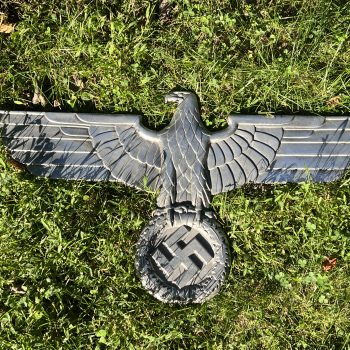
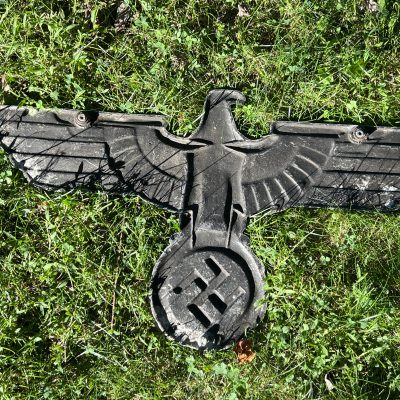
A large original Deutsche Reichsbahn (German State Railways) eagle from the Third Reich period. The eagle is depicted with outstretched wings, clutching a wreath bearing a swastika in its talons. The piece features strong three-dimensional relief, with detailed feathering and wing construction.
The reverse retains stamped/raised manufacturer or production markings, as well as original mounting hardware. The eagle displays an attractive period patina with surface wear, oxidation, scratches, and traces of finish loss consistent with its age and history.
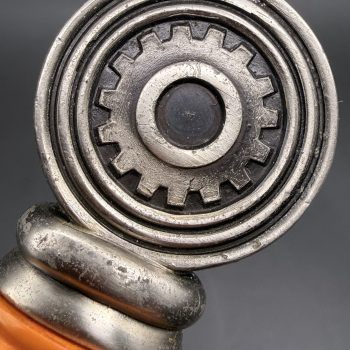
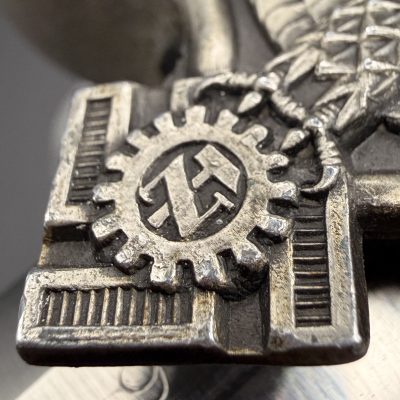
Technical Emergency Corps (TeNo) Leader’s Dagger, Model 1938, manufactured by Carl Eickhorn of Solingen. This example bears the manufacturer’s trademark and retains matching numbers on the blade and scabbard, confirming their factory pairing and attesting to the complete original preservation of the piece.
This dagger model was introduced in November 1938, concurrently with the adoption of new regulation edged weapons for the TeNo organization. It was intended to be worn with dress uniform by commanding officers holding the rank of Stabsscharführer and above. Officers purchased these daggers at their own expense through special organizational outlets.
The history of the Technical Emergency Corps began on September 30, 1919. Throughout the existence of the Weimar Republic, the corps repeatedly distinguished itself, demonstrating efficiency and excellent technical training. Naturally, this organization could not escape the attention of the new leadership, the National Socialist Party. In 1939, to further enhance efficiency, TeNo was transferred to the jurisdiction of the Reich Ministry of Foreign Affairs and subordinated to police structures, allowing for improved operational capacity. Prior to the commencement of the Polish campaign, TeNo was commanded by SS Gruppenführer (SS Lieutenant General) Schmelzer; he was later succeeded in this post by SS Gruppenführer Weinreich.
The Carl Eickhorn company was founded in Solingen in 1865 and became one of the largest manufacturers of edged weapons in Germany. The company’s trademark, featuring a squirrel (Eichhörnchen), served as a guarantee of the highest quality products. During the Third Reich period, the firm produced a wide range of regulation edged weapons, including daggers for all branches of service, SA and SS daggers, NPEA, NSFK, and TeNo daggers, as well as dress daggers, sabers, and swords. Carl Eickhorn products are distinguished by superior steel quality and meticulous finishing, and are highly valued by modern collectors.
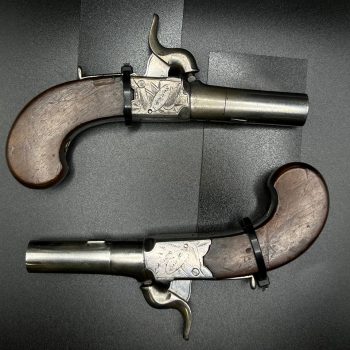
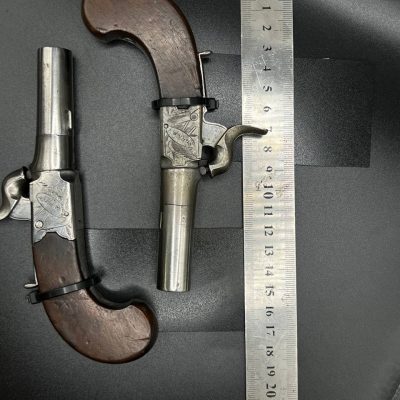
Pair of English Drop Trigger Percussion Pistols Marked H Nock.
Marked with one of England’s premier makers of the period, these guns are likely the fake watches of their day. Both guns are in nice condition with engraved frames and slab butts with vacant silver escutcheons.
Both actions, including push-on safeties, function without problems.
Overall length approximately 5 7/8 inches, with twist off barrels, standard British proofs.
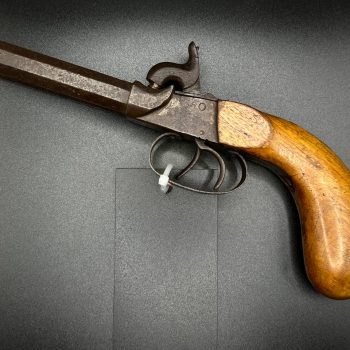
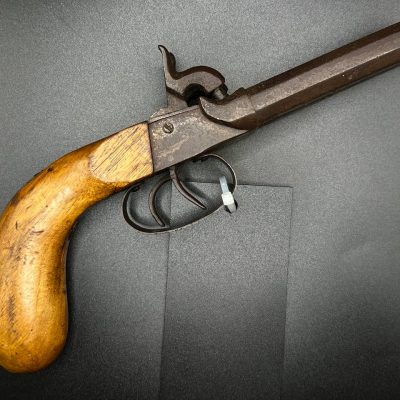
Original Victorian Era Double Barreled Percussion Coat Pistol
.40 caliber with turn-off 3 inch barrels. Overall length is a little over 8 inches.
Actions are mostly functional. The left action holds on half cock only; right action holds on half and full cock.
A good example of this early ‘concealed carry’ firearm at an attractive price.

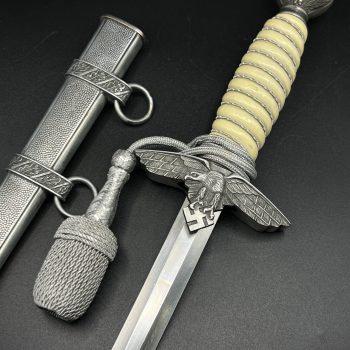
![Luftwaffe Dagger, Model 1937 (2nd Model). [FW. Höller]. Stamp – FW. Höller.](https://alexmp.com/wp-content/uploads/2026/09/1789668280335-kn7b5dmr0ys-400x400.jpeg)
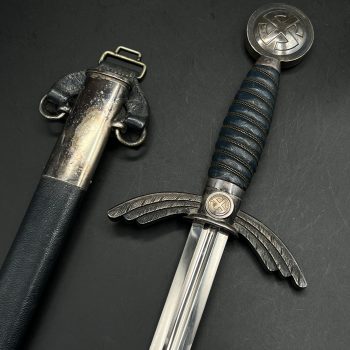
![Luftwaffe Officer’s Sword (Offizierschwert / Fliegerschwert) (nickel-silver fittings). [E. & F. Horster]. Stamp – “5”. Personalised.](https://alexmp.com/wp-content/uploads/2026/08/1786672535591-x9d553vyih-400x400.jpeg)
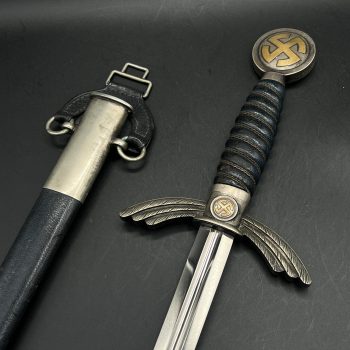
![Luftwaffe Officer’s Sword (Offizierschwert / Fliegerschwert) (nickel-silver fittings). [SMF Stöcker & Co.]. Stamp – “5”.](https://alexmp.com/wp-content/uploads/2026/08/1786673018265-jin5rc205g8-400x400.jpeg)
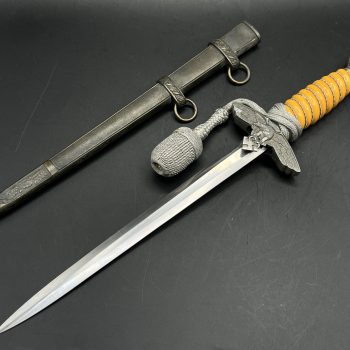
![Luftwaffe Dagger, Model 1937 (aluminum fittings). [Carl Eickhorn]. Stamp – Carl Eickhorn.](https://alexmp.com/wp-content/uploads/2026/08/1786413485849-dyrcyoerko-400x400.jpeg)
![Luftwaffe Dagger, Model 1935 (nickel-silver fittings). [Stöcker & Co. SMF]. Stamp – SMF.](https://alexmp.com/wp-content/uploads/2026/08/1786375507903-sde70nlaeh-400x400.jpeg)
![Luftwaffe Dagger, Model 1935 (1st Model). [Stöcker & Co. SMF].](https://alexmp.com/wp-content/uploads/2026/08/1786375138480-df0k9fohi59-400x400.jpeg)