Login
Register
By clicking Login or Register, you agree that the images of Nazi symbols shown on alexmp.com are not propaganda of fascism, Nazism and are shown solely for historical, cognitive and scientific purposes.
Order a free call and our specialist will contact you shortly!
Contact us and we will get back to you shortly.
Contact us and we will get back to you shortly.
Contact us and we will get back to you shortly.
Contact us and we will get back to you shortly.
Error: Contact form not found.
We will get back to you shortly.
В честь запуска Энциклопедии мы рады предложить вам бесплатный доступ до 01.10.2026.
Будем рады вашим комментариям и предложениям!
Inspected and guaranteed by Alex Warstory.
For more details on AlexMP Guarantee, click [HERE]
Item guaranteed by a verified dealer.
Click [HERE] for full seller guarantee terms.
Sold without expert review or guarantees. No claims accepted post-sale.
Learn more [HERE]


Showing 1–16 of 20 results
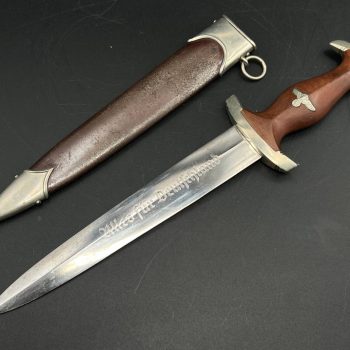
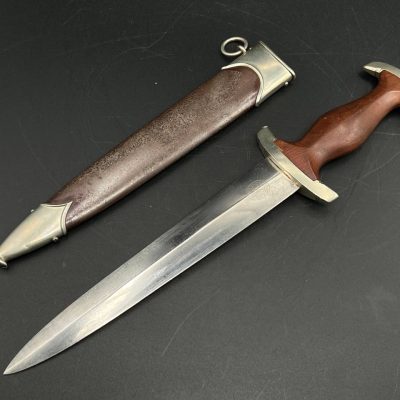
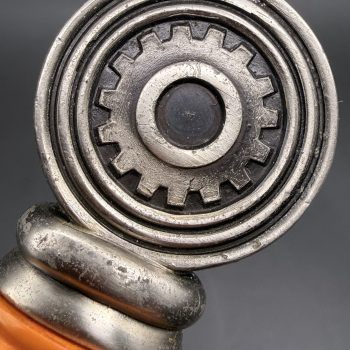
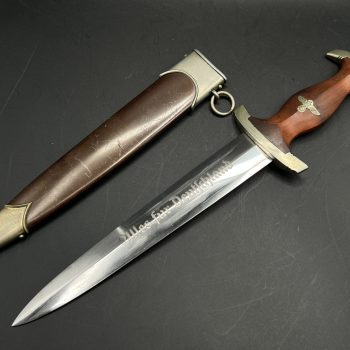
FiltersA service edged weapon of the SA (Sturmabteilung) storm troopers, adopted in 1933. The distinctively shaped blade with double-sided sharpening bears the legendary motto “Alles für Deutschland.” The handle is made of brown-colored wood and decorated with the SA emblem featuring an eagle; the metal scabbard is finished in the same brown tone.
The early type of SA/NSKK daggers was produced between 1933 and 1936 and is distinguished by a number of characteristic design features. The scabbard and handle fittings are made of nickel silver (German silver), which, combined with the high quality of component fitting and the anodized scabbard coating, sets these examples apart from later production runs. This dagger was manufactured by Stöcker & Co. SMF. Early examples are particularly prized by collectors due to their impeccable craftsmanship and historical significance as the first service daggers of the storm troopers.
A rarity rating of 5 out of 10 according to the Ralf Siegert classification indicates that such examples are relatively uncommon on the antiques market.
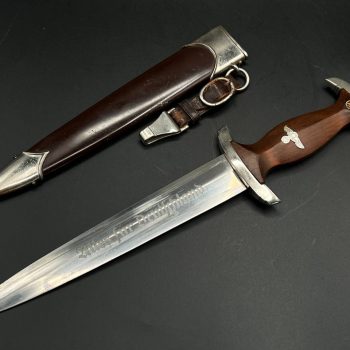
Officially adopted in 1933, this SA (Sturmabteilung) storm trooper dagger represents a characteristic example of Third Reich service edged weapons. The blade features the distinctive double-edged form and bears the legendary motto “Alles für Deutschland.” The grip is crafted from brown wood, adorned with the SA emblem and eagle, while the metal scabbard is finished in the same brown color.
The early type SA/NSKK daggers were produced from 1933 to 1936 and are distinguished by characteristic construction features. The scabbard and grip fittings are made of nickel silver (neusilber); the quality of parts fitting and the anodized scabbard finish set these examples apart from later production runs. Early specimens are particularly valued by collectors due to their high manufacturing quality and historical significance as the first service daggers of the storm troopers.
The blade was manufactured by Edward Wüsthof, a German firm from Solingen specializing in edged weapons production. The company was one of the authorized manufacturers of service daggers for the SA storm troopers and the National Socialist Motor Corps (NSKK) during the Third Reich period.
Rarity category 5 out of 10 according to the Ralf Siegert classification.
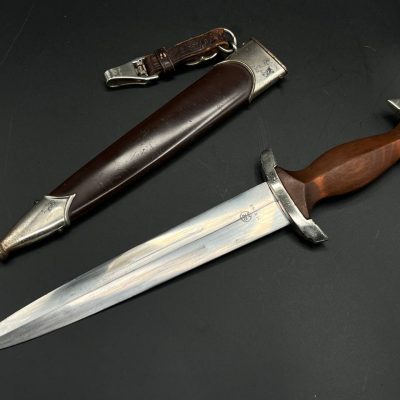
An early type of regulation edged weapon of the SA (Sturmabteilung) assault detachments, adopted in 1933. This specimen was manufactured by the Gustav Wirth workshop. The blade features a characteristic shape with double-edged sharpening and bears the famous motto “Alles für Deutschland.” The handle is made of brown wood, decorated with the SA emblem and eagle. The dagger comes complete with brown metal scabbard.
This Hitler Youth organization knife belongs to the RZM type category, which determines its characteristic features and marking method. The blade bears the stamp M7/13, replacing the traditional manufacturer’s designation. This coding system was introduced by the Reichszeugmeisterei (the Imperial Equipment Office of the NSDAP) for standardization and quality control of party edged weapons. Items in this category are distinguished by more unified execution compared to earlier examples bearing open manufactory stamps.
RZM type daggers and knives represent a separate category of German edged weapons from the Third Reich period. Instead of traditional manufacturer stamps, they were marked with a special RZM code and an assigned producer number. This approach allowed the Imperial Equipment Office to exercise centralized control over the production of party weapons and equipment.
The code M7/13 corresponds to the company Arthur Schüttelhofer & Co, which fulfilled orders for youth knives under a government contract.
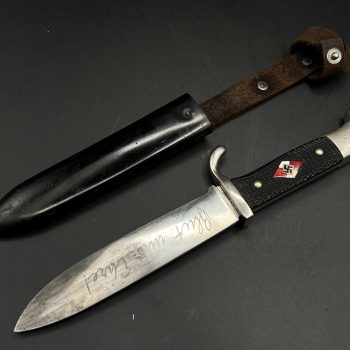
A Hitler Youth knife complete with metal scabbard and leather hanger. The handle features characteristic diamond-pattern checkering and is adorned with an enameled HJ emblem in red, white, and black tones depicting a swastika. The blade is etched with the motto “Blut und Ehre!” (“Blood and Honor!”). On the reverse side of the blade, there is a manufacturer’s mark from Tiger Solingen featuring a tiger image and the inscription “Gesetzl. Geschützt” (legally protected). This specimen belongs to an early production type, manufactured prior to the introduction of the RZM licensing system.
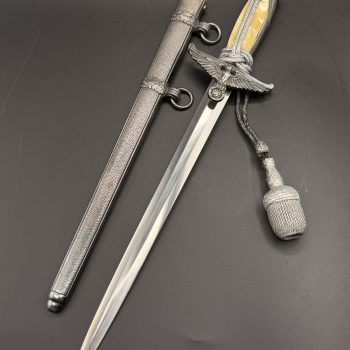
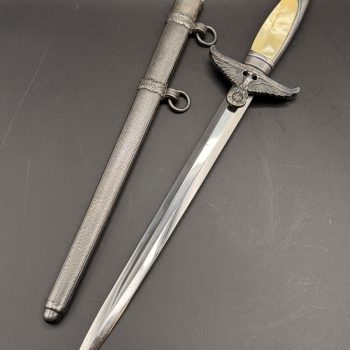
The Government Official’s Dagger (Staatsbeamten-Dolch) was introduced in 1938 and was intended for senior German government officials as part of the prescribed formal uniform. It reflected the status of its wearer and his position within the German state administrative system, serving less as a practical weapon than as a symbol of rank and position within the hierarchy of the Third Reich.
The blade was manufactured by Alexander Coppel & Co., widely known under the Alcoso trademark, derived from the name Alexander Coppel Solingen. The company was founded in Solingen in 1821 and was one of the city’s oldest manufacturers of edged weapons. The firm produced a wide range of edged weapons, including bayonets, sabers, swords, and daggers, fulfilling both military and government contracts. Several variations of the company’s maker marks can be found on its products.
The crossguard takes the form of a stylized German national eagle, one of the distinctive features of this type of dagger. A closely related but separate type was the Diplomatic Corps Dagger (Diplomatendolch), intended for members of the German diplomatic service. Despite the overall similarity of the two models, the Government Official’s Dagger and Diplomatic Corps Dagger can be distinguished by the direction in which the eagle’s head faces on the crossguard.
Luftwaffe officer’s dagger, Model 1937, complete with metal scabbard featuring the characteristic ‘fish skin’ texture. The grip is crafted from yellowish celluloid, with aluminum fittings. The crossguard is designed in the form of an eagle with outstretched wings, bearing a swastika within a wreath. The pommel is executed as a stylized eagle’s head. The blade bears the manufacturer’s mark, ‘Original Eickhorn Solingen,’ depicting a squirrel holding a sword. The scabbard is fitted with two hangers with suspension rings.
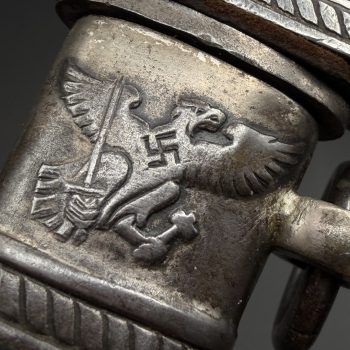
A dirk in excellent condition, with its original hanger, representing a rare example of regulation edged weapon issued to the leadership of the Hitler Youth. Introduced in 1937, this type of dirk was intended exclusively for leaders of the youth organization and differed significantly from the mass-produced knives of ordinary HJ members. Its ornate design and prestigious status distinguished it among other uniform elements, emphasizing the owner’s position within the organization’s hierarchy.
Hitler Youth leader dirks were produced in considerably smaller quantities than standard knives, which from the outset determined their special place among German regulation edged weapons of the Third Reich period. Today, original examples, particularly those retaining their hangers and in a high state of preservation, are among the rarest and most sought-after pieces by collectors.
The blade was manufactured by E. & F. Horster, a firm founded in Solingen in 1850 by brothers Emil and Friedrich Horster. The company specialized in the production of military blades and was one of the leading suppliers of edged weapons for the German army, producing officer sabers, swords, bayonets, and daggers for various branches of service. During the Third Reich period, the firm actively manufactured regulation edged weapons for the Wehrmacht, Luftwaffe, and NSDAP party organizations. Blades by E. & F. Horster are distinguished by their high-quality steel and meticulous finish, making them valuable collectibles.
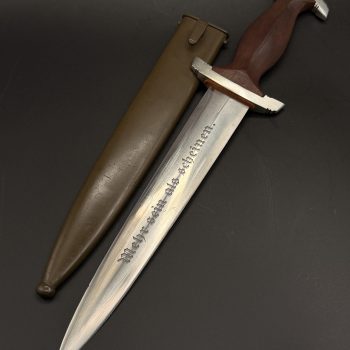
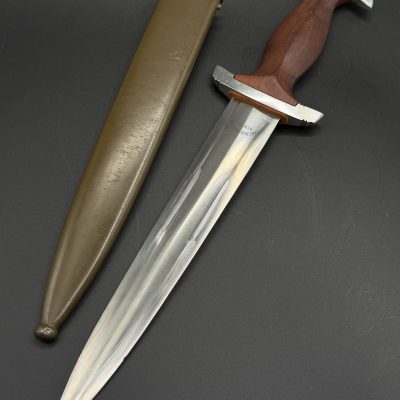
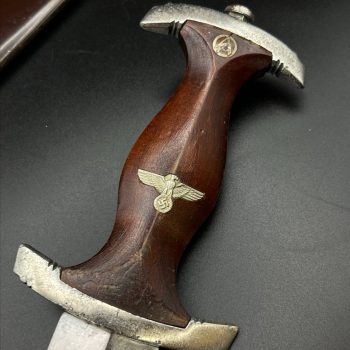
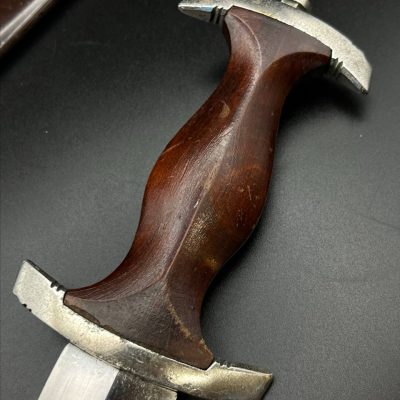
The blade bears the motto “Mehr sein als scheinen” (“To be better than to seem”), as well as the manufacturer’s mark with the inscription “Karl Burgsmüller Berlin-Charlottenburg 5.” The dagger for students of Nationalpolitische Erziehungsanstalten (NPEA, also known as Napola) was introduced in 1935 for pupils of national political educational institutions. These schools were established in Germany beginning in 1933 and were intended to train future cadres for state, military, and party apparatus. The daggers were supplied to educational institutions centrally and issued to students to be worn with their uniforms.
The Berlin firm Karl Burgsmüller was an official supplier of edged weapons for NPEA schools and was associated with the centralized supply of regulation weapons to these institutions. Production of individual components may have been carried out by other Solingen enterprises, while Burgsmüller served as the official supplier. Due to this supply system, the name Karl Burgsmüller is firmly associated primarily with NPEA daggers and represents one of the most characteristic markings found on original specimens.
The impeccable preservation of this specimen allows it to be classified in the highest condition category of Mint, which is exceptionally rare for German edged weapons from the period prior to 1945. The dagger has retained its original factory blade polish, intact nickel plating, and pristine appearance of the grip and scabbard without wear marks, scratches, or traces of corrosion. The absence of signs of use, improper storage, or restoration determines the maximum collectible value of this item.
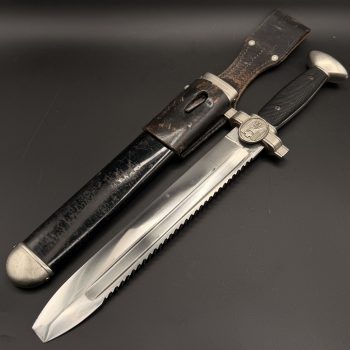
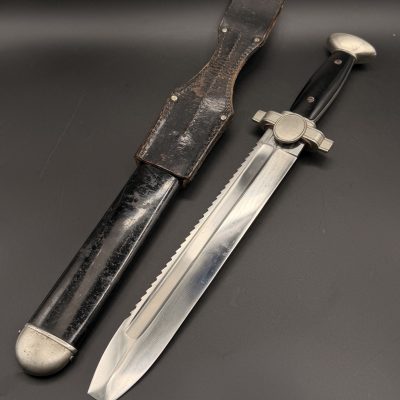
A regulation edged weapon for NCO personnel of the DRK (Deutsches Rotes Kreuz) organization, distinguished by its characteristic blade featuring a saw back and a specially shaped combat point. These design features rendered the hanger a functional tool suitable not only for ceremonial wear but also for practical field applications.
The item bears the marking “Ges. Gesch.” — an abbreviation of the German “Gesetzlich Geschützt” (“Protected by Law”), indicating patent protection of the item or its components within German territory. This marking was widely applied to Third Reich edged weapons, predominantly on daggers and dirks of party and paramilitary organizations, denoting patented design solutions for hilts, scabbards, or decorative elements. The presence of the original marking attests to the item’s authenticity and its manufacture during the period when German patent legislation was in effect, constituting an important attribution criterion for collectors.
The hanger was introduced following the reorganization of the German Red Cross in 1937 and its integration into the state structure of the Third Reich under the control of the Ministry of the Interior. The adoption of this pattern in 1938 was reflected in the National Socialist symbolism of its design, characteristic of all organizations incorporated into the party-state hierarchy of that period.
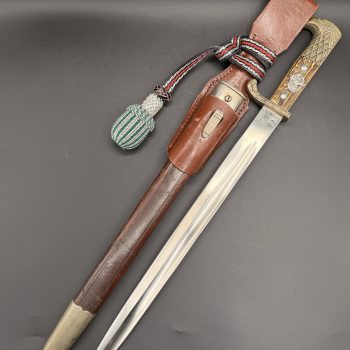
A police bayonet of the Weimar period, subsequently modified in accordance with Third Reich standards, representing a characteristic example of the unification measures implemented within German police structures after 1933. The blade bears the trademark of the renowned Solingen firm Carl Eickhorn — the squirrel emblem that served as a guarantee of the highest quality from this manufacturer.
Structurally, the bayonet retains evidence of its Weimar origins: the originally longer blade was shortened, with the point reground to conform to the new standard. The grip was similarly reduced in length. The Weimar-era escutcheon was replaced with a new police emblem — an eagle with swastika within an oak wreath, characteristic of the Third Reich police service. The leather scabbard has likewise been adjusted to accommodate the reduced blade length. Matching numbers are preserved on both blade and scabbard — identical serial designations confirming their factory pairing.
Police bayonets constituted a distinctive type of edged weapon issued to German police forces during the Weimar Republic and Third Reich periods. Police bayonets differed structurally from military patterns in blade configuration and the characteristic grip treatment featuring the police emblem. Weapons of this type were employed primarily for parade and ceremonial purposes, as well as during guard duty. The modification of Weimar-era bayonets was conducted on a large scale as part of the standardisation of police unit armaments, rendering this category of items relatively common among collectors of German police edged weapons. Many surviving examples display original Weimar-period police unit markings, frequently accompanied by later numbers and stamps added following modification during re-inventory or reissue to different units.
The Carl Eickhorn company was established in Solingen in 1865 and became one of the largest manufacturers of edged weapons in Germany. The trademark squirrel emblem (Eichhörnchen) served as a guarantee of the highest quality. During the Third Reich period, the firm produced an extensive range of regulation edged weapons: daggers for all branches of service, SA, SS, NPEA, NSFK, and TeNo daggers, as well as dress daggers, sabres, and swords. Carl Eickhorn products are distinguished by superior steel quality and meticulous finishing, and are highly prized by contemporary collectors.
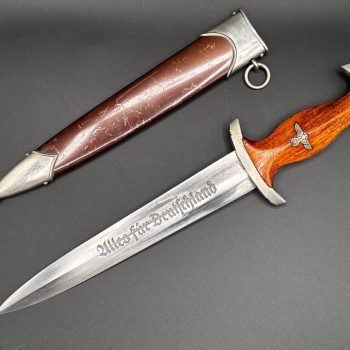
SA service dagger, Model 1933, early type. Wooden grip with eagle and SA emblem. Blade etched «Alles für Deutschland», spine marked «Wilh. Kober & Co. Suhl» with horseman logo. Scabbard in factory lacquer. Fully matching, bright condition. Rare Suhl manufacturer.
Magnificent SA Service Dagger Model 1933, complete with scabbard and hanger! The blade bears the legendary motto ‘Alles für Deutschland’ in Gothic script and the mark of the renowned Berlin manufacturer ‘HACO Berlin’. The letter ‘B’ on the spine is the Berlin Gau stamp. The grip and scabbard retain their original lacquer over anodizing — only minor scratches on the lacquer surface attest to the item’s authentic history. An impeccable collector’s piece!
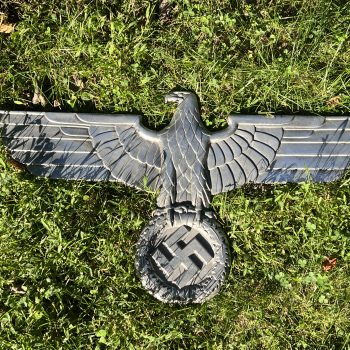
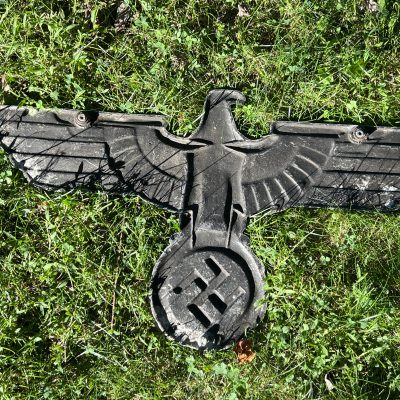
A large original Deutsche Reichsbahn (German State Railways) eagle from the Third Reich period. The eagle is depicted with outstretched wings, clutching a wreath bearing a swastika in its talons. The piece features strong three-dimensional relief, with detailed feathering and wing construction.
The reverse retains stamped/raised manufacturer or production markings, as well as original mounting hardware. The eagle displays an attractive period patina with surface wear, oxidation, scratches, and traces of finish loss consistent with its age and history.
Technical Emergency Corps (TeNo) Leader’s Dagger, Model 1938, manufactured by Carl Eickhorn of Solingen. This example bears the manufacturer’s trademark and retains matching numbers on the blade and scabbard, confirming their factory pairing and attesting to the complete original preservation of the piece.
This dagger model was introduced in November 1938, concurrently with the adoption of new regulation edged weapons for the TeNo organization. It was intended to be worn with dress uniform by commanding officers holding the rank of Stabsscharführer and above. Officers purchased these daggers at their own expense through special organizational outlets.
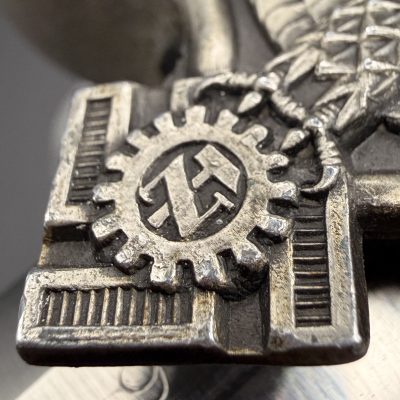
The history of the Technical Emergency Corps began on September 30, 1919. Throughout the existence of the Weimar Republic, the corps repeatedly distinguished itself, demonstrating efficiency and excellent technical training. Naturally, this organization could not escape the attention of the new leadership, the National Socialist Party. In 1939, to further enhance efficiency, TeNo was transferred to the jurisdiction of the Reich Ministry of Foreign Affairs and subordinated to police structures, allowing for improved operational capacity. Prior to the commencement of the Polish campaign, TeNo was commanded by SS Gruppenführer (SS Lieutenant General) Schmelzer; he was later succeeded in this post by SS Gruppenführer Weinreich.
The Carl Eickhorn company was founded in Solingen in 1865 and became one of the largest manufacturers of edged weapons in Germany. The company’s trademark, featuring a squirrel (Eichhörnchen), served as a guarantee of the highest quality products. During the Third Reich period, the firm produced a wide range of regulation edged weapons, including daggers for all branches of service, SA and SS daggers, NPEA, NSFK, and TeNo daggers, as well as dress daggers, sabers, and swords. Carl Eickhorn products are distinguished by superior steel quality and meticulous finishing, and are highly valued by modern collectors.
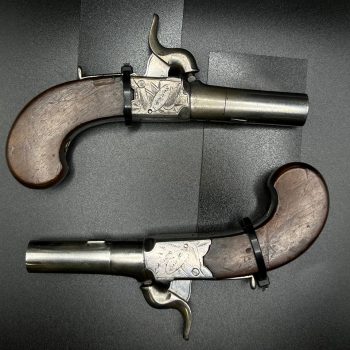
Pair of English Drop Trigger Percussion Pistols Marked H Nock.
Marked with one of England’s premier makers of the period, these guns are likely the fake watches of their day. Both guns are in nice condition with engraved frames and slab butts with vacant silver escutcheons.
Both actions, including push-on safeties, function without problems.
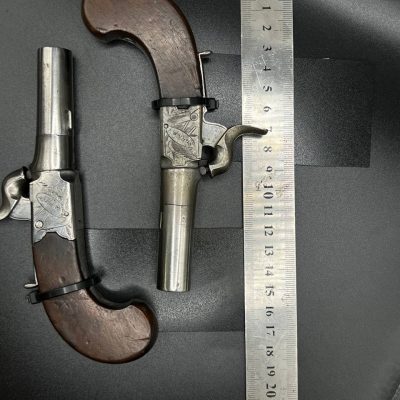
Overall length approximately 5 7/8 inches, with twist off barrels, standard British proofs.
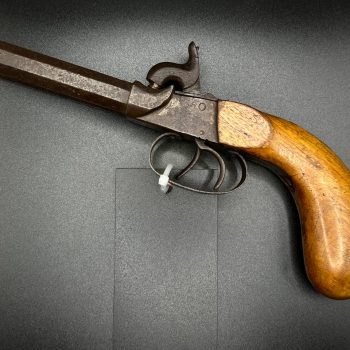
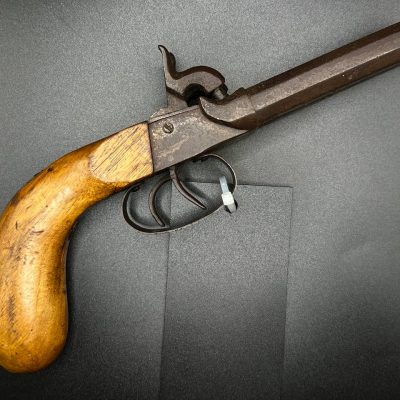
Original Victorian Era Double Barreled Percussion Coat Pistol
.40 caliber with turn-off 3 inch barrels. Overall length is a little over 8 inches.
Actions are mostly functional. The left action holds on half cock only; right action holds on half and full cock.
A good example of this early ‘concealed carry’ firearm at an attractive price.

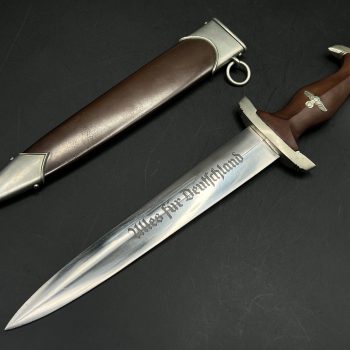
![SA Service Dagger (Early type). [Stöcker & Co. SMF]. Rarity 6/10](https://alexmp.com/wp-content/uploads/2026/09/1789687669012-dhjyhj17vk-400x400.jpeg)
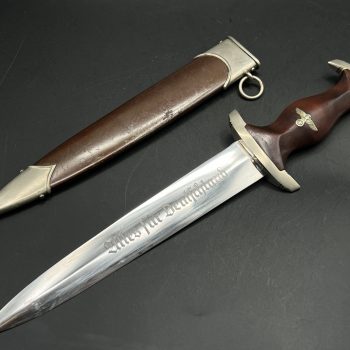
![SA Service Dagger (Early type). [Edward Wusthof]. Rarity 5/10](https://alexmp.com/wp-content/uploads/2026/08/1786490454403-k8ux7lz1wva-400x400.jpeg)
![SA Service Dagger (Early type). [Gustav Wirth].](https://alexmp.com/wp-content/uploads/2026/08/1786373444428-yew7601aybl-400x400.jpeg)
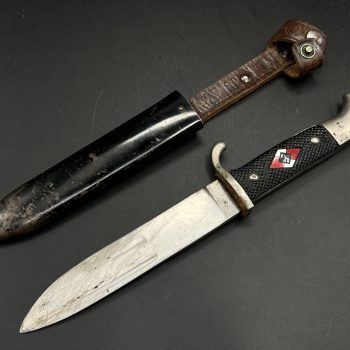
![HITLER YOUTH KNIFE (RZM type). [Arthur Schüttelhofer & Co]. Stamp – M7/13.](https://alexmp.com/wp-content/uploads/2026/08/1785522856239-fnhxydjbzb9-400x400.jpeg)
![HITLER YOUTH KNIFE (Early type). [Tiger]. Stamp – Tiger.](https://alexmp.com/wp-content/uploads/2026/08/1785522406807-wor3jw2s8gp-400x400.jpeg)
![Government Official’s Dagger Model 1938 [Coppel Alexander {Alcoso} Solingen].](https://alexmp.com/wp-content/uploads/2026/07/1784345124370-e3699ewkdvq-400x400.jpeg)
![Government Official’s Dagger Model 1938 [Carl Eickhorn].](https://alexmp.com/wp-content/uploads/2026/07/1784345984685-fobnru7jv2-400x400.jpeg)
![HIitler Youth Leader dagger [E. & F. Horster].](https://alexmp.com/wp-content/uploads/2026/07/1784345458986-rtuscvn6xdi-400x400.jpeg)
![POLICE BAYONET Third Reich period emblem, upgraded from the Weimar-era design. [Carl Eickhorn]. (Matching numbers)](https://alexmp.com/wp-content/uploads/2026/07/1783612664729-3qulcxsxea8-400x400.jpeg)
![SA Service Dagger (Early type). [Wilhelm Kober].](https://alexmp.com/wp-content/uploads/2026/06/1781725008814-074dx1pqhtb-400x400.jpeg)
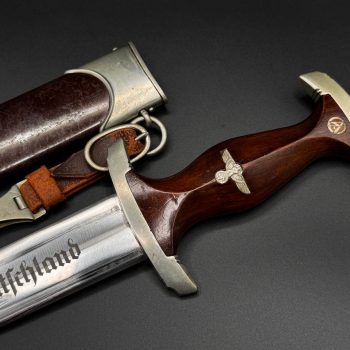
![SA Service Dagger (Early type). [Haco Berlin] (B).](https://alexmp.com/wp-content/uploads/2026/06/1781724590264-ivikyk1m4bc-400x400.jpeg)