By clicking Login or Register, you agree that the images of Nazi symbols shown on alexmp.com are not propaganda of fascism, Nazism and are shown solely for historical, cognitive and scientific purposes.
Request a callback
Order a free call and our specialist will contact you shortly!
Ask a question
Contact us and we will get back to you shortly.
Request a Blitz Price
Contact us and we will get back to you shortly.
Request a price
Contact us and we will get back to you shortly.
Offer your blitz price
Contact us and we will get back to you shortly.
Error: Contact form not found.
Request a subscription
We will get back to you shortly.
Subscription
В честь запуска Энциклопедии мы рады предложить вам бесплатный доступ до 01.10.2036. Будем рады вашим комментариям и предложениям!
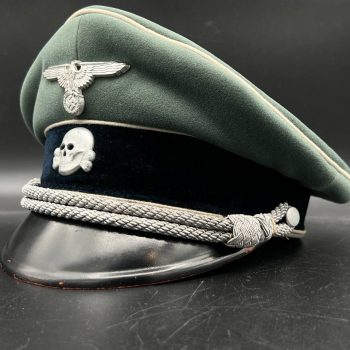
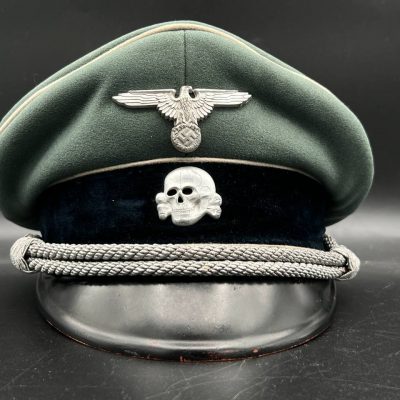
Absolutely stunning cap with very interesting history. Cap is in very nice overall condition showing signs of wear, but still very clean. The exterior has a great shape to the body and perfect insignia and piping. The interior has some sweat staining to the band and has the initials “HW” stamped to the one side. The sweat diamond is intact and has the paper name tag still present. Cap comes with a complete binder full showing the different awards he was issued as well as brief story of Wackerle. Just a stunning piece and the type of cap that you do not see very often .Below is more info on his time in service.
DACHAU
In 1933 Wäckerle was picked by his old ally Himmler to be commandant of the newly established Dachau concentration camp.[6] Under orders from Himmler, he established ‘special’ rules for dealing with prisoners, rules that instituted terror as a way of life at the camp.[7] His initiatives included execution of four prisoners for ‘violent insubordination’ and ‘incitement to disobedience’[8] for which he was charged criminally. He left the post a few months later, with Theodor Eicke taking his place.
WAFFEN-SS
Wäckerle was an early member of the units that became the Waffen-SS and finally came to be an officer with this group, serving in the Netherlands. He led his SS-battalion during the breakthrough of the Dutch Grebbe-line and was wounded in the process. He also served in the invasion of the Soviet Union.[6] His service was spent with the 5th SS Panzer Division Wiking.[10] He had reached the rank of Standartenführer by the time he was killed in action near Lviv in 1941.
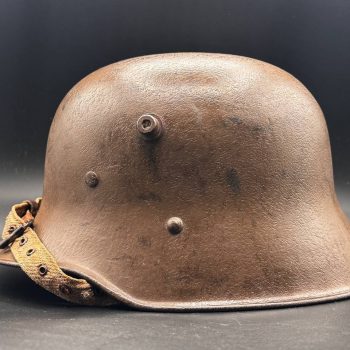
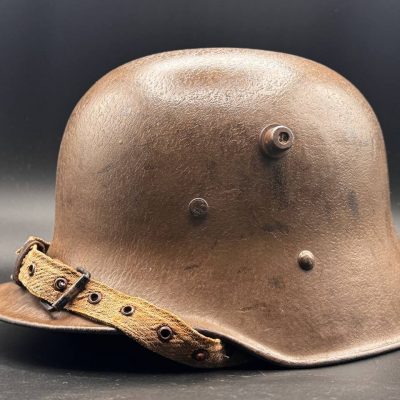
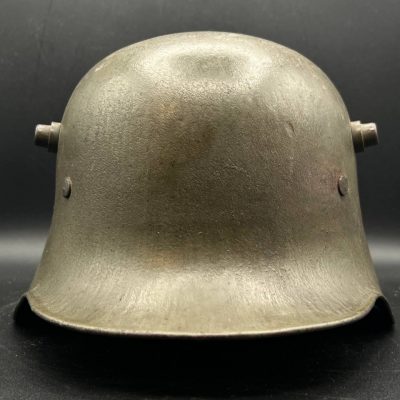
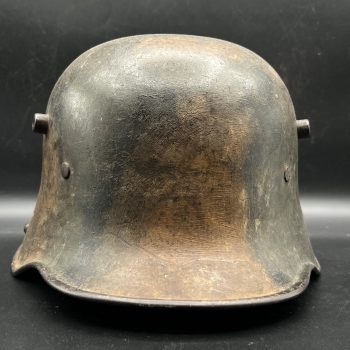
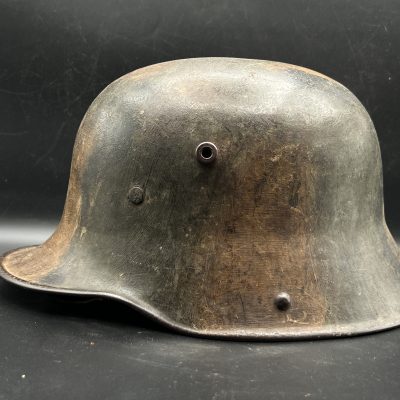
Genuine Austro-Hungarian Stahlhelm, Model M17, of the First World War. Austria-Hungary used the German M16 but produced its own M17 version, and this example shows all the correct Austrian markers.
The key indicators of Austrian manufacture are the cloth (web) chinstrap with leather tabs and roller buckle, and the chinstrap attachment set higher on the dome than on German shells. The dome retains its characteristic side ventilation lugs (Hörner), which also served as the mounting points for the armored brow plate. The warm brown surface tone is consistent with the Austrian Isonzo-braun finish.
An important dating detail: the cloth chinstrap points to wartime production of 1917 to 1918. Later, postwar Austrian helmets of this type used a leather chinstrap, so a complete web chinstrap marks this as a genuine wartime piece rather than an interwar one. Inside, it retains the complete original three-pad leather liner with its drawstring, a feature frequently missing or replaced on surviving helmets. The liner carries a size stamp reading 64.
Provenance: the helmet is accompanied by an old collector tag stating that it was brought back from France in November to December 1918, and named to William Joseph Tobiska. In keeping with the period, the tag calls the helmet German: the American soldier did not distinguish the Austrian pattern from the German one, which is typical of war souvenirs and only underlines the authenticity of the story.
Condition: an honest, untouched example with a textured surface, light oxidation, and wear consistent with a century old combat item. Offered exactly as found, a genuine WWI Austro-Hungarian helmet with complete liner, original wartime web chinstrap, and a named bring back provenance.
Please review all photos closely, they form part of the description. Worldwide shipping.
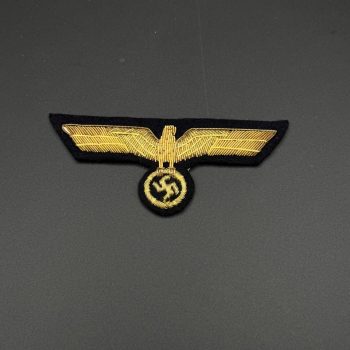
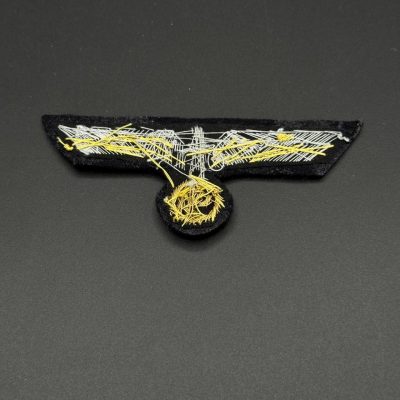
Gold bullion-embroidered breast eagle (Brustadler) on black wool backing, Kriegsmarine pattern with downward-facing wings and swastika in wreath. Reverse shows typical hand-stitched bullion thread construction. Fine quality, consistent with officer tunic application.
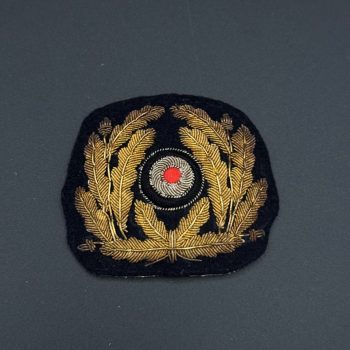
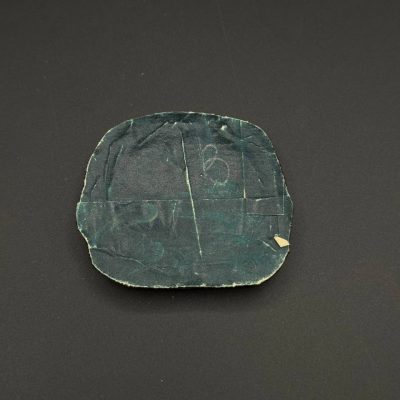
Large bullion-embroidered cap wreath on navy blue wool backing, gold oakleaf wreath surrounding central cockade in national colors (black-white-red). Reverse with original backing material partially worn. Consistent with Kriegsmarine or senior Wehrmacht officer visor cap insignia.
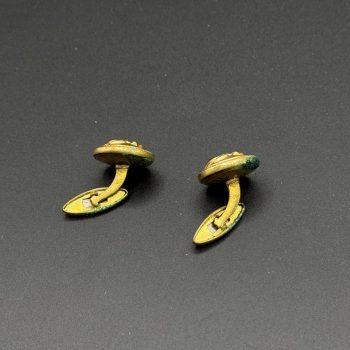
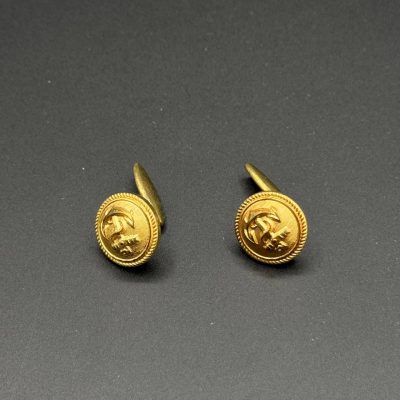
Pair of small gilt brass uniform buttons with anchor-and-rope border motif, Kriegsmarine pattern. Both retain original shank fittings. Showing age-appropriate patina. Desirable matching pair.
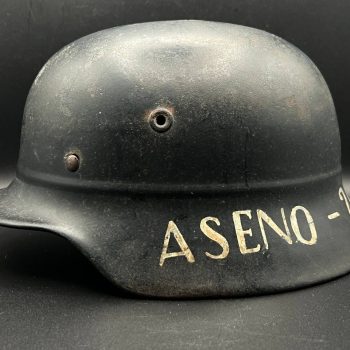
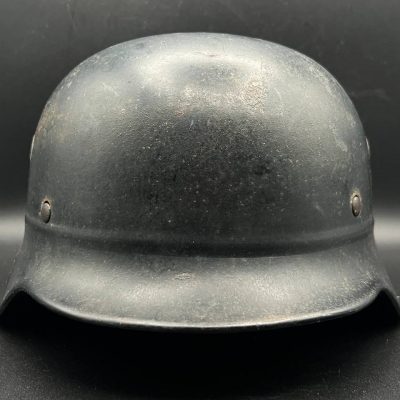
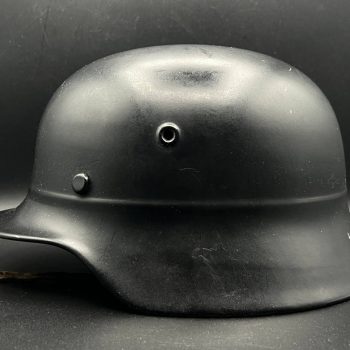
A well-presented example of the M35 Beaded Helmet – ET66, manufactured by ET and stamped ET66, with lot number 5064. This civil defense helmet retains much of its original paint
The steel shell is finished in black paint, a standard color for fire brigades and civil services. White alphanumeric markings (“ASENO-248”, “G.S.”) are painted on the sides and rear, indicating assignment to a specific unit or facility.
The shell is clearly stamped “ET66” (Eisenhüttenwerke Thale, size 66) and “5064” (lot number).
An original German Beaded helmet from the Third Reich period. Manufactured from steel based on the military M34/M35 helmet, it was adapted to meet the needs of civil defence and police.
The shell retains its ventilation holes and rivets, with the manufacturer’s stamp “ET64” indicating production by Eisenhüttenwerke Thale and a size 64 shell. An additional marking “692” is visible inside (batch number). The interior is fitted with the original leather liner with multiple tongues and the chinstrap.
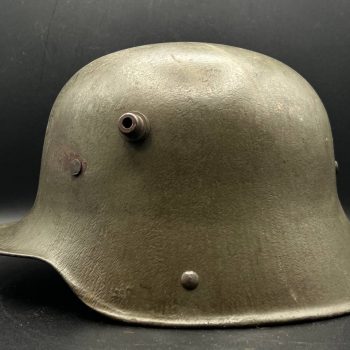
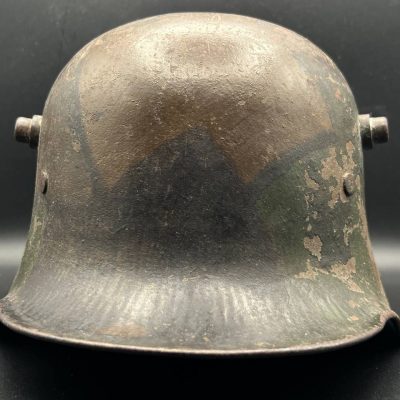
An exceptionally well-preserved German M16 combat helmet from the First World War, in a rare and highly desirable state of originality. This is an early-production example, easily identified by its large external lugs (“ventilation lugs”) designed both for airflow and to accommodate an additional brow plate.
The helmet retains 100% of its original field-gray textured paint, with a beautiful, untouched patina that speaks to its age and authenticity. Unlike later examples with replaced or refurbished interiors, this piece still contains its original leather liner band, complete with the three-pad leather system and remnants of the interior drawstring. The leather shows wear consistent with service use but remains stable and complete.
Maker’s mark and lot number are clearly visible inside the shell (stamped G62), confirming both the size and manufacturer. The split pins remain tight and untouched, further underlining the helmet’s originality.
Helmets of this type and condition are seldom encountered on the market, as most surviving examples were either repainted, reissued in WWII, or have suffered liner replacement. This untouched example represents a textbook collector’s piece.
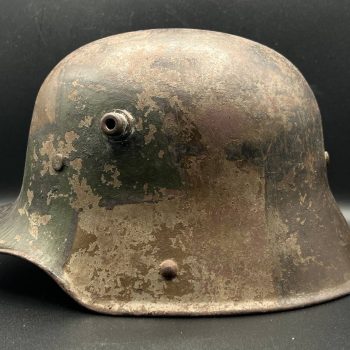
This is an original German M16 steel helmet from the First World War. The shell is made of steel with the characteristic outward vent lugs, which also served as fittings for the additional frontal armor plate (Stirnpanzer). The surface retains traces of the factory finish with an overpainted camouflage in the so-called Buntfarbenanstrich style — the typical multi-color pattern introduced in 1916, featuring green, ochre, and brown segments divided by black lines. The paint shows natural wear, confirming its authenticity.
Inside, the original leather liner, complete with its three leather pads and metal band, is preserved, along with the chinstrap. On the rear skirt of the shell, the stamped marking “G62” is visible, indicating the manufacturer and the shell size (62). Additional factory markings are also present on the interior.
Helmets of this type were introduced to the German Army in 1916, replacing the earlier leather Pickelhaube. Thanks to their strength and protective qualities, the M16 became a symbol of the German soldier of the First World War and served as the foundation for the entire line of steel helmets leading up to the M35 of the Second World War.
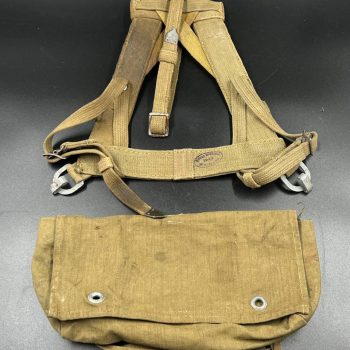
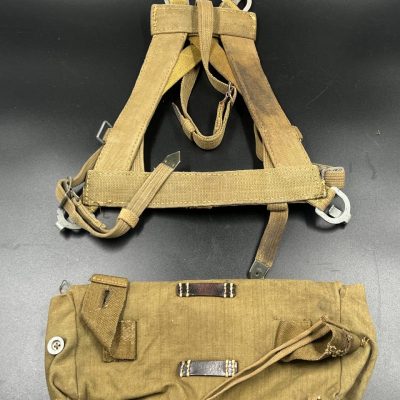
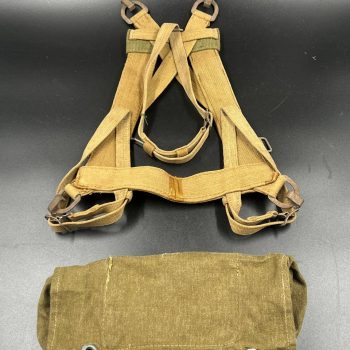
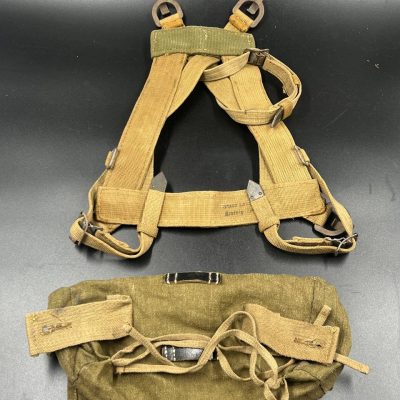
Complete WWII German Wehrmacht Infantry Combat Assault Pack (Sturmgepäck / A-Frame), introduced April 1939. Designed for use with Y-straps by assault infantry.
Set includes:
∙ A-frame (Traggestell) with original riveted leather straps
∙ Y-straps (Koppeltragegestell)
∙ Small items bag (Beutel)
∙ Belt with original steel hardware
Construction: Heavy canvas webbing, double-layered vertical straps with internal metal reinforcement, cross-straps forming characteristic “X” pattern, quick-release D-rings, original matte gray steel fittings.
Condition: Age-appropriate patina. Straps remain supple and functional. Metal shows expected oxidation.
Near mint condition
Complete sets with all components are increasingly difficult to find.
Sold as shown. Please review all photos carefully.
Excellent overall condition on this helmet. Features a standard camo pattern with colors of brown, green ad dark yellows. No dents and heavy damage, just expected wear for a helmet of this age. Interior is even better with all three liner pads intact which is quite rare as the tend to rot and fall out. Has a size stamping to the one side which is faint, but can just make it out. Nice WWI helmet with a great look about it.
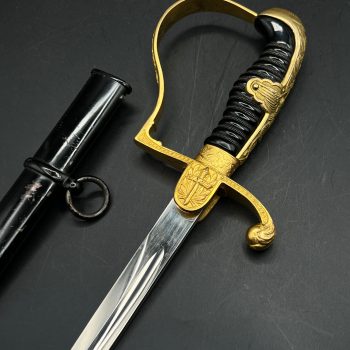
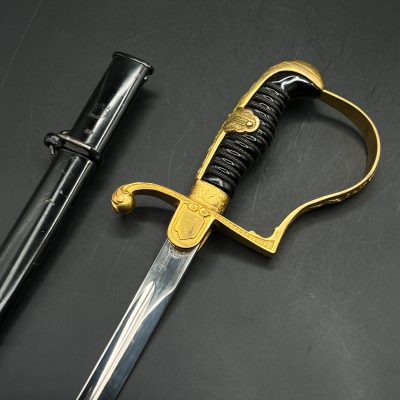
Officer parade weapons, revived following the restoration of the German armed forces, continued the proud traditions of the Imperial Army and the Reichswehr. Unlike the Army dagger model 1935, officer sabers were produced in numerous design variations by various Solingen manufacturers. Production of this type of weapon was discontinued in May 1943 due to wartime industrial demands; however, examples already in service continued to be worn with parade uniforms. In late 1944, the wearing of parade edged weapons was completely abolished, and officers were ordered to carry a pistol instead of a saber or dagger.
The blade bears the mark of the renowned Solingen firm F. W. Höller Waffenfabrik, founded in 1866 and officially registered with the Solingen authorities on 5 June 1883. From its founding, the company specialized in the production of edged weapons and cutlery. Throughout the late 19th century and during the First World War, the firm manufactured a wide range of military products, including bayonets, sabers, and swords. In 1905, the company registered its well-known trademarks: the thermometer image, as well as the figure of a man tipping his hat with the inscription “Hut ab!” (“Hats off!”). From 1914 to 1939, the firm was managed by Julius Küller. During the Third Reich period, Höller became one of the largest and most prolific edged weapons manufacturers in Solingen, specializing in a broad range of military products. In 1935, the company was located at Sonnenstraße 8, Solingen, and that same year received RZM license M7/33. Products were actively advertised in specialized journals and catalogs, showcasing an extensive assortment that included NSDAP and Wehrmacht daggers, swords, and bayonets. The firm also produced parade bayonets with high-quality etched blades. In 1941, Höller celebrated its 75th anniversary, promoting the Höller Model 21 sword as its flagship model. In June 1941, the company was assigned the K98 bayonet manufacturer letter code (fze). Following the end of the Second World War, under the ownership of Herr Grah, the firm continued operations, producing cutlery, kitchen and professional knives, swords, and scissors through the 1970s. The company was officially liquidated in December 1974. Particular collector value is added to this example by a rare decorative detail: an additional eagle on the grip backstrap, distinguishing this saber from standard production specimens.
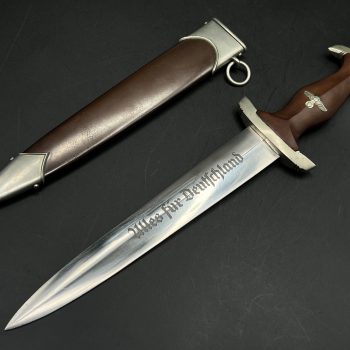
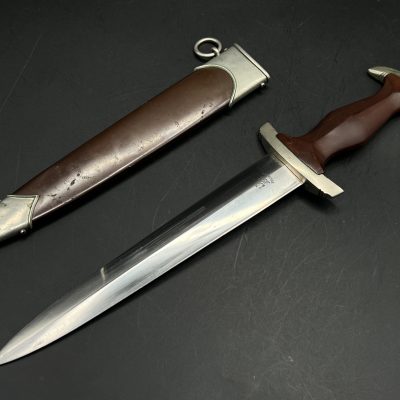
A service edged weapon of the SA (Sturmabteilung) storm troopers, adopted in 1933. The distinctively shaped blade with double-sided sharpening bears the legendary motto “Alles für Deutschland.” The handle is made of brown-colored wood and decorated with the SA emblem featuring an eagle; the metal scabbard is finished in the same brown tone.
The early type of SA/NSKK daggers was produced between 1933 and 1936 and is distinguished by a number of characteristic design features. The scabbard and handle fittings are made of nickel silver (German silver), which, combined with the high quality of component fitting and the anodized scabbard coating, sets these examples apart from later production runs. This dagger was manufactured by Stöcker & Co. SMF. Early examples are particularly prized by collectors due to their impeccable craftsmanship and historical significance as the first service daggers of the storm troopers.
A rarity rating of 5 out of 10 according to the Ralf Siegert classification indicates that such examples are relatively uncommon on the antiques market.
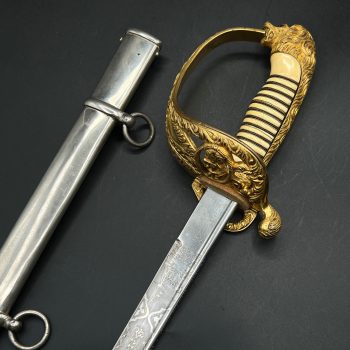
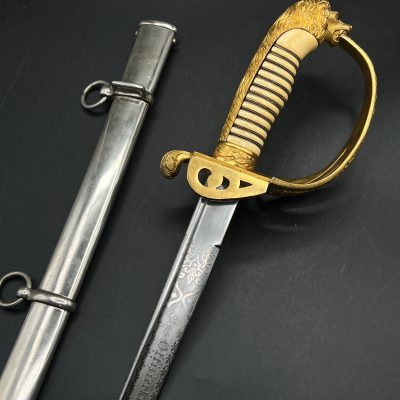
The naval saber was a mandatory attribute of the dress uniform of officers in the Kaiserliche Marine. During the period of Kaiser’s Germany, the imperial anchor beneath the Kaiser’s crown was characteristic in the design of the hilt. The classical variant featured a brass hilt, ivory grip, and a lion’s head with eyes of red and green color. The scabbard was typically made of black leather with brass fittings; steel scabbards are considerably rarer. Sabers were purchased by officers at their own expense, which resulted in numerous variations of execution. Standard and Damascus blades can be found, various hilt designs and decorative scabbard finishes, as well as several sizes ranging from light and elegant to large Grosse Pattern models. It is precisely this diversity of execution that makes naval sabers a particularly interesting independent field of collecting: collections can be built according to manufacturers, sizes, hilt types, blades, and finishing variations. Along with the dirk, the saber remained a symbol of officer status and the continuity of German naval weaponry traditions of the nineteenth century.
E. & F. Hörster, one of the largest Solingen manufacturers of naval edged weapons, operated from the nineteenth century and continued production during the Weimar Republic and the Third Reich. The firm produced high-quality naval sabers and dirks in various execution variants. Already before World War I, Hörster products were supplied not only for the German market but were also exported to other European countries, including the Russian Empire. Thanks to its long operational period, Hörster products allow one to trace the development of naval edged weapons from the Kaiser era to the Kriegsmarine.
Seebataillone represented naval infantry units of the Kaiserliche Marine. There were several marine battalions, and the custom-made edged weapons associated with them constitute a separate field of collecting German naval weaponry. A characteristic feature of such items is the combination of naval and infantry attributes. For example, an officer’s saber could feature a traditional naval hilt and blade but be equipped with steel infantry-type scabbards. Custom specimens frequently bear personal dedications from one officer to another or from the officer corps to a specific serviceman of a Seebataillon. In addition to officer sabers and other custom edged weapons, this group includes infantry-type bayonets for Mauser system rifles with Seebataillone designations and symbols. Most such items bear unit designations; however, named specimens also occur, representing particular collecting interest.
This saber features a characteristic openwork pierced hilt, presented in the catalogs of several manufacturers; however, it did not correspond to the established standard for Kaiserliche Marine edged weapons and was subsequently prohibited from being worn. It is precisely this unusual feature that makes such sabers particularly desirable among collectors today. Such specimens were predominantly ordered as presentation weapons, for example upon an officer’s transfer to another unit or upon his retirement from service, and served as an object of special pride for the owner. The present specimen is entirely original; the factory riveting of the hilt remains intact, the saber has not been disassembled, and retains its original configuration.