Login
Register
By clicking Login or Register, you agree that the images of Nazi symbols shown on alexmp.com are not propaganda of fascism, Nazism and are shown solely for historical, cognitive and scientific purposes.
Order a free call and our specialist will contact you shortly!
Contact us and we will get back to you shortly.
Contact us and we will get back to you shortly.
Contact us and we will get back to you shortly.
Contact us and we will get back to you shortly.
Error: Contact form not found.
We will get back to you shortly.
В честь запуска Энциклопедии мы рады предложить вам бесплатный доступ до 01.10.2036.
Будем рады вашим комментариям и предложениям!
Inspected and guaranteed by Alex Warstory.
For more details on AlexMP Guarantee, click [HERE]
Item guaranteed by a verified dealer.
Click [HERE] for full seller guarantee terms.
Sold without expert review or guarantees. No claims accepted post-sale.
Learn more [HERE]


Showing 65–80 of 197 results
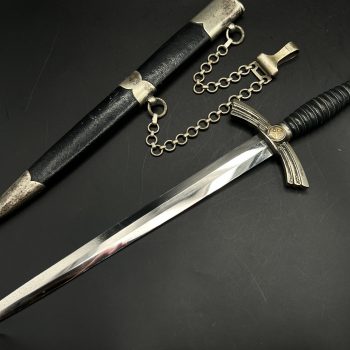
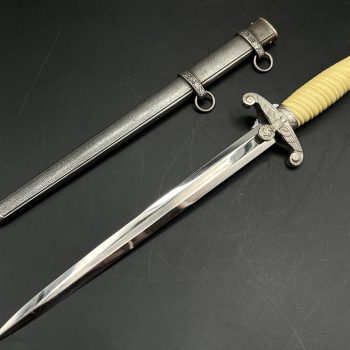
FiltersOfficially established on 10 March 1935 alongside the creation of the German Air Force, this dagger was intended for Luftwaffe career personnel in accordance with the established uniform regulations and represented the first official edged weapon of the new branch of the armed forces. Notably, the dagger’s design was based on the earlier Deutscher Luftsportverband (DLV) dagger, the German Air Sports Association, which in the early 1930s effectively served as a cover organization for training future Luftwaffe personnel. For this reason, the early Luftwaffe dagger retained many features of the DLV dagger and is considered a transitional model in the development of German aviation edged weapons.
The fittings made of nickel silver (German silver) are characteristic of early examples, typically manufactured before 1936. Due to limited production runs, high manufacturing quality, and distinguished appearance, such pieces are traditionally valued by collectors more highly than later variants.
The manufacturer was Stöcker & Co. SMF, a German metalworking company from Solingen that specialized in producing edged weapons for aviation organizations of the Third Reich. The firm produced daggers for the DLV, NSFK, and Luftwaffe, distinguished by the high quality of their blades and fittings. The blade bears the characteristic “SMF” mark, confirming the item’s origin.
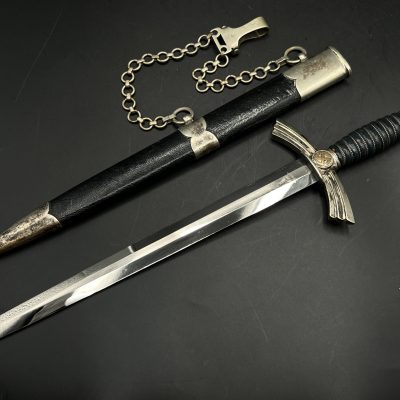
Officially established on 10 March 1935 concurrently with the creation of the German Air Force, this dagger was intended for Luftwaffe career personnel in accordance with the established uniform regulations and represented the first official edged weapon of the new branch of the armed forces. Notably, the dagger’s design was based on the earlier Deutscher Luftsportverband (DLV) dagger, the German Air Sports Association, which in the early 1930s effectively served as a cover organization for training future Luftwaffe personnel. For this reason, the early Luftwaffe dagger retained many features of the DLV dagger and is considered a transitional model in the development of German aviation edged weapons.
Manufactured by Stöcker & Co., a German metalworking company from Solingen that produced edged weapons for aviation organizations of the Third Reich. The company specialized in the production of daggers for the DLV, NSFK, and Luftwaffe, distinguished by the high quality of their blades and fittings. Items were marked with the “SMF” stamp; this specimen belongs to the first model of daggers produced by this manufacturer.
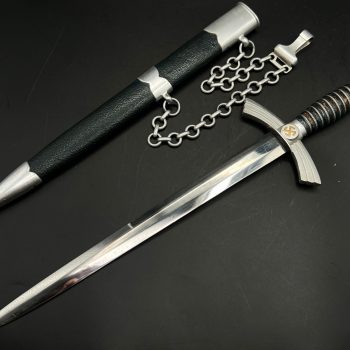
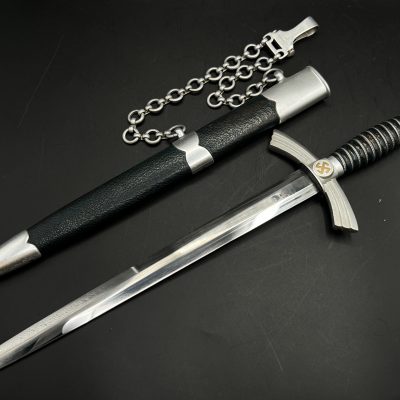
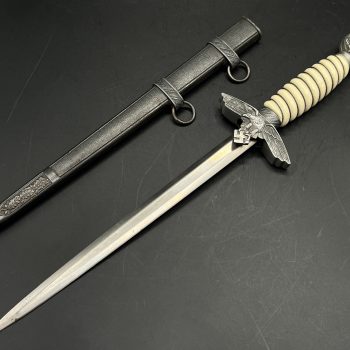
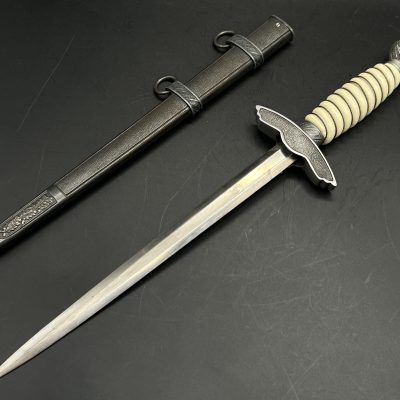
A Luftwaffe officer’s dagger, Model 1937, complete with metal scabbard. The grip is crafted from white plastic featuring characteristic spiral fluting wrapped with twisted wire. The spherical pommel is adorned with a relief depiction of oak leaves with a gilded swastika at the center. The crossguard is designed in the form of a flying eagle clutching a swastika in its talons. The blade is steel, double-edged, with a diamond-shaped cross-section. The metal scabbard is fitted with two hanging bands with suspension rings, decorated with an oak leaf ornament. The scabbard tip is embellished with a relief depiction of oak leaves.
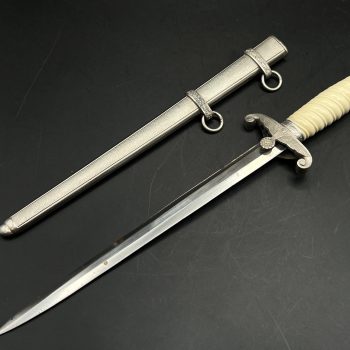
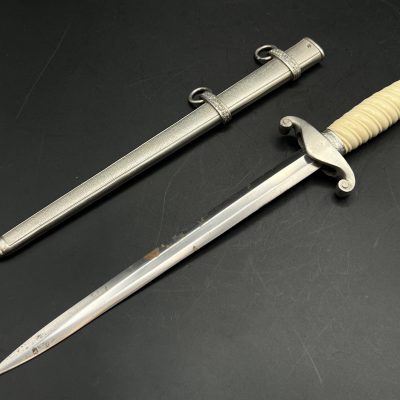
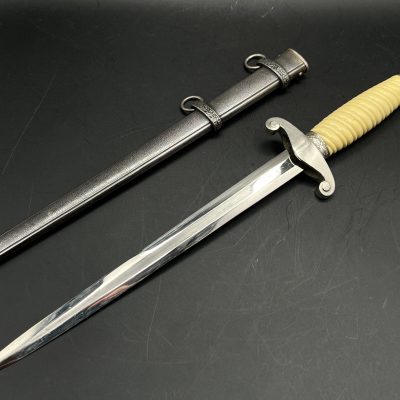
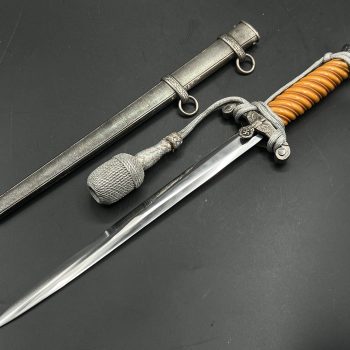
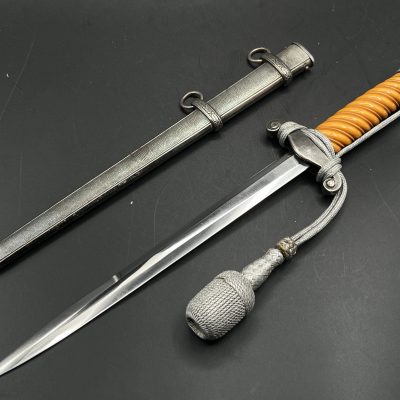
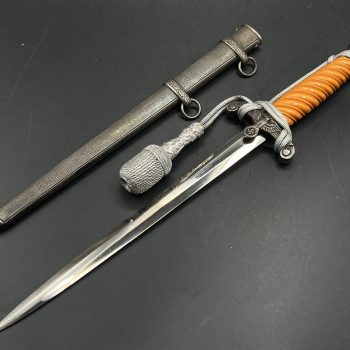
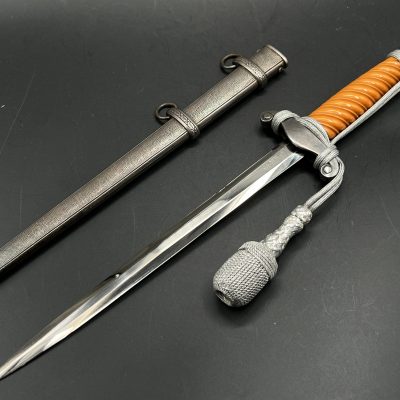
A Wehrmacht Army officer’s dagger, Model 1935, complete with metal scabbard. The grip is crafted from white celluloid featuring characteristic spiral fluting. The crossguard is adorned with a relief depiction of the Wehrmacht eagle with outstretched wings, clutching a swastika within an oak wreath. The pommel and guard ferrule are decorated with engraved oak leaf ornamentation. The metal scabbard has a textured surface and is fitted with two suspension rings featuring ornamented fittings. The blade displays traces of patina.
Officially introduced on 4 May 1935 alongside the restoration of the German armed forces, this dagger was intended for officers of the Army (Heer) and served as an essential part of dress and walking-out uniform. The example presented here was manufactured by the firm Carl Julius Krebs. The dagger quickly became one of the principal symbols of the Wehrmacht officer corps and was worn with the appropriate officer’s uniform. It was used by officers of all branches of the ground forces, including general officers, and production continued until 1942. Owing to this extended period of manufacture, the Model 1935 Army dagger became the most widely produced German officer’s dagger of the Third Reich era and remains today one of the most popular areas of collecting German edged weapons.
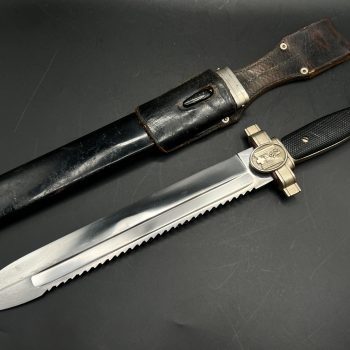
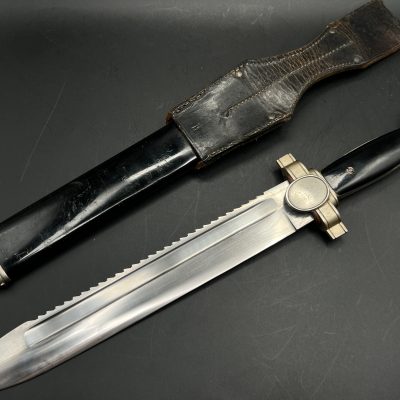
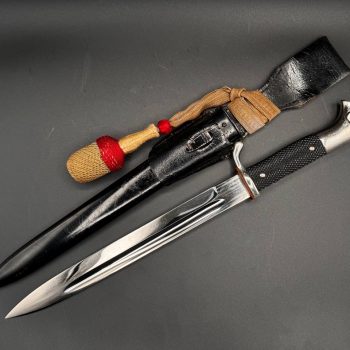
A regulation edged weapon for non-commissioned officers of the DRK (Deutsches Rotes Kreuz) organization, representing a characteristic example with a blade featuring a saw back and a combat tip of specific form. The hanger was introduced following the large-scale reorganization of the German Red Cross in 1937 and the subsequent integration of the organization into the state structure of the Third Reich under the control of the Ministry of Internal Affairs. Official adoption occurred in 1938, which is reflected in the Nazi symbolism present in the design of this example.
The marking “Ges. Gesch.” stamped on the item is an abbreviation of the German “Gesetzlich Geschützt” (“Protected by Law”) and indicates patent protection of the object or its individual elements within German territory. Such markings were widely used on edged weapons of the Third Reich, predominantly on daggers and dirks of party and paramilitary organizations, denoting patented design solutions for hilts, scabbards, or decorative elements. The presence of the original marking attests to the authenticity of the item and its manufacture during the period when German patent legislation was in effect; this constitutes an important attribution criterion for collectors.
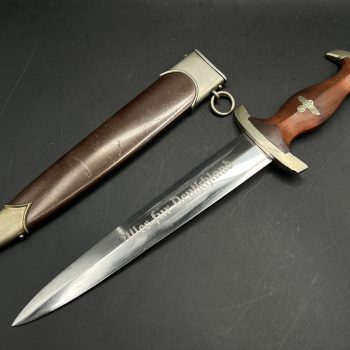
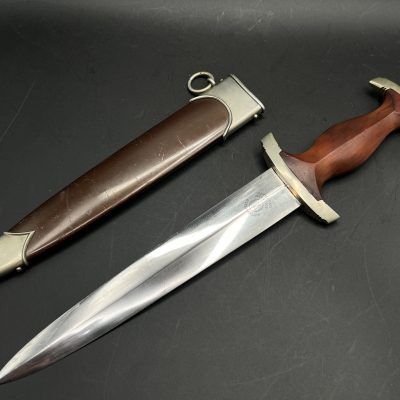
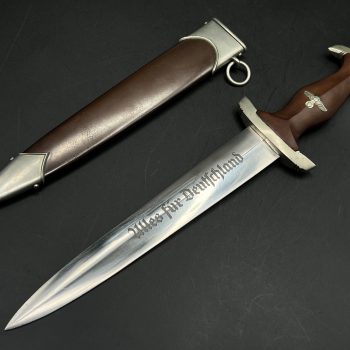
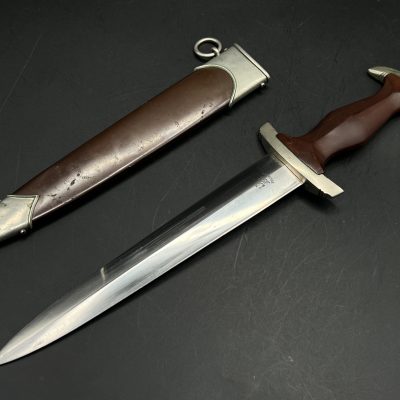
An early type of regulation edged weapon of the SA (Sturmabteilung) assault detachments, adopted in 1933. This specimen was manufactured by the Gustav Wirth workshop. The blade features a characteristic shape with double-edged sharpening and bears the famous motto “Alles für Deutschland.” The handle is made of brown wood, decorated with the SA emblem and eagle. The dagger comes complete with brown metal scabbard.
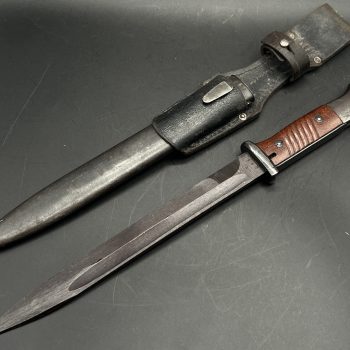
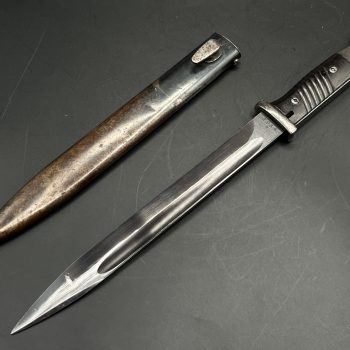
A true “calling card” of the German soldier during World War II, this bayonet model 1884/1898 was designed to accompany the legendary Mauser Gewehr 98 rifle. The modernized variant of the S84/98 model was mass-produced by the German arms industry and remained in service with the Wehrmacht throughout the entire period of World War II. This particular example dates to 1944, as evidenced by the “crs 44” marking belonging to the renowned manufacturer P. Weyersberg.
Matching serial numbers on the blade and scabbard confirm the original factory pairing since the time of manufacture; the corresponding markings indicate that these components have never been separated since leaving the production line. Such examples are encountered considerably less frequently due to combat losses and postwar reassembly, when bayonets and scabbards were often rematched from disparate parts. This is precisely why specimens with preserved matching numbers possess substantially higher collectible value and are of particular interest to serious collectors of military antiques.
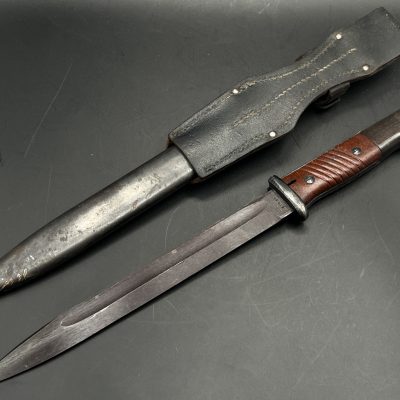
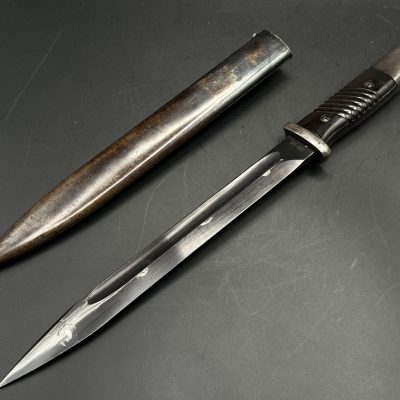
A quintessential “calling card” of the German soldier during World War II, this bayonet model 1884/1898 represents a modernized variant of the S84/98, designed specifically to complement the legendary Mauser Gewehr 98 rifle. Manufactured in 1941 at the Jos Corts production facilities (marked ddl 41), this specimen was mass produced by the German arms industry and remained in service with the Wehrmacht throughout the entire Second World War period.
This particular example derives special collector value from its matching serial numbers, with corresponding markings on both the blade and scabbard, confirming their original pairing since the time of manufacture. Such bayonets are encountered considerably less frequently due to combat losses and postwar reassembly, when original sets were separated and mixed. The preservation of matching numbers indicates that the blade and scabbard have traveled their entire journey together, which substantially increases the appeal of this lot to serious collectors of military antiques.
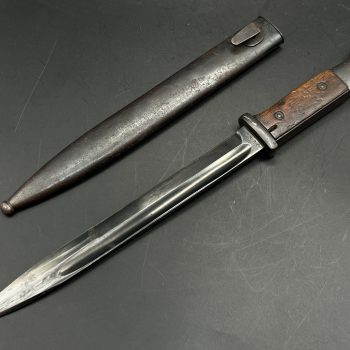
A legendary bayonet that became the true “signature weapon” of the German soldier during World War II. This modernized variant of the S84/98 bayonet was created specifically for use with the Mauser Gewehr 98 rifle and was mass-produced by the German weapons industry, remaining in service with the Wehrmacht throughout the entire war period.
The Berg&Co 39 marking indicates that the bayonet was manufactured in 1939. This particular date adds special value to the specimen: the year marking the beginning of World War II makes examples with such markings especially sought after among collectors.
The manufacturer, Berg & Co, was a German firm specializing in the production of edged weapons and bayonets in the late 19th and early 20th centuries. The company was located in Solingen, the traditional center of weapons manufacturing in Germany. The Berg & Co marking is found predominantly on bayonets produced under contract for the military department.
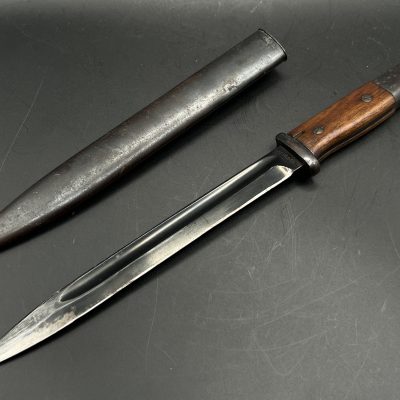
The blade was sharpened in field conditions to provide the bayonet with additional combat or utility functions, as most German bayonets were issued without factory sharpening and were intended primarily for thrusting. In the ground forces, such sharpening was officially prohibited. However, excavation results from former Luftwaffe positions show that bayonets with sharpened blades are found quite frequently, indicating the widespread practice of such field modifications among Luftwaffe personnel, particularly in paratrooper units.
Matching numbers on the blade and scabbard confirm their original pairing from the time of manufacture. Such specimens are encountered considerably less frequently due to combat losses and postwar reassembly, which significantly increases the collectible value of this example.
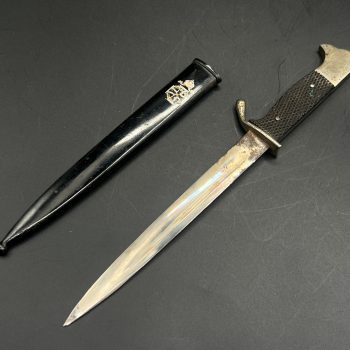
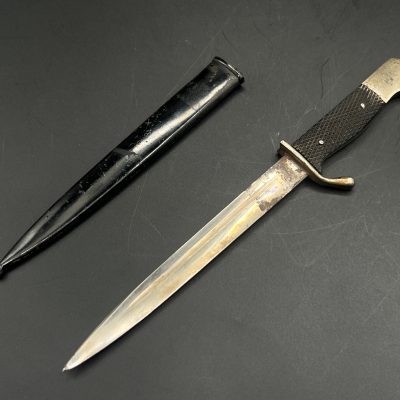
An elegant miniature replica of a dress bayonet, executed with meticulous attention to all structural elements of the original pattern. This item belongs to the category of collectible edged weapon miniatures, traditionally created as commemorative or presentation pieces, as well as for augmenting private collections.
Of particular interest is the scabbard, adorned with an engraved image, which lends this specimen an individual character and distinguishes it among standard miniaturs. Such decorative elements are encountered infrequently and substantially enhance the collectible value of the piece.
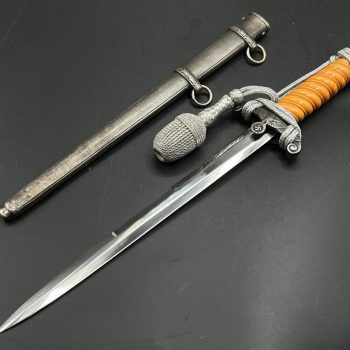
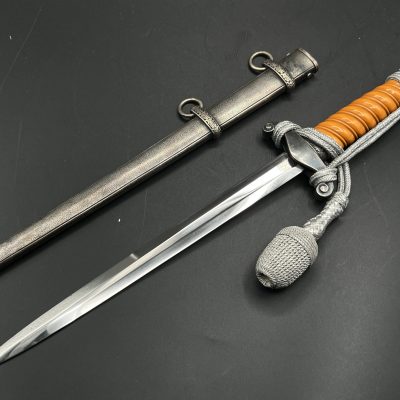
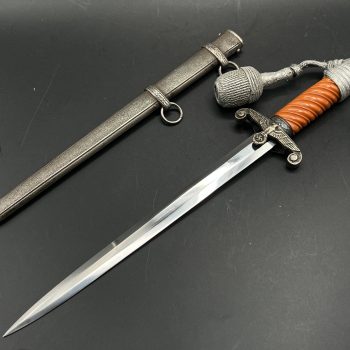
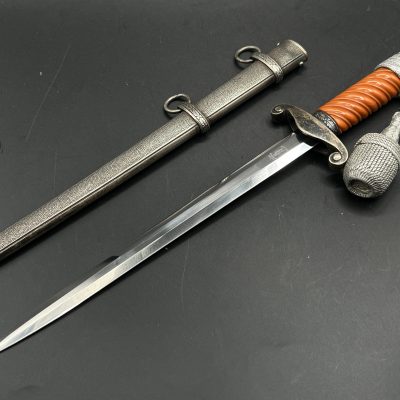
Officially introduced on 4 May 1935 simultaneously with the restoration of the German armed forces, this dagger was intended for officers of the Army (Heer) and served as an integral part of dress and walking-out uniform. It was worn with the appropriate officer’s uniform and quickly became one of the main symbols of the Wehrmacht officer corps. The dagger was authorized for officers of all branches of the land forces, including general officers, and its production continued until 1942. Due to this lengthy manufacturing period, the Army dagger model 1935 became the most widely produced German officer’s dagger of the Third Reich era and remains today one of the most popular categories for collectors of German edged weapons.
The fittings made of nickel silver (German silver) are characteristic of early examples, typically manufactured prior to 1936. This specimen was crafted by the firm Gustav C. Spitzer. Owing to their limited production runs, high quality of manufacture, and distinguished appearance, such pieces are traditionally valued by collectors more highly than their later counterparts.
This dagger was officially introduced on 4 May 1935, coinciding with the restoration of Germany’s armed forces. Intended for officers of the Army (Heer), it served as part of the dress and walking-out uniform and was worn with the corresponding officer’s attire. The dagger quickly became one of the principal symbols of the Wehrmacht officer corps. It was worn by officers of all branches of the ground forces, including general officers, and production continued until 1942. Due to this extended manufacturing period, the Army dagger became the most widely produced German officer’s dagger of the Third Reich era and remains today one of the most popular areas of German edged weapons collecting.
The fittings made of nickel silver (German silver) are characteristic of early examples, typically manufactured before 1936. Owing to their limited production numbers, superior craftsmanship, and distinguished appearance, such pieces are traditionally valued by collectors more highly than their later counterparts.
The Carl Eickhorn company was founded in Solingen in 1865 and became one of the largest edged weapons manufacturers in Germany. The trademark featuring a squirrel (Eichhörnchen) served as a guarantee of the highest quality products. During the Third Reich period, the firm produced a wide range of regulation edged weapons: daggers for all branches of service, SA, SS, NPEA, NSFK, and TeNo daggers, as well as dress daggers, sabres, and swords. Carl Eickhorn products are distinguished by superb steel quality and meticulous finishing, and they are highly prized by modern collectors.
Officially introduced on 4 May 1935 concurrently with the restoration of Germany’s armed forces, this dagger was intended for officers of the Army (Heer) and served as part of the dress and walking-out uniform, worn with the appropriate officer’s attire. The dagger quickly became one of the principal symbols of the Wehrmacht officer corps. It was worn by officers of all branches of the ground forces, including general officers, and production continued until 1942. Due to the extended period of manufacture, the Army dagger became the most widely produced German officer’s dagger of the Third Reich era and remains today one of the most popular collecting categories for German edged weapons.
The fittings made of nickel silver (German silver) are characteristic of early examples, generally produced before 1936. The present specimen was manufactured by the renowned Solingen firm Anton Wingen Jr. Owing to their limited production numbers, high quality of craftsmanship, and distinguished appearance, such pieces are traditionally valued by collectors more highly than their later counterparts.
The official introduction of this pattern took place on 4 May 1935, coinciding with the restoration of Germany’s armed forces. The dagger was intended for officers of the Army (Heer) and constituted an integral component of dress and walking-out uniform, worn with the corresponding officer’s attire. Having quickly acquired the status of one of the principal symbols of the Wehrmacht officer corps, it was carried by officers of all branches of the land forces, including general officers. Production continued until 1942, making the Army dagger the most widely produced German officer’s dagger of the Third Reich period. Today it remains one of the most popular collecting areas within German edged weapons.
The fittings are executed in nickel silver (German silver) by the craftsmen of the firm Gebr Heller, characteristic of early examples generally manufactured prior to 1936. Owing to limited production runs, superior manufacturing quality, and distinguished appearance, such pieces are traditionally valued by collectors more highly than their later counterparts.
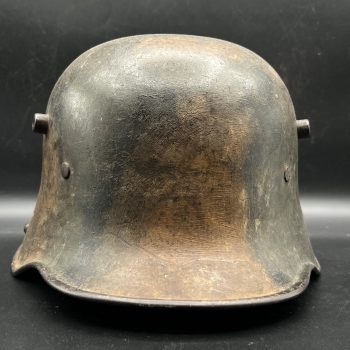
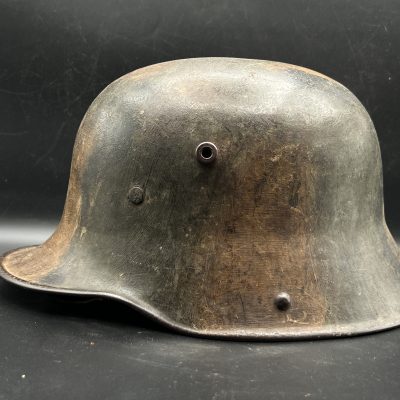
Excellent overall condition on this helmet. Features a standard camo pattern with colors of brown, green ad dark yellows. No dents and heavy damage, just expected wear for a helmet of this age. Interior is even better with all three liner pads intact which is quite rare as the tend to rot and fall out. Has a size stamping to the one side which is faint, but can just make it out. Nice WWI helmet with a great look about it.
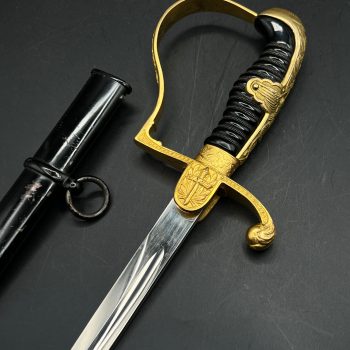
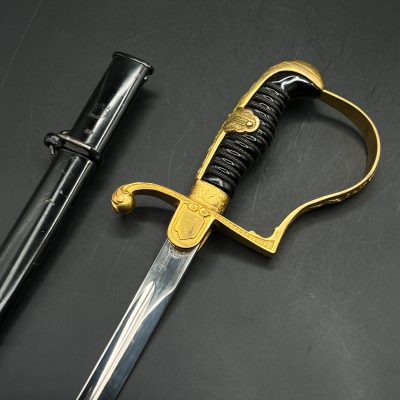
Officer parade weapons, revived following the restoration of the German armed forces, continued the proud traditions of the Imperial Army and the Reichswehr. Unlike the Army dagger model 1935, officer sabers were produced in numerous design variations by various Solingen manufacturers. Production of this type of weapon was discontinued in May 1943 due to wartime industrial demands; however, examples already in service continued to be worn with parade uniforms. In late 1944, the wearing of parade edged weapons was completely abolished, and officers were ordered to carry a pistol instead of a saber or dagger.
The blade bears the mark of the renowned Solingen firm F. W. Höller Waffenfabrik, founded in 1866 and officially registered with the Solingen authorities on 5 June 1883. From its founding, the company specialized in the production of edged weapons and cutlery. Throughout the late 19th century and during the First World War, the firm manufactured a wide range of military products, including bayonets, sabers, and swords. In 1905, the company registered its well-known trademarks: the thermometer image, as well as the figure of a man tipping his hat with the inscription “Hut ab!” (“Hats off!”). From 1914 to 1939, the firm was managed by Julius Küller. During the Third Reich period, Höller became one of the largest and most prolific edged weapons manufacturers in Solingen, specializing in a broad range of military products. In 1935, the company was located at Sonnenstraße 8, Solingen, and that same year received RZM license M7/33. Products were actively advertised in specialized journals and catalogs, showcasing an extensive assortment that included NSDAP and Wehrmacht daggers, swords, and bayonets. The firm also produced parade bayonets with high-quality etched blades. In 1941, Höller celebrated its 75th anniversary, promoting the Höller Model 21 sword as its flagship model. In June 1941, the company was assigned the K98 bayonet manufacturer letter code (fze). Following the end of the Second World War, under the ownership of Herr Grah, the firm continued operations, producing cutlery, kitchen and professional knives, swords, and scissors through the 1970s. The company was officially liquidated in December 1974. Particular collector value is added to this example by a rare decorative detail: an additional eagle on the grip backstrap, distinguishing this saber from standard production specimens.
A service edged weapon of the SA (Sturmabteilung) storm troopers, adopted in 1933. The distinctively shaped blade with double-sided sharpening bears the legendary motto “Alles für Deutschland.” The handle is made of brown-colored wood and decorated with the SA emblem featuring an eagle; the metal scabbard is finished in the same brown tone.
The early type of SA/NSKK daggers was produced between 1933 and 1936 and is distinguished by a number of characteristic design features. The scabbard and handle fittings are made of nickel silver (German silver), which, combined with the high quality of component fitting and the anodized scabbard coating, sets these examples apart from later production runs. This dagger was manufactured by Stöcker & Co. SMF. Early examples are particularly prized by collectors due to their impeccable craftsmanship and historical significance as the first service daggers of the storm troopers.
A rarity rating of 5 out of 10 according to the Ralf Siegert classification indicates that such examples are relatively uncommon on the antiques market.
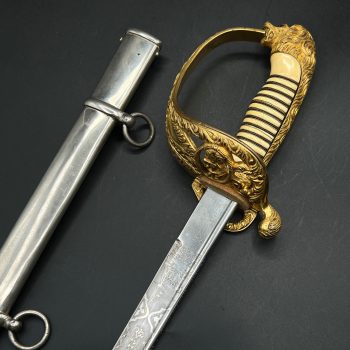
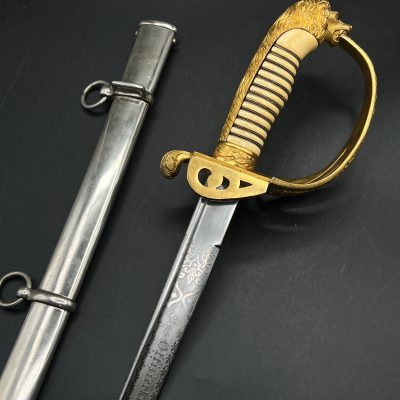
The naval saber was a mandatory attribute of the dress uniform of officers in the Kaiserliche Marine. During the period of Kaiser’s Germany, the imperial anchor beneath the Kaiser’s crown was characteristic in the design of the hilt. The classical variant featured a brass hilt, ivory grip, and a lion’s head with eyes of red and green color. The scabbard was typically made of black leather with brass fittings; steel scabbards are considerably rarer. Sabers were purchased by officers at their own expense, which resulted in numerous variations of execution. Standard and Damascus blades can be found, various hilt designs and decorative scabbard finishes, as well as several sizes ranging from light and elegant to large Grosse Pattern models. It is precisely this diversity of execution that makes naval sabers a particularly interesting independent field of collecting: collections can be built according to manufacturers, sizes, hilt types, blades, and finishing variations. Along with the dirk, the saber remained a symbol of officer status and the continuity of German naval weaponry traditions of the nineteenth century.
E. & F. Hörster, one of the largest Solingen manufacturers of naval edged weapons, operated from the nineteenth century and continued production during the Weimar Republic and the Third Reich. The firm produced high-quality naval sabers and dirks in various execution variants. Already before World War I, Hörster products were supplied not only for the German market but were also exported to other European countries, including the Russian Empire. Thanks to its long operational period, Hörster products allow one to trace the development of naval edged weapons from the Kaiser era to the Kriegsmarine.
Seebataillone represented naval infantry units of the Kaiserliche Marine. There were several marine battalions, and the custom-made edged weapons associated with them constitute a separate field of collecting German naval weaponry. A characteristic feature of such items is the combination of naval and infantry attributes. For example, an officer’s saber could feature a traditional naval hilt and blade but be equipped with steel infantry-type scabbards. Custom specimens frequently bear personal dedications from one officer to another or from the officer corps to a specific serviceman of a Seebataillon. In addition to officer sabers and other custom edged weapons, this group includes infantry-type bayonets for Mauser system rifles with Seebataillone designations and symbols. Most such items bear unit designations; however, named specimens also occur, representing particular collecting interest.
This saber features a characteristic openwork pierced hilt, presented in the catalogs of several manufacturers; however, it did not correspond to the established standard for Kaiserliche Marine edged weapons and was subsequently prohibited from being worn. It is precisely this unusual feature that makes such sabers particularly desirable among collectors today. Such specimens were predominantly ordered as presentation weapons, for example upon an officer’s transfer to another unit or upon his retirement from service, and served as an object of special pride for the owner. The present specimen is entirely original; the factory riveting of the hilt remains intact, the saber has not been disassembled, and retains its original configuration.