Login
Register
By clicking Login or Register, you agree that the images of Nazi symbols shown on alexmp.com are not propaganda of fascism, Nazism and are shown solely for historical, cognitive and scientific purposes.
Order a free call and our specialist will contact you shortly!
Contact us and we will get back to you shortly.
Contact us and we will get back to you shortly.
Contact us and we will get back to you shortly.
Contact us and we will get back to you shortly.
Error: Contact form not found.
We will get back to you shortly.
В честь запуска Энциклопедии мы рады предложить вам бесплатный доступ до 01.10.2026.
Будем рады вашим комментариям и предложениям!
Inspected and guaranteed by Alex Warstory.
For more details on AlexMP Guarantee, click [HERE]
Item guaranteed by a verified dealer.
Click [HERE] for full seller guarantee terms.
Sold without expert review or guarantees. No claims accepted post-sale.
Learn more [HERE]


Showing 1–16 of 179 results
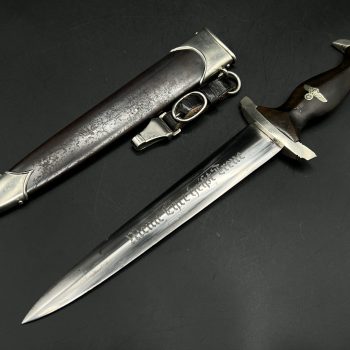
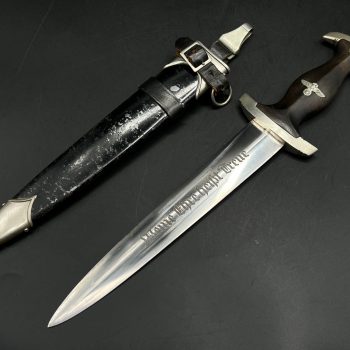
FiltersThe first official cold weapon of the Schutzstaffel, introduced in 1933, became one of the most recognizable symbols of the organization. The dagger’s design traces back to sixteenth-century Swiss daggers known as Holbein daggers and closely resembles the SA dagger adopted at approximately the same time. The blade bears the motto ‘Meine Ehre heißt Treue’ (‘My honor is loyalty’), which became one of the principal symbols of the SS. In the organization’s early years, the dagger was regarded not only as an element of uniform and symbol of SS membership, but also as personal cold steel that the owner could use when necessary.
Early SS daggers produced before 1936 were distinguished by nickel-silver fittings on the hilt and scabbard, high manufacturing quality, and careful assembly of components. The scabbards typically featured an anodized finish, although original painted variants are also encountered. Blades most often bore maker’s marks with the manufacturer’s company name; early RZM stamps are sometimes present. From 1936 onward, the construction gradually simplified; zinc, aluminum, and steel scabbard fittings came into use, along with painted scabbards. Transitional stamps appeared bearing the manufacturer’s logo and RZM code, followed later by RZM markings alone. Early daggers were produced in smaller quantities and typically saw extended service wear, making mint and near-mint condition examples extremely rare. Minor chips to the hilt and signs of use are entirely normal for these pieces. Special attention should be paid to restorations and later assembly; should such interventions be present, they are separately noted in the item’s description.
Robert Klaas ranks among the most sought-after manufacturers of German cold weapons by collectors. A characteristic feature of many Klaas products is their contrasting bluing and high-quality finishing, which has often allowed decorative elements to remain well preserved to the present day. The company operated in Solingen and produced parade and combat cold weapons, bayonets and components, and participated in the manufacture of experimental samples for military industry. In 1944, the production facilities of Robert Klaas, like much of Solingen’s weapons industry, suffered damage from Allied bombing.
The stamp ‘I’ on the reverse of the lower crossguard of this early SS dagger indicates the SS distribution and inspection center in Munich (München). Such marking is characteristic of early daggers from the 1933–1935 period and represents an important feature of the original SS dagger acceptance and distribution system.
Includes suspension loop with 1938 maker’s mark.
The official Schutzstaffel edged weapon pattern, introduced in 1933, became the first SS dagger and one of the most recognizable symbols of this organization. The blade design derives from 16th-century Swiss daggers known as Holbein daggers, and visually bears considerable resemblance to the SA dagger, which was adopted at nearly the same time. The blade featured the motto “Meine Ehre heißt Treue” (“My Honor is Loyalty”), which became one of the principal symbols of the SS. In the early years of the organization, the dagger was regarded not merely as a uniform element and a mark of SS membership, but also as a personal edged weapon that the owner could use if necessary.
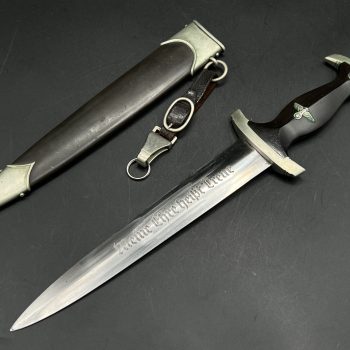
In 1934, a certain number of SS members were awarded honor daggers bearing a facsimile of Ernst Röhm’s signature and the dedication “In herzlicher Kameradschaft” (“In Heartfelt Comradeship”) on the reverse of the blade. Following the “Night of the Long Knives” and the elimination of the SA leadership in the summer of 1934, Röhm’s name became undesirable, and an order was issued to remove his dedication from the award daggers. Surviving examples display various methods of such removal, ranging from complete grinding of the entire inscription to partial removal of only Röhm’s facsimile. Of particular interest are the so-called “Lazy Röhms,” on which Röhm’s name was only partially removed or essentially scratched out, leaving a significant portion of the original dedication visible. An intermediate variant also exists: Röhm’s facsimile is completely removed, yet the text “In herzlicher Kameradschaft” remains untouched. Such removal allowed the direct connection to Röhm to be eliminated while preserving visible evidence of the owner’s original award. The traces of removal in this case do not constitute a blade defect; rather, they represent an important historical and attributional feature. All else being equal, examples with completely removed dedications are typically valued at the level of ordinary early SS daggers, whereas pieces retaining elements of the dedication hold greater collector interest. “Lazy Röhms” are especially prized, with the degree of preservation of the original inscription being significant. Examples with Röhm’s facsimile completely removed but the dedication text preserved occupy an intermediate position.
The firm Richard Herder of Solingen was one of the edged weapon manufacturers for Third Reich organizations and participated in the production of SA daggers as early as 1934. This is confirmed, in particular, by surviving early Richard Herder daggers bearing Ernst Röhm’s dedication, as well as examples on which this inscription was subsequently officially removed following the events of summer 1934. Thus, Richard Herder belongs to the manufacturers whose participation in SA dagger production is documented from the very earliest period of their manufacture.
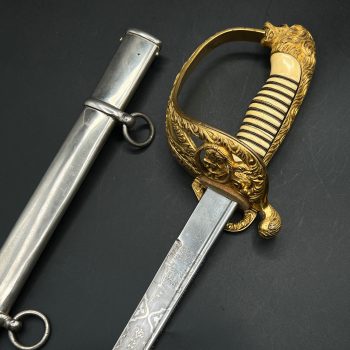
The naval saber was a mandatory attribute of the dress uniform of officers in the Kaiserliche Marine. During the period of Kaiser’s Germany, the imperial anchor beneath the Kaiser’s crown was characteristic in the design of the hilt. The classical variant featured a brass hilt, ivory grip, and a lion’s head with eyes of red and green color. The scabbard was typically made of black leather with brass fittings; steel scabbards are considerably rarer. Sabers were purchased by officers at their own expense, which resulted in numerous variations of execution. Standard and Damascus blades can be found, various hilt designs and decorative scabbard finishes, as well as several sizes ranging from light and elegant to large Grosse Pattern models. It is precisely this diversity of execution that makes naval sabers a particularly interesting independent field of collecting: collections can be built according to manufacturers, sizes, hilt types, blades, and finishing variations. Along with the dirk, the saber remained a symbol of officer status and the continuity of German naval weaponry traditions of the nineteenth century.
E. & F. Hörster, one of the largest Solingen manufacturers of naval edged weapons, operated from the nineteenth century and continued production during the Weimar Republic and the Third Reich. The firm produced high-quality naval sabers and dirks in various execution variants. Already before World War I, Hörster products were supplied not only for the German market but were also exported to other European countries, including the Russian Empire. Thanks to its long operational period, Hörster products allow one to trace the development of naval edged weapons from the Kaiser era to the Kriegsmarine.
Seebataillone represented naval infantry units of the Kaiserliche Marine. There were several marine battalions, and the custom-made edged weapons associated with them constitute a separate field of collecting German naval weaponry. A characteristic feature of such items is the combination of naval and infantry attributes. For example, an officer’s saber could feature a traditional naval hilt and blade but be equipped with steel infantry-type scabbards. Custom specimens frequently bear personal dedications from one officer to another or from the officer corps to a specific serviceman of a Seebataillon. In addition to officer sabers and other custom edged weapons, this group includes infantry-type bayonets for Mauser system rifles with Seebataillone designations and symbols. Most such items bear unit designations; however, named specimens also occur, representing particular collecting interest.
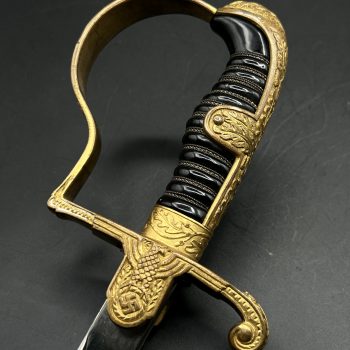
This saber features a characteristic openwork pierced hilt, presented in the catalogs of several manufacturers; however, it did not correspond to the established standard for Kaiserliche Marine edged weapons and was subsequently prohibited from being worn. It is precisely this unusual feature that makes such sabers particularly desirable among collectors today. Such specimens were predominantly ordered as presentation weapons, for example upon an officer’s transfer to another unit or upon his retirement from service, and served as an object of special pride for the owner. The present specimen is entirely original; the factory riveting of the hilt remains intact, the saber has not been disassembled, and retains its original configuration.
The first official cold weapon of the Schutzstaffel, introduced in 1933 and created based on Swiss daggers of the 16th century, known as Holbein daggers. In appearance, it bore considerable resemblance to the SA dagger, adopted at approximately the same time. The blade bore the motto ‘Meine Ehre heißt Treue’ (‘My Honor is Called Loyalty’), which became one of the principal symbols of the SS. In the early years of the organization’s existence, the dagger was regarded not only as an element of uniform and a symbol of SS membership, but also as a personal cold weapon that its owner could use when necessary.
Early SS daggers produced before 1936 were distinguished by nickel-silver fittings on the hilt and scabbard, high quality of manufacture, and careful assembly of components. Scabbards typically featured an anodized finish, although original painted variants do occur. Blades most commonly bore a maker’s mark with the manufacturer’s name; early RZM stamps are occasionally encountered. From 1936 onward, the construction was gradually simplified; zinc, aluminum, and steel fittings for scabbards came into use, along with painted scabbards. Transitional stamps bearing the manufacturer’s logo and RZM code appeared, followed later by RZM stamps alone. Early daggers were produced in smaller quantities and typically saw longer periods of wear; consequently, specimens in mint and near-mint condition are extremely rare. Minor chips to the hilt and signs of use are quite normal for such pieces. Particular attention should be paid to restorations and later assembly; any such interventions are noted separately in the item description.
Robert Klaas ranks among the most sought-after manufacturers of German cold weapons by collectors. A characteristic feature of many Klaas products is their contrasting bluing and high quality of finish, thanks to which decorative elements often remain well-preserved to the present day. The firm operated in Solingen and produced dress and combat cold weapons, bayonets and fittings, and also participated in the manufacture of experimental samples for military industry. In 1944, the production facilities of Robert Klaas, like a significant portion of Solingen’s weapons industry, suffered damage as a result of Allied bombing.
The stamp ‘I’ on the reverse side of the lower crossguard indicates the SS distribution and inspection center in Munich. Such marking is characteristic of early daggers from the period 1933-1935 and represents an important feature of the initial SS dagger acceptance and distribution system.
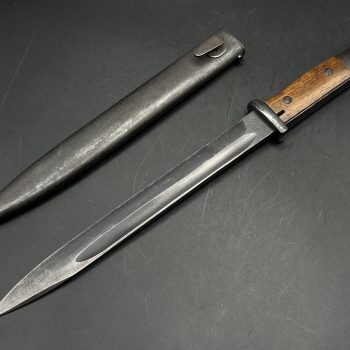
The marking ‘cof 44’ on this bayonet model 1884/1898 for the Mauser rifle model 1898 indicates production in 1944 at the renowned Carl Eickhorn factory in Solingen, which operated under the military code ‘cof’. This marking is characteristic of late-period German bayonets from World War II, when manufacturers used three-letter codes instead of full names for purposes of secrecy.
The blade has never been sharpened, which represents particular value to collectors. Such condition testifies to minimal combat use of the item or its storage in military arsenals. The absence of resharpening marks has preserved the original blade geometry, which significantly enhances the collectible value of this specimen.
Matching serial numbers on both the blade and scabbard confirm their original pairing from the time of manufacture. Such examples are encountered significantly more rarely due to combat losses and post-war reassembly, when bayonets and scabbards were often permanently separated. The preservation of the original matched set gives this lot special appeal to serious collectors of German edged weapons.
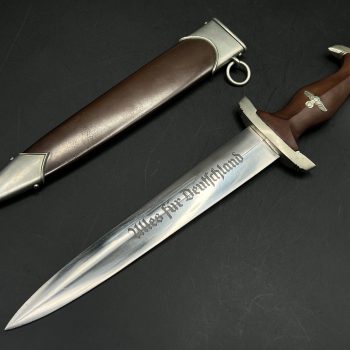
A service edged weapon of the SA (Sturmabteilung) storm troopers, adopted in 1933. The distinctively shaped blade with double-sided sharpening bears the legendary motto “Alles für Deutschland.” The handle is made of brown-colored wood and decorated with the SA emblem featuring an eagle; the metal scabbard is finished in the same brown tone.
The early type of SA/NSKK daggers was produced between 1933 and 1936 and is distinguished by a number of characteristic design features. The scabbard and handle fittings are made of nickel silver (German silver), which, combined with the high quality of component fitting and the anodized scabbard coating, sets these examples apart from later production runs. This dagger was manufactured by Stöcker & Co. SMF. Early examples are particularly prized by collectors due to their impeccable craftsmanship and historical significance as the first service daggers of the storm troopers.
A rarity rating of 5 out of 10 according to the Ralf Siegert classification indicates that such examples are relatively uncommon on the antiques market.
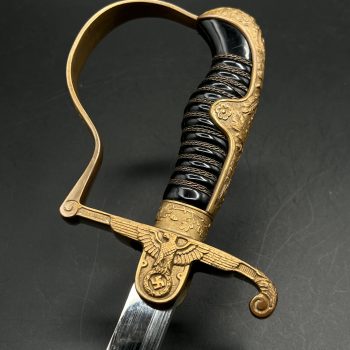
Following the restoration of German armed forces, the saber was reintroduced as a ceremonial cold weapon for officers, continuing the traditions of the Imperial Army and the Reichswehr. Unlike the army dagger model of 1935, officer sabers were produced in numerous design variations by various Solingen manufacturers. In May 1943, saber production was discontinued due to military industrial requirements; however, specimens already in service continued to be worn with dress uniforms. At the end of 1944, the wearing of ceremonial cold weapons was abolished, and officers were ordered to carry a pistol instead of a saber or dagger.
The Carl Eickhorn company was founded in Solingen in 1865 and became one of Germany’s largest producers of cold weapons. The company trademark featuring a squirrel (Eichhörnchen) was a guarantee of the highest quality products. During the Third Reich, the enterprise produced a wide range of regulation cold weapons: daggers for all branches of service, SA, SS, NPEA, NSFK, and TeNo daggers, as well as ceremonial daggers, sabers, and dress swords. Carl Eickhorn products are distinguished by superior steel quality, meticulous finishing, and are highly valued by modern collectors.
The mark “Ges. Gesch.,” an abbreviation of the German “Gesetzlich Geschützt” (Legally Protected), indicates patent protection for the product or its elements within German territory. This marking was widely applied to Third Reich cold weapons, primarily on daggers and daggers of party and paramilitary organizations, designating patented design solutions for hilts, scabbards, or decorative elements. The presence of an original mark attests to the authenticity of the object and its manufacture during the period when German patent law was in effect, which serves as an important attribution characteristic for collectors.
A special place among army sabers of the Third Reich era is occupied by the famous “Field Marshal Series” of Carl Eickhorn, Solingen. The series consisted of nine different models, each bearing the name of an outstanding German military figure or historical personage: Wrangel, Scharnhorst, Blücher, von Stein, Roon, Derfflinger, Zieten, Prinz Eugen, and Lützow. The term “Field Marshal Series” is a traditional collector’s designation. The models had their own catalog numbers and differed in the design of their hilts, pommels, and decorative elements. A significant portion of the designs is connected to the renowned artist and weapons designer Paul Casberg. Today, the “Field Marshal Series” represents a special collecting interest precisely as a complete thematic collection: nine catalog models from one of Solingen’s leading manufacturers allow for assembling a complete, historically established series of Eickhorn army sabers. Individual models are considerably rarer than others, making the creation of a complete set a serious collecting objective.
Following the restoration of the German armed forces, the saber was reintroduced as a ceremonial edged weapon for officers, continuing the traditions of the Imperial Army and the Reichswehr. Unlike the army dagger model of 1935, officer sabers were produced in numerous design variations by different Solingen manufacturers. In May 1943, saber production was discontinued due to wartime industrial demands; however, examples already in service continued to be worn with dress uniforms. In late 1944, the wearing of ceremonial edged weapons was definitively abolished, and officers were instructed to carry a pistol instead of a saber or dagger.
The blade was manufactured by Paul Seilheimer, Solingen, a German edged weapons producer that made sabers, daggers, bayonets, and knives. Of particular interest to collectors is the fact that original Paul Seilheimer catalogs from the Third Reich period have survived to the present day, featuring illustrations of sabers, daggers, and equipment elements; some catalog copies have even preserved the original company price lists. This makes it possible today to compare surviving pieces with the manufacturer’s original product range. Paul Seilheimer blades are encountered considerably less frequently than products from the largest Solingen factories and represent sustained collector interest.
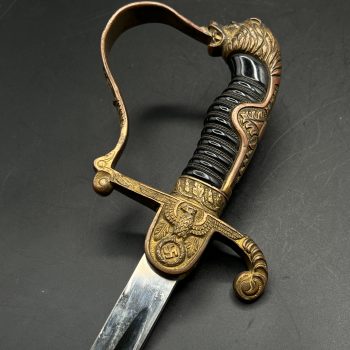
Ceremonial edged weapon for officers, reintroduced following the restoration of the German armed forces and continuing the traditions of the Imperial Army and the Reichswehr. Unlike the army dagger model 1935, officer sabers were produced in numerous design variants by various Solingen manufacturers. In May 1943, saber production was discontinued due to wartime industrial demands; however, examples already in service continued to be worn with dress uniform. In late 1944, the wearing of ceremonial edged weapons was abolished, and officers were required to carry a pistol instead of a saber or dagger.
The blade was manufactured by Emil Voos, Solingen, a renowned German edged weapons producer whose sabers, daggers, and knives represent sustained collector interest today. The firm operated in Solingen, the famous center of German blade production, and was distinguished by its high quality of manufacture and finish. Emil Voos products are encountered noticeably less frequently than those of many major Solingen manufacturers, which enhances their appeal to collectors. At the end of World War II, Solingen suffered heavy Allied bombing, particularly in November 1944, when a significant portion of the city was destroyed.
The hilt featuring a lion head is complemented by a rare design feature: an eagle on the guard. This execution is found among a limited number of manufacturers and represents an interesting collector variant, distinguished by its hilt ornamentation.
Technical Emergency Corps (TeNo) Leader’s Dagger, Model 1938, manufactured by Carl Eickhorn of Solingen. This example bears the manufacturer’s trademark and retains matching numbers on the blade and scabbard, confirming their factory pairing and attesting to the complete original preservation of the piece.
This dagger model was introduced in November 1938, concurrently with the adoption of new regulation edged weapons for the TeNo organization. It was intended to be worn with dress uniform by commanding officers holding the rank of Stabsscharführer and above. Officers purchased these daggers at their own expense through special organizational outlets.
The history of the Technical Emergency Corps began on September 30, 1919. Throughout the existence of the Weimar Republic, the corps repeatedly distinguished itself, demonstrating efficiency and excellent technical training. Naturally, this organization could not escape the attention of the new leadership, the National Socialist Party. In 1939, to further enhance efficiency, TeNo was transferred to the jurisdiction of the Reich Ministry of Foreign Affairs and subordinated to police structures, allowing for improved operational capacity. Prior to the commencement of the Polish campaign, TeNo was commanded by SS Gruppenführer (SS Lieutenant General) Schmelzer; he was later succeeded in this post by SS Gruppenführer Weinreich.
The Carl Eickhorn company was founded in Solingen in 1865 and became one of the largest manufacturers of edged weapons in Germany. The company’s trademark, featuring a squirrel (Eichhörnchen), served as a guarantee of the highest quality products. During the Third Reich period, the firm produced a wide range of regulation edged weapons, including daggers for all branches of service, SA and SS daggers, NPEA, NSFK, and TeNo daggers, as well as dress daggers, sabers, and swords. Carl Eickhorn products are distinguished by superior steel quality and meticulous finishing, and are highly valued by modern collectors.
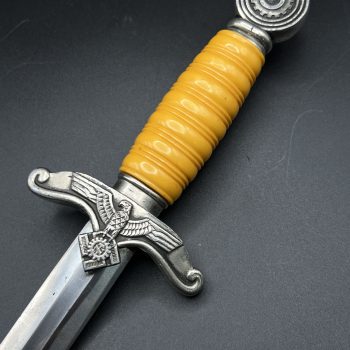
Luftwaffe officer’s dagger, second model (1937 pattern), complete with metal scabbard and officer’s sword knot. The handle is made of celluloid with characteristic spiral wrapping of aluminum wire. The spherical pommel is decorated with relief plant ornament featuring oak leaves and a swastika in yellow metal. The crossguard is fashioned as a spread eagle grasping a swastika in its talons. The blade bears an oval maker’s mark of F.W. Höller, Solingen, with a thermometer motif. The metal scabbard features characteristic shagreen texture and is adorned with metal fittings decorated with relief ornament of oak leaves.
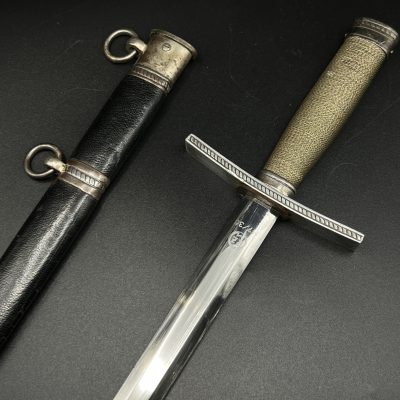
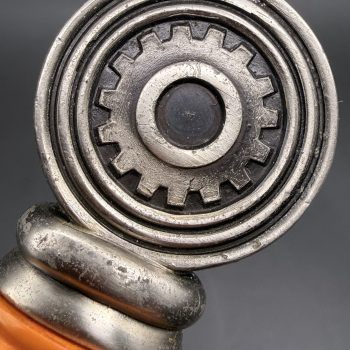
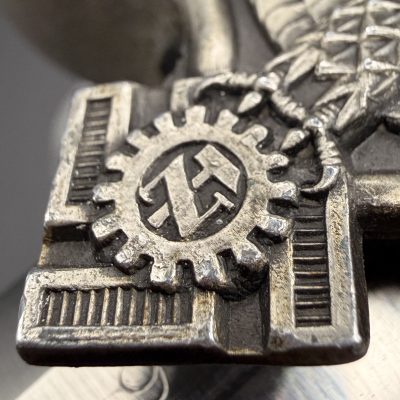
A rare example of edged weaponry created specifically for the leadership echelon of the Reichsarbeitsdienst, the Reich Labour Service. Initially, both junior and senior RAD personnel were issued the standard RAD hewer. It was only in 1938 that a separate RAD leader’s dagger was introduced specifically for commanding officers, immediately establishing it as a distinct category of status weapon.
The distinguishing feature of this example is its smaller dimensions and more refined execution compared to the standard hewer issued to enlisted and junior personnel. The dagger was worn on a special leather hanger, emphasizing its designation as officer’s equipment. The blade bears the traditional RAD motto “Arbeit adelt” (“Labour Ennobles”), expressing the ideological foundation of the organization. The piece was manufactured at the production facilities of the renowned German firm WKC, attesting to its high quality of craftsmanship.
The honorary edged weapon intended for wear by the leadership of the Hitler Youth organization served as an important status attribute for leaders. However, the number of daggers actually purchased was notably lower than the number of leaders who were entitled to such weapons by virtue of their position. According to the recollections of a son of one of the Hitler Youth leaders, his father preferred to wear a pistol in a holster with his uniform instead of a dagger. The reason was that the dagger had to be purchased with one’s own funds, and at the time it was quite expensive. Therefore, not every organization leader who had the right to wear one actually acquired such a dagger. This circumstance is one of the reasons for the comparative rarity of original examples today. A separate challenge for collectors is the authentication of such items. The market contains fairly high-quality modern reproductions, as well as restored and assembled examples with replaced parts. Consequently, a Hitler Youth leader’s dagger requires particularly careful examination: one must evaluate not only the blade and manufacturer’s mark, but also the grip, emblem, metal fittings, scabbard, and hanger, as well as the correspondence of all components to one another and to the period of manufacture.
The RZM type represents a category of German daggers from the Third Reich period produced under the control of the Reichszeugmeisterei (the Imperial Equipment Office of the NSDAP). Such items were marked with a special RZM code and manufacturer number instead of the traditional maker’s trademark; this was introduced for standardization and quality control of Party edged weapons. RZM-type daggers are characterized by more uniform execution.
The marking M7/36 is an RZM production code assigned to the firm E. & F. Hörster of Solingen, one of the renowned German manufacturers of edged weapons.
Technical Emergency Corps (TeNo) Leader’s Dagger, Model 1938, manufactured by Carl Eickhorn of Solingen. This example bears the manufacturer’s trademark and retains matching numbers on the blade and scabbard, confirming their factory pairing and attesting to the complete original preservation of the piece.
This dagger model was introduced in November 1938, concurrently with the adoption of new regulation edged weapons for the TeNo organization. It was intended to be worn with dress uniform by commanding officers holding the rank of Stabsscharführer and above. Officers purchased these daggers at their own expense through special organizational outlets.
The history of the Technical Emergency Corps began on September 30, 1919. Throughout the existence of the Weimar Republic, the corps repeatedly distinguished itself, demonstrating efficiency and excellent technical training. Naturally, this organization could not escape the attention of the new leadership, the National Socialist Party. In 1939, to further enhance efficiency, TeNo was transferred to the jurisdiction of the Reich Ministry of Foreign Affairs and subordinated to police structures, allowing for improved operational capacity. Prior to the commencement of the Polish campaign, TeNo was commanded by SS Gruppenführer (SS Lieutenant General) Schmelzer; he was later succeeded in this post by SS Gruppenführer Weinreich.
The Carl Eickhorn company was founded in Solingen in 1865 and became one of the largest manufacturers of edged weapons in Germany. The company’s trademark, featuring a squirrel (Eichhörnchen), served as a guarantee of the highest quality products. During the Third Reich period, the firm produced a wide range of regulation edged weapons, including daggers for all branches of service, SA and SS daggers, NPEA, NSFK, and TeNo daggers, as well as dress daggers, sabers, and swords. Carl Eickhorn products are distinguished by superior steel quality and meticulous finishing, and are highly valued by modern collectors.
The dagger remains in very good collector’s condition. All metal fittings retain their original natural patina. The blade preserves its original factory finish, has never been sharpened, and retains its original factory geometry. The scabbard still has its original factory paint finish with no evidence of repainting.
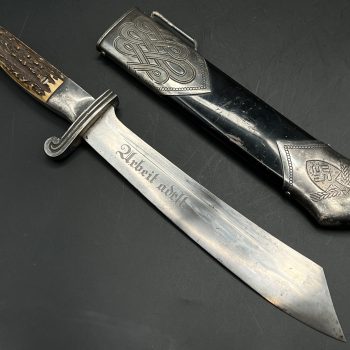
The Model 1934 hewer was the standard edged weapon of the Reichsarbeitsdienst (RAD). Prior to the introduction of a separate officer’s hewer in 1938, this model was used by both junior personnel and the leadership of the organization. Following the adoption of the officer’s pattern in 1938, the Model 1934 hewer remained the weapon of junior personnel, and the distinction between hewer types came to correspond with service ranks.
This example was manufactured by Edward Wusthof, a German edged weapons producer based in Solingen, which produced hewers and daggers for the Reich Labor Service (RAD) during the Third Reich period. The company specialized in the manufacture of high-quality bladed weapons characteristic of the Solingen arms-making tradition.
The piece bears the marking “Ges. Gesch.,” an abbreviation of the German “Gesetzlich Geschützt” (“Protected by Law”), indicating patent protection of the item or its components within German territory. This marking was widely applied to Third Reich edged weapons, predominantly on daggers and dirks of party and paramilitary organizations, denoting patented design features of hilts, scabbards, or decorative elements. The presence of the original marking attests to the authenticity of the piece and its manufacture during the period when German patent legislation was in effect; this constitutes an important attributional indicator for collectors.
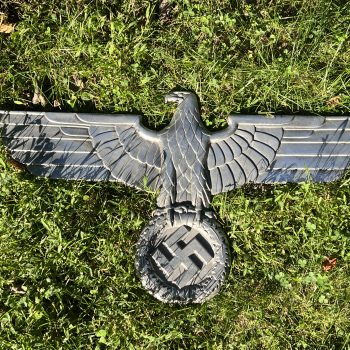
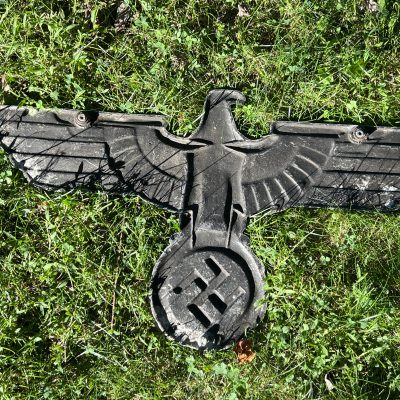
A large original Deutsche Reichsbahn (German State Railways) eagle from the Third Reich period. The eagle is depicted with outstretched wings, clutching a wreath bearing a swastika in its talons. The piece features strong three-dimensional relief, with detailed feathering and wing construction.
The reverse retains stamped/raised manufacturer or production markings, as well as original mounting hardware. The eagle displays an attractive period patina with surface wear, oxidation, scratches, and traces of finish loss consistent with its age and history.
Technical Emergency Corps (TeNo) Leader’s Dagger, Model 1938, manufactured by Carl Eickhorn of Solingen. This example bears the manufacturer’s trademark and retains matching numbers on the blade and scabbard, confirming their factory pairing and attesting to the complete original preservation of the piece.
This dagger model was introduced in November 1938, concurrently with the adoption of new regulation edged weapons for the TeNo organization. It was intended to be worn with dress uniform by commanding officers holding the rank of Stabsscharführer and above. Officers purchased these daggers at their own expense through special organizational outlets.
The history of the Technical Emergency Corps began on September 30, 1919. Throughout the existence of the Weimar Republic, the corps repeatedly distinguished itself, demonstrating efficiency and excellent technical training. Naturally, this organization could not escape the attention of the new leadership, the National Socialist Party. In 1939, to further enhance efficiency, TeNo was transferred to the jurisdiction of the Reich Ministry of Foreign Affairs and subordinated to police structures, allowing for improved operational capacity. Prior to the commencement of the Polish campaign, TeNo was commanded by SS Gruppenführer (SS Lieutenant General) Schmelzer; he was later succeeded in this post by SS Gruppenführer Weinreich.
The Carl Eickhorn company was founded in Solingen in 1865 and became one of the largest manufacturers of edged weapons in Germany. The company’s trademark, featuring a squirrel (Eichhörnchen), served as a guarantee of the highest quality products. During the Third Reich period, the firm produced a wide range of regulation edged weapons, including daggers for all branches of service, SA and SS daggers, NPEA, NSFK, and TeNo daggers, as well as dress daggers, sabers, and swords. Carl Eickhorn products are distinguished by superior steel quality and meticulous finishing, and are highly valued by modern collectors.
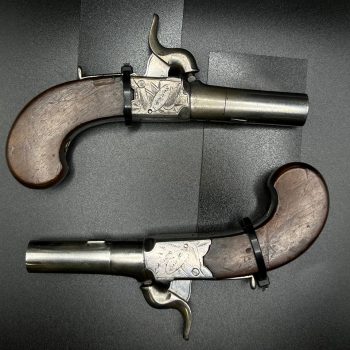
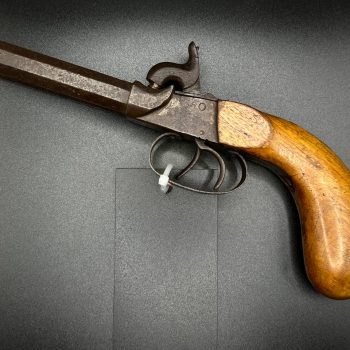
Pair of English Drop Trigger Percussion Pistols Marked H Nock.
Marked with one of England’s premier makers of the period, these guns are likely the fake watches of their day. Both guns are in nice condition with engraved frames and slab butts with vacant silver escutcheons.
Both actions, including push-on safeties, function without problems.
Overall length approximately 5 7/8 inches, with twist off barrels, standard British proofs.
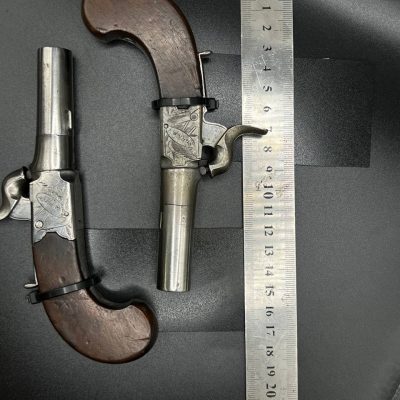
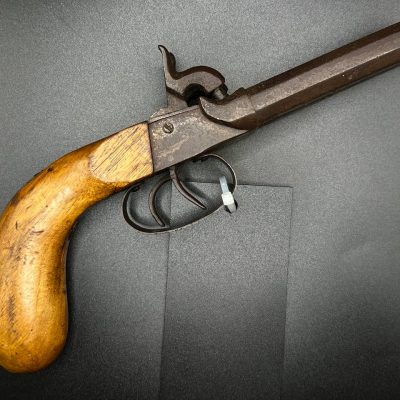
Original Victorian Era Double Barreled Percussion Coat Pistol
.40 caliber with turn-off 3 inch barrels. Overall length is a little over 8 inches.
Actions are mostly functional. The left action holds on half cock only; right action holds on half and full cock.
A good example of this early ‘concealed carry’ firearm at an attractive price.

![SS Dagger, Model 1933. (Early type). [Robert Klaas]. Stamp – I.](https://alexmp.com/wp-content/uploads/2026/09/1789683178998-9z7gm3a6syw-400x400.jpeg)
![SS Dagger, Model 1933. (with the Röhm dedication ground off). [Richard Albrecht Herder].](https://alexmp.com/wp-content/uploads/2026/09/1789683006033-1r4qka6ed64-400x400.jpeg)
![Imperial German Navy Officer’s Sword [E. & F. Horster]. Marine Corps (Seebataillon)](https://alexmp.com/wp-content/uploads/2026/09/1789686030894-wm81ct25z8n-400x400.jpeg)
![SS Dagger, Model 1933. (Early type). [Robert Klaas]. Stamp – I. SS ID Number](https://alexmp.com/wp-content/uploads/2026/09/1789683422849-4z7tl53pjc7-400x400.jpeg)
![Bayonet model 1884/1898 for the Mauser rifle model 1898. 1944 – cof 44. [Carl Eickhorn]. Unsharpened blade. Matching numbers.](https://alexmp.com/wp-content/uploads/2026/09/1789687580694-rpwqvaw6fk7-400x400.jpeg)
![SA Service Dagger (Early type). [Stöcker & Co. SMF]. Rarity 6/10](https://alexmp.com/wp-content/uploads/2026/09/1789687669012-dhjyhj17vk-400x400.jpeg)
![Officer sword of Third Reich [Carl Eickhorn]. Stamp – Ges. Gesch.. Field Marshall Series Wrangel №1693](https://alexmp.com/wp-content/uploads/2026/09/1786671590887-pgipz40tou-400x400.jpeg)
![Officer sword of Third Reich [Paul Seilheimer].](https://alexmp.com/wp-content/uploads/2026/09/1786671657509-5r9qvm0bju-400x400.jpeg)
![Officer sword of Third Reich Lion Head. [Emil Voos]. Extra eagle on the langet](https://alexmp.com/wp-content/uploads/2026/09/1786672077809-s7vyu7s3oqh-400x400.jpeg)
![Dagger of the Leader of the Technical Emergency Corps (TeNo), Model 1938 (Matching numbers). [Carl Eickhorn].](https://alexmp.com/wp-content/uploads/2026/09/1789668565848-cxuvyigzmo5-400x400.jpeg)
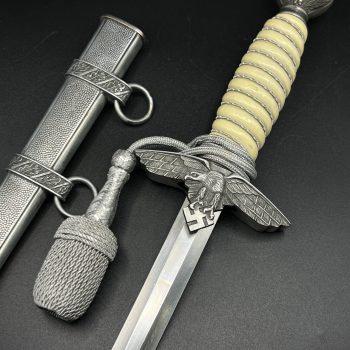
![Luftwaffe Dagger, Model 1937 (2nd Model). [FW. Höller]. Stamp – FW. Höller.](https://alexmp.com/wp-content/uploads/2026/09/1789668280335-kn7b5dmr0ys-400x400.jpeg)
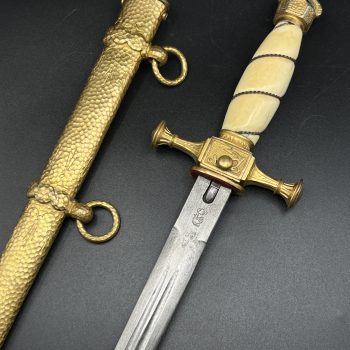
![Imperial German Navy Officer’s Dagger pre 1918 [WKC] (damascus steel blade)](https://alexmp.com/wp-content/uploads/2026/09/1789665658850-1zh5cw14spn-400x400.jpeg)
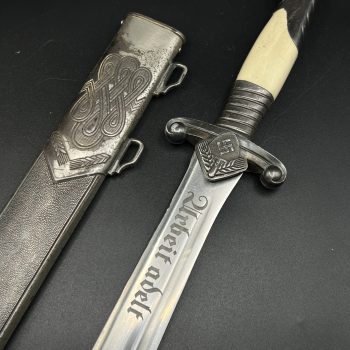
![RAD Leader Man’s Hewer [WKC].](https://alexmp.com/wp-content/uploads/2026/09/1789667956846-k7g2b9c6hj-400x400.jpeg)
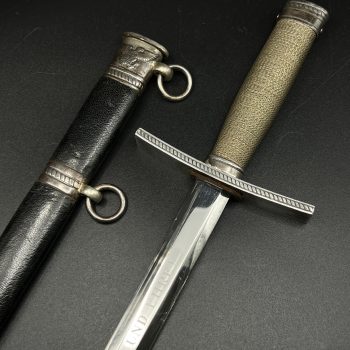
![RAD Enlisted Man’s Hewer [Edward Wusthof]. Stamp – Ges. Gesch..](https://alexmp.com/wp-content/uploads/2026/08/1786490523093-h48z7jg68gj-400x400.jpeg)