Login
Register
By clicking Login or Register, you agree that the images of Nazi symbols shown on alexmp.com are not propaganda of fascism, Nazism and are shown solely for historical, cognitive and scientific purposes.
Order a free call and our specialist will contact you shortly!
Contact us and we will get back to you shortly.
Contact us and we will get back to you shortly.
Contact us and we will get back to you shortly.
Contact us and we will get back to you shortly.
Error: Contact form not found.
We will get back to you shortly.
В честь запуска Энциклопедии мы рады предложить вам бесплатный доступ до 01.10.2026.
Будем рады вашим комментариям и предложениям!
Inspected and guaranteed by Alex Warstory.
For more details on AlexMP Guarantee, click [HERE]
Item guaranteed by a verified dealer.
Click [HERE] for full seller guarantee terms.
Sold without expert review or guarantees. No claims accepted post-sale.
Learn more [HERE]


Showing 49–64 of 179 results
FiltersA true “calling card” of the German soldier during World War II, this bayonet model 1884/1898 was designed to accompany the legendary Mauser Gewehr 98 rifle. The modernized variant of the S84/98 model was mass-produced by the German arms industry and remained in service with the Wehrmacht throughout the entire period of World War II. This particular example dates to 1944, as evidenced by the “crs 44” marking belonging to the renowned manufacturer P. Weyersberg.
Matching serial numbers on the blade and scabbard confirm the original factory pairing since the time of manufacture; the corresponding markings indicate that these components have never been separated since leaving the production line. Such examples are encountered considerably less frequently due to combat losses and postwar reassembly, when bayonets and scabbards were often rematched from disparate parts. This is precisely why specimens with preserved matching numbers possess substantially higher collectible value and are of particular interest to serious collectors of military antiques.
A quintessential “calling card” of the German soldier during World War II, this bayonet model 1884/1898 represents a modernized variant of the S84/98, designed specifically to complement the legendary Mauser Gewehr 98 rifle. Manufactured in 1941 at the Jos Corts production facilities (marked ddl 41), this specimen was mass produced by the German arms industry and remained in service with the Wehrmacht throughout the entire Second World War period.
This particular example derives special collector value from its matching serial numbers, with corresponding markings on both the blade and scabbard, confirming their original pairing since the time of manufacture. Such bayonets are encountered considerably less frequently due to combat losses and postwar reassembly, when original sets were separated and mixed. The preservation of matching numbers indicates that the blade and scabbard have traveled their entire journey together, which substantially increases the appeal of this lot to serious collectors of military antiques.
A legendary bayonet that became the true “signature weapon” of the German soldier during World War II. This modernized variant of the S84/98 bayonet was created specifically for use with the Mauser Gewehr 98 rifle and was mass-produced by the German weapons industry, remaining in service with the Wehrmacht throughout the entire war period.
The Berg&Co 39 marking indicates that the bayonet was manufactured in 1939. This particular date adds special value to the specimen: the year marking the beginning of World War II makes examples with such markings especially sought after among collectors.
The manufacturer, Berg & Co, was a German firm specializing in the production of edged weapons and bayonets in the late 19th and early 20th centuries. The company was located in Solingen, the traditional center of weapons manufacturing in Germany. The Berg & Co marking is found predominantly on bayonets produced under contract for the military department.
The blade was sharpened in field conditions to provide the bayonet with additional combat or utility functions, as most German bayonets were issued without factory sharpening and were intended primarily for thrusting. In the ground forces, such sharpening was officially prohibited. However, excavation results from former Luftwaffe positions show that bayonets with sharpened blades are found quite frequently, indicating the widespread practice of such field modifications among Luftwaffe personnel, particularly in paratrooper units.
Matching numbers on the blade and scabbard confirm their original pairing from the time of manufacture. Such specimens are encountered considerably less frequently due to combat losses and postwar reassembly, which significantly increases the collectible value of this example.
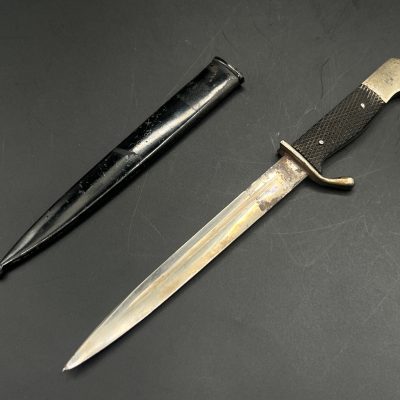
An elegant miniature replica of a dress bayonet, executed with meticulous attention to all structural elements of the original pattern. This item belongs to the category of collectible edged weapon miniatures, traditionally created as commemorative or presentation pieces, as well as for augmenting private collections.
Of particular interest is the scabbard, adorned with an engraved image, which lends this specimen an individual character and distinguishes it among standard miniaturs. Such decorative elements are encountered infrequently and substantially enhance the collectible value of the piece.
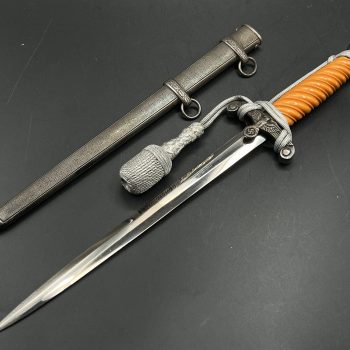
Officially introduced on 4 May 1935 simultaneously with the restoration of the German armed forces, this dagger was intended for officers of the Army (Heer) and served as an integral part of dress and walking-out uniform. It was worn with the appropriate officer’s uniform and quickly became one of the main symbols of the Wehrmacht officer corps. The dagger was authorized for officers of all branches of the land forces, including general officers, and its production continued until 1942. Due to this lengthy manufacturing period, the Army dagger model 1935 became the most widely produced German officer’s dagger of the Third Reich era and remains today one of the most popular categories for collectors of German edged weapons.
The fittings made of nickel silver (German silver) are characteristic of early examples, typically manufactured prior to 1936. This specimen was crafted by the firm Gustav C. Spitzer. Owing to their limited production runs, high quality of manufacture, and distinguished appearance, such pieces are traditionally valued by collectors more highly than their later counterparts.
This dagger was officially introduced on 4 May 1935, coinciding with the restoration of Germany’s armed forces. Intended for officers of the Army (Heer), it served as part of the dress and walking-out uniform and was worn with the corresponding officer’s attire. The dagger quickly became one of the principal symbols of the Wehrmacht officer corps. It was worn by officers of all branches of the ground forces, including general officers, and production continued until 1942. Due to this extended manufacturing period, the Army dagger became the most widely produced German officer’s dagger of the Third Reich era and remains today one of the most popular areas of German edged weapons collecting.
The fittings made of nickel silver (German silver) are characteristic of early examples, typically manufactured before 1936. Owing to their limited production numbers, superior craftsmanship, and distinguished appearance, such pieces are traditionally valued by collectors more highly than their later counterparts.
The Carl Eickhorn company was founded in Solingen in 1865 and became one of the largest edged weapons manufacturers in Germany. The trademark featuring a squirrel (Eichhörnchen) served as a guarantee of the highest quality products. During the Third Reich period, the firm produced a wide range of regulation edged weapons: daggers for all branches of service, SA, SS, NPEA, NSFK, and TeNo daggers, as well as dress daggers, sabres, and swords. Carl Eickhorn products are distinguished by superb steel quality and meticulous finishing, and they are highly prized by modern collectors.
Officially introduced on 4 May 1935 concurrently with the restoration of Germany’s armed forces, this dagger was intended for officers of the Army (Heer) and served as part of the dress and walking-out uniform, worn with the appropriate officer’s attire. The dagger quickly became one of the principal symbols of the Wehrmacht officer corps. It was worn by officers of all branches of the ground forces, including general officers, and production continued until 1942. Due to the extended period of manufacture, the Army dagger became the most widely produced German officer’s dagger of the Third Reich era and remains today one of the most popular collecting categories for German edged weapons.
The fittings made of nickel silver (German silver) are characteristic of early examples, generally produced before 1936. The present specimen was manufactured by the renowned Solingen firm Anton Wingen Jr. Owing to their limited production numbers, high quality of craftsmanship, and distinguished appearance, such pieces are traditionally valued by collectors more highly than their later counterparts.
The official introduction of this pattern took place on 4 May 1935, coinciding with the restoration of Germany’s armed forces. The dagger was intended for officers of the Army (Heer) and constituted an integral component of dress and walking-out uniform, worn with the corresponding officer’s attire. Having quickly acquired the status of one of the principal symbols of the Wehrmacht officer corps, it was carried by officers of all branches of the land forces, including general officers. Production continued until 1942, making the Army dagger the most widely produced German officer’s dagger of the Third Reich period. Today it remains one of the most popular collecting areas within German edged weapons.
The fittings are executed in nickel silver (German silver) by the craftsmen of the firm Gebr Heller, characteristic of early examples generally manufactured prior to 1936. Owing to limited production runs, superior manufacturing quality, and distinguished appearance, such pieces are traditionally valued by collectors more highly than their later counterparts.
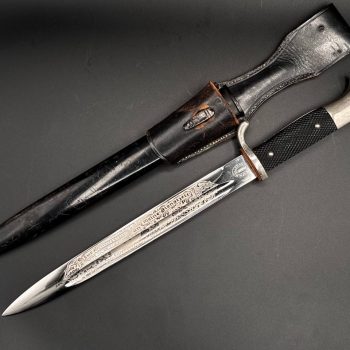
Wehrmacht dress bayonet complete with scabbard and frog. The blade is decorated with high-quality etching featuring the inscription “Zur Erinnerung an meine Dienstzeit” (“In Memory of My Service”), depictions of military equipment, and floral ornamentation. On one side of the blade ricasso, the manufacturer’s mark of F.W. Höller, Solingen is present, accompanied by the company’s trademark thermometer logo; the opposite side bears the retailer’s marking “Robert Kappe, Magdeburg.” The grip is crafted from black Bakelite with characteristic diamond-pattern checkering, and the fittings are nickel-plated. The grip backstrap is fitted with a red velvet insert.
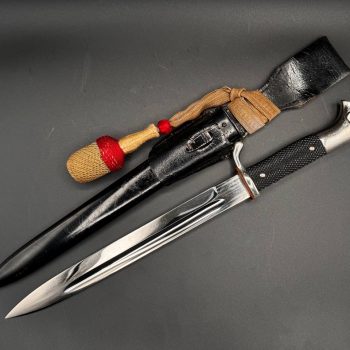
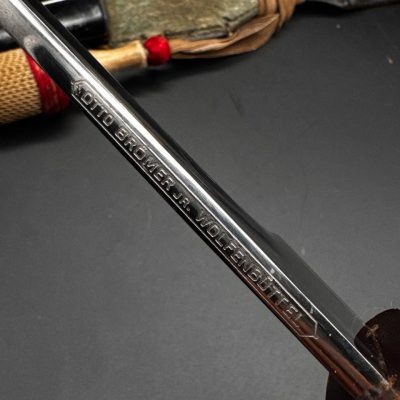
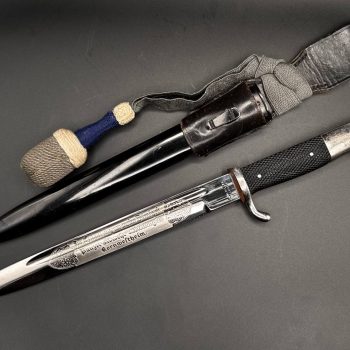
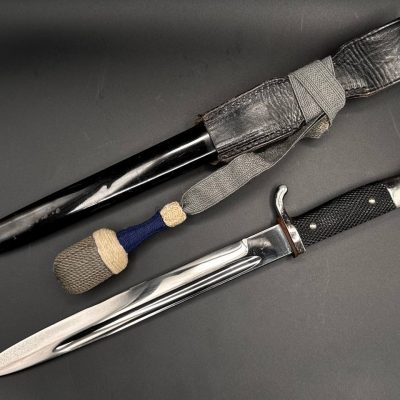
Wehrmacht dress bayonet complete with metal scabbard, leather frog, and sword knot. The blade, featuring two fullers, is adorned with high-quality etching bearing the inscription “Zur Erinnerung an meine Dienstzeit Panzer-Abwehr-Abteilung 25 Kornwestheim” (“In memory of my service in the 25th Anti-Tank Battalion, Kornwestheim”). The etching is framed by ornamental cartouches depicting the Imperial Eagle and an anti-tank gun. The blade ricasso bears the mark “Joh. Hiller Bad Cannstatt”. The grip is crafted from black Bakelite with characteristic diamond-pattern checkering; metal fittings are nickel-plated. This set holds considerable historical value due to its clear association with a specific military unit.
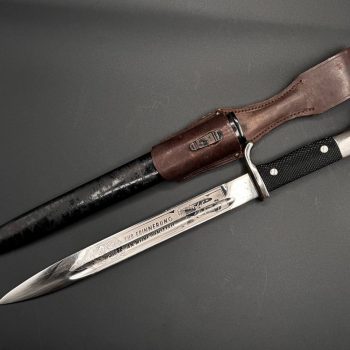
Dress bayonet knife complete with metal scabbard and leather frog. The double-edged blade features fullers and is decorated with high-quality etching depicting aviation themes: a Luftwaffe aircraft with fuselage code and the commemorative inscription “Zur Erinnerung an meine Dienstzeit” (“In Memory of My Service”). The grip is made of black Bakelite with characteristic diamond-pattern checkering; metal fittings are nickel-plated. The blade ricasso bears the manufacturer’s mark “Siegfried Waffen, E. Pack & Söhne, Solingen” featuring the figure of Siegfried. This specimen is of particular collector interest due to the rare aviation-themed etching.
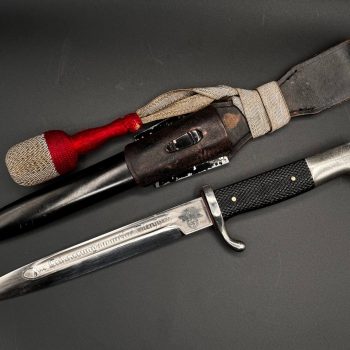
Wehrmacht dress bayonet-knife, complete with scabbard, leather frog, and sword knot with red tassel. The double-edged blade features fullers and is decorated with high-quality etching: one side displays the Imperial Eagle with swastika and a Gothic script inscription “Zur Erinnerung an meine Dienstzeit” (“In Memory of My Service”); the etching bears the marking “Ges. Gesch.” (registered design). The grip is executed with characteristic diamond-pattern checkering, secured with brass rivets. The blade ricasso bears a clear manufacturer’s mark of Robert Klaas, Solingen, featuring the company’s emblem.
Wehrmacht dress bayonet with a blade decorated with deep etching. One side of the blade features a composition with the Wehrmacht eagle on a swastika, the inscription ‘Zur Erinnerung an meine Dienstzeit’ (‘In Memory of My Service’), military trophies (helmet, rifles, bayonet in an oak wreath), and a waving banner. The blade ricasso bears the manufacturer’s mark of C. Eickhorn, Solingen (squirrel with letters). The handle features Bakelite grip scales with characteristic diamond checkering; the metal fittings are nickel plated. Accompanied by original scabbard with frog and knot (white and red).
A Wehrmacht dress bayonet, complete with metal scabbard and leather frog. The grip is crafted from genuine stag horn with characteristic texture, secured by nickel-plated fittings. The blade features elaborate acid etching depicting an imperial eagle with swastika, oak leaves, and the inscription ‘Zur Erinnerung an meine Dienstzeit’ (‘In Memory of My Service’). The blade ricasso bears the manufacturer’s mark of Original Eickhorn Solingen with the squirrel emblem, as well as the retail marking of Militärwarenhaus Dürbeck, Wien IX, indicating sale through the Viennese military goods store following the Anschluss of Austria.
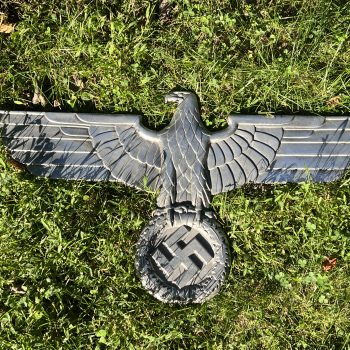
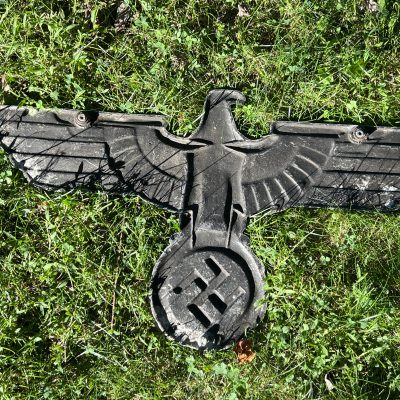
A large original Deutsche Reichsbahn (German State Railways) eagle from the Third Reich period. The eagle is depicted with outstretched wings, clutching a wreath bearing a swastika in its talons. The piece features strong three-dimensional relief, with detailed feathering and wing construction.
The reverse retains stamped/raised manufacturer or production markings, as well as original mounting hardware. The eagle displays an attractive period patina with surface wear, oxidation, scratches, and traces of finish loss consistent with its age and history.
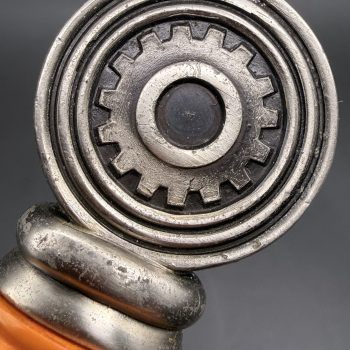
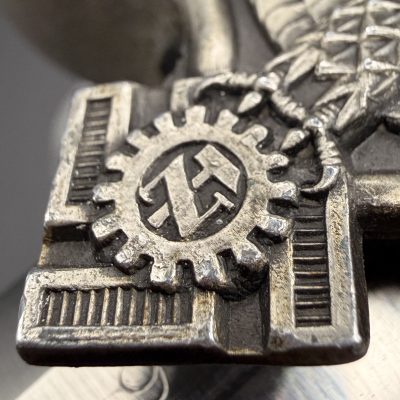
Technical Emergency Corps (TeNo) Leader’s Dagger, Model 1938, manufactured by Carl Eickhorn of Solingen. This example bears the manufacturer’s trademark and retains matching numbers on the blade and scabbard, confirming their factory pairing and attesting to the complete original preservation of the piece.
This dagger model was introduced in November 1938, concurrently with the adoption of new regulation edged weapons for the TeNo organization. It was intended to be worn with dress uniform by commanding officers holding the rank of Stabsscharführer and above. Officers purchased these daggers at their own expense through special organizational outlets.
The history of the Technical Emergency Corps began on September 30, 1919. Throughout the existence of the Weimar Republic, the corps repeatedly distinguished itself, demonstrating efficiency and excellent technical training. Naturally, this organization could not escape the attention of the new leadership, the National Socialist Party. In 1939, to further enhance efficiency, TeNo was transferred to the jurisdiction of the Reich Ministry of Foreign Affairs and subordinated to police structures, allowing for improved operational capacity. Prior to the commencement of the Polish campaign, TeNo was commanded by SS Gruppenführer (SS Lieutenant General) Schmelzer; he was later succeeded in this post by SS Gruppenführer Weinreich.
The Carl Eickhorn company was founded in Solingen in 1865 and became one of the largest manufacturers of edged weapons in Germany. The company’s trademark, featuring a squirrel (Eichhörnchen), served as a guarantee of the highest quality products. During the Third Reich period, the firm produced a wide range of regulation edged weapons, including daggers for all branches of service, SA and SS daggers, NPEA, NSFK, and TeNo daggers, as well as dress daggers, sabers, and swords. Carl Eickhorn products are distinguished by superior steel quality and meticulous finishing, and are highly valued by modern collectors.
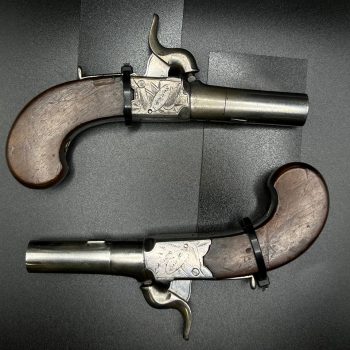
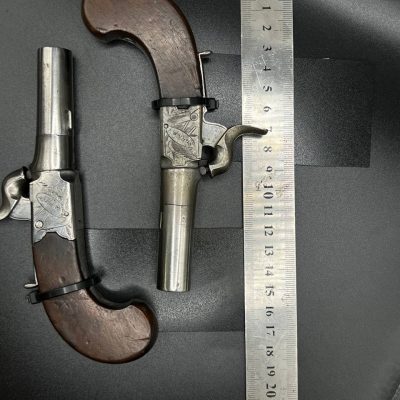
Pair of English Drop Trigger Percussion Pistols Marked H Nock.
Marked with one of England’s premier makers of the period, these guns are likely the fake watches of their day. Both guns are in nice condition with engraved frames and slab butts with vacant silver escutcheons.
Both actions, including push-on safeties, function without problems.
Overall length approximately 5 7/8 inches, with twist off barrels, standard British proofs.
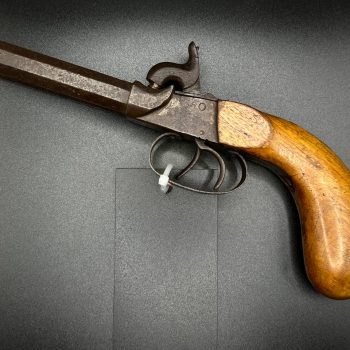
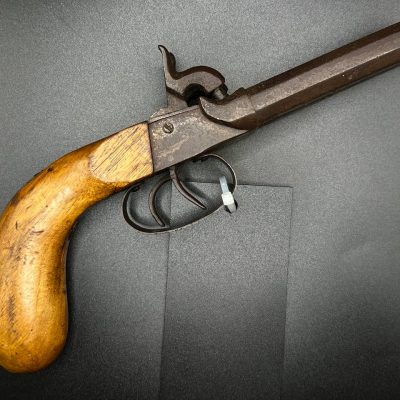
Original Victorian Era Double Barreled Percussion Coat Pistol
.40 caliber with turn-off 3 inch barrels. Overall length is a little over 8 inches.
Actions are mostly functional. The left action holds on half cock only; right action holds on half and full cock.
A good example of this early ‘concealed carry’ firearm at an attractive price.

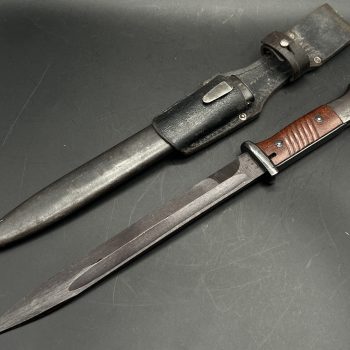
![Mauser rifle bayonet (1934-1945). 1944 – crs 44. [P. Weyersberg]. Matching numbers.](https://alexmp.com/wp-content/uploads/2026/08/1786373179110-p4pf7ebnlkk-400x400.jpeg)
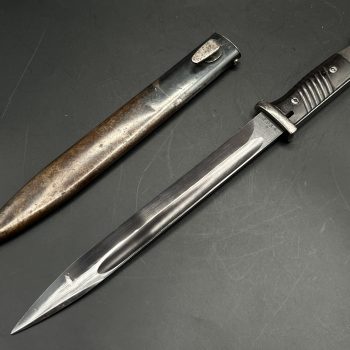
![Mauser rifle bayonet (1934-1945). 1941 – ddl 41. [Jos Corts]. Matching numbers.](https://alexmp.com/wp-content/uploads/2026/08/1786372998080-bkxb01h38ts-400x400.jpeg)
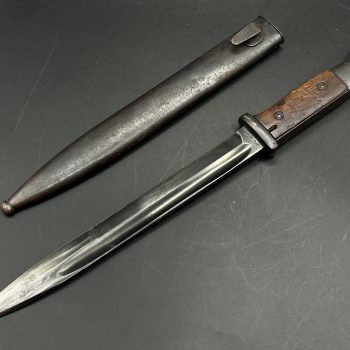
![Mauser rifle bayonet (1934-1945). 1939 – Berg&Co 39. [Berg & Co]. Sharpened blade. Matching numbers.](https://alexmp.com/wp-content/uploads/2026/08/1786372862738-vfcy039rcte-400x400.jpeg)
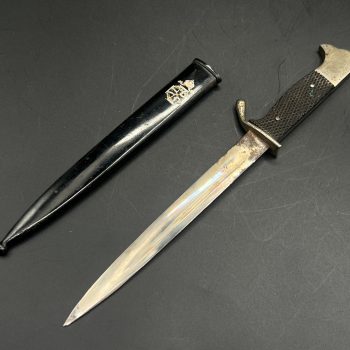
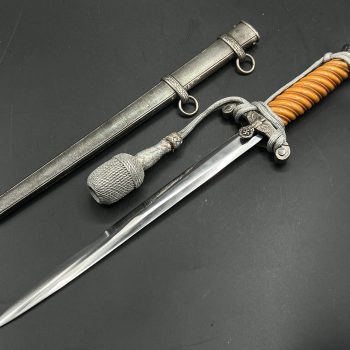
![German Army Dagger, Model 1935 (nickel-silver fittings). [Gustav C. Spitzer].](https://alexmp.com/wp-content/uploads/2026/08/1786283399870-s46108nq9z-400x400.jpeg)
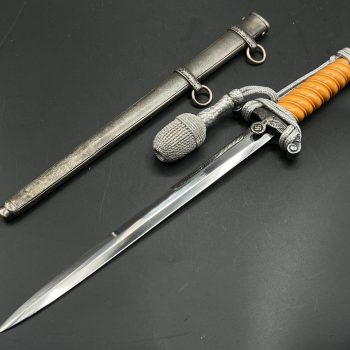
![German Army Dagger, Model 1935 (nickel-silver fittings). [Carl Eickhorn].](https://alexmp.com/wp-content/uploads/2026/08/1786282888986-eaqghbvlk6p-400x400.jpeg)
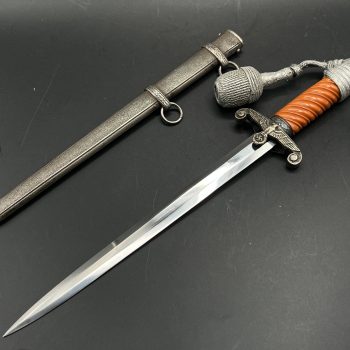
![German Army Dagger, Model 1935 (nickel-silver fittings). [Anton Wingen Jr].](https://alexmp.com/wp-content/uploads/2026/08/1786282483207-z308rppddc8-400x400.jpeg)
![German Army Dagger, Model 1935 (nickel-silver fittings). [Gebr Heller].](https://alexmp.com/wp-content/uploads/2026/08/1786282115364-u3256i4be47-400x400.jpeg)
![Etched Bayonet. [FW. Höller].](https://alexmp.com/wp-content/uploads/2026/08/1785959762436-cd6pk6twrcq-400x400.jpeg)
![Etched Bayonet. [E.P.&S.].](https://alexmp.com/wp-content/uploads/2026/08/1785959620748-lwesd7pxp28-400x400.jpeg)
![Etched Bayonet. [Robert Klaas]. Stamp – Robert Klaas.](https://alexmp.com/wp-content/uploads/2026/08/1785959531766-76hxrlh77lx-400x400.jpeg)
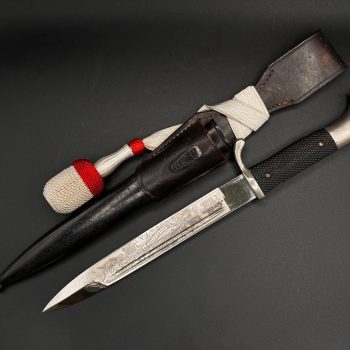
![Etched Bayonet. [Carl Eickhorn].](https://alexmp.com/wp-content/uploads/2026/08/1785959474943-g4gs6iktz7d-400x400.jpeg)
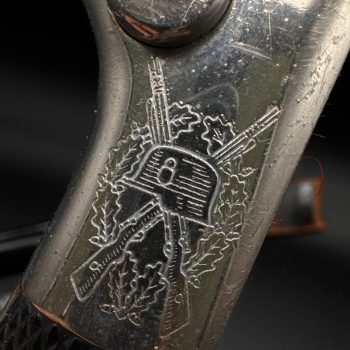
![Etched Bayonet. [Carl Eickhorn].](https://alexmp.com/wp-content/uploads/2026/08/1785958500787-zyrekcgcvh-400x400.jpeg)
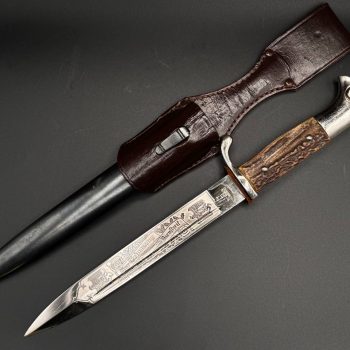
![Etched Bayonet. [Carl Eickhorn].](https://alexmp.com/wp-content/uploads/2026/08/1785958423878-1aqyjmxonwh-400x400.jpeg)