Login
Register
By clicking Login or Register, you agree that the images of Nazi symbols shown on alexmp.com are not propaganda of fascism, Nazism and are shown solely for historical, cognitive and scientific purposes.
Order a free call and our specialist will contact you shortly!
Contact us and we will get back to you shortly.
Contact us and we will get back to you shortly.
Contact us and we will get back to you shortly.
Contact us and we will get back to you shortly.
Error: Contact form not found.
We will get back to you shortly.
В честь запуска Энциклопедии мы рады предложить вам бесплатный доступ до 01.10.2026.
Будем рады вашим комментариям и предложениям!
Inspected and guaranteed by Alex Warstory.
For more details on AlexMP Guarantee, click [HERE]
Item guaranteed by a verified dealer.
Click [HERE] for full seller guarantee terms.
Sold without expert review or guarantees. No claims accepted post-sale.
Learn more [HERE]


Showing 33–48 of 179 results
FiltersThe legendary S84/98 bayonet is one of the most recognizable symbols of the German soldier during World War II. Representing a further development of the earlier S84/98 model, it was adopted as the standard bayonet for the Mauser Karabiner 98k carbine and was mass-produced by the German weapons industry. Due to its widespread distribution, this bayonet remained in service with the Wehrmacht throughout World War II and today represents one of the most popular areas of German edged weapons collecting.
This 1940-dated example is of particular interest from an attribution standpoint. WKC bayonets from this period are characterized by the existence of two marking variants: early in the year, blades were produced with the traditional WKC company trademark; however, the manufacturer later transitioned to the letter code “cvl,” introduced as part of a system of anonymous manufacturer designations aimed at limiting the identification of military contractors. Thus, both variants date to 1940 and reflect a transitional period in the marking system of the German weapons industry, presenting additional interest for collectors.
The manufacturer WKC (Weyersberg, Kirschbaum & Cie) is rightfully considered one of the oldest and most prestigious weapons manufacturers in Solingen. Founded in 1883 through the merger of two renowned workshops, the company was the largest supplier of bayonets to the German army from the late 19th century onward, producing a wide range of models from Mauser rifle bayonets to dress examples.
The collectible appeal of this example is substantially enhanced by the fact that the blade was never sharpened. Bayonets with unsharpened blades are of particular value to collectors, as they indicate minimal combat use or depot storage of the item. The absence of resharpening marks preserves the original blade geometry, which significantly increases the collectible value of the specimen.
The S84/98 bayonet is one of the most recognizable symbols of the German soldier during the Second World War. Representing a further development of the earlier S84/98 model, it was adopted as the standard bayonet for the Mauser Karabiner 98k carbine and was mass-produced by the German arms industry. Due to its widespread use, this bayonet remained in service with the Wehrmacht throughout the Second World War and today represents one of the most popular collecting areas for German edged weapons.
The “ffc 43” marking indicates that the bayonet was manufactured in 1943 at the Friedrich Herder Abr. Sohn factory in Solingen, which operated under a code designation within the Third Reich’s military secrecy system. This period is characterized by mass production of K98k bayonets for Wehrmacht requirements under conditions of total war. The “ffc” stamp belongs to the three-letter production codes introduced by the German military authority to conceal information about the locations of defense enterprises.
F. Herder A. Sn. (full name Friedr. Herder Abraham Sohn) is a renowned German cutlery manufactory from Solingen, founded in 1727. The company was one of the largest edged weapons manufacturers in Germany, fulfilling state contracts for bayonet production for the Prussian and subsequently the German army.
The blade of this example has not been sharpened, which is of particular value to collectors as it indicates minimal combat use or warehouse storage. The absence of resharpening marks preserves the original blade geometry, substantially increasing the collectible value of the specimen.
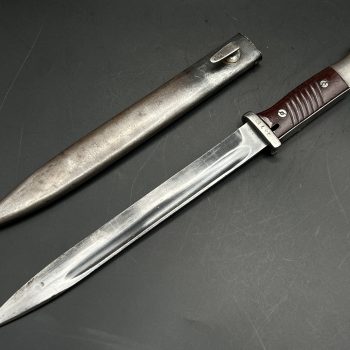
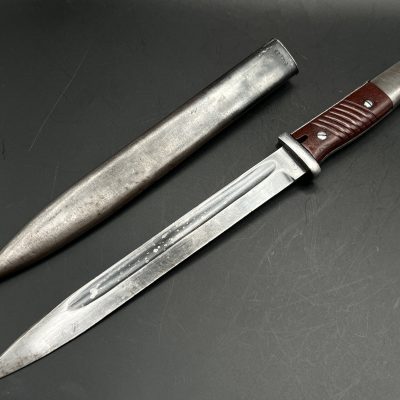
Model 1884/98 bayonet for the Mauser K98k carbine, complete with metal scabbard. The handle features Bakelite grips with characteristic checkering. The blade is single-edged with a fuller; the ricasso bears serial number 9259 and the letter code ‘k’. The pommel displays Wehrmacht military acceptance stamps WaA253 and WaA268. The metal scabbard has a ball-shaped tip, with markings on the throat including the ‘1937’ production year designation. The bayonet is in good collectible condition with age-appropriate patina.
A true “calling card” of the German soldier during World War II, this bayonet represents a modernized variant of the S84/98 model, created specifically for use with the Mauser Gewehr 98 rifle. Mass-produced by the German weapons industry, it remained in service with the Wehrmacht throughout the entire period of World War II.
The “ddl 42” marking on the blade definitively identifies this bayonet as a 1942 production item, manufactured at the Jos Corts facility in Solingen. This production code belongs to the coding system used by German military enterprises during World War II. Bayonets bearing this marking were produced for arming K98k carbines and represent significant collecting interest as examples of mass military production of the Third Reich.
The Jos Corts company was located in Solingen, the traditional center of German blade manufacturing with centuries of history. The company specialized in the production of edged weapons and bayonets, supplying products for the needs of the German army in the late 19th and first half of the 20th century. The “Jos Corts” marking is found on bayonets of various models, including bayonets for Mauser rifles, and is considered relatively rare among collectors, which adds additional appeal to this particular example.
A legendary “calling card” of the German soldier during World War II, this is a modernized variant of the S84/98 bayonet, created specifically for the famous Mauser Gewehr 98 rifle. This edged weapon was mass-produced by the German arms industry and remained in service with the Wehrmacht throughout the entire period of World War II.
The marking “fnj 43” on the blade indicates that the bayonet was manufactured in 1943 at the Alexander Coppel GmbH factory located in Solingen. The letter code “fnj” served as the secret designation for the enterprise within the Wehrmacht coding system, which in itself is of interest to military history researchers. This period is characterized by the mass production of K98k bayonets for the needs of the Eastern Front, where the demand for weapons was particularly acute. It should be noted that the serial numbers on the bayonet’s components do not match, indicating assembly from parts of different origins (a practice characteristic of wartime production) and lending the specimen additional collector’s uniqueness.
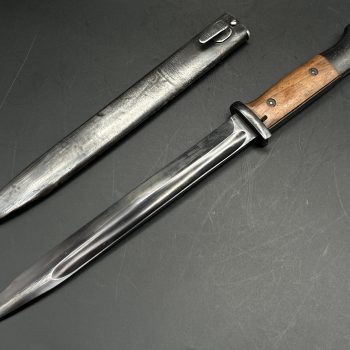
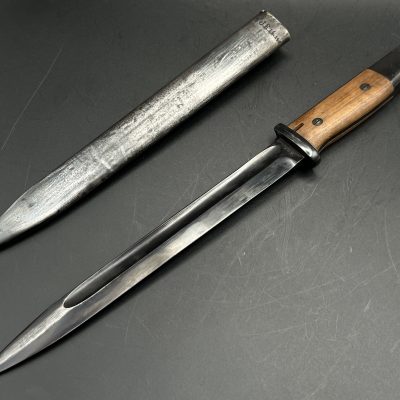
Model 1884/98 bayonet for the Mauser 98k rifle, complete with metal scabbard. The grip is fitted with walnut wood scales, secured by two screws. The blade ricasso bears the manufacturer’s mark “crs” (E. & F. Hörster, Solingen). The pommel is stamped with the acceptance mark “25u”. The scabbard is engraved with the regimental marking “J.R.14” (14th Infantry Regiment), indicating the bayonet’s assignment to a specific Wehrmacht military unit. The single-edged blade features a characteristic fuller and retains its original polish.
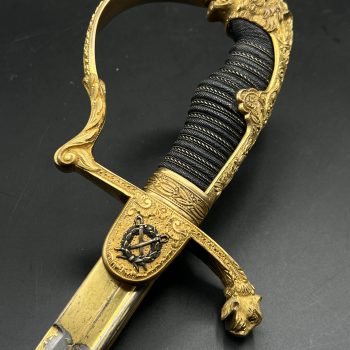
Cavalry edged weapons of the German Empire were intended for officers and enlisted men of dragoon, cuirassier, uhlan, hussar, and other cavalry regiments, remaining in service until the end of the First World War in 1918. This category includes sabers, pallasches, and other examples of bladed weapons that formed an integral part of German cavalry equipment. The presented German saber, dating to before 1918, serves as an excellent example of officer armament from the Imperial period.
The most distinctive feature of many officer cavalry sabers is the pommel in the form of a lion’s head, one of the most recognizable symbols of German edged weapons from the Imperial period. This model gained widespread use in German armies of the 19th century, particularly among cavalry and infantry officers, and to this day remains a desirable acquisition for serious collectors.
The firm M. Neumann, Berlin was a German supplier of military equipment and edged weapons in the late 19th and early 20th centuries. The enterprise was located in Berlin and supplied sabers, pallasches, bayonets, and other military items for the German army, earning a reputation as a reliable manufacturer of quality officer weapons.
A coat of arms on the blade or hilt of a German saber indicates that the weapon belonged to a member of a noble house or aristocratic family. Such examples were made to individual order and were frequently embellished with a motto, initials, or a crown of the appropriate rank. The presence of a family coat of arms significantly enhances the historical and collectible value of the piece, as in certain cases it allows identification of the specific owner and tracing of the weapon’s provenance.
The blade is forged from Damascus steel and decorated with ornamental etching and gilding. This combination of materials and techniques is characteristic of the most prestigious examples of ceremonial and presentation edged weapons, making this specimen particularly attractive to discerning connoisseurs of German military antiques.
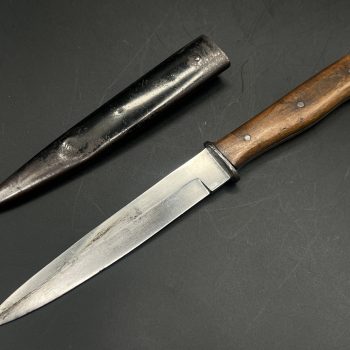
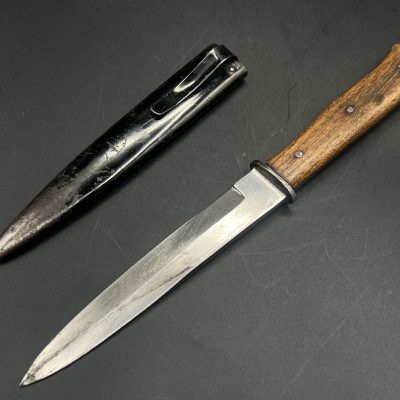
The Nahkampfmesser combat knife, Model 1942, was officially adopted by the German armed forces in 1942. It was intended for use by military personnel across various branches of service and was distinguished by its simple, robust, and technologically efficient design.
Unlike ceremonial edged weapons, the Nahkampfmesser was an exclusively utilitarian item. It served as a combat knife, a tool for fieldwork, and an element of the soldier’s individual equipment.
The Nahkampfmesser was manufactured by numerous German enterprises; however, maker’s marks on the blades are encountered extremely rarely.
During excavations at Second World War battle sites, Nahkampfmesser knives are regularly discovered both along the lines of direct combat engagement and among the personal effects of military personnel. However, examples in good or excellent condition are extremely rare, as these knives continued to be widely used by the civilian population after the war, resulting in significant wear and loss of their original condition.
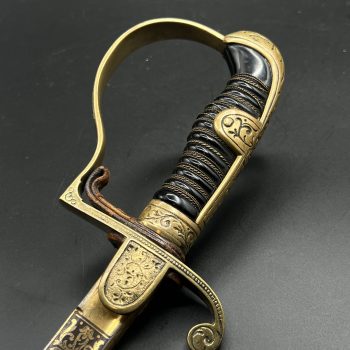
Honorary Award Sabre “For Outstanding Achievements in Marksmanship” ranks among the most prestigious state awards of Germany in the period before 1939. Such sabres were presented to military personnel for outstanding results in marksmanship training and represented not a prize for placing in competition, but rather the sole honorary award for the best marksman of the competition. Unlike most richly decorated ceremonial sabres manufactured through private commissions, these blades were official state award weapons. Each was associated with a specific award presentation, making such items considerably rarer and more valuable to collectors. The tradition of such awards existed during the Reichswehr era and continued into the Wehrmacht period. OKW sabres were produced from 1935 to 1937 without the swastika, and from 1938 a new variant appeared featuring an eagle on the crossguard. All award sabres of this type were manufactured exclusively with Damascus steel blades. The blades featured rich etched ornamentation as well as inscriptions indicating the name, rank, and type of weapon with which outstanding results were demonstrated. Depending on the manufacturer and production period, the design could vary slightly. A common characteristic of original examples is also the presence of military acceptance stamps confirming their official state origin.
The year of the sabre’s production (1930) is attested by corresponding markings on the blade. Thus, this example dates to the Reichswehr period and was manufactured before the establishment of the Wehrmacht.
The manufacturer was WKC (Weyersberg, Kirschbaum & Cie), one of the oldest and most respected arms manufactories in Solingen, founded in 1883 through the merger of two historic production facilities. The company was a major supplier of edged weapons for the German army, producing army daggers and sabres of the highest quality bearing their distinctive mark. WKC products were distinguished by superb blade finishing, impeccable polishing, and precise conformity to regulation patterns, making them particularly valuable to collectors.
Officially established on 10 March 1935 alongside the creation of the German Air Force, this dagger was intended for Luftwaffe career personnel in accordance with the established uniform regulations and represented the first official edged weapon of the new branch of the armed forces. Notably, the dagger’s design was based on the earlier Deutscher Luftsportverband (DLV) dagger, the German Air Sports Association, which in the early 1930s effectively served as a cover organization for training future Luftwaffe personnel. For this reason, the early Luftwaffe dagger retained many features of the DLV dagger and is considered a transitional model in the development of German aviation edged weapons.
The fittings made of nickel silver (German silver) are characteristic of early examples, typically manufactured before 1936. Due to limited production runs, high manufacturing quality, and distinguished appearance, such pieces are traditionally valued by collectors more highly than later variants.
The manufacturer was Stöcker & Co. SMF, a German metalworking company from Solingen that specialized in producing edged weapons for aviation organizations of the Third Reich. The firm produced daggers for the DLV, NSFK, and Luftwaffe, distinguished by the high quality of their blades and fittings. The blade bears the characteristic “SMF” mark, confirming the item’s origin.
Officially established on 10 March 1935 concurrently with the creation of the German Air Force, this dagger was intended for Luftwaffe career personnel in accordance with the established uniform regulations and represented the first official edged weapon of the new branch of the armed forces. Notably, the dagger’s design was based on the earlier Deutscher Luftsportverband (DLV) dagger, the German Air Sports Association, which in the early 1930s effectively served as a cover organization for training future Luftwaffe personnel. For this reason, the early Luftwaffe dagger retained many features of the DLV dagger and is considered a transitional model in the development of German aviation edged weapons.
Manufactured by Stöcker & Co., a German metalworking company from Solingen that produced edged weapons for aviation organizations of the Third Reich. The company specialized in the production of daggers for the DLV, NSFK, and Luftwaffe, distinguished by the high quality of their blades and fittings. Items were marked with the “SMF” stamp; this specimen belongs to the first model of daggers produced by this manufacturer.
A Luftwaffe officer’s dagger, Model 1937, complete with metal scabbard. The grip is crafted from white plastic featuring characteristic spiral fluting wrapped with twisted wire. The spherical pommel is adorned with a relief depiction of oak leaves with a gilded swastika at the center. The crossguard is designed in the form of a flying eagle clutching a swastika in its talons. The blade is steel, double-edged, with a diamond-shaped cross-section. The metal scabbard is fitted with two hanging bands with suspension rings, decorated with an oak leaf ornament. The scabbard tip is embellished with a relief depiction of oak leaves.
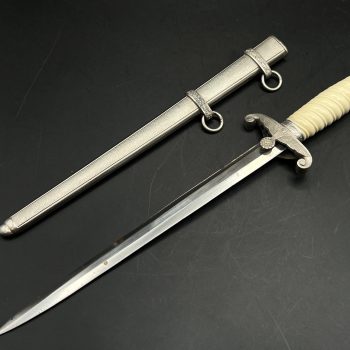
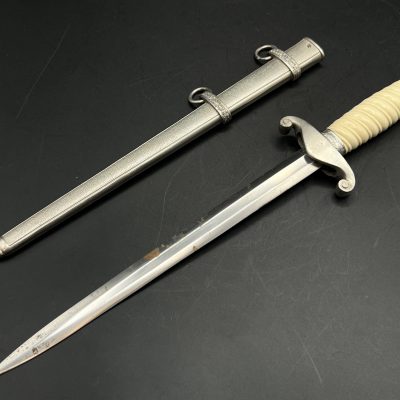
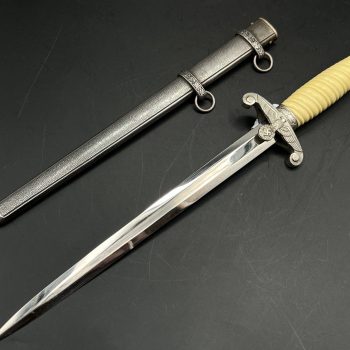
A Wehrmacht Army officer’s dagger, Model 1935, complete with metal scabbard. The grip is crafted from white celluloid featuring characteristic spiral fluting. The crossguard is adorned with a relief depiction of the Wehrmacht eagle with outstretched wings, clutching a swastika within an oak wreath. The pommel and guard ferrule are decorated with engraved oak leaf ornamentation. The metal scabbard has a textured surface and is fitted with two suspension rings featuring ornamented fittings. The blade displays traces of patina.
Officially introduced on 4 May 1935 alongside the restoration of the German armed forces, this dagger was intended for officers of the Army (Heer) and served as an essential part of dress and walking-out uniform. The example presented here was manufactured by the firm Carl Julius Krebs. The dagger quickly became one of the principal symbols of the Wehrmacht officer corps and was worn with the appropriate officer’s uniform. It was used by officers of all branches of the ground forces, including general officers, and production continued until 1942. Owing to this extended period of manufacture, the Model 1935 Army dagger became the most widely produced German officer’s dagger of the Third Reich era and remains today one of the most popular areas of collecting German edged weapons.
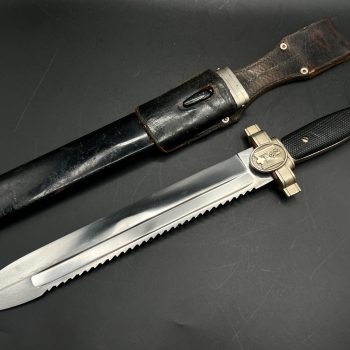
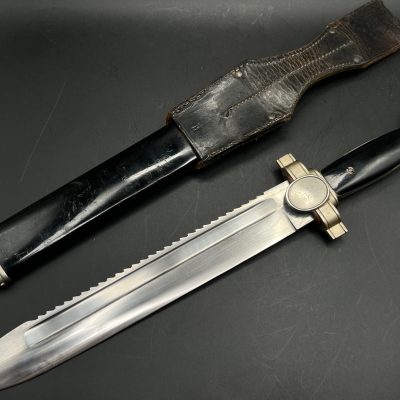
A regulation edged weapon for non-commissioned officers of the DRK (Deutsches Rotes Kreuz) organization, representing a characteristic example with a blade featuring a saw back and a combat tip of specific form. The hanger was introduced following the large-scale reorganization of the German Red Cross in 1937 and the subsequent integration of the organization into the state structure of the Third Reich under the control of the Ministry of Internal Affairs. Official adoption occurred in 1938, which is reflected in the Nazi symbolism present in the design of this example.
The marking “Ges. Gesch.” stamped on the item is an abbreviation of the German “Gesetzlich Geschützt” (“Protected by Law”) and indicates patent protection of the object or its individual elements within German territory. Such markings were widely used on edged weapons of the Third Reich, predominantly on daggers and dirks of party and paramilitary organizations, denoting patented design solutions for hilts, scabbards, or decorative elements. The presence of the original marking attests to the authenticity of the item and its manufacture during the period when German patent legislation was in effect; this constitutes an important attribution criterion for collectors.
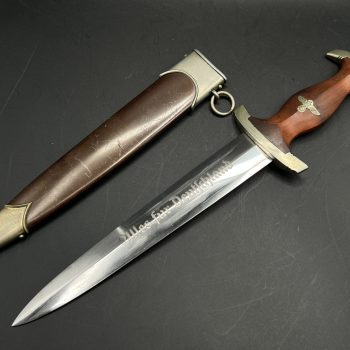
An early type of regulation edged weapon of the SA (Sturmabteilung) assault detachments, adopted in 1933. This specimen was manufactured by the Gustav Wirth workshop. The blade features a characteristic shape with double-edged sharpening and bears the famous motto “Alles für Deutschland.” The handle is made of brown wood, decorated with the SA emblem and eagle. The dagger comes complete with brown metal scabbard.
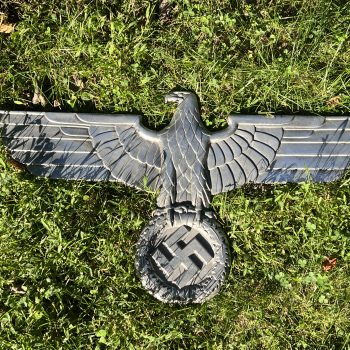
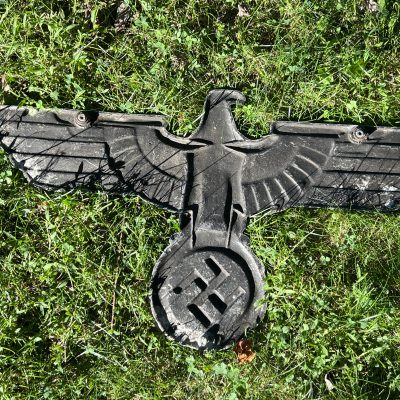
A large original Deutsche Reichsbahn (German State Railways) eagle from the Third Reich period. The eagle is depicted with outstretched wings, clutching a wreath bearing a swastika in its talons. The piece features strong three-dimensional relief, with detailed feathering and wing construction.
The reverse retains stamped/raised manufacturer or production markings, as well as original mounting hardware. The eagle displays an attractive period patina with surface wear, oxidation, scratches, and traces of finish loss consistent with its age and history.
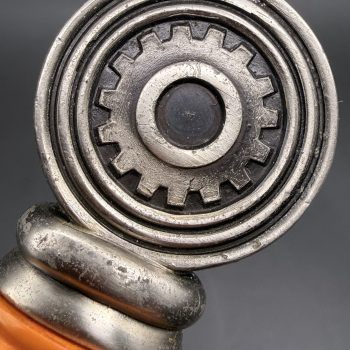
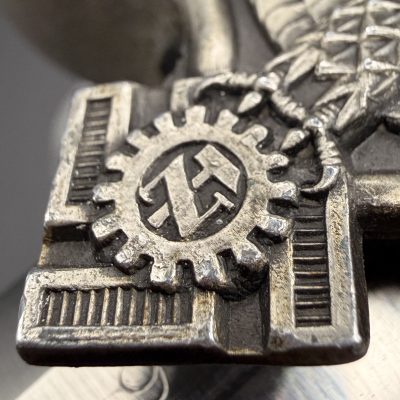
Technical Emergency Corps (TeNo) Leader’s Dagger, Model 1938, manufactured by Carl Eickhorn of Solingen. This example bears the manufacturer’s trademark and retains matching numbers on the blade and scabbard, confirming their factory pairing and attesting to the complete original preservation of the piece.
This dagger model was introduced in November 1938, concurrently with the adoption of new regulation edged weapons for the TeNo organization. It was intended to be worn with dress uniform by commanding officers holding the rank of Stabsscharführer and above. Officers purchased these daggers at their own expense through special organizational outlets.
The history of the Technical Emergency Corps began on September 30, 1919. Throughout the existence of the Weimar Republic, the corps repeatedly distinguished itself, demonstrating efficiency and excellent technical training. Naturally, this organization could not escape the attention of the new leadership, the National Socialist Party. In 1939, to further enhance efficiency, TeNo was transferred to the jurisdiction of the Reich Ministry of Foreign Affairs and subordinated to police structures, allowing for improved operational capacity. Prior to the commencement of the Polish campaign, TeNo was commanded by SS Gruppenführer (SS Lieutenant General) Schmelzer; he was later succeeded in this post by SS Gruppenführer Weinreich.
The Carl Eickhorn company was founded in Solingen in 1865 and became one of the largest manufacturers of edged weapons in Germany. The company’s trademark, featuring a squirrel (Eichhörnchen), served as a guarantee of the highest quality products. During the Third Reich period, the firm produced a wide range of regulation edged weapons, including daggers for all branches of service, SA and SS daggers, NPEA, NSFK, and TeNo daggers, as well as dress daggers, sabers, and swords. Carl Eickhorn products are distinguished by superior steel quality and meticulous finishing, and are highly valued by modern collectors.
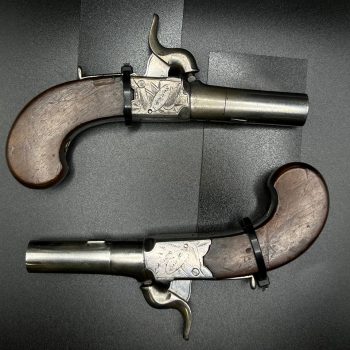
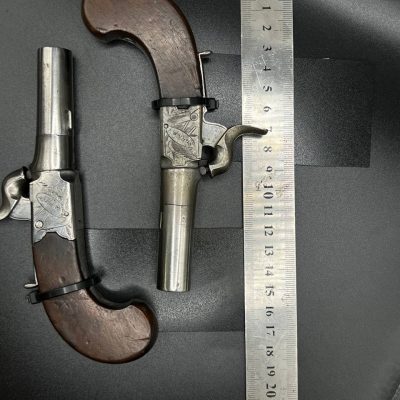
Pair of English Drop Trigger Percussion Pistols Marked H Nock.
Marked with one of England’s premier makers of the period, these guns are likely the fake watches of their day. Both guns are in nice condition with engraved frames and slab butts with vacant silver escutcheons.
Both actions, including push-on safeties, function without problems.
Overall length approximately 5 7/8 inches, with twist off barrels, standard British proofs.
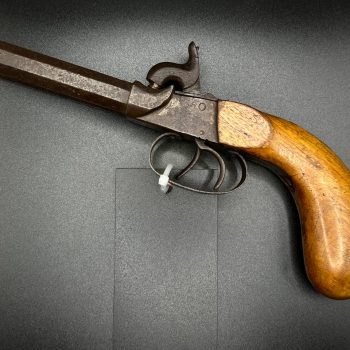
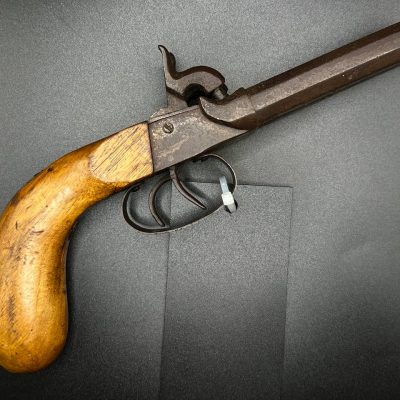
Original Victorian Era Double Barreled Percussion Coat Pistol
.40 caliber with turn-off 3 inch barrels. Overall length is a little over 8 inches.
Actions are mostly functional. The left action holds on half cock only; right action holds on half and full cock.
A good example of this early ‘concealed carry’ firearm at an attractive price.

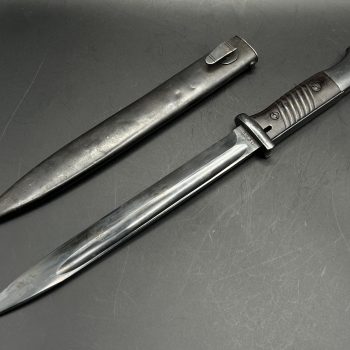
![Mauser rifle bayonet (1934-1945). 1940 – cvl 40 WKC 40. [WKC]. Unsharpened blade.](https://alexmp.com/wp-content/uploads/2026/08/1786402122233-4k0oh1iii8r-400x400.jpeg)
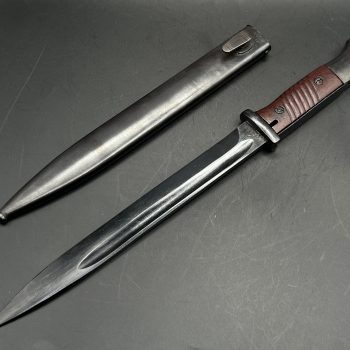
![Mauser rifle bayonet (1934-1945). 1943 – ffc 43. [F. Herder A Sn]. Unsharpened blade.](https://alexmp.com/wp-content/uploads/2026/08/1786401819387-8pv4qr0xfyr-400x400.jpeg)
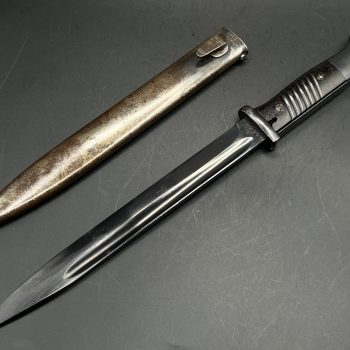
![Mauser rifle bayonet (1934-1945). [Unidentified manufacturer]. Unsharpened blade.](https://alexmp.com/wp-content/uploads/2026/08/1786401687818-e9hi88b8d7t-400x400.jpeg)
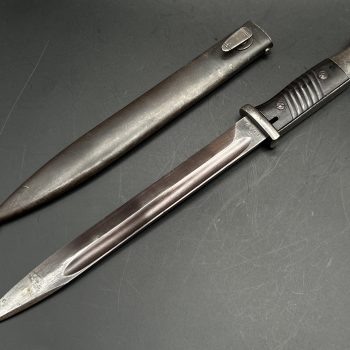
![Mauser rifle bayonet (1934-1945). 1942 – ddl 42. [Jos Corts].](https://alexmp.com/wp-content/uploads/2026/08/1786401314576-d1220ogczvs-400x400.jpeg)
![German Sword, pre-1918 Cavalry. Lion head [M. Neumann Berlin] Family Coat of Arms. Damascus steel, etching, gilding.](https://alexmp.com/wp-content/uploads/2026/08/1786327259162-s0zmv22ljzb-400x400.jpeg)
![Honor Presentation Saber for Outstanding Marksmanship of the Oberkommando der Wehrmacht (OKW) 1930. [WKC].](https://alexmp.com/wp-content/uploads/2026/08/1786327324223-5t9w0mpjwk5-400x400.jpeg)
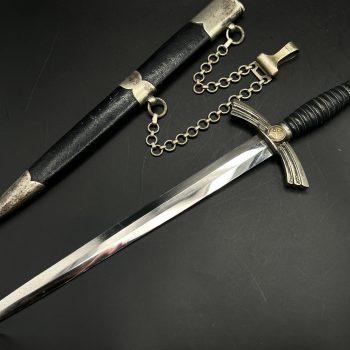
![Luftwaffe Dagger, Model 1935 (nickel-silver fittings). [Stöcker & Co. SMF]. Stamp – SMF.](https://alexmp.com/wp-content/uploads/2026/08/1786375507903-sde70nlaeh-400x400.jpeg)
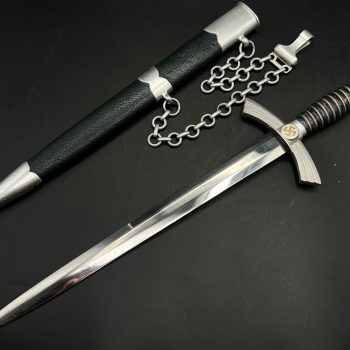
![Luftwaffe Dagger, Model 1935 (1st Model). [Stöcker & Co. SMF].](https://alexmp.com/wp-content/uploads/2026/08/1786375138480-df0k9fohi59-400x400.jpeg)
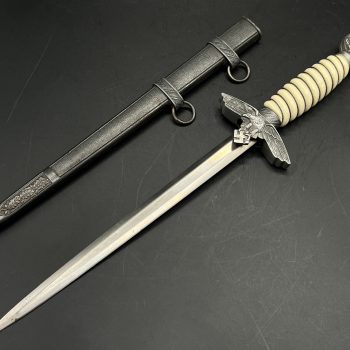
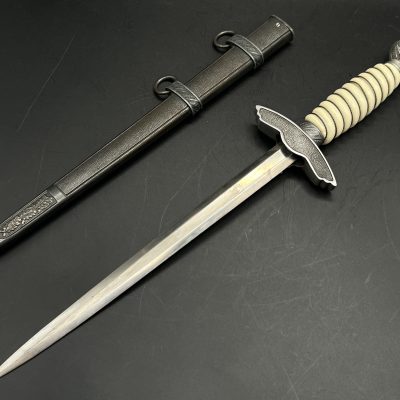
![German Army Dagger, Model 1935 [Carl Julius Krebs].](https://alexmp.com/wp-content/uploads/2026/08/1786373962754-4ptduaaklpx-400x400.jpeg)
![SA Service Dagger (Early type). [Gustav Wirth].](https://alexmp.com/wp-content/uploads/2026/08/1786373444428-yew7601aybl-400x400.jpeg)