Login
Register
By clicking Login or Register, you agree that the images of Nazi symbols shown on alexmp.com are not propaganda of fascism, Nazism and are shown solely for historical, cognitive and scientific purposes.
Order a free call and our specialist will contact you shortly!
Contact us and we will get back to you shortly.
Contact us and we will get back to you shortly.
Contact us and we will get back to you shortly.
Contact us and we will get back to you shortly.
Error: Contact form not found.
We will get back to you shortly.
В честь запуска Энциклопедии мы рады предложить вам бесплатный доступ до 01.10.2036.
Будем рады вашим комментариям и предложениям!
Inspected and guaranteed by Alex Warstory.
For more details on AlexMP Guarantee, click [HERE]
Item guaranteed by a verified dealer.
Click [HERE] for full seller guarantee terms.
Sold without expert review or guarantees. No claims accepted post-sale.
Learn more [HERE]


Showing 129–144 of 197 results
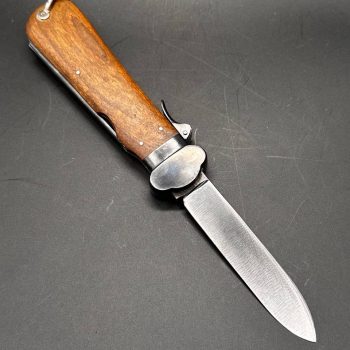
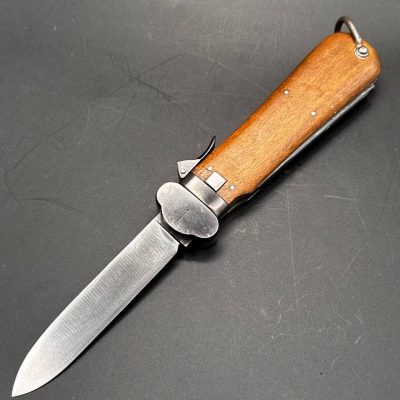
FiltersLuftwaffe paratrooper gravity knife, 2nd model (take-down type). Wooden handle. Blade retains rare factory polish with no corrosion spots. Spine stamped ‘R.B.NR. 0/0561/0019’. Marlinspike matching numbered 341 — pristine example.
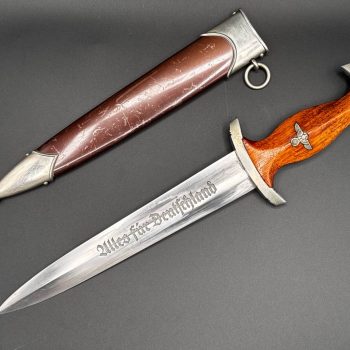
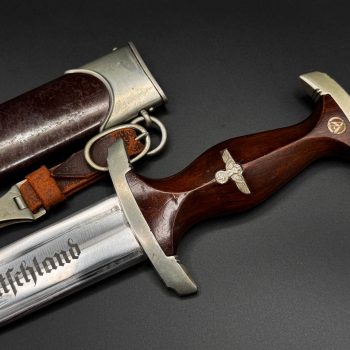
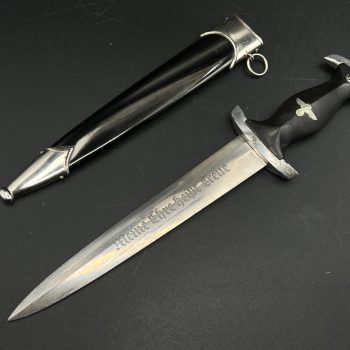
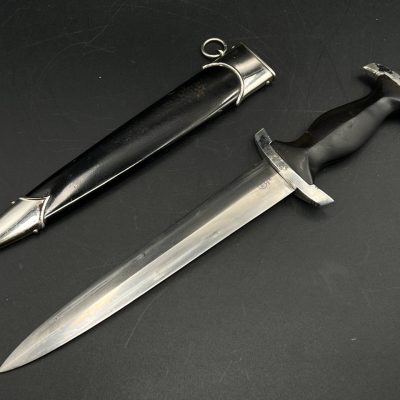
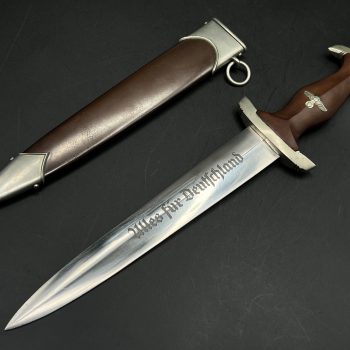
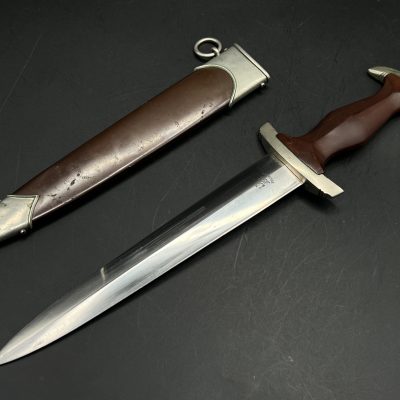
SA service dagger, Model 1933, early type. Wooden grip with eagle and SA emblem. Blade etched «Alles für Deutschland», spine marked «Wilh. Kober & Co. Suhl» with horseman logo. Scabbard in factory lacquer. Fully matching, bright condition. Rare Suhl manufacturer.
Magnificent SA Service Dagger Model 1933, complete with scabbard and hanger! The blade bears the legendary motto ‘Alles für Deutschland’ in Gothic script and the mark of the renowned Berlin manufacturer ‘HACO Berlin’. The letter ‘B’ on the spine is the Berlin Gau stamp. The grip and scabbard retain their original lacquer over anodizing — only minor scratches on the lacquer surface attest to the item’s authentic history. An impeccable collector’s piece!
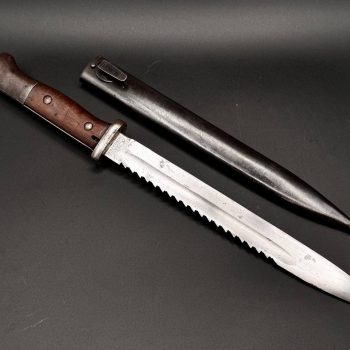
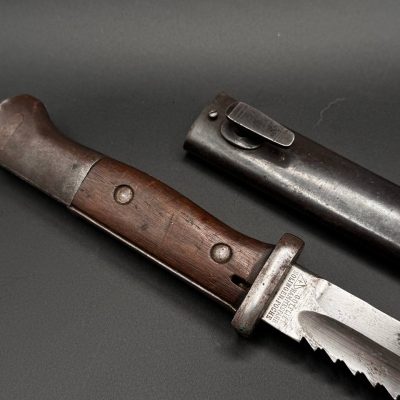
A stunning near-mint sawback bayonet (Sägerückenbajonett) for the Mauser 98 rifle from WWI! Blade uncleaned, manufacturer’s mark “Gottlieb Hammesfahr Solingen” — crisp and clear. Complete with original scabbard. Extremely rare in such condition!
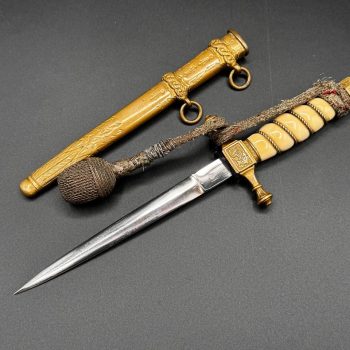
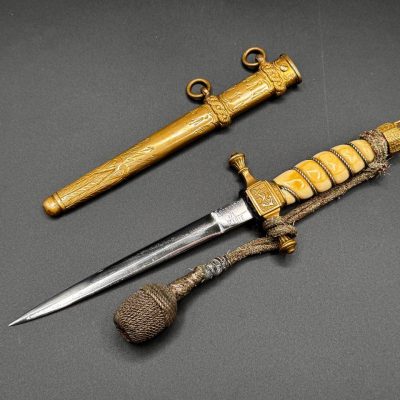
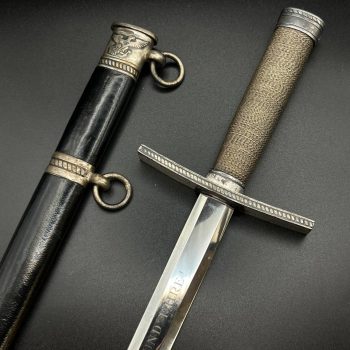
A miniature Reichsmarine officer’s dirk from the Weimar Republic period, complete with metal scabbard. The grip is crafted from orange celluloid featuring characteristic spiral fluting with metal wire wrapping; the pommel is adorned with a relief flower motif. The guard crosspiece bears the traditional naval emblem — an anchor with flower. The blade is double-edged and nickel-plated. The manufacturer’s mark WKC is preserved on the blade ricasso. The brass scabbard features elaborate relief decoration, including anchors and floral motifs, fitted with two suspension rings. Control numbers 13 are present on the guard base. This piece represents considerable collector value as a miniature of a naval officer’s dirk from the Weimar Republic era.
A miniature naval officer’s dagger of the Imperial German Navy (Kaiserliche Marine). Ivory grip with wire wrapping, pommel in the form of an imperial crown. Crossguard with relief anchor motif. Double-edged blade with engraved inscription «EBERHARD s/l. MARIE» — a personal dedication. Includes a miniature knot. A rare personalized Imperial period example.
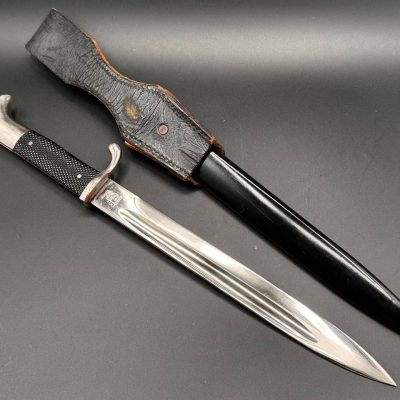
Dress bayonet for the Mauser 98k rifle with metal scabbard and leather frog. Black plastic grips, single-edged blade with wide fuller. Manufacturer’s mark “Original Eickhorn Solingen” with squirrel emblem on ricasso. Scabbard with black lacquer finish in good condition. A collectible example of Wehrmacht edged weaponry from the renowned Solingen manufacturer.
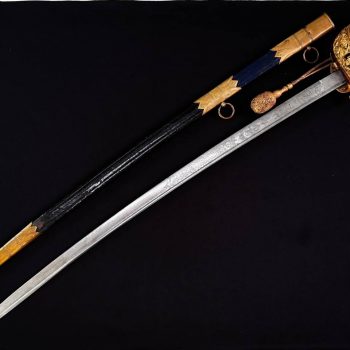
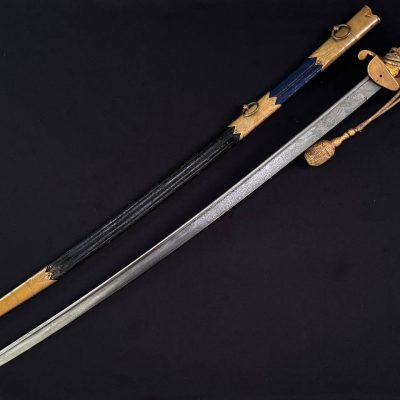
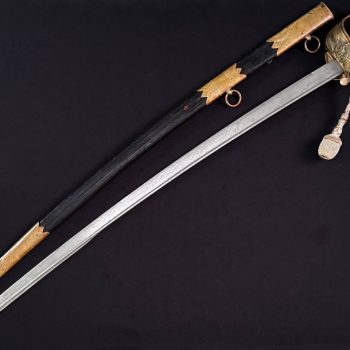
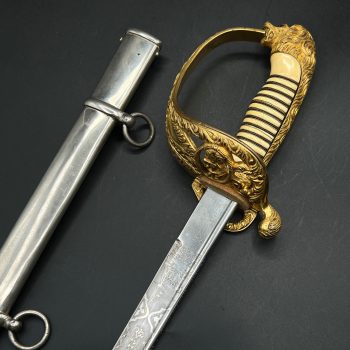
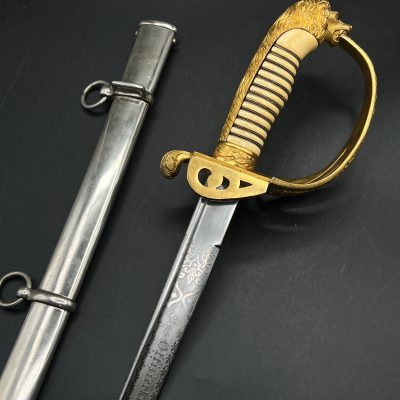
A dress officer’s sword of the Imperial German Navy (Kaiserliche Marine) in an oversized (große Ausführung) variant — the blade is noticeably broader and the grip larger than the standard regulation pattern. This bespoke specification, together with the exceptional quality of the mounts, points to a privately commissioned piece made for an officer of considerable means. complete with a leather scabbard and a gold-colored officer’s sword knot. The hilt is gilt, of openwork design, featuring the characteristic lion’s head pommel and a guard cup adorned with a relief depiction of an anchor surmounted by a crown, floral motifs, and rosettes. The grip is fashioned from ivory with horizontal fluting and wire wrapping. The blade is from multi-layered Damascus steel. The flats feature rich etched ornamentation with floral motifs and the retailer’s inscription “Waarenhaus für Armee & Marine in Berlin.” The scabbard is leather-mounted with gilt brass fittings, comprising a locket with shaped cutout, a middle band with suspension ring, and a chape with foliate ornamentation. An exceptionally rare example of dress naval officer’s weaponry of the highest quality from the German Empire period. 100% original piece.
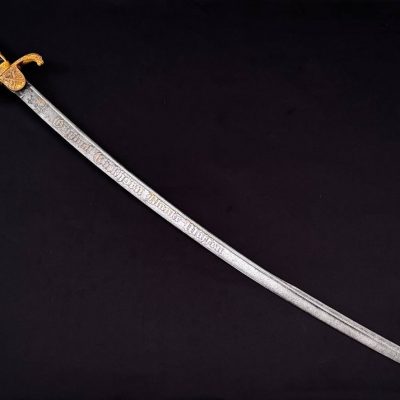
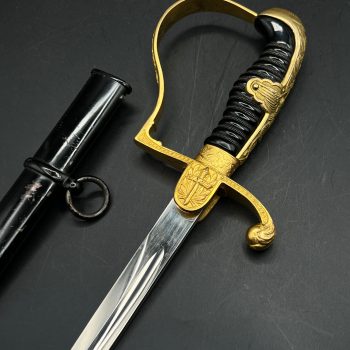
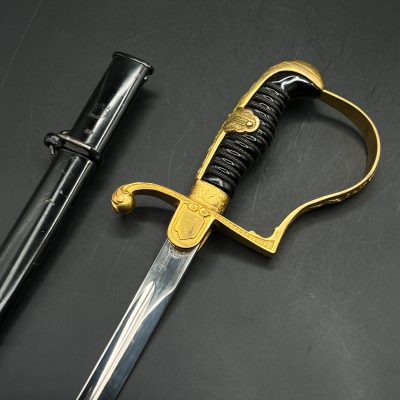
Wehrmacht Army (Heer) officer’s saber featuring a Damascus steel blade and luxurious gilt hilt. The pommel is executed in the form of a lion’s head with finely detailed mane, while the knuckle bow guard terminates in a smaller lion’s head. The grip is fashioned from black material with silver-tone wire wrap. The guard’s languet bears a relief depicting crossed swords with oak leaves. The blade is single-edged, slightly curved, forged from multi-layered Damascus steel displaying the characteristic wavy pattern. The blade features an etched Gothic script inscription reading ‘Original Eickhorn Blanke Waffen’ and the manufacturer’s trademark — a running squirrel with the legend ‘Original Eickhorn Solingen’. This particular example was displayed in showcases as an Imperial-era armament specimen. An exceptionally rare example of premium-grade exhibition ceremonial officer’s edged weapon.
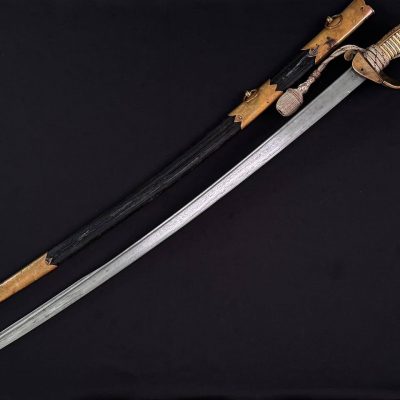
A parade officer’s saber of the Imperial German Navy from the Kaiserreich period. The hilt is crafted from ivory featuring a characteristic fluted surface, with a pommel in the form of a sculptural lion’s head displaying a finely detailed mane and red eyes. The brass bowl guard is adorned with a relief depiction of the Imperial Crown and anchor. The crossguard bears the owner’s name “Victor Schütze” engraved in Gothic script. The Damascus blade is in excellent condition and features a Damascus pattern with two maker’s marks on the ricasso. Similar examples are known with markings applied to both sides of the ricasso. The blade is notably wide, broader than those typically encountered on this saber pattern, giving the piece a particularly impressive appearance. The hilt fittings are free of any significant defects. The reverse side of the scabbard has a separated seam where the stitching has come undone, but this does not detract from the overall presentation of the piece. Overall, this is a very well-preserved collectible example. The saber is named, adding significant historical interest and desirability for collectors.
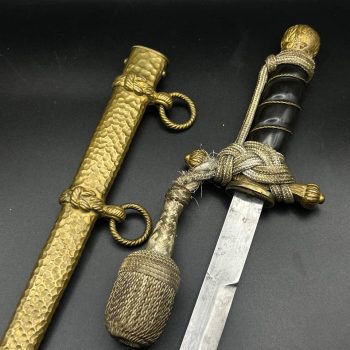
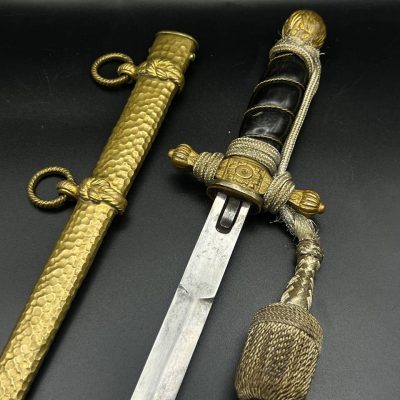
Black horn or synthetic grip with intact wire wrapping, plain rhomboid blade without maker’s mark, pommel and crossguard made of brass, hammered scabbard, the suspension bands in rope form with decorative knots, the rings with rope decoration, complete with knotted portepee sword knot. An honest dagger.
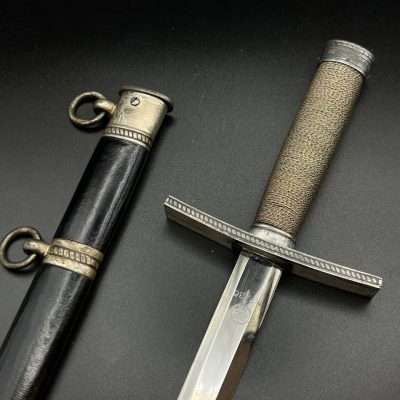
This Customs dagger has a nice blade that only shows a few lights spots here and there. The fittings are shows some wear but no abuse and the green leather grip has darkened over time. The scabbard however, is very nice and has perfect green leather and excellent aluminum fittings.
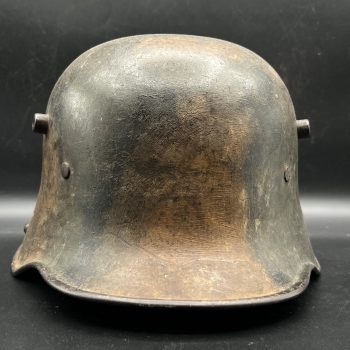
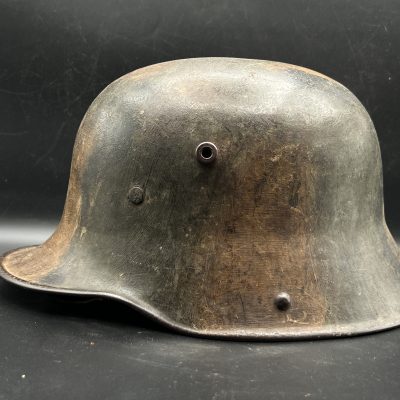
Excellent overall condition on this helmet. Features a standard camo pattern with colors of brown, green ad dark yellows. No dents and heavy damage, just expected wear for a helmet of this age. Interior is even better with all three liner pads intact which is quite rare as the tend to rot and fall out. Has a size stamping to the one side which is faint, but can just make it out. Nice WWI helmet with a great look about it.
Officer parade weapons, revived following the restoration of the German armed forces, continued the proud traditions of the Imperial Army and the Reichswehr. Unlike the Army dagger model 1935, officer sabers were produced in numerous design variations by various Solingen manufacturers. Production of this type of weapon was discontinued in May 1943 due to wartime industrial demands; however, examples already in service continued to be worn with parade uniforms. In late 1944, the wearing of parade edged weapons was completely abolished, and officers were ordered to carry a pistol instead of a saber or dagger.
The blade bears the mark of the renowned Solingen firm F. W. Höller Waffenfabrik, founded in 1866 and officially registered with the Solingen authorities on 5 June 1883. From its founding, the company specialized in the production of edged weapons and cutlery. Throughout the late 19th century and during the First World War, the firm manufactured a wide range of military products, including bayonets, sabers, and swords. In 1905, the company registered its well-known trademarks: the thermometer image, as well as the figure of a man tipping his hat with the inscription “Hut ab!” (“Hats off!”). From 1914 to 1939, the firm was managed by Julius Küller. During the Third Reich period, Höller became one of the largest and most prolific edged weapons manufacturers in Solingen, specializing in a broad range of military products. In 1935, the company was located at Sonnenstraße 8, Solingen, and that same year received RZM license M7/33. Products were actively advertised in specialized journals and catalogs, showcasing an extensive assortment that included NSDAP and Wehrmacht daggers, swords, and bayonets. The firm also produced parade bayonets with high-quality etched blades. In 1941, Höller celebrated its 75th anniversary, promoting the Höller Model 21 sword as its flagship model. In June 1941, the company was assigned the K98 bayonet manufacturer letter code (fze). Following the end of the Second World War, under the ownership of Herr Grah, the firm continued operations, producing cutlery, kitchen and professional knives, swords, and scissors through the 1970s. The company was officially liquidated in December 1974. Particular collector value is added to this example by a rare decorative detail: an additional eagle on the grip backstrap, distinguishing this saber from standard production specimens.
A service edged weapon of the SA (Sturmabteilung) storm troopers, adopted in 1933. The distinctively shaped blade with double-sided sharpening bears the legendary motto “Alles für Deutschland.” The handle is made of brown-colored wood and decorated with the SA emblem featuring an eagle; the metal scabbard is finished in the same brown tone.
The early type of SA/NSKK daggers was produced between 1933 and 1936 and is distinguished by a number of characteristic design features. The scabbard and handle fittings are made of nickel silver (German silver), which, combined with the high quality of component fitting and the anodized scabbard coating, sets these examples apart from later production runs. This dagger was manufactured by Stöcker & Co. SMF. Early examples are particularly prized by collectors due to their impeccable craftsmanship and historical significance as the first service daggers of the storm troopers.
A rarity rating of 5 out of 10 according to the Ralf Siegert classification indicates that such examples are relatively uncommon on the antiques market.
The naval saber was a mandatory attribute of the dress uniform of officers in the Kaiserliche Marine. During the period of Kaiser’s Germany, the imperial anchor beneath the Kaiser’s crown was characteristic in the design of the hilt. The classical variant featured a brass hilt, ivory grip, and a lion’s head with eyes of red and green color. The scabbard was typically made of black leather with brass fittings; steel scabbards are considerably rarer. Sabers were purchased by officers at their own expense, which resulted in numerous variations of execution. Standard and Damascus blades can be found, various hilt designs and decorative scabbard finishes, as well as several sizes ranging from light and elegant to large Grosse Pattern models. It is precisely this diversity of execution that makes naval sabers a particularly interesting independent field of collecting: collections can be built according to manufacturers, sizes, hilt types, blades, and finishing variations. Along with the dirk, the saber remained a symbol of officer status and the continuity of German naval weaponry traditions of the nineteenth century.
E. & F. Hörster, one of the largest Solingen manufacturers of naval edged weapons, operated from the nineteenth century and continued production during the Weimar Republic and the Third Reich. The firm produced high-quality naval sabers and dirks in various execution variants. Already before World War I, Hörster products were supplied not only for the German market but were also exported to other European countries, including the Russian Empire. Thanks to its long operational period, Hörster products allow one to trace the development of naval edged weapons from the Kaiser era to the Kriegsmarine.
Seebataillone represented naval infantry units of the Kaiserliche Marine. There were several marine battalions, and the custom-made edged weapons associated with them constitute a separate field of collecting German naval weaponry. A characteristic feature of such items is the combination of naval and infantry attributes. For example, an officer’s saber could feature a traditional naval hilt and blade but be equipped with steel infantry-type scabbards. Custom specimens frequently bear personal dedications from one officer to another or from the officer corps to a specific serviceman of a Seebataillon. In addition to officer sabers and other custom edged weapons, this group includes infantry-type bayonets for Mauser system rifles with Seebataillone designations and symbols. Most such items bear unit designations; however, named specimens also occur, representing particular collecting interest.
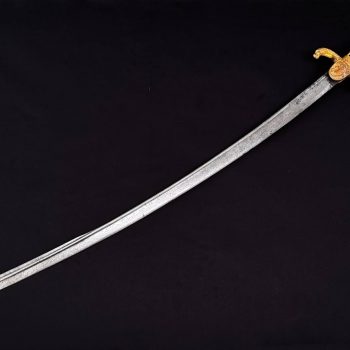
This saber features a characteristic openwork pierced hilt, presented in the catalogs of several manufacturers; however, it did not correspond to the established standard for Kaiserliche Marine edged weapons and was subsequently prohibited from being worn. It is precisely this unusual feature that makes such sabers particularly desirable among collectors today. Such specimens were predominantly ordered as presentation weapons, for example upon an officer’s transfer to another unit or upon his retirement from service, and served as an object of special pride for the owner. The present specimen is entirely original; the factory riveting of the hilt remains intact, the saber has not been disassembled, and retains its original configuration.