Login
Register
By clicking Login or Register, you agree that the images of Nazi symbols shown on alexmp.com are not propaganda of fascism, Nazism and are shown solely for historical, cognitive and scientific purposes.
Order a free call and our specialist will contact you shortly!
Contact us and we will get back to you shortly.
Contact us and we will get back to you shortly.
Contact us and we will get back to you shortly.
Contact us and we will get back to you shortly.
Error: Contact form not found.
We will get back to you shortly.
В честь запуска Энциклопедии мы рады предложить вам бесплатный доступ до 01.10.2036.
Будем рады вашим комментариям и предложениям!
Inspected and guaranteed by Alex Warstory.
For more details on AlexMP Guarantee, click [HERE]
Item guaranteed by a verified dealer.
Click [HERE] for full seller guarantee terms.
Sold without expert review or guarantees. No claims accepted post-sale.
Learn more [HERE]


Showing 257–272 of 315 results
FiltersOriginal German event badge issued for the “Day of Labour” (Tag der Arbeit) celebrations on May 1st, 1934. Die-struck aluminum with pin-back fastening. The obverse shows an allegorical female figure with a child beside the national eagle and symbols of labour — hammer and sickle. Reverse maker-marked J. Mohr & Sohn, Lobenstein. One of the most artistically detailed designs of the “Day of Labour” series. Very good condition with light age patina.
Original German propaganda badge issued in 1934 in support of the Saar region’s return to Germany. Octagonal bronze-finished metal with pin-back fastening. The obverse features an eagle with swastika above a handshake on a cross, with inscriptions “Deutsch ist die Saar” and “Des Deutschen Ehre ist die Treue” (“A German’s honor is loyalty”). Produced during the national campaign leading up to the 1935 Saar plebiscite. Very good condition with attractive bronze patina.
Original German event badge issued for the “Day of Labour” (Tag der Arbeit) on May 1st, 1937. Die-struck aluminum with pin-back fastening. The obverse depicts a child standing atop the national eagle holding an oak leaf — symbolizing Germany’s rebirth and future through labour. Reverse maker-marked G. Brehmer, Markneukirchen. One of the most artistic and distinctive designs in the “Day of Labour” series. Very good condition with mild age patina.
Original German event badge issued for the “Day of Labour” (Tag der Arbeit) celebrations on May 1st, 1936. Die-struck aluminum with pin-back fastening. The obverse depicts a plow, hammer, and sickle beneath a national eagle with swastika — symbolizing unity of workers, farmers, and the state. Reverse marked Fr. Zimmermann, Stuttgart. One of the finest designs in the “Day of Labour” tinnie series. Excellent condition.
Rare early NSDAP badge issued for the “National Reich Youth Day” (NS-Reichsjugendtag) of 1932 — the last event of its kind before the party came to power. Bronze-finished metal, die-struck construction. Obverse features a sword passing through a wreath with swastika and the inscription “NS-Reichsjugendtag 1932”. Reverse shows solder traces from a missing pin. A scarce and historically significant pre-1933 propaganda youth badge, sought after among early-period collectors.
Original SA (Sturmabteilung) sports competition badge issued for the “Military Games of the SA Group Lower Rhine” in 1939. White bakelite shield-shaped base with attached gilt metal sword and oak wreath with swastika emblem. Reverse maker-marked Richard Sieper & Söhne, Lüdenscheid and RZM code M9/25. Pin-back fastening. A fine and well-preserved example of late-period regional SA competition awards.
Original German event badge issued for the “Day of German Seafaring” (Tag der Deutschen Seefahrt) held on May 25–26, 1935. Die-struck aluminum construction with pin-back fastening. The obverse features a three-masted sailing ship beneath an eagle with swastika and the inscription “Seefahrt ist Not – Tag der Deutschen Seefahrt 25.–26.5.1935” (“Seafaring is a necessity”). Reverse marked Hoffstätter, Bonn. A well-detailed and attractive maritime-themed propaganda tinnie. Excellent condition.
Original German event badge issued for the “Day of Labour” (Tag der Arbeit) celebrations on May 1st, 1934. Die-struck bronze-finished metal with pin-back fastening. The obverse depicts a worker’s head above hammer and sickle, with an eagle and swastika below, dated 1934. Issued to participants of the German Labour Front (Deutsche Arbeitsfront, DAF). Very good condition with even bronze patina.
Original Hitler Youth commemorative badge issued for the Jugendfest (Youth Festival) of 1937. Die-struck aluminum alloy construction with pin-back fastening. The obverse depicts an eagle clutching the Hitlerjugend diamond above a campfire, surrounded by the inscription “Jugendfest 1937” in runic script. Typical propaganda tinnie of the Third Reich period. Good condition with light age wear.
Original German charity badge from 1934 issued for the “Kinder aufs Land” (“Children to the Countryside”) program, organized under the NSDAP and the Winter Relief (WHW) initiative. Bronze-finished metal construction with pin-back fastening. Obverse depicts an adult leading two children surrounded by sun rays, dated 1934 with inscription “Kinder aufs Land”. Early WHW-related social campaign badge. Good condition with attractive bronze patina.
Original German badge issued during the first Winter Relief campaign of 1933–1934 (Winterhilfswerk des Deutschen Volkes). Bronze-finished metal construction with pin-back fastening. Obverse features a national eagle with swastika and inscription “Wir kämpften gegen Hunger und Kälte 1933–34” (“We fought against hunger and cold”). Early and well-made WHW type. Very good condition with even bronze patina.
Original German event badge issued for the “Day of Labour” celebrations on May 1st 1935. Die-struck aluminium construction with pin-back fastening. Obverse shows three workers with tools and an eagle with wreath and swastika; dated 1935 below. Reverse maker-marked Pleuger & Voss G.m.b.H., Lüdenscheid. A typical Third Reich propaganda tinnie, well-preserved collectible example.
Original German event badge issued for the “Day of the German Craftsman” in 1939. Die-struck zinc construction with pin-back fastening. The obverse shows an eagle with wreath and swastika above craftsmen figures; reverse marked “Tag des Deutschen Handwerks 1939” with maker’s stamp. A representative Third Reich propaganda tinnie.
This medal is in extremely nice condition. No enamel damage. The ribbon is intact and the gold was is still excellent and bright.
German Luftwaffe Honor Goblet and citations set to Oberleutnant Wolfgang Vorpahl Kampfgeschwader 55, fine example of an Alpaka goblet which has a beautiful uncleaned black patina to the body. Around the lower band it is engraved ‘Oberleutnant Wolfgang Vorpahl AM 22.1.43’. Underside of the goblet it is stamped ‘Feinsilber Alpaka Auflage Joh.Wagner & Sohn’. Accompanying the goblet is his award citations for the rest of his awards which include the German cross in gold, this Honor Goblet, pilots badge, EK1, EK2, wound badge, Krim shield and bronze and silver grade bomber operational clasps. Also with the group is two promotion citations plus a small grouping of original snapshot and studio photographs relating to Vorpahl. Overall this is an excellent complete grouping.
Stunning condition on this clasp that comes on the original ribbon that has excellent color. The clasp has the slant cut pins and perfect gold gilt.
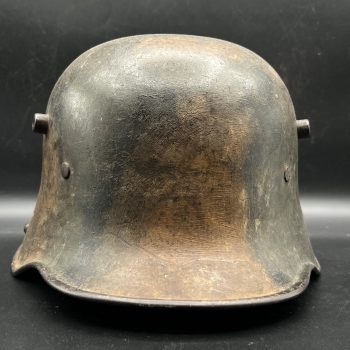
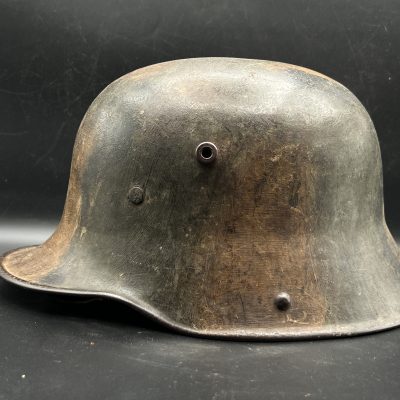
Excellent overall condition on this helmet. Features a standard camo pattern with colors of brown, green ad dark yellows. No dents and heavy damage, just expected wear for a helmet of this age. Interior is even better with all three liner pads intact which is quite rare as the tend to rot and fall out. Has a size stamping to the one side which is faint, but can just make it out. Nice WWI helmet with a great look about it.
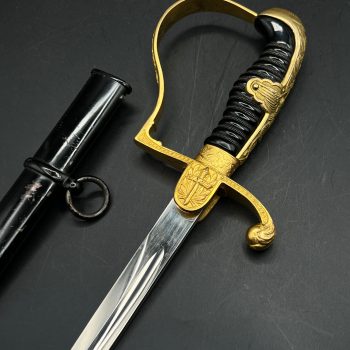
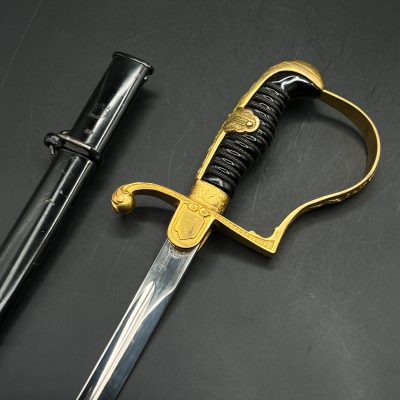
Officer parade weapons, revived following the restoration of the German armed forces, continued the proud traditions of the Imperial Army and the Reichswehr. Unlike the Army dagger model 1935, officer sabers were produced in numerous design variations by various Solingen manufacturers. Production of this type of weapon was discontinued in May 1943 due to wartime industrial demands; however, examples already in service continued to be worn with parade uniforms. In late 1944, the wearing of parade edged weapons was completely abolished, and officers were ordered to carry a pistol instead of a saber or dagger.
The blade bears the mark of the renowned Solingen firm F. W. Höller Waffenfabrik, founded in 1866 and officially registered with the Solingen authorities on 5 June 1883. From its founding, the company specialized in the production of edged weapons and cutlery. Throughout the late 19th century and during the First World War, the firm manufactured a wide range of military products, including bayonets, sabers, and swords. In 1905, the company registered its well-known trademarks: the thermometer image, as well as the figure of a man tipping his hat with the inscription “Hut ab!” (“Hats off!”). From 1914 to 1939, the firm was managed by Julius Küller. During the Third Reich period, Höller became one of the largest and most prolific edged weapons manufacturers in Solingen, specializing in a broad range of military products. In 1935, the company was located at Sonnenstraße 8, Solingen, and that same year received RZM license M7/33. Products were actively advertised in specialized journals and catalogs, showcasing an extensive assortment that included NSDAP and Wehrmacht daggers, swords, and bayonets. The firm also produced parade bayonets with high-quality etched blades. In 1941, Höller celebrated its 75th anniversary, promoting the Höller Model 21 sword as its flagship model. In June 1941, the company was assigned the K98 bayonet manufacturer letter code (fze). Following the end of the Second World War, under the ownership of Herr Grah, the firm continued operations, producing cutlery, kitchen and professional knives, swords, and scissors through the 1970s. The company was officially liquidated in December 1974. Particular collector value is added to this example by a rare decorative detail: an additional eagle on the grip backstrap, distinguishing this saber from standard production specimens.
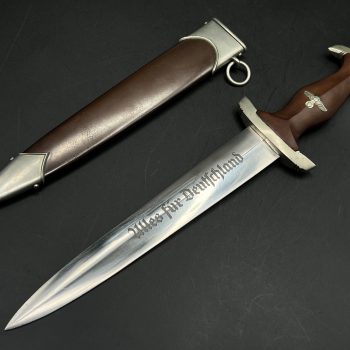
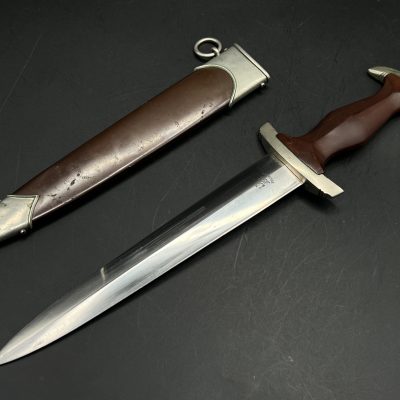
A service edged weapon of the SA (Sturmabteilung) storm troopers, adopted in 1933. The distinctively shaped blade with double-sided sharpening bears the legendary motto “Alles für Deutschland.” The handle is made of brown-colored wood and decorated with the SA emblem featuring an eagle; the metal scabbard is finished in the same brown tone.
The early type of SA/NSKK daggers was produced between 1933 and 1936 and is distinguished by a number of characteristic design features. The scabbard and handle fittings are made of nickel silver (German silver), which, combined with the high quality of component fitting and the anodized scabbard coating, sets these examples apart from later production runs. This dagger was manufactured by Stöcker & Co. SMF. Early examples are particularly prized by collectors due to their impeccable craftsmanship and historical significance as the first service daggers of the storm troopers.
A rarity rating of 5 out of 10 according to the Ralf Siegert classification indicates that such examples are relatively uncommon on the antiques market.
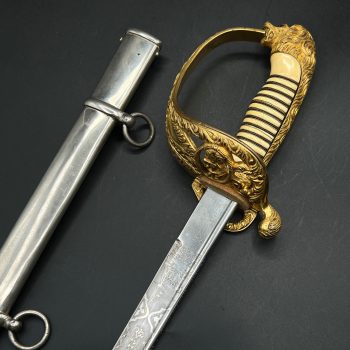
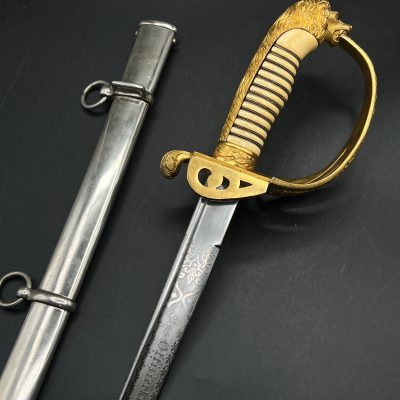
The naval saber was a mandatory attribute of the dress uniform of officers in the Kaiserliche Marine. During the period of Kaiser’s Germany, the imperial anchor beneath the Kaiser’s crown was characteristic in the design of the hilt. The classical variant featured a brass hilt, ivory grip, and a lion’s head with eyes of red and green color. The scabbard was typically made of black leather with brass fittings; steel scabbards are considerably rarer. Sabers were purchased by officers at their own expense, which resulted in numerous variations of execution. Standard and Damascus blades can be found, various hilt designs and decorative scabbard finishes, as well as several sizes ranging from light and elegant to large Grosse Pattern models. It is precisely this diversity of execution that makes naval sabers a particularly interesting independent field of collecting: collections can be built according to manufacturers, sizes, hilt types, blades, and finishing variations. Along with the dirk, the saber remained a symbol of officer status and the continuity of German naval weaponry traditions of the nineteenth century.
E. & F. Hörster, one of the largest Solingen manufacturers of naval edged weapons, operated from the nineteenth century and continued production during the Weimar Republic and the Third Reich. The firm produced high-quality naval sabers and dirks in various execution variants. Already before World War I, Hörster products were supplied not only for the German market but were also exported to other European countries, including the Russian Empire. Thanks to its long operational period, Hörster products allow one to trace the development of naval edged weapons from the Kaiser era to the Kriegsmarine.
Seebataillone represented naval infantry units of the Kaiserliche Marine. There were several marine battalions, and the custom-made edged weapons associated with them constitute a separate field of collecting German naval weaponry. A characteristic feature of such items is the combination of naval and infantry attributes. For example, an officer’s saber could feature a traditional naval hilt and blade but be equipped with steel infantry-type scabbards. Custom specimens frequently bear personal dedications from one officer to another or from the officer corps to a specific serviceman of a Seebataillon. In addition to officer sabers and other custom edged weapons, this group includes infantry-type bayonets for Mauser system rifles with Seebataillone designations and symbols. Most such items bear unit designations; however, named specimens also occur, representing particular collecting interest.
This saber features a characteristic openwork pierced hilt, presented in the catalogs of several manufacturers; however, it did not correspond to the established standard for Kaiserliche Marine edged weapons and was subsequently prohibited from being worn. It is precisely this unusual feature that makes such sabers particularly desirable among collectors today. Such specimens were predominantly ordered as presentation weapons, for example upon an officer’s transfer to another unit or upon his retirement from service, and served as an object of special pride for the owner. The present specimen is entirely original; the factory riveting of the hilt remains intact, the saber has not been disassembled, and retains its original configuration.