By clicking Login or Register, you agree that the images of Nazi symbols shown on alexmp.com are not propaganda of fascism, Nazism and are shown solely for historical, cognitive and scientific purposes.
Request a callback
Order a free call and our specialist will contact you shortly!
Ask a question
Contact us and we will get back to you shortly.
Request a Blitz Price
Contact us and we will get back to you shortly.
Request a price
Contact us and we will get back to you shortly.
Offer your blitz price
Contact us and we will get back to you shortly.
Error: Contact form not found.
Request a subscription
We will get back to you shortly.
Subscription
В честь запуска Энциклопедии мы рады предложить вам бесплатный доступ до 01.10.2026. Будем рады вашим комментариям и предложениям!
A fine example of the SA Sports Badge in Bronze (SA-Sportabzeichen in Bronze), instituted by Ernst Röhm in 1933 as a physical fitness award for members of the SA and later the wider population. The design features a vertical sword over a swastika, encircled by an oak leaf wreath.
This piece is marked on the reverse with “Eigentum D.S.A. Sportabzeichen Hauptstelle” and produced by Berg & Nolte A.G., Lüdenscheid, a well-known maker of Third Reich awards and insignia. Retaining its original finish and showing honest age toning, it is a desirable and collectible bronze grade example.
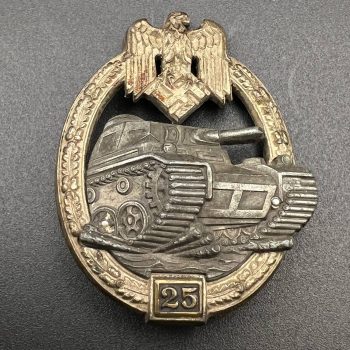
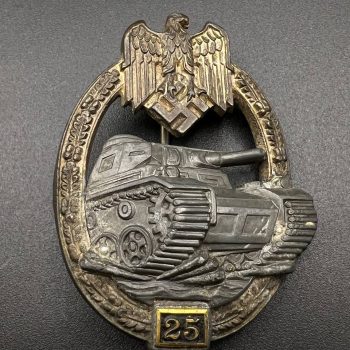
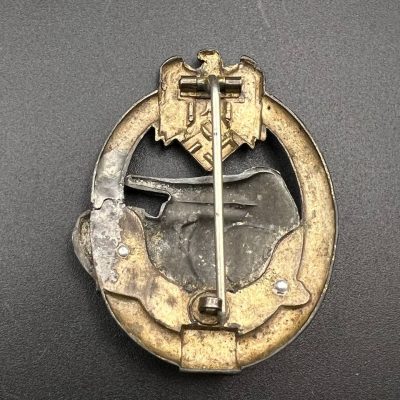
Fine zinc, semi-hollow construction; the tank finished in a lighter tone; the tank section riveted to the wreath with two aluminum rivets. The silvering on the wreath remains over 80% intact. Reverse fitted with a round magnetic pin, with the magnetic pin plate soldered in place.
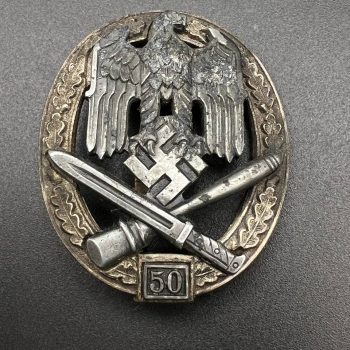
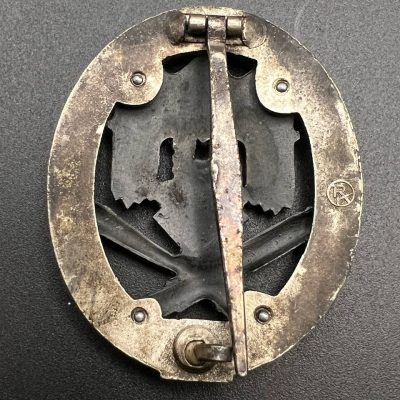
Fine zinc; the eagle finished in a steel-grey tone; the wreath silver-plated. The reverse bears the manufacturer’s mark “RK” on the wreath; the pin, catch, and hinge are magnetic. Clearly worn, with visible corrosion traces on the eagle.
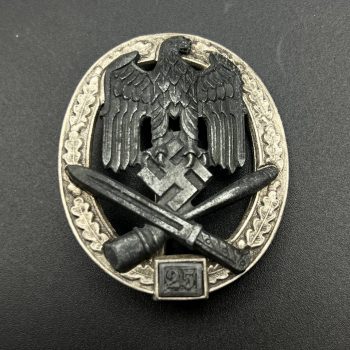
Fine zinc; the eagle finished in steel-grey tone; the wreath silver-plated. The reverse is marked with the manufacturer’s “RK” within the wreath; the pin, catch, and hinge are magnetic. Lightly worn.
Fine zinc, semi-hollow construction; the tank finished in a lighter tone; the tank section riveted to the wreath with two aluminum rivets; the wreath silver-plated; reverse fitted with a round non-magnetic pin, the pin plate soldered in place. Heavily worn; the badge was wartime-repaired on the reverse. Condition: 2–3.
Panzer Assault Badges with engagement numbers manufactured by Juncker are extremely rare. By order of 22 June 1943, the Army High Command approved the introduction of Panzer Assault Badges with engagement numbers. The newly established grade structure was as follows:
1st grade: Panzer Assault Badge
2nd grade: Panzer Assault Badge with number 25
3rd grade: Panzer Assault Badge with number 50
4th grade: Panzer Assault Badge with number 75
5th grade: Panzer Assault Badge with number 100
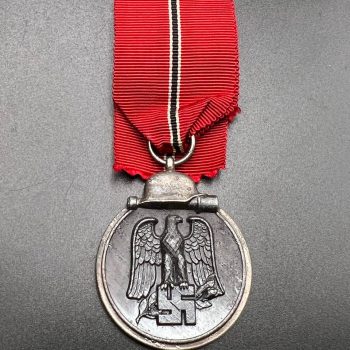
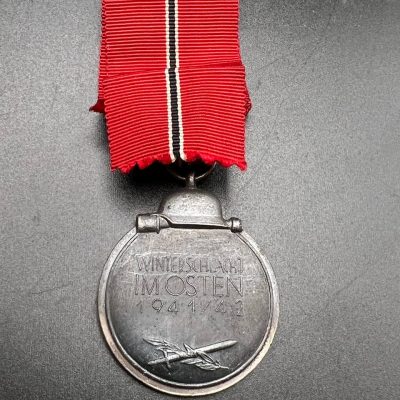
Original Eastern Front Medal 1941/42 with the maker’s mark stamped on the suspension ring. Produced in zinc with a well-preserved dark patina and traces of the original silver wash along the rim. The eagle motif and all inscriptions remain clear and sharp, showing no signs of cleaning or restoration.
The ribbon is bright, with the correct wartime weave and colour tone, mounted on the original marked ring. Overall condition is excellent for a zinc Ostmedaille: even patina, strong relief, and a fully authentic, untouched set.
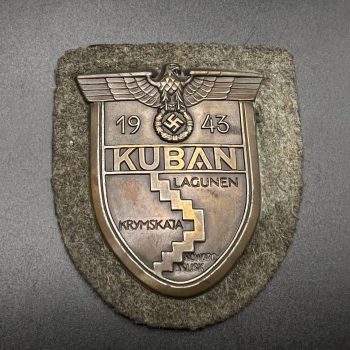
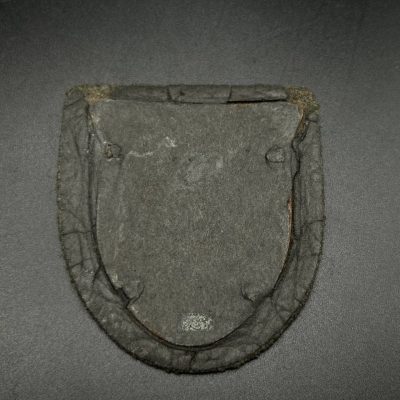
Original Kuban Shield. Complete with its period-correct construction: felt backing, internal paper layer, and folded prongs on the reverse.
Sharp relief throughout — including the eagle, the “1943” date, “KUBAN”, “LAGUNEN”, and the sector names “KRYMSKAJA” and “NOWOROSSIJSK”. Attractive untouched patina, no restoration. Fully original piece.
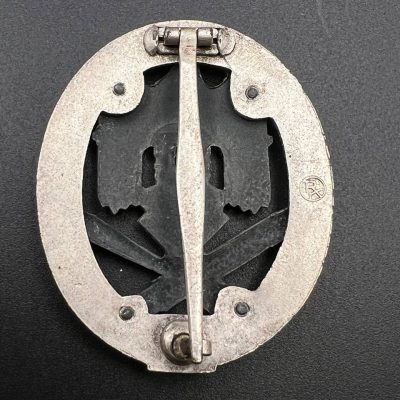
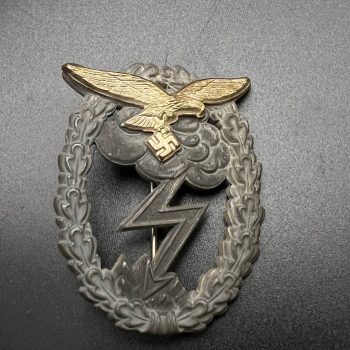
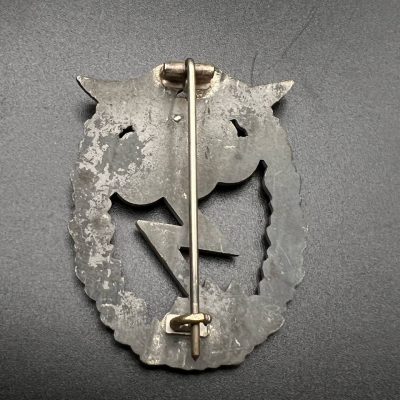
Original Luftwaffe Ground Assault Badge, two-piece type with a separately applied eagle. The wreath is made of nickel silver with an even dark patina, and the lightning bolt shows crisp detail. The golden-toned eagle is fixed with separate posts and displays slight movement — a known and typical feature of genuine early assembled examples.
Fully functional hardware: tubular hinge, long pin, and solid catch. No restoration, attractive original finish with natural aging.
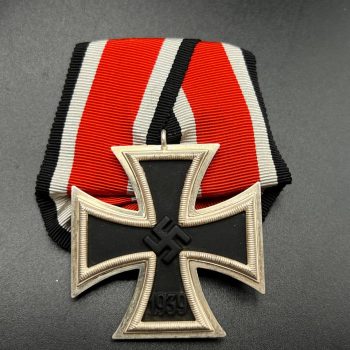
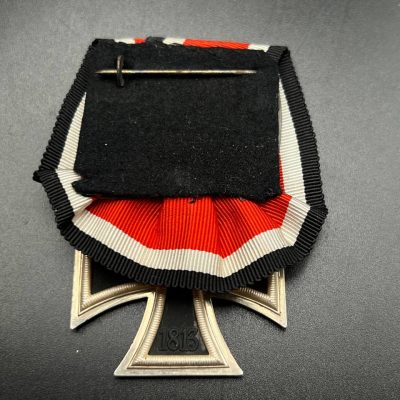
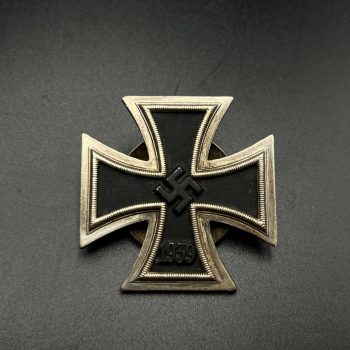
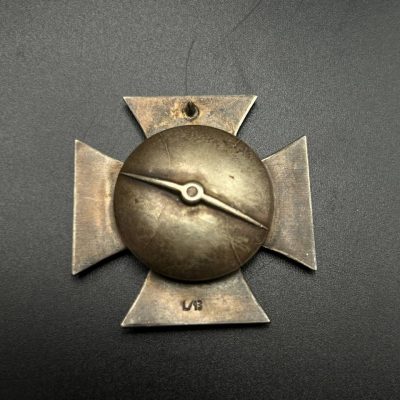
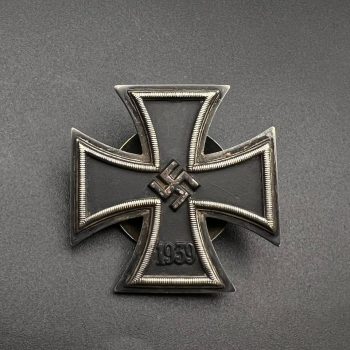
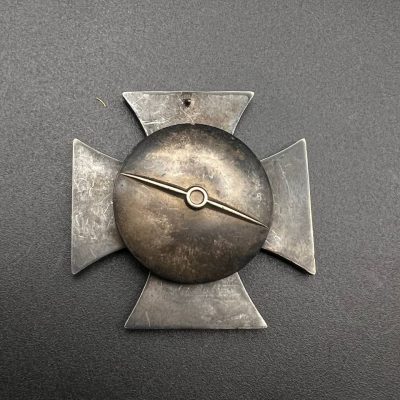
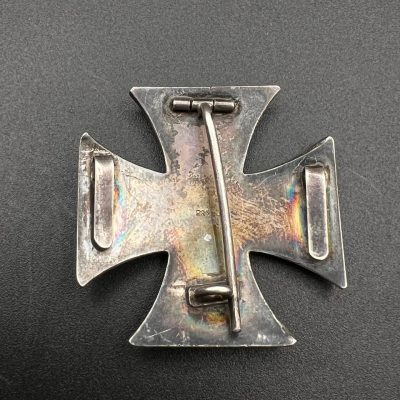
Original screw-back Iron Cross 1st Class with L/13 maker mark on the reverse. Three-piece construction with magnetic iron core, black lacquer finish, and silvered frame. Rare screw-back variant complete with its original base plate and nut. Reverse is stamped L/13, indicating the manufacturer Paul Meybauer, Berlin. Attractive patina, all parts original, no restoration.
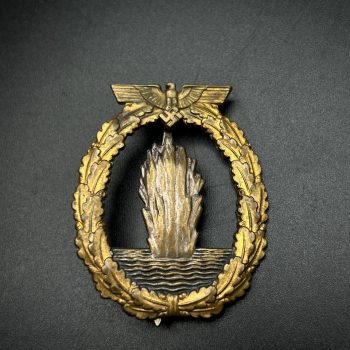
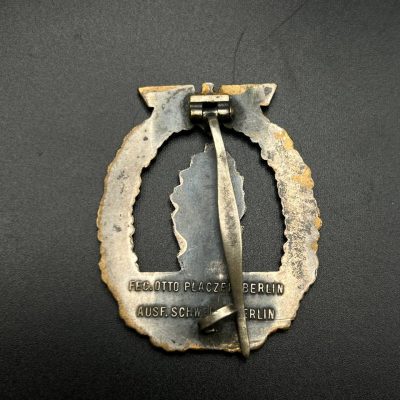
Original early-type Minesweeper Badge made of tombac, featuring a gilt oak-leaf wreath and silvered mine-explosion plume above stylised waves. The reverse bears the correct maker marks:
“FEC. OTTO PLACZEK BERLIN” and
“AUSF. SCHWERIN BERLIN”.
Typical Schwerin hardware: solid block hinge, broad long pin, and classic catch construction. Condition is very good for age — attractive patina, honest wear to the edges, and partially preserved gilding on the wreath. No cleaning, all finishes are original.
A desirable early tombac example by Schwerin, considered one of the most collectible makers of this award.
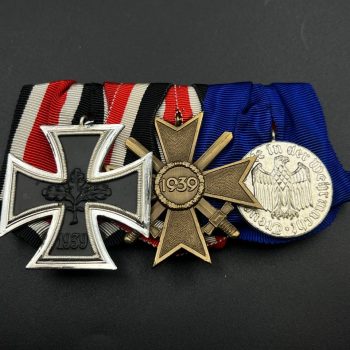
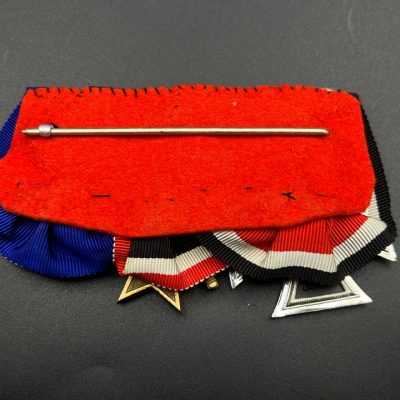
A post-war medal bar assembled in accordance with the 1957 German law permitting veterans to wear “denazified” versions of wartime decorations, redesigned without prohibited symbols. The bar includes:
1. Iron Cross 2nd Class, 1957 Issue (Eisernes Kreuz 2. Klasse, 1957 pattern) — redesigned without the swastika, featuring oak leaves in the center. Nickel-plated frame, black core, original red-white-black ribbon.
2. War Merit Cross 2nd Class with Swords, 1957 Issue (Kriegsverdienstkreuz 2. Klasse mit Schwertern, 1957 pattern) — denazified version in bronze finish, original ribbon.
3. Wehrmacht Long Service Medal, 4th Class, 1957 Issue (Wehrmacht Dienstauszeichnung 4. Klasse, 1957 pattern) — silvered medal with the legal FRG design, on the correct blue ribbon.
The bar is hand-assembled on red backing with a long, full-length pin typical for post-war construction. Excellent condition with minimal wear.
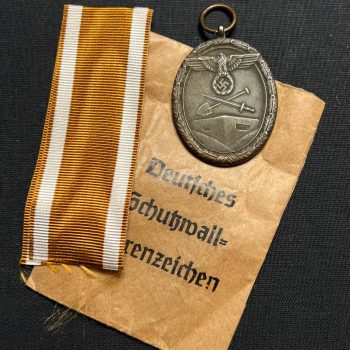
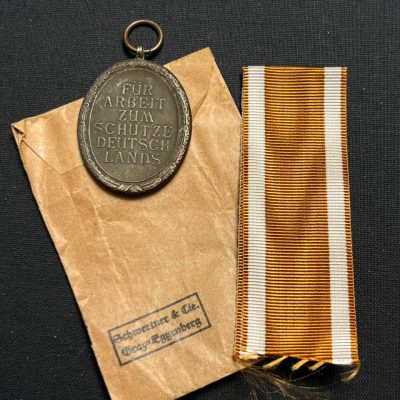
Oval medal with dark-silver finish and sharp relief; reverse marked “Für Arbeit zum Schutze Deutschlands”. Includes original ribbon and maker-marked paper packet (Schworzin & Cie, Graz-Eggenberg). Good collectible condition.
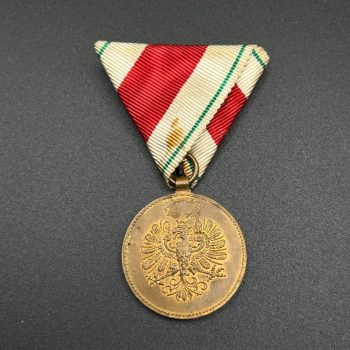
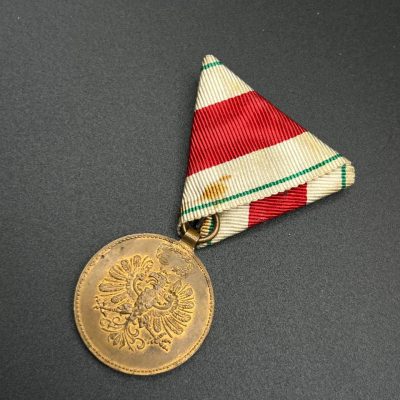
Original Tyrolean Medal, issued in Austria to honor the resistance of Tyrolean militia and local citizens during World War I.
Details:
• Era: World War I, 1914–1918
• Material: Bronze
• Diameter: Approx. 33 mm
• Obverse: Features the Austrian imperial eagle
• Reverse: (Can provide photo if needed)
• Ribbon: Original triangular red and white ribbon with green edging
• Condition: Good vintage condition with some signs of age (see photos)
This medal holds historical and collectible value—a great addition to any collection of Austrian or military memorabilia.
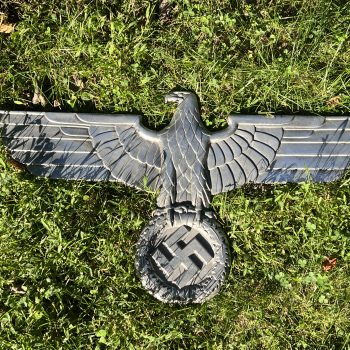
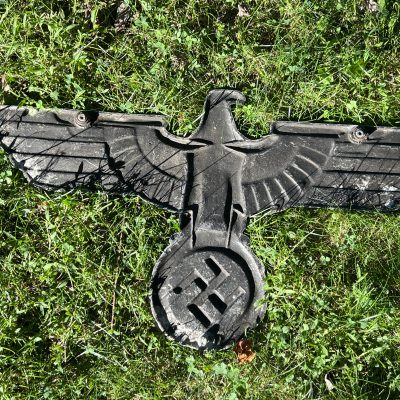
A large original Deutsche Reichsbahn (German State Railways) eagle from the Third Reich period. The eagle is depicted with outstretched wings, clutching a wreath bearing a swastika in its talons. The piece features strong three-dimensional relief, with detailed feathering and wing construction.
The reverse retains stamped/raised manufacturer or production markings, as well as original mounting hardware. The eagle displays an attractive period patina with surface wear, oxidation, scratches, and traces of finish loss consistent with its age and history.
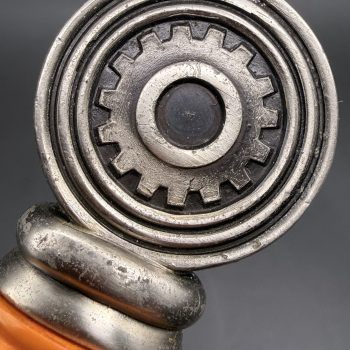
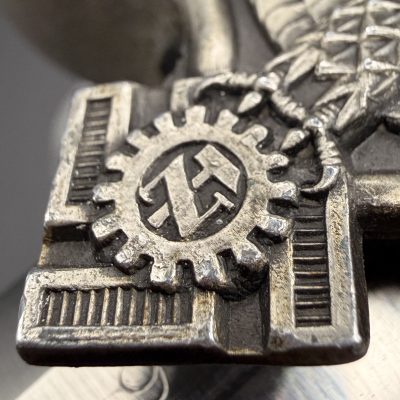
Technical Emergency Corps (TeNo) Leader’s Dagger, Model 1938, manufactured by Carl Eickhorn of Solingen. This example bears the manufacturer’s trademark and retains matching numbers on the blade and scabbard, confirming their factory pairing and attesting to the complete original preservation of the piece.
This dagger model was introduced in November 1938, concurrently with the adoption of new regulation edged weapons for the TeNo organization. It was intended to be worn with dress uniform by commanding officers holding the rank of Stabsscharführer and above. Officers purchased these daggers at their own expense through special organizational outlets.
The history of the Technical Emergency Corps began on September 30, 1919. Throughout the existence of the Weimar Republic, the corps repeatedly distinguished itself, demonstrating efficiency and excellent technical training. Naturally, this organization could not escape the attention of the new leadership, the National Socialist Party. In 1939, to further enhance efficiency, TeNo was transferred to the jurisdiction of the Reich Ministry of Foreign Affairs and subordinated to police structures, allowing for improved operational capacity. Prior to the commencement of the Polish campaign, TeNo was commanded by SS Gruppenführer (SS Lieutenant General) Schmelzer; he was later succeeded in this post by SS Gruppenführer Weinreich.
The Carl Eickhorn company was founded in Solingen in 1865 and became one of the largest manufacturers of edged weapons in Germany. The company’s trademark, featuring a squirrel (Eichhörnchen), served as a guarantee of the highest quality products. During the Third Reich period, the firm produced a wide range of regulation edged weapons, including daggers for all branches of service, SA and SS daggers, NPEA, NSFK, and TeNo daggers, as well as dress daggers, sabers, and swords. Carl Eickhorn products are distinguished by superior steel quality and meticulous finishing, and are highly valued by modern collectors.
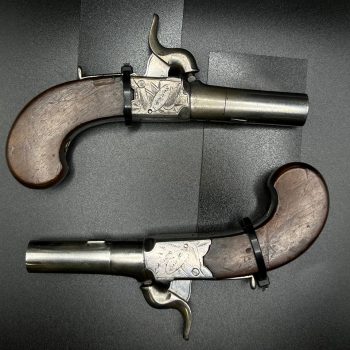
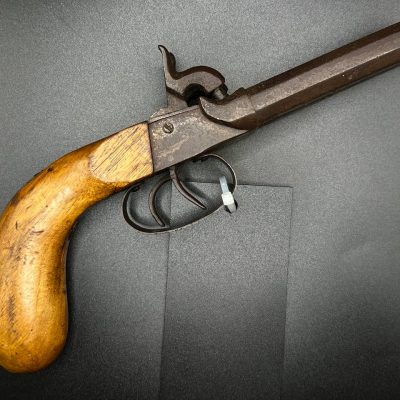
Pair of English Drop Trigger Percussion Pistols Marked H Nock.
Marked with one of England’s premier makers of the period, these guns are likely the fake watches of their day. Both guns are in nice condition with engraved frames and slab butts with vacant silver escutcheons.
Both actions, including push-on safeties, function without problems.
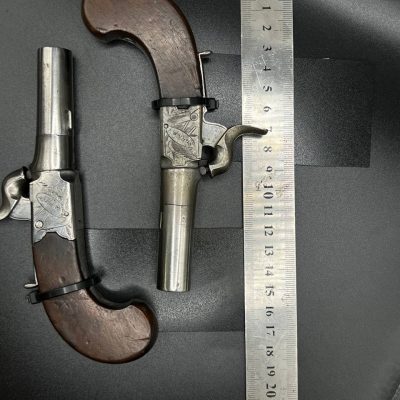
Overall length approximately 5 7/8 inches, with twist off barrels, standard British proofs.