By clicking Login or Register, you agree that the images of Nazi symbols shown on alexmp.com are not propaganda of fascism, Nazism and are shown solely for historical, cognitive and scientific purposes.
Request a callback
Order a free call and our specialist will contact you shortly!
Ask a question
Contact us and we will get back to you shortly.
Request a Blitz Price
Contact us and we will get back to you shortly.
Request a price
Contact us and we will get back to you shortly.
Offer your blitz price
Contact us and we will get back to you shortly.
Error: Contact form not found.
Request a subscription
We will get back to you shortly.
Subscription
В честь запуска Энциклопедии мы рады предложить вам бесплатный доступ до 01.10.2026. Будем рады вашим комментариям и предложениям!
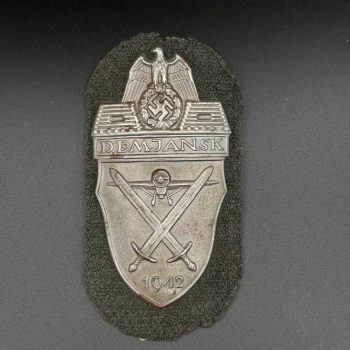
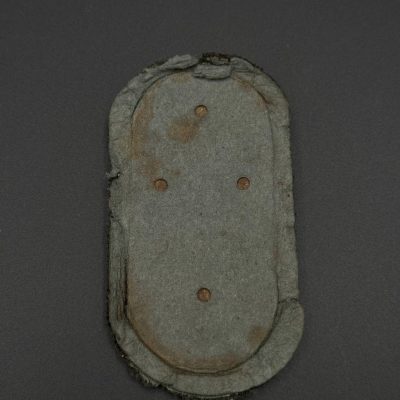
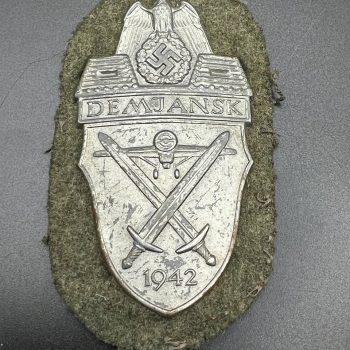
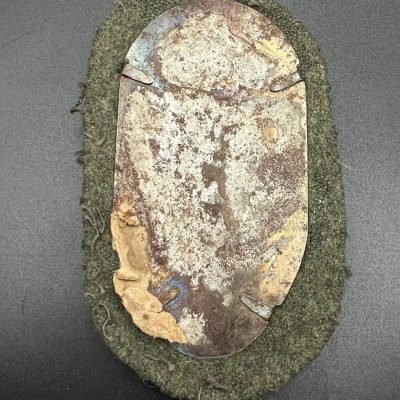
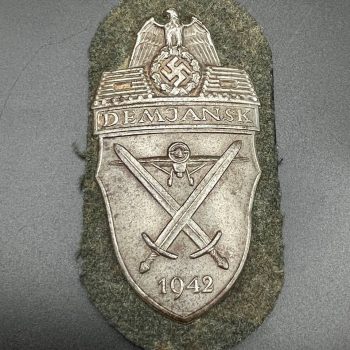
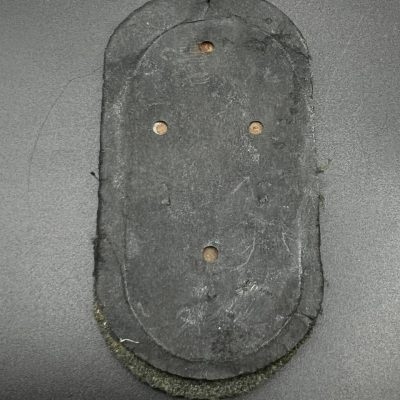
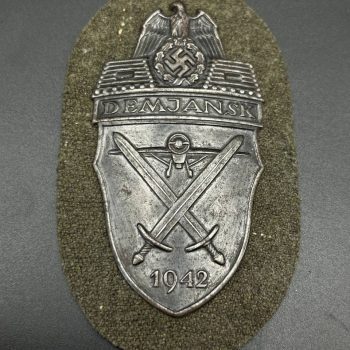
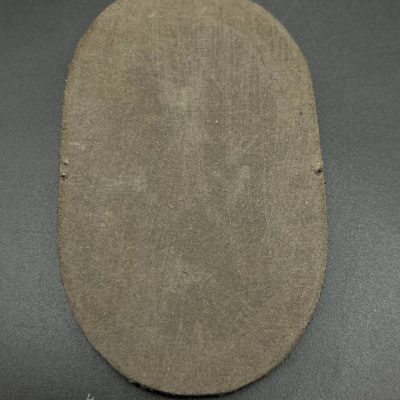
Demjansk arm shield in silver-finish metal on original field-grey wool backing, secured with four copper rivets. Obverse: DEMJANSK inscription, date 1942, crossed swords with aircraft, eagle with swastika wreath at top. Reverse shows typical four-rivet attachment to backing pad. One of the rarest and most coveted German campaign shields — awarded to participants in the Demjansk Pocket encirclement battle.
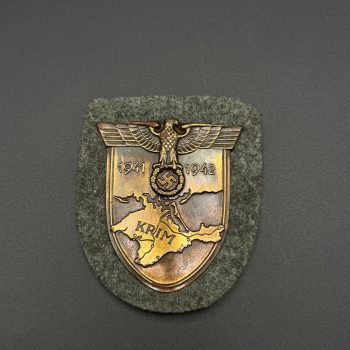
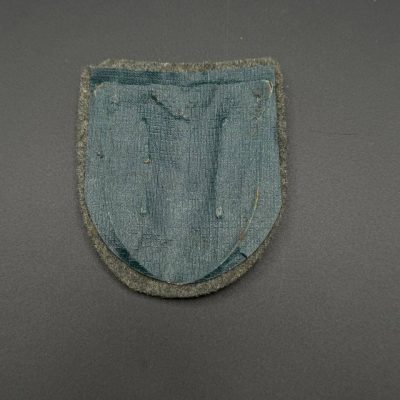
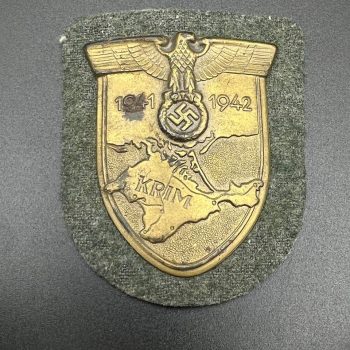
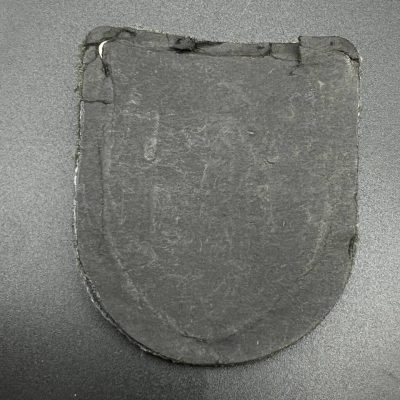
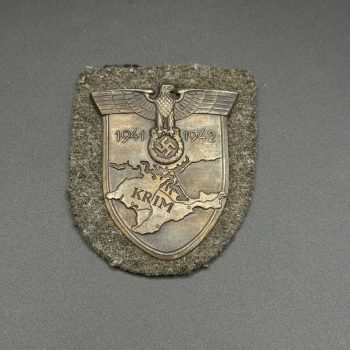
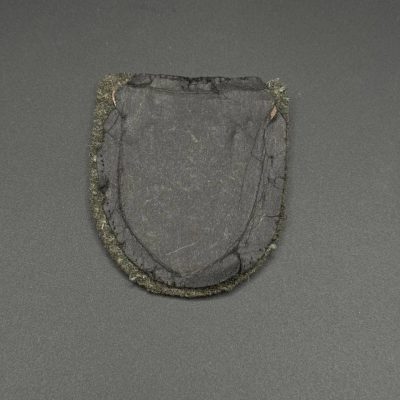
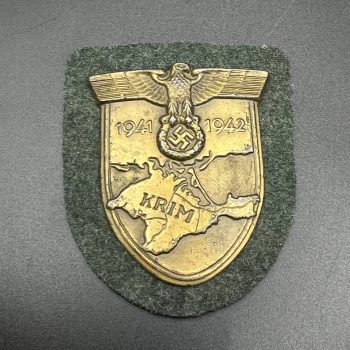
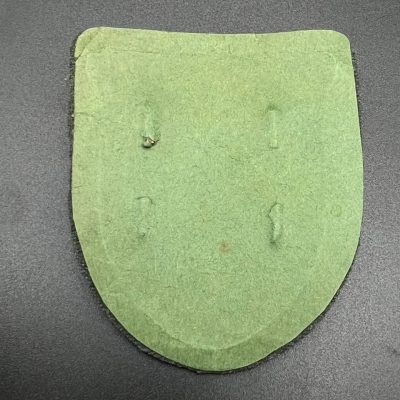
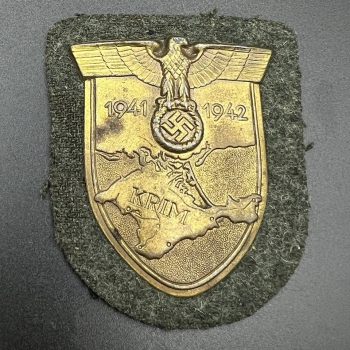
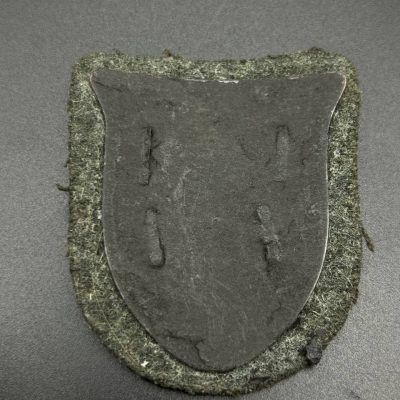
Second Krimschild on original Heer field-grey wool backing. Same bronze shield design — eagle, dates 1941–1942, Crimea map, “KRIM.” Reverse with original fabric backing. Field-grey wool confirms Army attribution. Good overall condition.
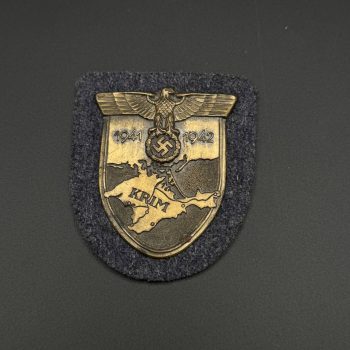
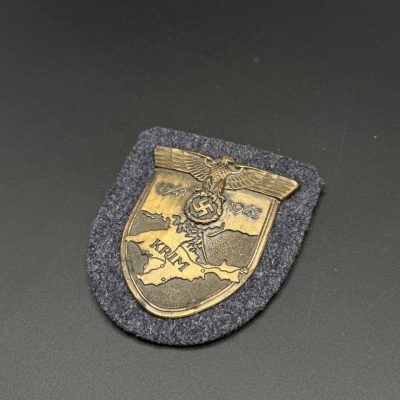
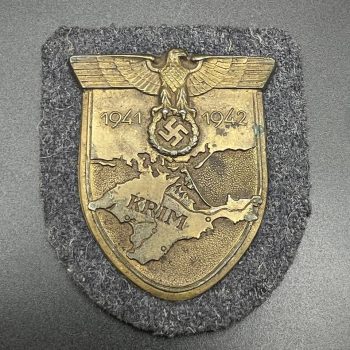
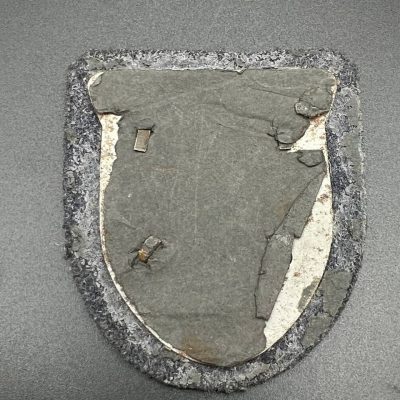
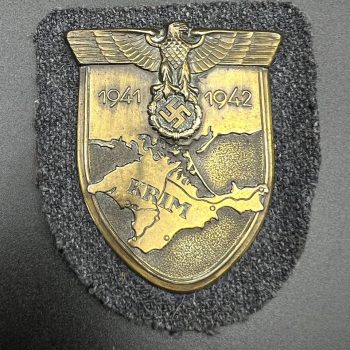
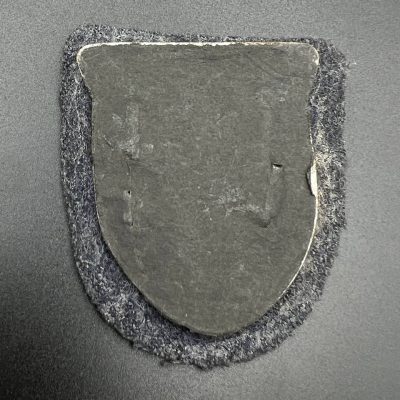
Krimschild campaign arm shield on original Luftwaffe blue-grey wool backing. Bronze-finish metal shield with eagle, dates 1941–1942, and map of Crimea with inscription “KRIM.” Service-worn patina. Blue-grey backing confirms Luftwaffe attribution.
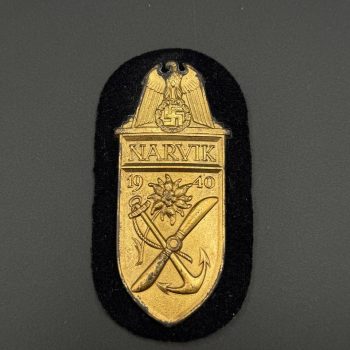
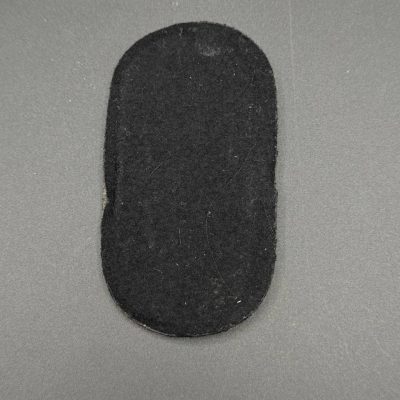
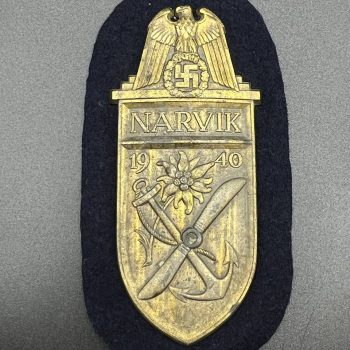
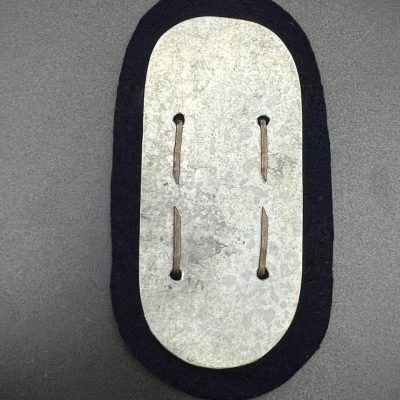
Narvik shield in gilt metal mounted on original black navy wool backing. Obverse: NARVIK inscription, date 1940, eagle with swastika wreath, crossed anchor, sword and edelweiss. Black backing confirms Kriegsmarine attribution. Highly desirable campaign shield — one of the rarest of the five authorized German arm shields.
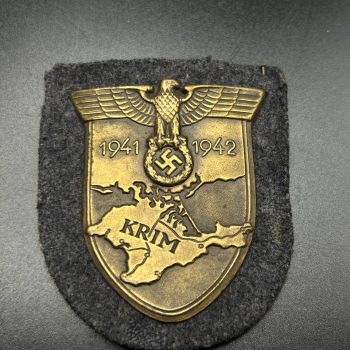
An original 1941–1942 Crimea Shield (Krimschild), produced as a solid brass stamped badge with strong, well-defined relief. The eagle, dates, and Crimea map are crisp, with a natural aged patina and no signs of restoration. The bronze finish is partially retained, typical for worn period examples.
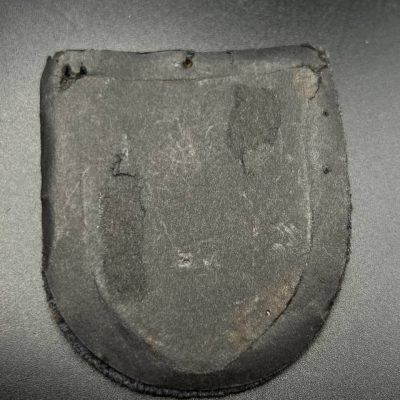
The shield is mounted on its correct dark-grey wool backing with internal cardboard stiffener, matching authentic wartime construction. The reverse shows period attachment marks, consistent with actual wear on the uniform. Overall condition is very good, with original materials fully intact.
Krimschild in silver-finish metal — distinct from the more common bronze variant — on original field-grey wool backing with aged black lining on reverse. Eagle, dates 1941–1942, Crimea map with “KRIM.” Silver finish indicates a different production run. Good display condition.
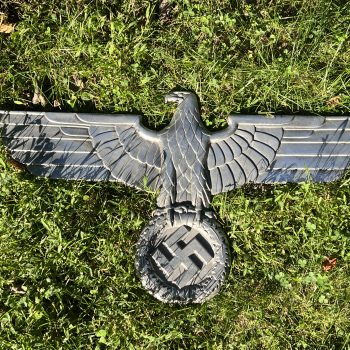
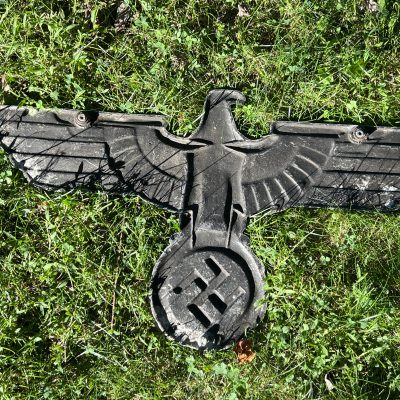
A large original Deutsche Reichsbahn (German State Railways) eagle from the Third Reich period. The eagle is depicted with outstretched wings, clutching a wreath bearing a swastika in its talons. The piece features strong three-dimensional relief, with detailed feathering and wing construction.
The reverse retains stamped/raised manufacturer or production markings, as well as original mounting hardware. The eagle displays an attractive period patina with surface wear, oxidation, scratches, and traces of finish loss consistent with its age and history.
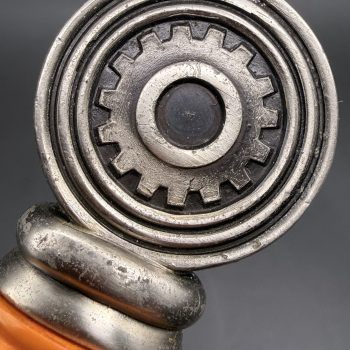
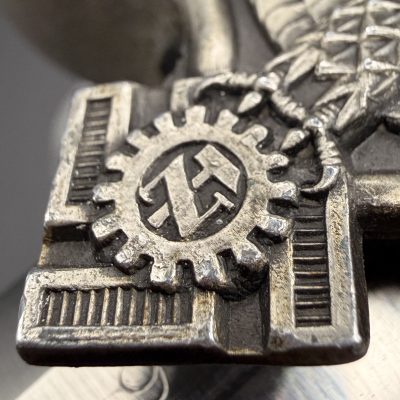
Technical Emergency Corps (TeNo) Leader’s Dagger, Model 1938, manufactured by Carl Eickhorn of Solingen. This example bears the manufacturer’s trademark and retains matching numbers on the blade and scabbard, confirming their factory pairing and attesting to the complete original preservation of the piece.
This dagger model was introduced in November 1938, concurrently with the adoption of new regulation edged weapons for the TeNo organization. It was intended to be worn with dress uniform by commanding officers holding the rank of Stabsscharführer and above. Officers purchased these daggers at their own expense through special organizational outlets.
The history of the Technical Emergency Corps began on September 30, 1919. Throughout the existence of the Weimar Republic, the corps repeatedly distinguished itself, demonstrating efficiency and excellent technical training. Naturally, this organization could not escape the attention of the new leadership, the National Socialist Party. In 1939, to further enhance efficiency, TeNo was transferred to the jurisdiction of the Reich Ministry of Foreign Affairs and subordinated to police structures, allowing for improved operational capacity. Prior to the commencement of the Polish campaign, TeNo was commanded by SS Gruppenführer (SS Lieutenant General) Schmelzer; he was later succeeded in this post by SS Gruppenführer Weinreich.
The Carl Eickhorn company was founded in Solingen in 1865 and became one of the largest manufacturers of edged weapons in Germany. The company’s trademark, featuring a squirrel (Eichhörnchen), served as a guarantee of the highest quality products. During the Third Reich period, the firm produced a wide range of regulation edged weapons, including daggers for all branches of service, SA and SS daggers, NPEA, NSFK, and TeNo daggers, as well as dress daggers, sabers, and swords. Carl Eickhorn products are distinguished by superior steel quality and meticulous finishing, and are highly valued by modern collectors.
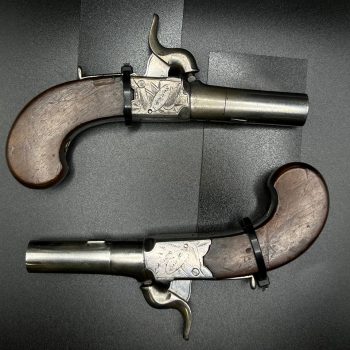
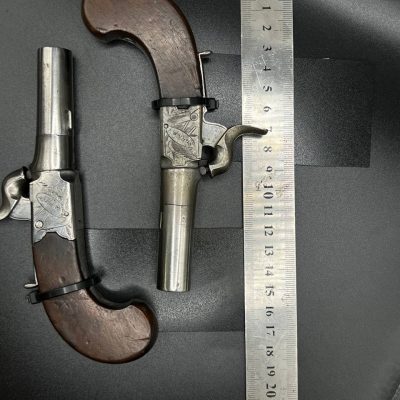
Pair of English Drop Trigger Percussion Pistols Marked H Nock.
Marked with one of England’s premier makers of the period, these guns are likely the fake watches of their day. Both guns are in nice condition with engraved frames and slab butts with vacant silver escutcheons.
Both actions, including push-on safeties, function without problems.
Overall length approximately 5 7/8 inches, with twist off barrels, standard British proofs.