Login
Register
By clicking Login or Register, you agree that the images of Nazi symbols shown on alexmp.com are not propaganda of fascism, Nazism and are shown solely for historical, cognitive and scientific purposes.
Order a free call and our specialist will contact you shortly!
Contact us and we will get back to you shortly.
Contact us and we will get back to you shortly.
Contact us and we will get back to you shortly.
Contact us and we will get back to you shortly.
Error: Contact form not found.
We will get back to you shortly.
В честь запуска Энциклопедии мы рады предложить вам бесплатный доступ до 01.10.2026.
Будем рады вашим комментариям и предложениям!
Inspected and guaranteed by Alex Warstory.
For more details on AlexMP Guarantee, click [HERE]
Item guaranteed by a verified dealer.
Click [HERE] for full seller guarantee terms.
Sold without expert review or guarantees. No claims accepted post-sale.
Learn more [HERE]


Showing all 12 results
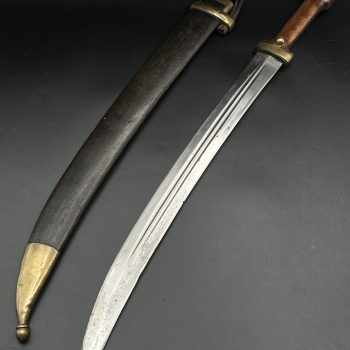
FiltersSoldier’s dagger of the 1907 model, known as the ‘bebut’, manufactured in 1912 at the Zlatoust Arms Factory. The characteristic curved blade and recognizable silhouette make this specimen of cold steel one of the most interesting items in the history of weapons of the Russian Imperial Army.
The Zlatoust Arms Factory, which was one of the leading manufacturers of cold steel weapons in the Russian Empire, produced bebuts for army use in accordance with approved standards. The manufacturer’s mark confirms the authenticity and provenance of this specimen.
Particular collector’s value is represented by the presence of matching serial numbers on the weapon’s components. The coincidence of numbers testifies to the preservation of the complete set in its original configuration and significantly enhances the significance of this item for collectors of military antiques from the late Russian Imperial period.
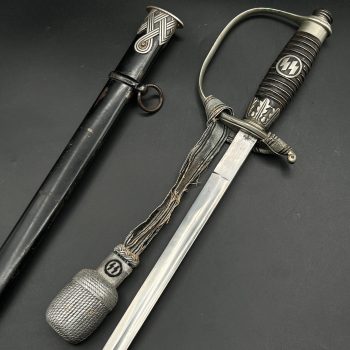
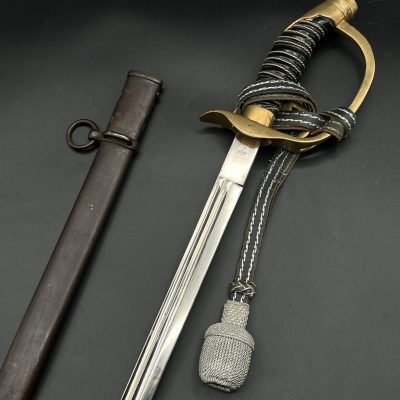
A blade produced by the workshop of Peter Dan Krebs, one of the recognized manufacturers of cold weapons for SS officer personnel, distinguished by impeccable quality of execution and characteristic features inherent to this firm’s products.
A personalized specimen executed to individual commission, which significantly enhances the collectible value of the item and testifies to the sword’s ownership by a specific officer. Such named examples are encountered considerably less frequently than standard serial productions and represent particular interest for collectors of military antiques from the Third Reich period.
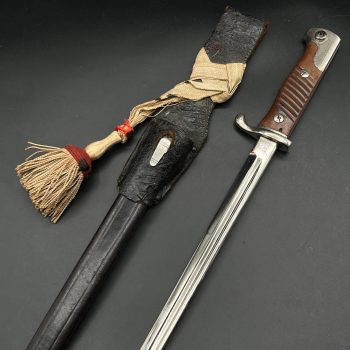
Adopted by the German Army in 1898 alongside the legendary Mauser rifle system, this bayonet became one of the most widespread and recognizable examples of edged weapons at the turn of the nineteenth and twentieth centuries. The blade bears the hallmark of the renowned Solingen firm Clemen & Jung, which specialized in the production of military blades and established itself as a reliable supplier to the German armed forces. The characteristic construction of the Model 1898 bayonet with its distinctive profile and mounting system for the Gewehr 98 rifle makes it a desirable acquisition for collectors of German military antiques and First World War history.
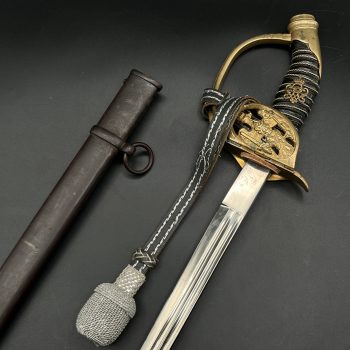
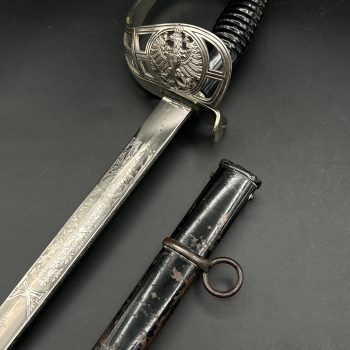
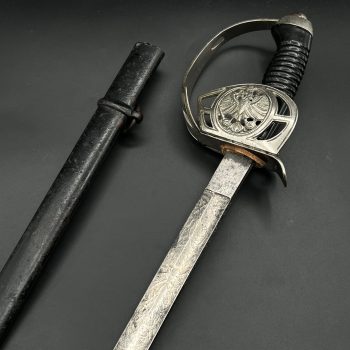
Officer’s cold weapon of the German Empire prior to 1918, belonging to infantry units. Land sabers of this period were distinguished by characteristic structural features dictated by the specific requirements of service in foot troops. Infantry officers carried sabers of a somewhat different pattern than cavalrymen; their blades typically had less curvature and were adapted primarily for parade and everyday wear rather than for mounted combat.
German sabers of this period bear the imprint of the military tradition of numerous German states united in 1871 into a single empire. Each kingdom, duchy, or principality contributed its own elements to the decoration of hilts and scabbards, making the attribution of such specimens a particularly engaging task for the collector. Infantry sabers of Prussian, Bavarian, Saxon, or Württemberg origin may differ substantially in details while maintaining overall similarity in silhouette.
Weapons of this type served as an integral part of officer’s equipment for decades, up until the end of World War I, when the German Empire ceased to exist. The collectible appeal of such objects is determined by their historical significance, quality of execution, and relative rarity on the contemporary antique market.
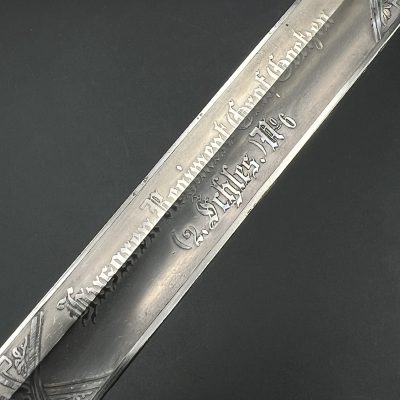
A rare example of a hussar saber belonging to an officer or non-commissioned officer of the 6th Hussar Regiment of the German Empire. Cavalry cold weapons of this period were intended for personnel of dragoon, cuirassier, uhlan, hussar, and other cavalry units and remained in service until the conclusion of World War I in 1918. Sabers, broadswords, and other examples of bladed weapons were an integral part of the equipment of the German cavalry, serving both combat functions and the role of a status attribute for military personnel. The attribution of this specimen to a specific regiment (No. 6) substantially increases its collectible value and presents particular interest for collectors of German military antiquities.
Hussar saber of the German army, which belonged to a serviceman of the 17th Regiment, represents a specimen of cavalry cold weapon of the German Empire. Such weapons were intended for officers and enlisted men of dragoon, cuirassier, uhlan, hussar, and other cavalry regiments and remained in service until the end of World War I in 1918. This category includes sabers, broadswords, and other specimens of bladed weapons that were an integral part of the equipment of German cavalry. The attribution of this specimen to a specific regiment (No. 17) imparts to it particular collector’s value and uniqueness, distinguishing it among other examples of hussar weapons of that period.
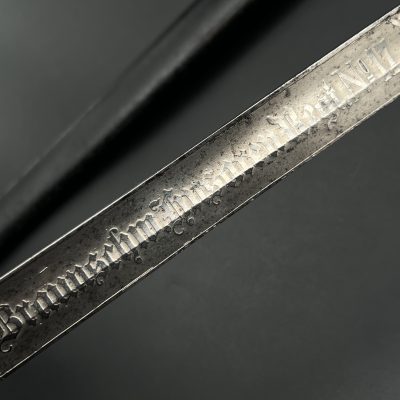
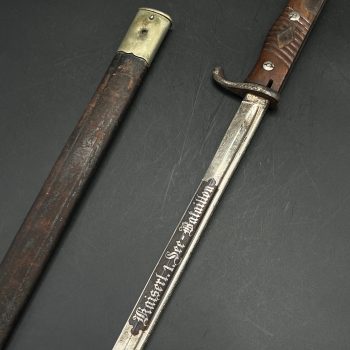
An exemplary specimen of German parade weaponry, produced by the renowned Solingen manufactory WKC, one of the oldest and most respected cold weapon manufacturers in Germany. The Model 1898 bayonet in parade configuration differs from service variants through the presence of decorative etching on the blade, transforming utilitarian weaponry into an object worthy of ceremonial use. Such bayonets were worn by servicemen of the German Army during parades, formal assemblies, and official ceremonies, emphasizing the owner’s status and membership in the military caste. The WKC mark (Weyersberg, Kirschbaum & Cie) on the piece serves as a guarantee of superior manufacturing quality and artistic execution of the etched decoration.
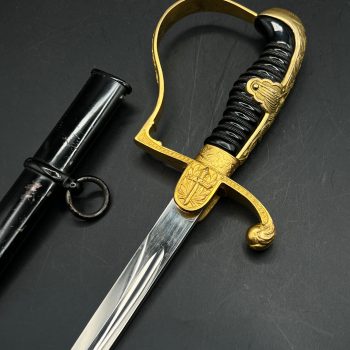
Officer parade weapons, revived following the restoration of the German armed forces, continued the proud traditions of the Imperial Army and the Reichswehr. Unlike the Army dagger model 1935, officer sabers were produced in numerous design variations by various Solingen manufacturers. Production of this type of weapon was discontinued in May 1943 due to wartime industrial demands; however, examples already in service continued to be worn with parade uniforms. In late 1944, the wearing of parade edged weapons was completely abolished, and officers were ordered to carry a pistol instead of a saber or dagger.
The blade bears the mark of the renowned Solingen firm F. W. Höller Waffenfabrik, founded in 1866 and officially registered with the Solingen authorities on 5 June 1883. From its founding, the company specialized in the production of edged weapons and cutlery. Throughout the late 19th century and during the First World War, the firm manufactured a wide range of military products, including bayonets, sabers, and swords. In 1905, the company registered its well-known trademarks: the thermometer image, as well as the figure of a man tipping his hat with the inscription “Hut ab!” (“Hats off!”). From 1914 to 1939, the firm was managed by Julius Küller. During the Third Reich period, Höller became one of the largest and most prolific edged weapons manufacturers in Solingen, specializing in a broad range of military products. In 1935, the company was located at Sonnenstraße 8, Solingen, and that same year received RZM license M7/33. Products were actively advertised in specialized journals and catalogs, showcasing an extensive assortment that included NSDAP and Wehrmacht daggers, swords, and bayonets. The firm also produced parade bayonets with high-quality etched blades. In 1941, Höller celebrated its 75th anniversary, promoting the Höller Model 21 sword as its flagship model. In June 1941, the company was assigned the K98 bayonet manufacturer letter code (fze). Following the end of the Second World War, under the ownership of Herr Grah, the firm continued operations, producing cutlery, kitchen and professional knives, swords, and scissors through the 1970s. The company was officially liquidated in December 1974. Particular collector value is added to this example by a rare decorative detail: an additional eagle on the grip backstrap, distinguishing this saber from standard production specimens.
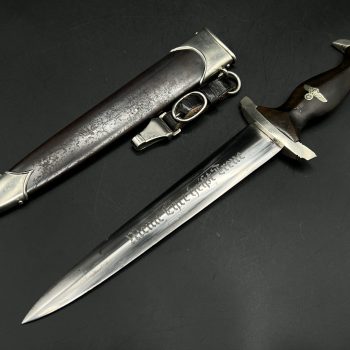
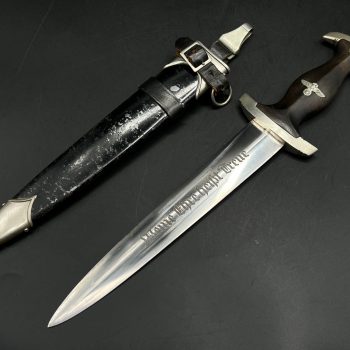
The first official cold weapon of the Schutzstaffel, introduced in 1933, became one of the most recognizable symbols of the organization. The dagger’s design traces back to sixteenth-century Swiss daggers known as Holbein daggers and closely resembles the SA dagger adopted at approximately the same time. The blade bears the motto ‘Meine Ehre heißt Treue’ (‘My honor is loyalty’), which became one of the principal symbols of the SS. In the organization’s early years, the dagger was regarded not only as an element of uniform and symbol of SS membership, but also as personal cold steel that the owner could use when necessary.
Early SS daggers produced before 1936 were distinguished by nickel-silver fittings on the hilt and scabbard, high manufacturing quality, and careful assembly of components. The scabbards typically featured an anodized finish, although original painted variants are also encountered. Blades most often bore maker’s marks with the manufacturer’s company name; early RZM stamps are sometimes present. From 1936 onward, the construction gradually simplified; zinc, aluminum, and steel scabbard fittings came into use, along with painted scabbards. Transitional stamps appeared bearing the manufacturer’s logo and RZM code, followed later by RZM markings alone. Early daggers were produced in smaller quantities and typically saw extended service wear, making mint and near-mint condition examples extremely rare. Minor chips to the hilt and signs of use are entirely normal for these pieces. Special attention should be paid to restorations and later assembly; should such interventions be present, they are separately noted in the item’s description.
Robert Klaas ranks among the most sought-after manufacturers of German cold weapons by collectors. A characteristic feature of many Klaas products is their contrasting bluing and high-quality finishing, which has often allowed decorative elements to remain well preserved to the present day. The company operated in Solingen and produced parade and combat cold weapons, bayonets and components, and participated in the manufacture of experimental samples for military industry. In 1944, the production facilities of Robert Klaas, like much of Solingen’s weapons industry, suffered damage from Allied bombing.
The stamp ‘I’ on the reverse of the lower crossguard of this early SS dagger indicates the SS distribution and inspection center in Munich (München). Such marking is characteristic of early daggers from the 1933–1935 period and represents an important feature of the original SS dagger acceptance and distribution system.
Includes suspension loop with 1938 maker’s mark.
The official Schutzstaffel edged weapon pattern, introduced in 1933, became the first SS dagger and one of the most recognizable symbols of this organization. The blade design derives from 16th-century Swiss daggers known as Holbein daggers, and visually bears considerable resemblance to the SA dagger, which was adopted at nearly the same time. The blade featured the motto “Meine Ehre heißt Treue” (“My Honor is Loyalty”), which became one of the principal symbols of the SS. In the early years of the organization, the dagger was regarded not merely as a uniform element and a mark of SS membership, but also as a personal edged weapon that the owner could use if necessary.
In 1934, a certain number of SS members were awarded honor daggers bearing a facsimile of Ernst Röhm’s signature and the dedication “In herzlicher Kameradschaft” (“In Heartfelt Comradeship”) on the reverse of the blade. Following the “Night of the Long Knives” and the elimination of the SA leadership in the summer of 1934, Röhm’s name became undesirable, and an order was issued to remove his dedication from the award daggers. Surviving examples display various methods of such removal, ranging from complete grinding of the entire inscription to partial removal of only Röhm’s facsimile. Of particular interest are the so-called “Lazy Röhms,” on which Röhm’s name was only partially removed or essentially scratched out, leaving a significant portion of the original dedication visible. An intermediate variant also exists: Röhm’s facsimile is completely removed, yet the text “In herzlicher Kameradschaft” remains untouched. Such removal allowed the direct connection to Röhm to be eliminated while preserving visible evidence of the owner’s original award. The traces of removal in this case do not constitute a blade defect; rather, they represent an important historical and attributional feature. All else being equal, examples with completely removed dedications are typically valued at the level of ordinary early SS daggers, whereas pieces retaining elements of the dedication hold greater collector interest. “Lazy Röhms” are especially prized, with the degree of preservation of the original inscription being significant. Examples with Röhm’s facsimile completely removed but the dedication text preserved occupy an intermediate position.
The firm Richard Herder of Solingen was one of the edged weapon manufacturers for Third Reich organizations and participated in the production of SA daggers as early as 1934. This is confirmed, in particular, by surviving early Richard Herder daggers bearing Ernst Röhm’s dedication, as well as examples on which this inscription was subsequently officially removed following the events of summer 1934. Thus, Richard Herder belongs to the manufacturers whose participation in SA dagger production is documented from the very earliest period of their manufacture.
The marking ‘cof 44’ on this bayonet model 1884/1898 for the Mauser rifle model 1898 indicates production in 1944 at the renowned Carl Eickhorn factory in Solingen, which operated under the military code ‘cof’. This marking is characteristic of late-period German bayonets from World War II, when manufacturers used three-letter codes instead of full names for purposes of secrecy.
The blade has never been sharpened, which represents particular value to collectors. Such condition testifies to minimal combat use of the item or its storage in military arsenals. The absence of resharpening marks has preserved the original blade geometry, which significantly enhances the collectible value of this specimen.
Matching serial numbers on both the blade and scabbard confirm their original pairing from the time of manufacture. Such examples are encountered significantly more rarely due to combat losses and post-war reassembly, when bayonets and scabbards were often permanently separated. The preservation of the original matched set gives this lot special appeal to serious collectors of German edged weapons.
A service edged weapon of the SA (Sturmabteilung) storm troopers, adopted in 1933. The distinctively shaped blade with double-sided sharpening bears the legendary motto “Alles für Deutschland.” The handle is made of brown-colored wood and decorated with the SA emblem featuring an eagle; the metal scabbard is finished in the same brown tone.
The early type of SA/NSKK daggers was produced between 1933 and 1936 and is distinguished by a number of characteristic design features. The scabbard and handle fittings are made of nickel silver (German silver), which, combined with the high quality of component fitting and the anodized scabbard coating, sets these examples apart from later production runs. This dagger was manufactured by Stöcker & Co. SMF. Early examples are particularly prized by collectors due to their impeccable craftsmanship and historical significance as the first service daggers of the storm troopers.
A rarity rating of 5 out of 10 according to the Ralf Siegert classification indicates that such examples are relatively uncommon on the antiques market.
The naval saber was a mandatory attribute of the dress uniform of officers in the Kaiserliche Marine. During the period of Kaiser’s Germany, the imperial anchor beneath the Kaiser’s crown was characteristic in the design of the hilt. The classical variant featured a brass hilt, ivory grip, and a lion’s head with eyes of red and green color. The scabbard was typically made of black leather with brass fittings; steel scabbards are considerably rarer. Sabers were purchased by officers at their own expense, which resulted in numerous variations of execution. Standard and Damascus blades can be found, various hilt designs and decorative scabbard finishes, as well as several sizes ranging from light and elegant to large Grosse Pattern models. It is precisely this diversity of execution that makes naval sabers a particularly interesting independent field of collecting: collections can be built according to manufacturers, sizes, hilt types, blades, and finishing variations. Along with the dirk, the saber remained a symbol of officer status and the continuity of German naval weaponry traditions of the nineteenth century.
E. & F. Hörster, one of the largest Solingen manufacturers of naval edged weapons, operated from the nineteenth century and continued production during the Weimar Republic and the Third Reich. The firm produced high-quality naval sabers and dirks in various execution variants. Already before World War I, Hörster products were supplied not only for the German market but were also exported to other European countries, including the Russian Empire. Thanks to its long operational period, Hörster products allow one to trace the development of naval edged weapons from the Kaiser era to the Kriegsmarine.
Seebataillone represented naval infantry units of the Kaiserliche Marine. There were several marine battalions, and the custom-made edged weapons associated with them constitute a separate field of collecting German naval weaponry. A characteristic feature of such items is the combination of naval and infantry attributes. For example, an officer’s saber could feature a traditional naval hilt and blade but be equipped with steel infantry-type scabbards. Custom specimens frequently bear personal dedications from one officer to another or from the officer corps to a specific serviceman of a Seebataillon. In addition to officer sabers and other custom edged weapons, this group includes infantry-type bayonets for Mauser system rifles with Seebataillone designations and symbols. Most such items bear unit designations; however, named specimens also occur, representing particular collecting interest.
This saber features a characteristic openwork pierced hilt, presented in the catalogs of several manufacturers; however, it did not correspond to the established standard for Kaiserliche Marine edged weapons and was subsequently prohibited from being worn. It is precisely this unusual feature that makes such sabers particularly desirable among collectors today. Such specimens were predominantly ordered as presentation weapons, for example upon an officer’s transfer to another unit or upon his retirement from service, and served as an object of special pride for the owner. The present specimen is entirely original; the factory riveting of the hilt remains intact, the saber has not been disassembled, and retains its original configuration.
The first official cold weapon of the Schutzstaffel, introduced in 1933 and created based on Swiss daggers of the 16th century, known as Holbein daggers. In appearance, it bore considerable resemblance to the SA dagger, adopted at approximately the same time. The blade bore the motto ‘Meine Ehre heißt Treue’ (‘My Honor is Called Loyalty’), which became one of the principal symbols of the SS. In the early years of the organization’s existence, the dagger was regarded not only as an element of uniform and a symbol of SS membership, but also as a personal cold weapon that its owner could use when necessary.
Early SS daggers produced before 1936 were distinguished by nickel-silver fittings on the hilt and scabbard, high quality of manufacture, and careful assembly of components. Scabbards typically featured an anodized finish, although original painted variants do occur. Blades most commonly bore a maker’s mark with the manufacturer’s name; early RZM stamps are occasionally encountered. From 1936 onward, the construction was gradually simplified; zinc, aluminum, and steel fittings for scabbards came into use, along with painted scabbards. Transitional stamps bearing the manufacturer’s logo and RZM code appeared, followed later by RZM stamps alone. Early daggers were produced in smaller quantities and typically saw longer periods of wear; consequently, specimens in mint and near-mint condition are extremely rare. Minor chips to the hilt and signs of use are quite normal for such pieces. Particular attention should be paid to restorations and later assembly; any such interventions are noted separately in the item description.
Robert Klaas ranks among the most sought-after manufacturers of German cold weapons by collectors. A characteristic feature of many Klaas products is their contrasting bluing and high quality of finish, thanks to which decorative elements often remain well-preserved to the present day. The firm operated in Solingen and produced dress and combat cold weapons, bayonets and fittings, and also participated in the manufacture of experimental samples for military industry. In 1944, the production facilities of Robert Klaas, like a significant portion of Solingen’s weapons industry, suffered damage as a result of Allied bombing.
The stamp ‘I’ on the reverse side of the lower crossguard indicates the SS distribution and inspection center in Munich. Such marking is characteristic of early daggers from the period 1933-1935 and represents an important feature of the initial SS dagger acceptance and distribution system.
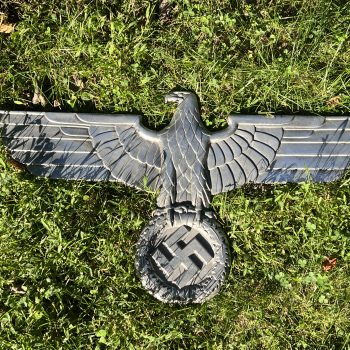
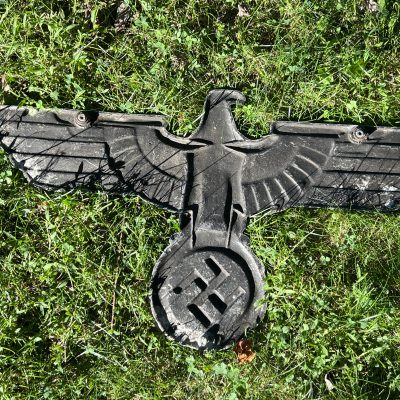
A large original Deutsche Reichsbahn (German State Railways) eagle from the Third Reich period. The eagle is depicted with outstretched wings, clutching a wreath bearing a swastika in its talons. The piece features strong three-dimensional relief, with detailed feathering and wing construction.
The reverse retains stamped/raised manufacturer or production markings, as well as original mounting hardware. The eagle displays an attractive period patina with surface wear, oxidation, scratches, and traces of finish loss consistent with its age and history.
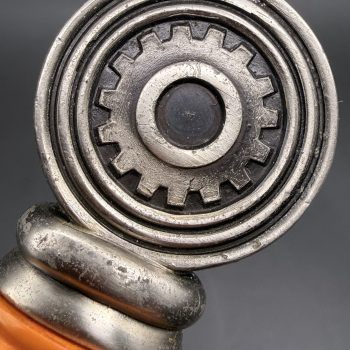
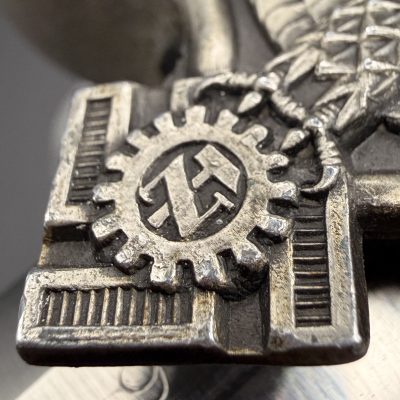
Technical Emergency Corps (TeNo) Leader’s Dagger, Model 1938, manufactured by Carl Eickhorn of Solingen. This example bears the manufacturer’s trademark and retains matching numbers on the blade and scabbard, confirming their factory pairing and attesting to the complete original preservation of the piece.
This dagger model was introduced in November 1938, concurrently with the adoption of new regulation edged weapons for the TeNo organization. It was intended to be worn with dress uniform by commanding officers holding the rank of Stabsscharführer and above. Officers purchased these daggers at their own expense through special organizational outlets.
The history of the Technical Emergency Corps began on September 30, 1919. Throughout the existence of the Weimar Republic, the corps repeatedly distinguished itself, demonstrating efficiency and excellent technical training. Naturally, this organization could not escape the attention of the new leadership, the National Socialist Party. In 1939, to further enhance efficiency, TeNo was transferred to the jurisdiction of the Reich Ministry of Foreign Affairs and subordinated to police structures, allowing for improved operational capacity. Prior to the commencement of the Polish campaign, TeNo was commanded by SS Gruppenführer (SS Lieutenant General) Schmelzer; he was later succeeded in this post by SS Gruppenführer Weinreich.
The Carl Eickhorn company was founded in Solingen in 1865 and became one of the largest manufacturers of edged weapons in Germany. The company’s trademark, featuring a squirrel (Eichhörnchen), served as a guarantee of the highest quality products. During the Third Reich period, the firm produced a wide range of regulation edged weapons, including daggers for all branches of service, SA and SS daggers, NPEA, NSFK, and TeNo daggers, as well as dress daggers, sabers, and swords. Carl Eickhorn products are distinguished by superior steel quality and meticulous finishing, and are highly valued by modern collectors.

![Russian Model 1907 Soldier’s Dagger (Bebut) Russian Empire [Weapons Factory Zlatoust] Matching numbers 1912](https://alexmp.com/wp-content/uploads/2026/09/1790361073532-hja8jtnway6-400x400.jpeg)
![SS Officer’s Sword. [Peter Dan Krebs]. Personalization](https://alexmp.com/wp-content/uploads/2026/09/1790361012656-28w5sagyp3w-400x400.jpeg)
![Bayonet, Model 1898. [Clemen & Jung].](https://alexmp.com/wp-content/uploads/2026/09/1790286189125-wquu9s9l8ym-400x400.jpeg)
![Etched Bayonet, Model 1898. [WKC].](https://alexmp.com/wp-content/uploads/2026/09/1789686671288-okch0ocebah-400x400.jpeg)
![Officer sword of Third Reich [FW. Höller]. With an additional eagle on the back of the grip](https://alexmp.com/wp-content/uploads/2026/09/1789686494288-yzkbrfazvk-400x400.jpeg)
![SS Dagger, Model 1933. (Early type). [Robert Klaas]. Stamp – I.](https://alexmp.com/wp-content/uploads/2026/09/1789683178998-9z7gm3a6syw-400x400.jpeg)
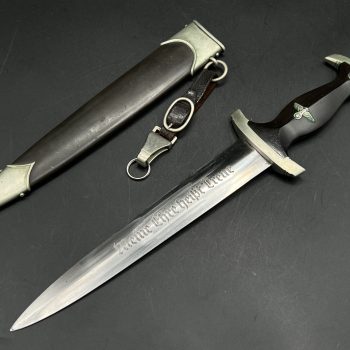
![SS Dagger, Model 1933. (with the Röhm dedication ground off). [Richard Albrecht Herder].](https://alexmp.com/wp-content/uploads/2026/09/1789683006033-1r4qka6ed64-400x400.jpeg)
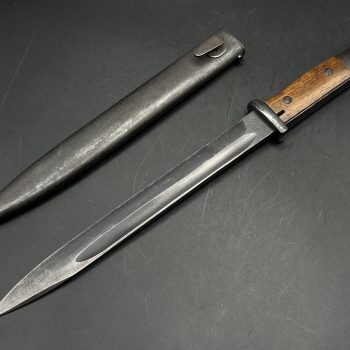
![Bayonet model 1884/1898 for the Mauser rifle model 1898. 1944 – cof 44. [Carl Eickhorn]. Unsharpened blade. Matching numbers.](https://alexmp.com/wp-content/uploads/2026/09/1789687580694-rpwqvaw6fk7-400x400.jpeg)
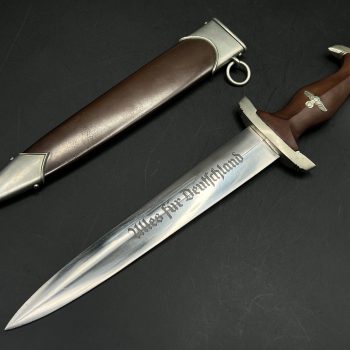
![SA Service Dagger (Early type). [Stöcker & Co. SMF]. Rarity 6/10](https://alexmp.com/wp-content/uploads/2026/09/1789687669012-dhjyhj17vk-400x400.jpeg)
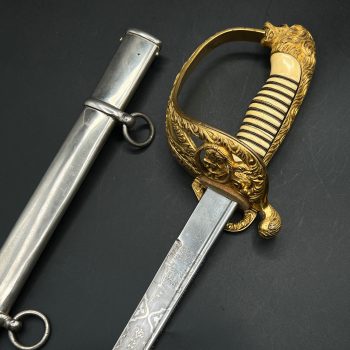
![Imperial German Navy Officer’s Sword [E. & F. Horster]. Marine Corps (Seebataillon)](https://alexmp.com/wp-content/uploads/2026/09/1789686030894-wm81ct25z8n-400x400.jpeg)
![SS Dagger, Model 1933. (Early type). [Robert Klaas]. Stamp – I. SS ID Number](https://alexmp.com/wp-content/uploads/2026/09/1789683422849-4z7tl53pjc7-400x400.jpeg)