By clicking Login or Register, you agree that the images of Nazi symbols shown on alexmp.com are not propaganda of fascism, Nazism and are shown solely for historical, cognitive and scientific purposes.
Request a callback
Order a free call and our specialist will contact you shortly!
Ask a question
Contact us and we will get back to you shortly.
Request a Blitz Price
Contact us and we will get back to you shortly.
Request a price
Contact us and we will get back to you shortly.
Offer your blitz price
Contact us and we will get back to you shortly.
Error: Contact form not found.
Request a subscription
We will get back to you shortly.
Subscription
В честь запуска Энциклопедии мы рады предложить вам бесплатный доступ до 01.10.2026. Будем рады вашим комментариям и предложениям!
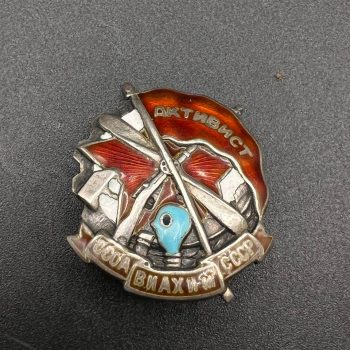
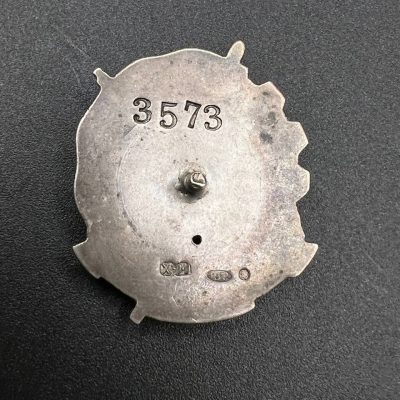
In silver and enamels. Measures 35.0 mm in height (from the bottom of the badge to the top point of the banner, not including the flagpole finial); 31.0 mm in width (near the bottom, along the swallow-tail scroll). Stamped serial number “3573” to the reverse. The reverse also shows sterling silver hallmark “916”, additional assay inspection hallmark and Cyrillic maker mark “KhEM”. Extremely nice quality, characteristic of the award badges of the early 30s.
In very fine condition overall. The obverse is very fine to excellent, with nicely preserved showing attractive original luster. There are minor scratches and contact marks to enamel but they are not easily noticeable to the naked eye. There are no chips or flaking anywhere. The details are well preserved and crisp; the only visible flaw is a small dent on the rifle butt. The reverse is pristine and shows attractive patina. The silver screw post has been reduced for wearing convenience as was customary but its remaining length of over 4 mm is enough to accommodate a screw plate. The wing nut marked “Vsekokhudoznik, Moscow” is of the period although probably not original to the badge.
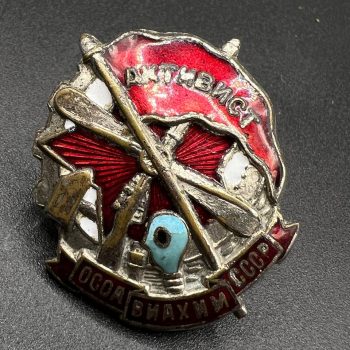
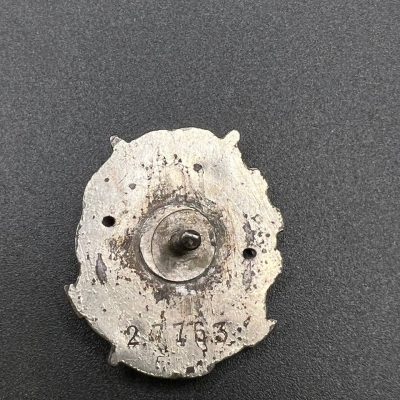
In bronze-plated and nickel-plated steel, enamels; 36.6 x 30.0 mm. Very uncommon version featuring hollow construction formed by a flat back plate with two vent holes. The serial number is stamped in the lower portion of the reverse.
In very fine condition. The enamel is mostly intact, with only a few small contact marks and tiny flakes, practically unnoticeable; still has its original luster. The silver finish shows very light wear to high points but is mostly intact otherwise. The screw post might have been replaced at some point and the screw plate, although of the period, is probably not original to the badge.
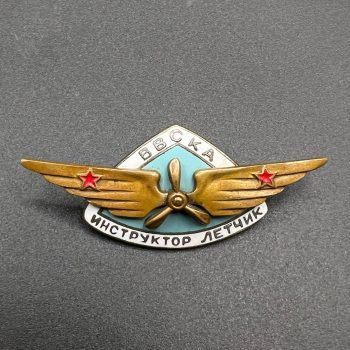
Brass, enamels; measures 24.5 mm in height, 60.4 mm in width; the width of the enameled portion is 37.0 mm; weighs 11.7 g without the screw plate. Three-piece construction: the propeller and wings are separate parts attached to the enameled triangular base by wires.
In excellent condition. The enamel is essentially perfect and shows a beautiful luster; there are only some microscopic contact marks that are completely unnoticeable to the naked eye. Unlike the sky-blue and white enamels in the center, the red enamel on the stars is the “cold” variety as it is supposed to be; it is of lighter shade of red than on most other badges of this type we have seen, but the color may vary and there are no obvious signs that it has been restored. The enamel in the center is unquestionably original. Traces of the original silver finish are clearly visible on the vertical edges of the propeller and wings, while the silver plating on the reverse is clearly visible throughout. The wire attachment is sound and relatively tight, allowing only a very minimal movement of the superimposed parts.
The screw post is nearly 9 mm in length, has not been shortened, and includes original screw plate maker-marked Lenizo Enamel Factory.
There is some debate among collectors about the exact time when this badge was introduced: according to many sources such as Avers 8, it was issued from 1943-45. We believe that it was instituted and manufactured immediately after the end of the Patriotic War and awarded for just a few years up until 1949. Judging by the inscription referring to the Red Army, it was designed and produced before mid-1946 (when the official designation changed to the Soviet Army). It is therefore not inconceivable that this badge could be worn at the end of WW2 by a pilot participating in the Soviet “blitz” campaign against Japan.
These very scarce Soviet Air Force wings are not to miss out on!
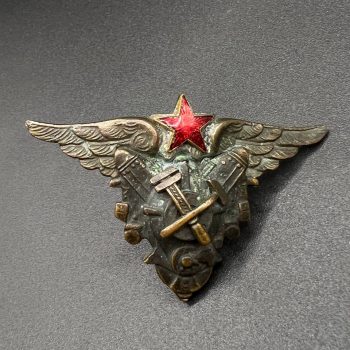
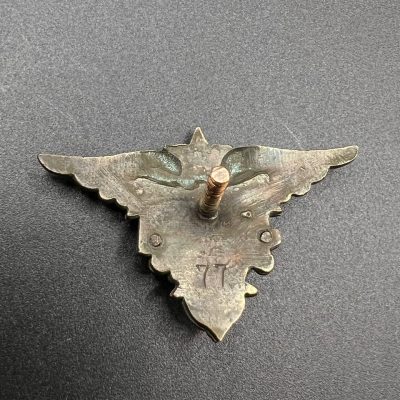
Brass, silver plating, enamel. Measures 35.6 mm in height, 53.6 mm in width; weighs 13.1 g without the screw plate. Massive riveted four- piece construction: the enameled red star, technical branch emblem of hammer and wrench, and aircraft engine are separate parts superimposed on the winged base. Engraved serial number to the reverse.
Excellent condition. The enamel on the star is essentially perfect and shows a beautiful luster; it has only a couple of microscopic contact marks that are completely invisible to the naked eye and none of the usual chips, flaking, rubbing or repairs. The silver plating on the wings, aircraft motor and the reverse is well-preserved, having only a minor amount of wear to the high points and exhibiting a very attractive uniform patina. There is a small amount of verdigris on the obverse under the star, greatly exaggerated in our enlarged photos but not detractive in the least in real life. The original copper screw post is full-length, approx. 14 mm. The unmarked screw plate is a replacement but works perfectly with the screw.
This piece is one of the first Soviet Air Force graduation badges, the type issued for only two years. In 1938, this series was replaced by a new series of badges, unnumbered, lighter-weight and of more streamlined design. The badges of the first series are rare. It is due in large part to the terrible attrition suffered by the Soviet Air Force cadres in the first weeks and months following the German invasion of the Soviet Union in June 1941. It also must be mentioned that the number of graduates of Soviet military aviation schools increased dramatically just before WW2, which of course reflects on the rarity of the early AF school badges in comparison with the 1938 series.
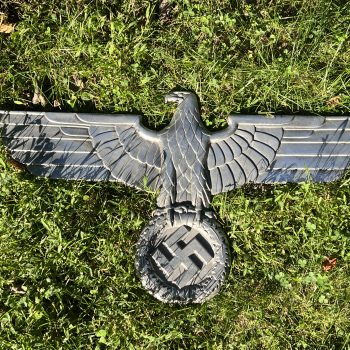
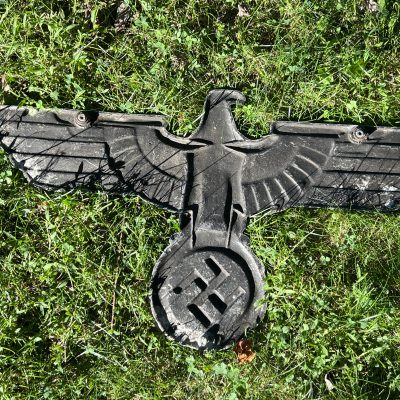
A large original Deutsche Reichsbahn (German State Railways) eagle from the Third Reich period. The eagle is depicted with outstretched wings, clutching a wreath bearing a swastika in its talons. The piece features strong three-dimensional relief, with detailed feathering and wing construction.
The reverse retains stamped/raised manufacturer or production markings, as well as original mounting hardware. The eagle displays an attractive period patina with surface wear, oxidation, scratches, and traces of finish loss consistent with its age and history.
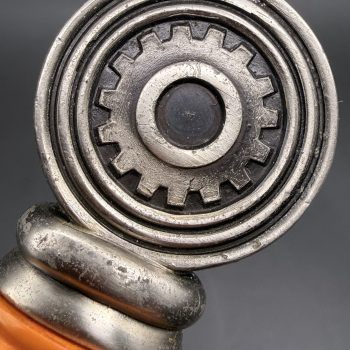
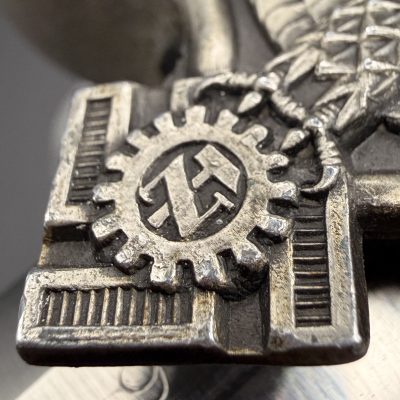
Technical Emergency Corps (TeNo) Leader’s Dagger, Model 1938, manufactured by Carl Eickhorn of Solingen. This example bears the manufacturer’s trademark and retains matching numbers on the blade and scabbard, confirming their factory pairing and attesting to the complete original preservation of the piece.
This dagger model was introduced in November 1938, concurrently with the adoption of new regulation edged weapons for the TeNo organization. It was intended to be worn with dress uniform by commanding officers holding the rank of Stabsscharführer and above. Officers purchased these daggers at their own expense through special organizational outlets.
The history of the Technical Emergency Corps began on September 30, 1919. Throughout the existence of the Weimar Republic, the corps repeatedly distinguished itself, demonstrating efficiency and excellent technical training. Naturally, this organization could not escape the attention of the new leadership, the National Socialist Party. In 1939, to further enhance efficiency, TeNo was transferred to the jurisdiction of the Reich Ministry of Foreign Affairs and subordinated to police structures, allowing for improved operational capacity. Prior to the commencement of the Polish campaign, TeNo was commanded by SS Gruppenführer (SS Lieutenant General) Schmelzer; he was later succeeded in this post by SS Gruppenführer Weinreich.
The Carl Eickhorn company was founded in Solingen in 1865 and became one of the largest manufacturers of edged weapons in Germany. The company’s trademark, featuring a squirrel (Eichhörnchen), served as a guarantee of the highest quality products. During the Third Reich period, the firm produced a wide range of regulation edged weapons, including daggers for all branches of service, SA and SS daggers, NPEA, NSFK, and TeNo daggers, as well as dress daggers, sabers, and swords. Carl Eickhorn products are distinguished by superior steel quality and meticulous finishing, and are highly valued by modern collectors.
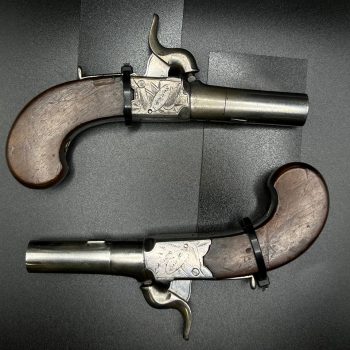
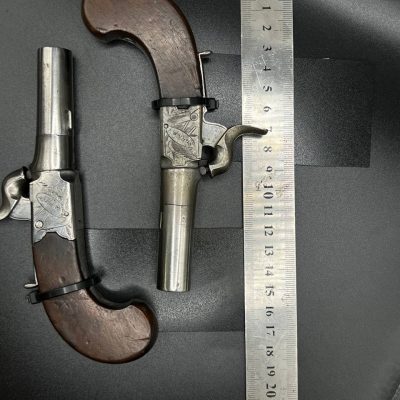
Pair of English Drop Trigger Percussion Pistols Marked H Nock.
Marked with one of England’s premier makers of the period, these guns are likely the fake watches of their day. Both guns are in nice condition with engraved frames and slab butts with vacant silver escutcheons.
Both actions, including push-on safeties, function without problems.
Overall length approximately 5 7/8 inches, with twist off barrels, standard British proofs.