Login
Register
By clicking Login or Register, you agree that the images of Nazi symbols shown on alexmp.com are not propaganda of fascism, Nazism and are shown solely for historical, cognitive and scientific purposes.
Order a free call and our specialist will contact you shortly!
Contact us and we will get back to you shortly.
Contact us and we will get back to you shortly.
Contact us and we will get back to you shortly.
Contact us and we will get back to you shortly.
Error: Contact form not found.
We will get back to you shortly.
В честь запуска Энциклопедии мы рады предложить вам бесплатный доступ до 01.10.2026.
Будем рады вашим комментариям и предложениям!
Inspected and guaranteed by Alex Warstory.
For more details on AlexMP Guarantee, click [HERE]
Item guaranteed by a verified dealer.
Click [HERE] for full seller guarantee terms.
Sold without expert review or guarantees. No claims accepted post-sale.
Learn more [HERE]


Showing 17–32 of 33 results
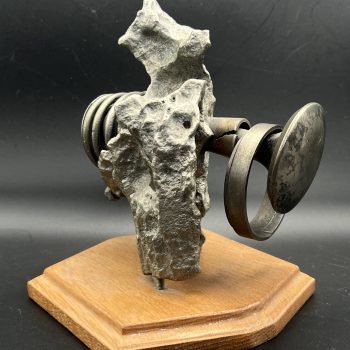
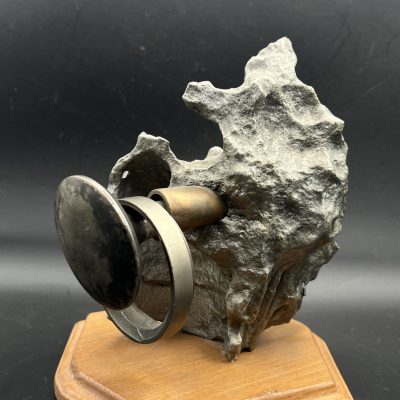
FiltersA fragment of a BMW 801 aircraft piston engine cylinder, originally fitted to Focke-Wulf Fw 190 fighters. The assembly includes a piston with connecting rod, valve mechanism with springs, and a deformed aluminum cylinder block bearing characteristic traces of combat damage or crash impact. The shaped wooden stand has been crafted specifically for display purposes. Approximate dimensions of the fragment: 6 x 6 inches.
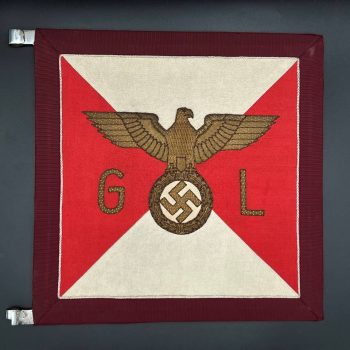
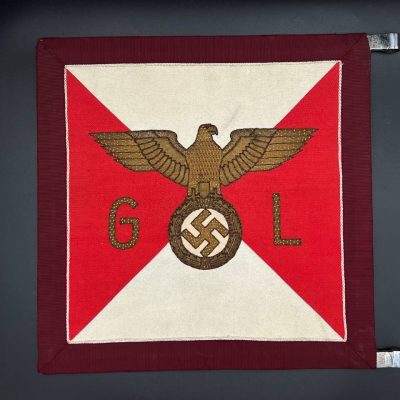
Car pennant of a Gauleiter of the National Socialist German Workers’ Party (NSDAP). The square banner is made of high-quality textile with a characteristic design featuring red and white triangular sectors, bordered by a burgundy grosgrain ribbon. At the center is the party eagle with outstretched wings, clutching a wreath with a swastika in its talons, executed in fine gold bullion embroidery. On the sides, the letters ‘G’ and ‘L’ (abbreviation for Gauleiter) are embroidered. The pennant is equipped with original metal fittings for mounting on an automobile, one of which retains the marking ‘RZM 3/45’. An exceptionally rare item of high party rank in excellent condition.
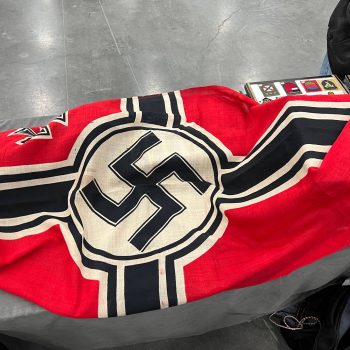
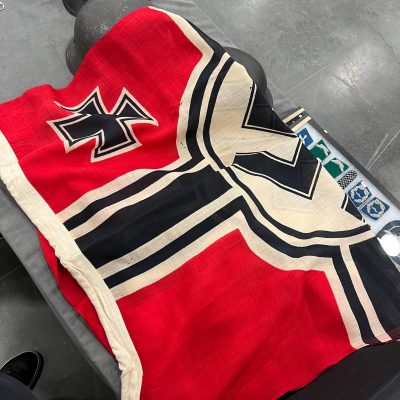
A Third Reich naval flag (Reichskriegsflagge), used on Kriegsmarine vessels and shore installations. The flag is made of red fabric featuring the characteristic design: a white disc with swastika at the center, framed by black and white rays, with an Iron Cross positioned in the upper left corner. The white selvedge bears factory markings in Gothic script reading “Kriegsflg. 100×170,” indicating the type and size of the flag, along with a military acceptance stamp (Kriegsmarine-Abnahme). The flag retains its original braided loops for halyard attachment. Condition is good, with minor traces of storage.
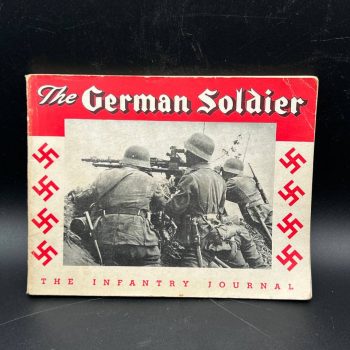
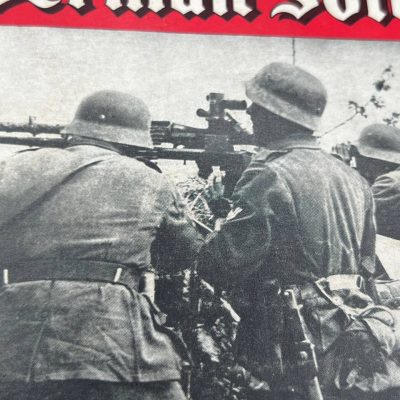
Original U.S. wartime publication from the Infantry Journal series, issued to American servicemen as an enemy intelligence guide covering Wehrmacht tactics, weapons, and psychology. Black-and-white photographs throughout with analytical text. Features a handwritten period ownership inscription — “Property of Pvt. Samuel Riskin” — adding personal provenance and documentary value. Cover worn, interior pages in good condition.
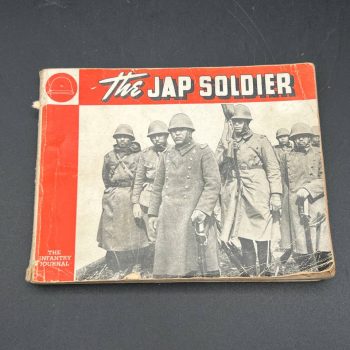
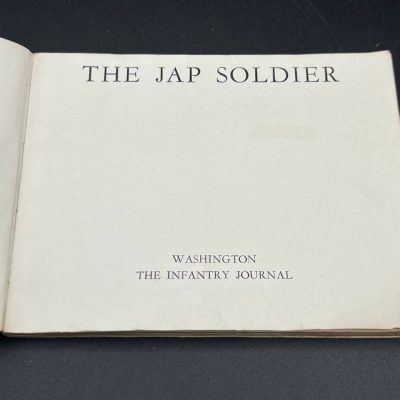
Original wartime U.S. military publication produced during the Pacific Campaign. Softcover photo handbook with black-and-white photographs of the Japanese Imperial Army accompanied by analytical text, issued to American servicemen as an enemy identification and intelligence guide. Published by Infantry Journal Inc., Washington D.C., 1943, First Edition. Cover shows wear and creasing; interior pages intact. A rare piece of WWII American propaganda and a primary historical document of the era.
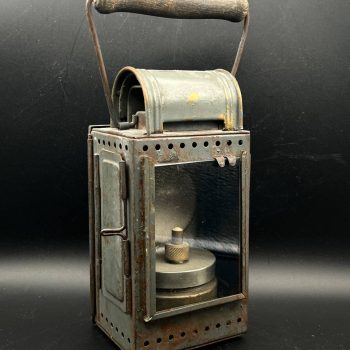
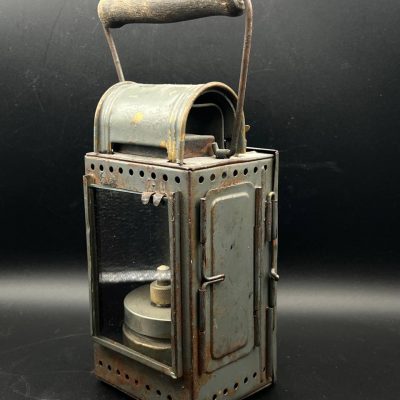
Steel body with original grey paint and stamped DR imperial eagle mark. Wooden carry handle, brass OSMEKA oil reservoir (1955), reflector unit by Hugo Znege, Esslingen marked Deutsche Bundesbahn (1954). Complete with two original colored glass filters — red (stop/danger signal) and blue (shunting/service signal). A compelling example of wartime equipment repurposed for post-war West German railway service.
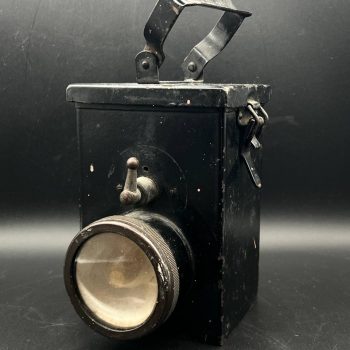
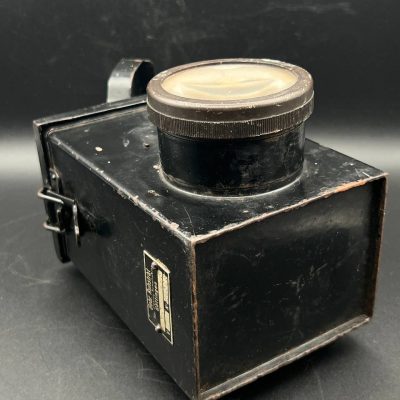
Original German portable electric military lamp from World War II. Manufactured by Gebr. Ruhstrat, Elektro-Schaltwerk division, Göttingen, Germany. Year of manufacture: 1943, serial number 14523. Features a steel body with original black lacquer paint, folding carry handle, round diffuser lens, toggle switch, and side latch closure. The original manufacturer’s data plate and stamped “Notlampe 4” designation are both intact. Shows natural age-appropriate wear, surface scratches, and patina consistent with field use. Unrestored original condition.
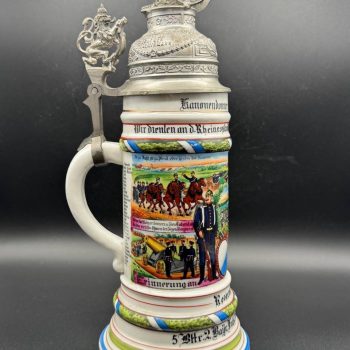
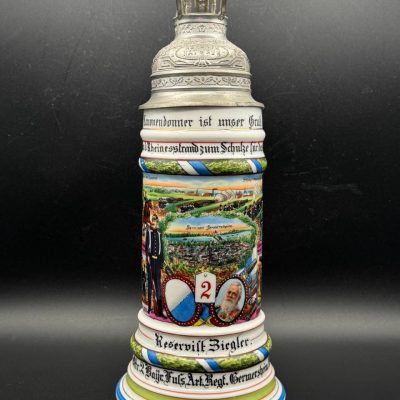
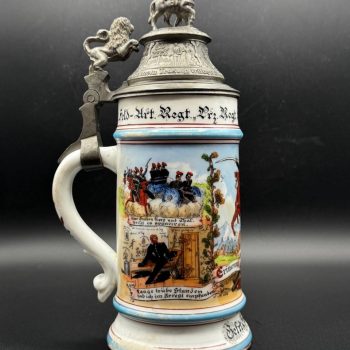
A superb early 20th-century regimental stein commemorating the service of Reservist Ziegler with the 5th Battery of the 2nd Bavarian Foot Artillery Regiment stationed at Germersheim, on the Rhine. The richly hand-painted body depicts heavy artillery crews in training, horse teams in the field, and a panoramic view of the Germersheim fortress. The motto “Wir dienen am d. Rheinesstrand zum Schutze für das Vaterland” (“We serve on the banks of the Rhine for the defense of the Fatherland”) runs around the top border. The pewter lid features an artilleryman with a field gun and a Bavarian lion thumb lift, symbolizing the proud Bavarian artillery tradition.
An outstanding example of pre-WWI reservist craftsmanship, combining patriotic imagery, vivid color, and fine porcelain detail typical of 1900s regimental souvenirs.
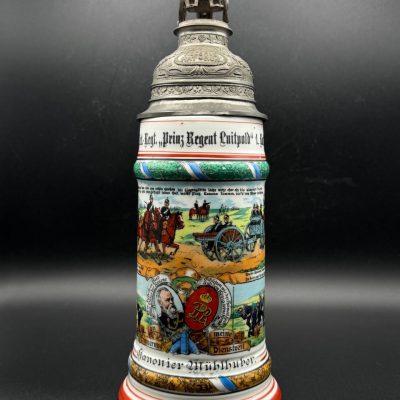
A fine early 20th-century regimental stein belonging to Gunner Mühlhuber, commemorating his service in the 7th Field Artillery Regiment “Prinzregent Luitpold”, 1st Battery, based in Munich during 1906–1908. The hand-painted porcelain body vividly depicts mounted artillery units in training and gun crews in action, with the patriotic motto “Drei Jahre haben wir gedient für Deutschlands Fried’ und Ehr’” (“Three years we served for Germany’s peace and honor”).
The front features the crowned initials PL of Prince Regent Luitpold, surrounded by ornamental motifs and regimental banners. Pewter lid with artilleryman and cannon finial, Bavarian lion thumb lift, and lithophane inside showing the classic “soldier’s farewell” scene. Rich color, fine detail, and strong glaze make this an outstanding example of Munich-produced reservist art from the pre-WWI period.
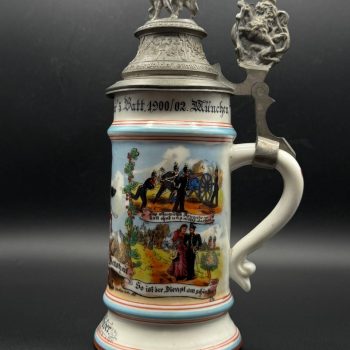
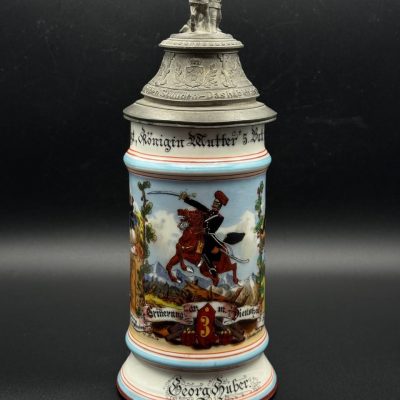
A fine early 20th-century regimental stein belonging to Georg Huber, commemorating his service with the 5th Battery, 2nd Bavarian Field Artillery Regiment “Königin Mutter”, stationed in Munich. The colorful hand-painted body features a cavalryman charging with drawn sabre against an Alpine backdrop, symbolizing Bavarian martial spirit. Surrounding panels depict gun crews in action and scenes of barracks life, with the inscription “Erinnerung an meine Dienstzeit” (“In memory of my service”).
The pewter lid bears a mounted cavalry figure and embossed Bavarian crest, with the motto “Mein Trost in trüben Stunden – Das hübsche Mäd’l aus Bayernland” (“My comfort in dark hours – the pretty girl from Bavaria”). Superb craftsmanship, vivid enamels, and early date (1900–02) make this an exceptional Munich-produced reservist stein of the “Königin Mutter” artillery regiment.
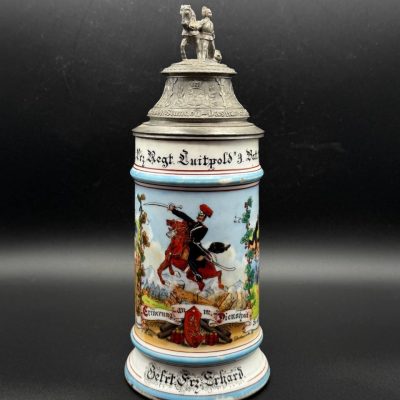
Beautifully hand-painted regimental stein commemorating the service of Gefreiter Fritz Erhard with the 3rd Battery, 2nd Bavarian Field Artillery Regiment “Prinz Luitpold”, stationed in Munich. The front panel depicts a mounted artilleryman charging with sabre against an Alpine backdrop; side scenes show cannon drill, barracks life, and farewells in vibrant colors. Pewter lid features a sculpted horse and soldier, Bavarian crest reliefs, and the traditional toast “Mein Trost in trüben Stunden – Das hübsche Mäd’l aus Bayernland.”
A fine and expressive example of early 20th-century Bavarian craftsmanship, combining humor, color, and regimental pride.
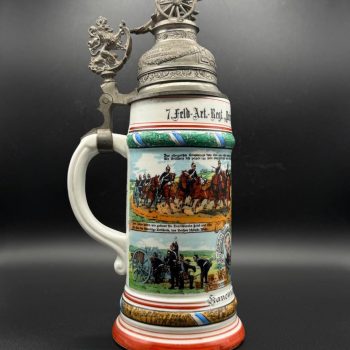
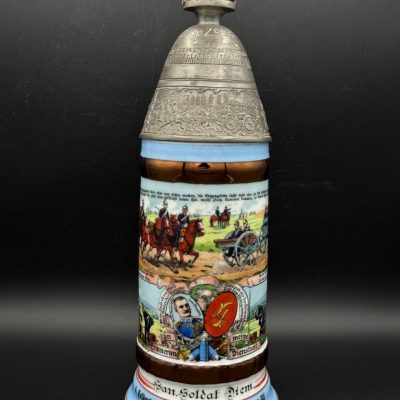
A superb regimental stein commemorating the service of Sanitäts-Soldat Diem with the 4th Bavarian Field Artillery Regiment “König,” 1st Battery, stationed in Augsburg.
Vibrant hand-painted panels show galloping artillery teams and gun crews in action, framed by patriotic mottos such as “Two years we served for Germany’s peace and honor.” Pewter lid shaped like a shell, topped by a detailed cannon finial and relief war scenes. Handle with Bavarian lion thumb lift, interior lithophane depicting soldier and sweetheart.
An expressive and richly detailed early 1900s Bavarian stein — combining fine craftsmanship, color, and symbolism of artillery pride.
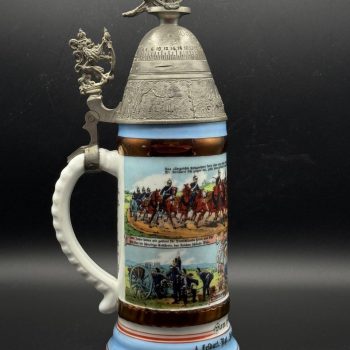
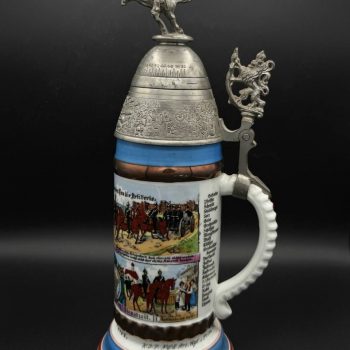
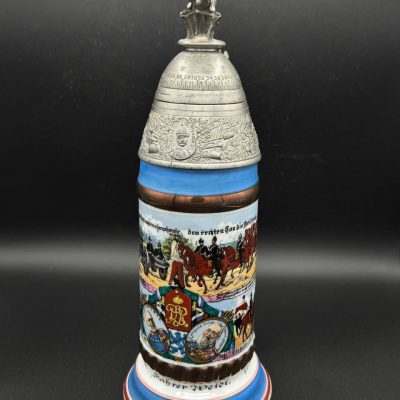
finely painted regimental stein commemorating the service of Driver Weidl with the 3rd Bavarian Field Artillery Regiment “Prince Regent Luitpold of Bavaria,” stationed in Munich, 1903–1905.
The body depicts vivid hand-painted artillery scenes — horse-drawn batteries charging into action, gun crews firing, and soldiers returning to the barracks. Center medallion features the crowned monogram “L” flanked by portraits of King Ludwig III and Prince Regent Luitpold.
Handle lists comrades-in-arms from the same battery. Pewter lid topped with a mounted cavalryman, richly engraved with battle motifs; thumb lift shaped as the Bavarian lion. Interior lithophane shows a soldier with cannon.
A beautiful and historically rich example of early 20th-century Bavarian military craftsmanship — vibrant, detailed, and full of regimental pride.
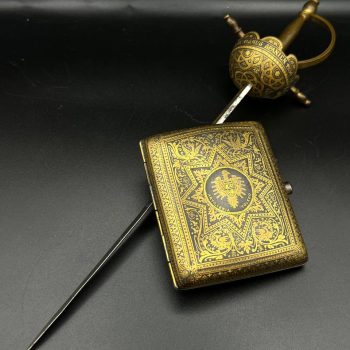
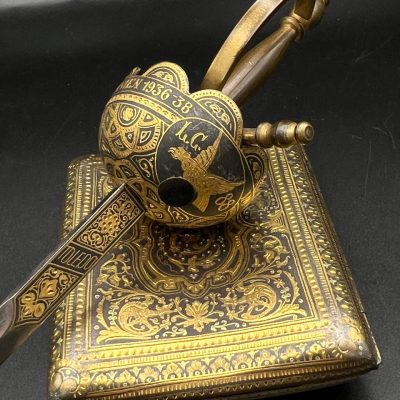
Spanish Toledo damascene set, comprising a decorative dagger letter opener and matching cigarette case. Richly decorated in traditional gold inlay (damascene) technique with intricate floral and geometric motifs.
Both pieces feature Luftwaffe-style eagle with swastika, along with inscriptions “Toledo” and “Artilleria,” typical for Toledo workshop production. The dagger has an ornate spherical hilt and finely etched blade, while the cigarette case is fully covered with detailed damascene work.
Mid-20th century, likely 1930s–1940s period style. These sets were produced in Toledo, Spain, as high-quality decorative or souvenir items.
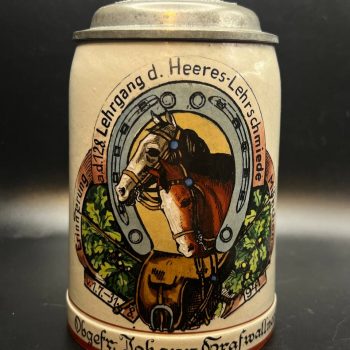
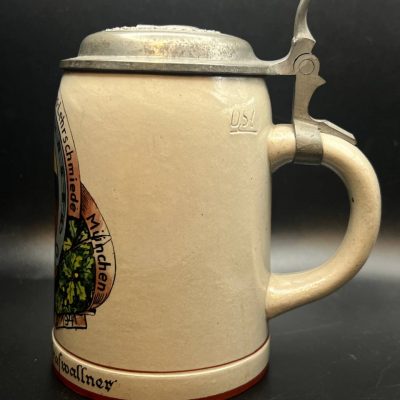
A commemorative ceramic stein from the Second World War period, associated with the army branch of the Wehrmacht (Heer) and the training establishment Heeres-Lehrschmiede, an army training forge responsible for educating and advancing blacksmiths, farriers, and technical personnel. These specialists were tasked with metalwork, repairs, and the shoeing and maintenance of army horses, which in 1941 still played a crucial role in transport, artillery, and logistical support within the Wehrmacht.
The depiction of a horse framed by a horseshoe is a deliberate and meaningful symbol, directly reflecting the farrier and forge-related nature of the training. Steins of this type were traditionally commissioned upon completion of a training course (Lehrgang) and served as personal keepsakes marking a soldier’s service or specialized instruction. The pewter lid features a relief Model M35 steel helmet within an oak wreath and is dated 1941, firmly placing the piece in the wartime period.
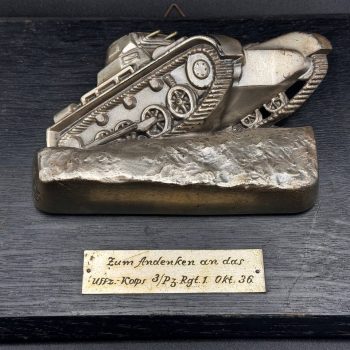
A unique collectible item is offered for sale — a commemorative desk piece dedicated to the non-commissioned officers’ corps of the 3rd Company, 1st Panzer Regiment of the Wehrmacht, dated October 1936.
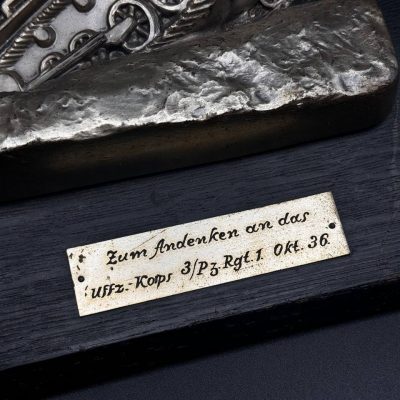
The miniature is made of metal and depicts a German light tank, Panzerkampfwagen I, traversing rough terrain. The piece is mounted on a wooden base with an attached plaque bearing the original inscription:
“Zum Andenken an das Uffz.-Korps 3./Pz.Rgt.1 Okt. 36”
(“In memory of the NCO Corps of the 3rd Company, 1st Panzer Regiment, October 1936”)
The condition is excellent for its age: the detailing of the tank and the plaque is well preserved, with only minor signs of aging on the base.
An ideal item for collectors of military history, especially from the early development period of German armored forces.
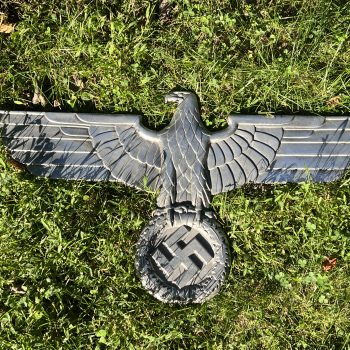
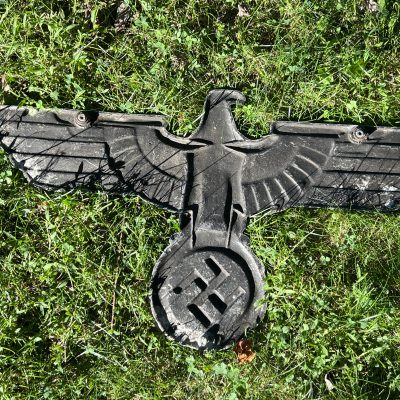
A large original Deutsche Reichsbahn (German State Railways) eagle from the Third Reich period. The eagle is depicted with outstretched wings, clutching a wreath bearing a swastika in its talons. The piece features strong three-dimensional relief, with detailed feathering and wing construction.
The reverse retains stamped/raised manufacturer or production markings, as well as original mounting hardware. The eagle displays an attractive period patina with surface wear, oxidation, scratches, and traces of finish loss consistent with its age and history.
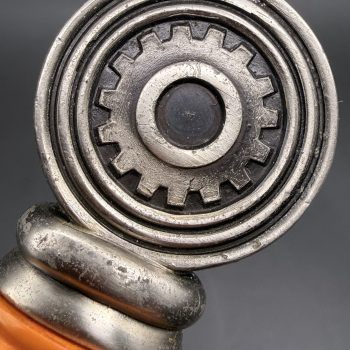
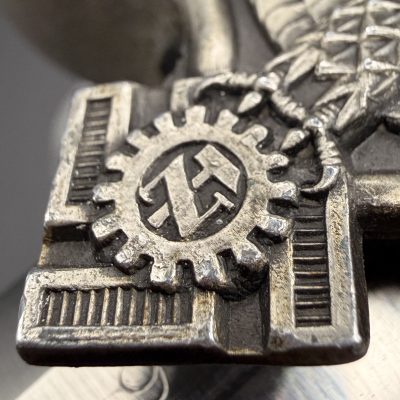
Technical Emergency Corps (TeNo) Leader’s Dagger, Model 1938, manufactured by Carl Eickhorn of Solingen. This example bears the manufacturer’s trademark and retains matching numbers on the blade and scabbard, confirming their factory pairing and attesting to the complete original preservation of the piece.
This dagger model was introduced in November 1938, concurrently with the adoption of new regulation edged weapons for the TeNo organization. It was intended to be worn with dress uniform by commanding officers holding the rank of Stabsscharführer and above. Officers purchased these daggers at their own expense through special organizational outlets.
The history of the Technical Emergency Corps began on September 30, 1919. Throughout the existence of the Weimar Republic, the corps repeatedly distinguished itself, demonstrating efficiency and excellent technical training. Naturally, this organization could not escape the attention of the new leadership, the National Socialist Party. In 1939, to further enhance efficiency, TeNo was transferred to the jurisdiction of the Reich Ministry of Foreign Affairs and subordinated to police structures, allowing for improved operational capacity. Prior to the commencement of the Polish campaign, TeNo was commanded by SS Gruppenführer (SS Lieutenant General) Schmelzer; he was later succeeded in this post by SS Gruppenführer Weinreich.
The Carl Eickhorn company was founded in Solingen in 1865 and became one of the largest manufacturers of edged weapons in Germany. The company’s trademark, featuring a squirrel (Eichhörnchen), served as a guarantee of the highest quality products. During the Third Reich period, the firm produced a wide range of regulation edged weapons, including daggers for all branches of service, SA and SS daggers, NPEA, NSFK, and TeNo daggers, as well as dress daggers, sabers, and swords. Carl Eickhorn products are distinguished by superior steel quality and meticulous finishing, and are highly valued by modern collectors.
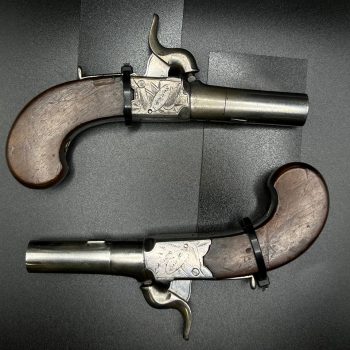
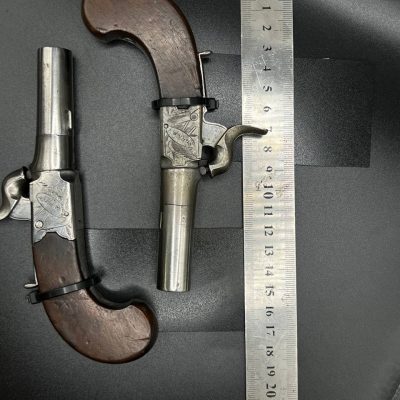
Pair of English Drop Trigger Percussion Pistols Marked H Nock.
Marked with one of England’s premier makers of the period, these guns are likely the fake watches of their day. Both guns are in nice condition with engraved frames and slab butts with vacant silver escutcheons.
Both actions, including push-on safeties, function without problems.
Overall length approximately 5 7/8 inches, with twist off barrels, standard British proofs.
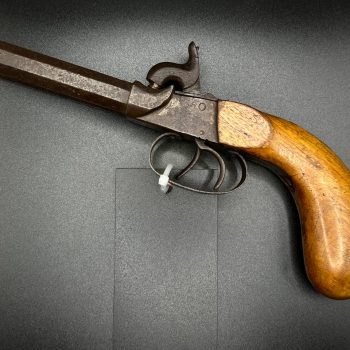
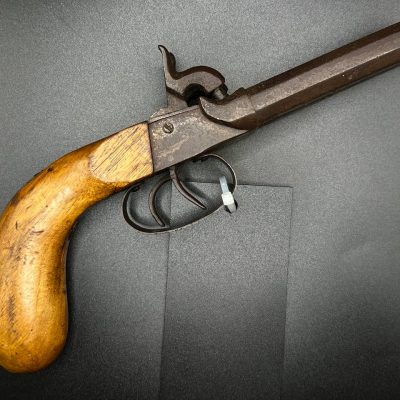
Original Victorian Era Double Barreled Percussion Coat Pistol
.40 caliber with turn-off 3 inch barrels. Overall length is a little over 8 inches.
Actions are mostly functional. The left action holds on half cock only; right action holds on half and full cock.
A good example of this early ‘concealed carry’ firearm at an attractive price.