By clicking Login or Register, you agree that the images of Nazi symbols shown on alexmp.com are not propaganda of fascism, Nazism and are shown solely for historical, cognitive and scientific purposes.
Request a callback
Order a free call and our specialist will contact you shortly!
Ask a question
Contact us and we will get back to you shortly.
Request a Blitz Price
Contact us and we will get back to you shortly.
Request a price
Contact us and we will get back to you shortly.
Offer your blitz price
Contact us and we will get back to you shortly.
Error: Contact form not found.
Request a subscription
We will get back to you shortly.
Subscription
В честь запуска Энциклопедии мы рады предложить вам бесплатный доступ до 01.10.2036. Будем рады вашим комментариям и предложениям!
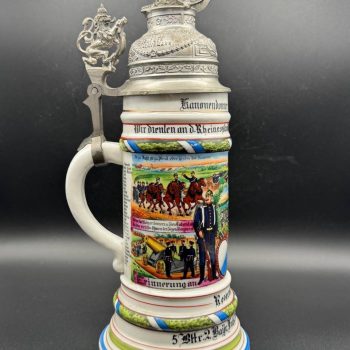
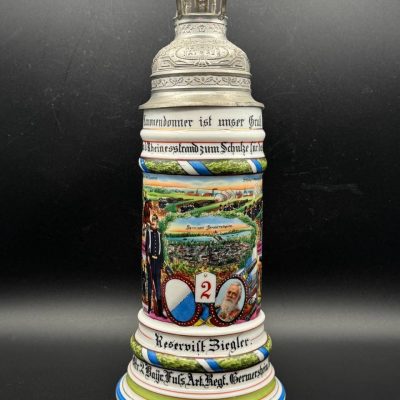
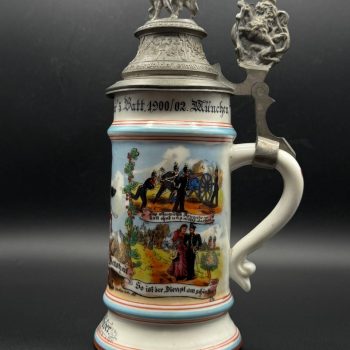
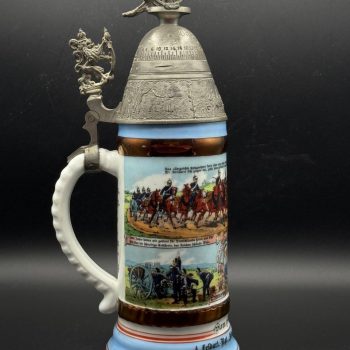
A superb early 20th-century regimental stein commemorating the service of Reservist Ziegler with the 5th Battery of the 2nd Bavarian Foot Artillery Regiment stationed at Germersheim, on the Rhine. The richly hand-painted body depicts heavy artillery crews in training, horse teams in the field, and a panoramic view of the Germersheim fortress. The motto “Wir dienen am d. Rheinesstrand zum Schutze für das Vaterland” (“We serve on the banks of the Rhine for the defense of the Fatherland”) runs around the top border. The pewter lid features an artilleryman with a field gun and a Bavarian lion thumb lift, symbolizing the proud Bavarian artillery tradition.
An outstanding example of pre-WWI reservist craftsmanship, combining patriotic imagery, vivid color, and fine porcelain detail typical of 1900s regimental souvenirs.
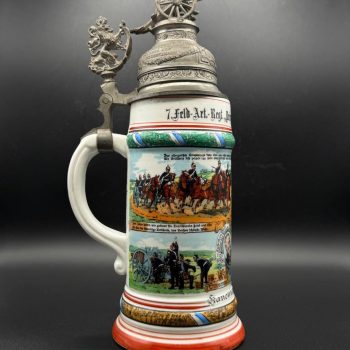
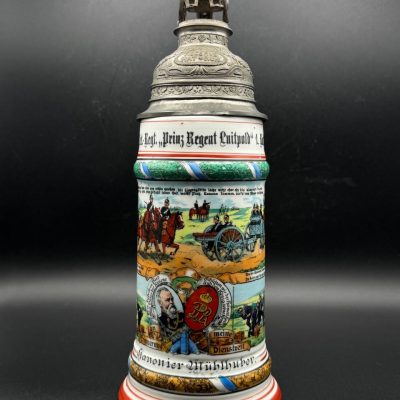
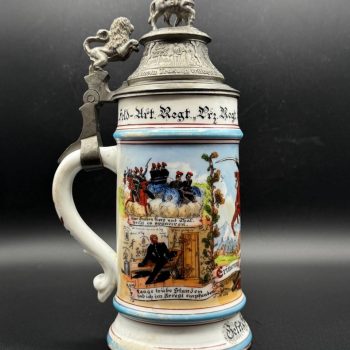
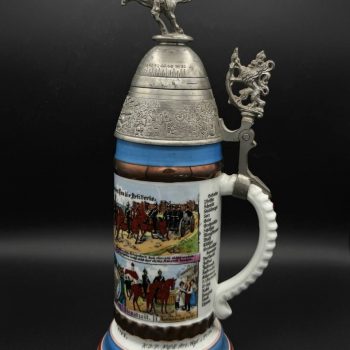
A fine early 20th-century regimental stein belonging to Gunner Mühlhuber, commemorating his service in the 7th Field Artillery Regiment “Prinzregent Luitpold”, 1st Battery, based in Munich during 1906–1908. The hand-painted porcelain body vividly depicts mounted artillery units in training and gun crews in action, with the patriotic motto “Drei Jahre haben wir gedient für Deutschlands Fried’ und Ehr’” (“Three years we served for Germany’s peace and honor”).
The front features the crowned initials PL of Prince Regent Luitpold, surrounded by ornamental motifs and regimental banners. Pewter lid with artilleryman and cannon finial, Bavarian lion thumb lift, and lithophane inside showing the classic “soldier’s farewell” scene. Rich color, fine detail, and strong glaze make this an outstanding example of Munich-produced reservist art from the pre-WWI period.
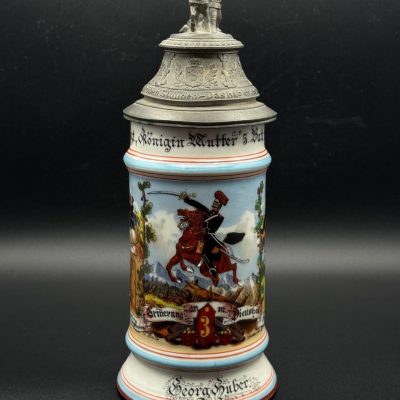
A fine early 20th-century regimental stein belonging to Georg Huber, commemorating his service with the 5th Battery, 2nd Bavarian Field Artillery Regiment “Königin Mutter”, stationed in Munich. The colorful hand-painted body features a cavalryman charging with drawn sabre against an Alpine backdrop, symbolizing Bavarian martial spirit. Surrounding panels depict gun crews in action and scenes of barracks life, with the inscription “Erinnerung an meine Dienstzeit” (“In memory of my service”).
The pewter lid bears a mounted cavalry figure and embossed Bavarian crest, with the motto “Mein Trost in trüben Stunden – Das hübsche Mäd’l aus Bayernland” (“My comfort in dark hours – the pretty girl from Bavaria”). Superb craftsmanship, vivid enamels, and early date (1900–02) make this an exceptional Munich-produced reservist stein of the “Königin Mutter” artillery regiment.
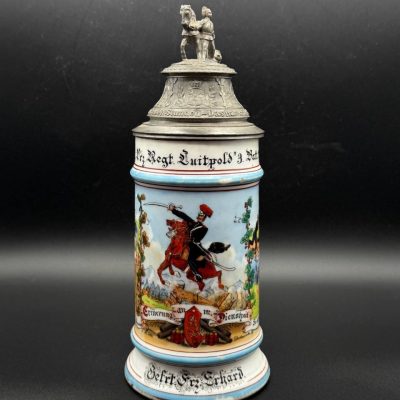
Beautifully hand-painted regimental stein commemorating the service of Gefreiter Fritz Erhard with the 3rd Battery, 2nd Bavarian Field Artillery Regiment “Prinz Luitpold”, stationed in Munich. The front panel depicts a mounted artilleryman charging with sabre against an Alpine backdrop; side scenes show cannon drill, barracks life, and farewells in vibrant colors. Pewter lid features a sculpted horse and soldier, Bavarian crest reliefs, and the traditional toast “Mein Trost in trüben Stunden – Das hübsche Mäd’l aus Bayernland.”
A fine and expressive example of early 20th-century Bavarian craftsmanship, combining humor, color, and regimental pride.
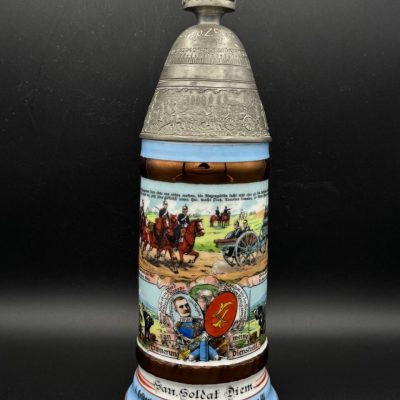
A superb regimental stein commemorating the service of Sanitäts-Soldat Diem with the 4th Bavarian Field Artillery Regiment “König,” 1st Battery, stationed in Augsburg.
Vibrant hand-painted panels show galloping artillery teams and gun crews in action, framed by patriotic mottos such as “Two years we served for Germany’s peace and honor.” Pewter lid shaped like a shell, topped by a detailed cannon finial and relief war scenes. Handle with Bavarian lion thumb lift, interior lithophane depicting soldier and sweetheart.
An expressive and richly detailed early 1900s Bavarian stein — combining fine craftsmanship, color, and symbolism of artillery pride.
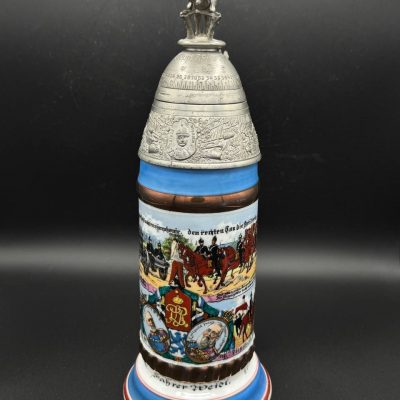
finely painted regimental stein commemorating the service of Driver Weidl with the 3rd Bavarian Field Artillery Regiment “Prince Regent Luitpold of Bavaria,” stationed in Munich, 1903–1905.
The body depicts vivid hand-painted artillery scenes — horse-drawn batteries charging into action, gun crews firing, and soldiers returning to the barracks. Center medallion features the crowned monogram “L” flanked by portraits of King Ludwig III and Prince Regent Luitpold.
Handle lists comrades-in-arms from the same battery. Pewter lid topped with a mounted cavalryman, richly engraved with battle motifs; thumb lift shaped as the Bavarian lion. Interior lithophane shows a soldier with cannon.
A beautiful and historically rich example of early 20th-century Bavarian military craftsmanship — vibrant, detailed, and full of regimental pride.
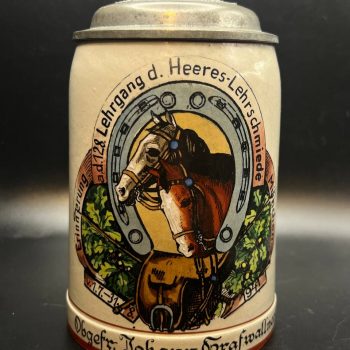
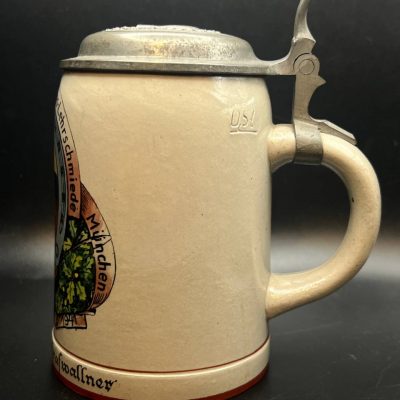
A commemorative ceramic stein from the Second World War period, associated with the army branch of the Wehrmacht (Heer) and the training establishment Heeres-Lehrschmiede, an army training forge responsible for educating and advancing blacksmiths, farriers, and technical personnel. These specialists were tasked with metalwork, repairs, and the shoeing and maintenance of army horses, which in 1941 still played a crucial role in transport, artillery, and logistical support within the Wehrmacht.
The depiction of a horse framed by a horseshoe is a deliberate and meaningful symbol, directly reflecting the farrier and forge-related nature of the training. Steins of this type were traditionally commissioned upon completion of a training course (Lehrgang) and served as personal keepsakes marking a soldier’s service or specialized instruction. The pewter lid features a relief Model M35 steel helmet within an oak wreath and is dated 1941, firmly placing the piece in the wartime period.
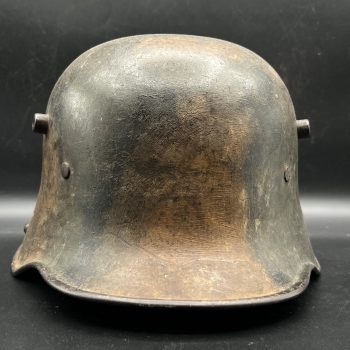
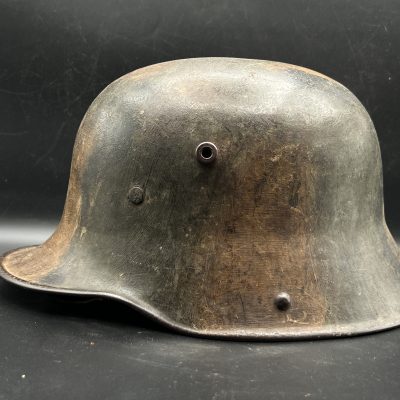
Excellent overall condition on this helmet. Features a standard camo pattern with colors of brown, green ad dark yellows. No dents and heavy damage, just expected wear for a helmet of this age. Interior is even better with all three liner pads intact which is quite rare as the tend to rot and fall out. Has a size stamping to the one side which is faint, but can just make it out. Nice WWI helmet with a great look about it.
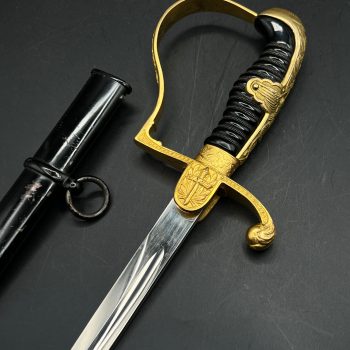
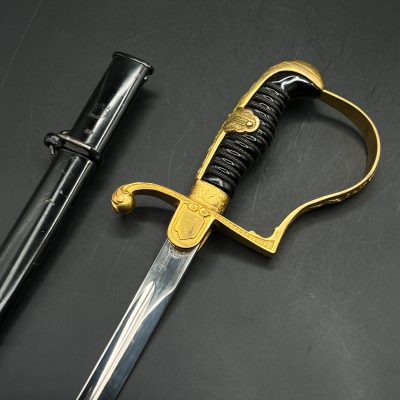
Officer parade weapons, revived following the restoration of the German armed forces, continued the proud traditions of the Imperial Army and the Reichswehr. Unlike the Army dagger model 1935, officer sabers were produced in numerous design variations by various Solingen manufacturers. Production of this type of weapon was discontinued in May 1943 due to wartime industrial demands; however, examples already in service continued to be worn with parade uniforms. In late 1944, the wearing of parade edged weapons was completely abolished, and officers were ordered to carry a pistol instead of a saber or dagger.
The blade bears the mark of the renowned Solingen firm F. W. Höller Waffenfabrik, founded in 1866 and officially registered with the Solingen authorities on 5 June 1883. From its founding, the company specialized in the production of edged weapons and cutlery. Throughout the late 19th century and during the First World War, the firm manufactured a wide range of military products, including bayonets, sabers, and swords. In 1905, the company registered its well-known trademarks: the thermometer image, as well as the figure of a man tipping his hat with the inscription “Hut ab!” (“Hats off!”). From 1914 to 1939, the firm was managed by Julius Küller. During the Third Reich period, Höller became one of the largest and most prolific edged weapons manufacturers in Solingen, specializing in a broad range of military products. In 1935, the company was located at Sonnenstraße 8, Solingen, and that same year received RZM license M7/33. Products were actively advertised in specialized journals and catalogs, showcasing an extensive assortment that included NSDAP and Wehrmacht daggers, swords, and bayonets. The firm also produced parade bayonets with high-quality etched blades. In 1941, Höller celebrated its 75th anniversary, promoting the Höller Model 21 sword as its flagship model. In June 1941, the company was assigned the K98 bayonet manufacturer letter code (fze). Following the end of the Second World War, under the ownership of Herr Grah, the firm continued operations, producing cutlery, kitchen and professional knives, swords, and scissors through the 1970s. The company was officially liquidated in December 1974. Particular collector value is added to this example by a rare decorative detail: an additional eagle on the grip backstrap, distinguishing this saber from standard production specimens.
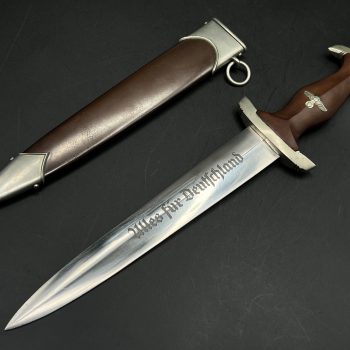
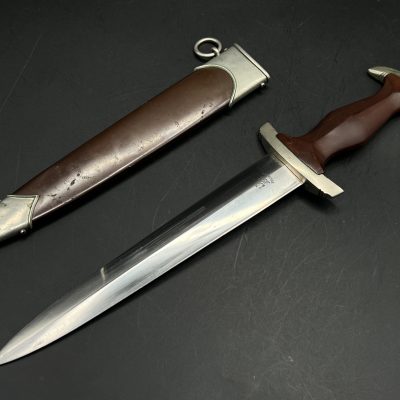
A service edged weapon of the SA (Sturmabteilung) storm troopers, adopted in 1933. The distinctively shaped blade with double-sided sharpening bears the legendary motto “Alles für Deutschland.” The handle is made of brown-colored wood and decorated with the SA emblem featuring an eagle; the metal scabbard is finished in the same brown tone.
The early type of SA/NSKK daggers was produced between 1933 and 1936 and is distinguished by a number of characteristic design features. The scabbard and handle fittings are made of nickel silver (German silver), which, combined with the high quality of component fitting and the anodized scabbard coating, sets these examples apart from later production runs. This dagger was manufactured by Stöcker & Co. SMF. Early examples are particularly prized by collectors due to their impeccable craftsmanship and historical significance as the first service daggers of the storm troopers.
A rarity rating of 5 out of 10 according to the Ralf Siegert classification indicates that such examples are relatively uncommon on the antiques market.
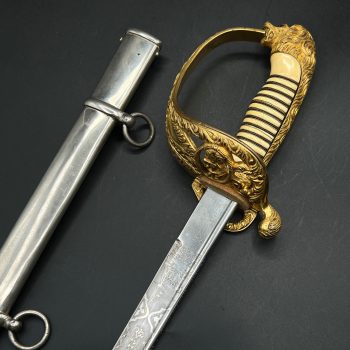
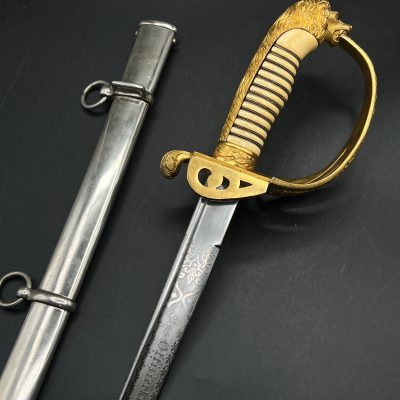
The naval saber was a mandatory attribute of the dress uniform of officers in the Kaiserliche Marine. During the period of Kaiser’s Germany, the imperial anchor beneath the Kaiser’s crown was characteristic in the design of the hilt. The classical variant featured a brass hilt, ivory grip, and a lion’s head with eyes of red and green color. The scabbard was typically made of black leather with brass fittings; steel scabbards are considerably rarer. Sabers were purchased by officers at their own expense, which resulted in numerous variations of execution. Standard and Damascus blades can be found, various hilt designs and decorative scabbard finishes, as well as several sizes ranging from light and elegant to large Grosse Pattern models. It is precisely this diversity of execution that makes naval sabers a particularly interesting independent field of collecting: collections can be built according to manufacturers, sizes, hilt types, blades, and finishing variations. Along with the dirk, the saber remained a symbol of officer status and the continuity of German naval weaponry traditions of the nineteenth century.
E. & F. Hörster, one of the largest Solingen manufacturers of naval edged weapons, operated from the nineteenth century and continued production during the Weimar Republic and the Third Reich. The firm produced high-quality naval sabers and dirks in various execution variants. Already before World War I, Hörster products were supplied not only for the German market but were also exported to other European countries, including the Russian Empire. Thanks to its long operational period, Hörster products allow one to trace the development of naval edged weapons from the Kaiser era to the Kriegsmarine.
Seebataillone represented naval infantry units of the Kaiserliche Marine. There were several marine battalions, and the custom-made edged weapons associated with them constitute a separate field of collecting German naval weaponry. A characteristic feature of such items is the combination of naval and infantry attributes. For example, an officer’s saber could feature a traditional naval hilt and blade but be equipped with steel infantry-type scabbards. Custom specimens frequently bear personal dedications from one officer to another or from the officer corps to a specific serviceman of a Seebataillon. In addition to officer sabers and other custom edged weapons, this group includes infantry-type bayonets for Mauser system rifles with Seebataillone designations and symbols. Most such items bear unit designations; however, named specimens also occur, representing particular collecting interest.
This saber features a characteristic openwork pierced hilt, presented in the catalogs of several manufacturers; however, it did not correspond to the established standard for Kaiserliche Marine edged weapons and was subsequently prohibited from being worn. It is precisely this unusual feature that makes such sabers particularly desirable among collectors today. Such specimens were predominantly ordered as presentation weapons, for example upon an officer’s transfer to another unit or upon his retirement from service, and served as an object of special pride for the owner. The present specimen is entirely original; the factory riveting of the hilt remains intact, the saber has not been disassembled, and retains its original configuration.