By clicking Login or Register, you agree that the images of Nazi symbols shown on alexmp.com are not propaganda of fascism, Nazism and are shown solely for historical, cognitive and scientific purposes.
Request a callback
Order a free call and our specialist will contact you shortly!
Ask a question
Contact us and we will get back to you shortly.
Request a Blitz Price
Contact us and we will get back to you shortly.
Request a price
Contact us and we will get back to you shortly.
Offer your blitz price
Contact us and we will get back to you shortly.
Error: Contact form not found.
Request a subscription
We will get back to you shortly.
Subscription
В честь запуска Энциклопедии мы рады предложить вам бесплатный доступ до 01.10.2036. Будем рады вашим комментариям и предложениям!
A beautiful original “Für Verdienste im Kriege 1914” (For Merit in War) cross from the Free and Hanseatic City of Hamburg. Made of silver, featuring deep red enamel with the Hamburg city coat of arms (gate and key) on the obverse. The reverse bears the inscription Für Verdienste im Kriege 1914.
The cross comes with its original pre-WWI red-white ribbon. Condition is excellent, enamel fully intact with no chips, and the silver shows an attractive naturally aged patina.
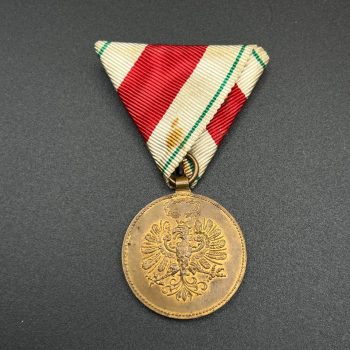
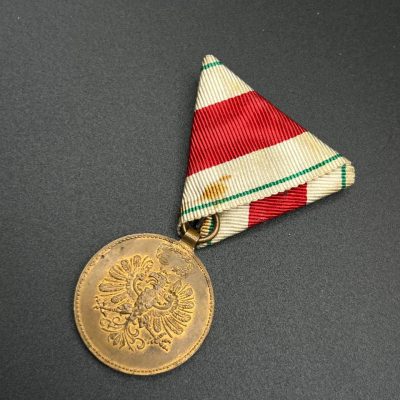
Original Tyrolean Medal, issued in Austria to honor the resistance of Tyrolean militia and local citizens during World War I.
Details:
• Era: World War I, 1914–1918
• Material: Bronze
• Diameter: Approx. 33 mm
• Obverse: Features the Austrian imperial eagle
• Reverse: (Can provide photo if needed)
• Ribbon: Original triangular red and white ribbon with green edging
• Condition: Good vintage condition with some signs of age (see photos)
This medal holds historical and collectible value—a great addition to any collection of Austrian or military memorabilia.
Offered here is a rare and authentic medal awarded for participation in the Prussian-Danish War of 1863–64, instituted by King Wilhelm I of Prussia on September 20, 1864. This medal was awarded to soldiers of Prussia and allied states who took part in military actions against Denmark.
Description:
• Material: Bronze
• Diameter: approx. 29 mm
• Obverse: Profile portrait of King Wilhelm I with surrounding inscription
• Reverse: Inscription “Für Tapferkeit im Kriege 1864” (“For Bravery in War 1864”) within a laurel wreath
• Ribbon: Original (black-white-red), minor signs of age possible
• Condition: Excellent for its age, clear details, beautiful patina, no damage
A rare historical artifact of interest to collectors and researchers of 19th-century German military history.
This Third Class Eagle Order with Swords is a stunning piece. The top quality white enamel on both sides is clean and perfect, with no chips. The beautifully detailed silver eagle emblems have taken on attractive dark age toning. The suspension ring is intact. This attractive cross is complete with its original ribbon, which is crisp and clean, with only extremely slight age toning. The original pin attachment on the reverse is functional and is neatly hand stitched in place. The original case of issue is present, and is in outstanding condition, with bright original color and nearly full original surface to the crimson leather covering. The large, bold, embossed German eagle and swastika emblem on the lid is virtually perfect. The clasps on the case are intact and functional. Inside the case, the white silk lining for the lid is marked with the German designation of the award. There is very slight patina to the white silk lining. The cross lies on an insert lined with a fine black velvet, which is perfect. It would be hard to find a better example of a 3rd Class Eagle Order with Swords. The condition rates as excellent plus overall.
An original commemorative medal issued in honor of Kaiser Wilhelm II, the last German Emperor and King of Prussia, who reigned from 1888 to 1918. The medal was produced either during his reign or shortly after his abdication as a tribute to his historical significance.
Details:
• Period: Late 19th to early 20th century
• Condition: Good collectible condition with natural age patina
• Purpose: Commemorative (non-award) medal, typically issued for ceremonial events, anniversaries, or as a souvenir
A noteworthy historical artifact from the era of the German Empire. A fine addition to any collection focused on monarchy or Imperial German memorabilia.
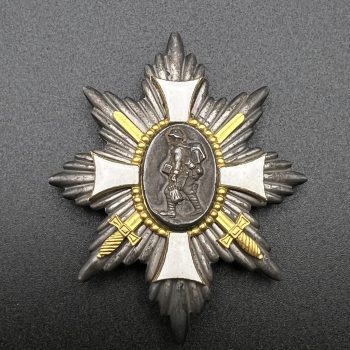
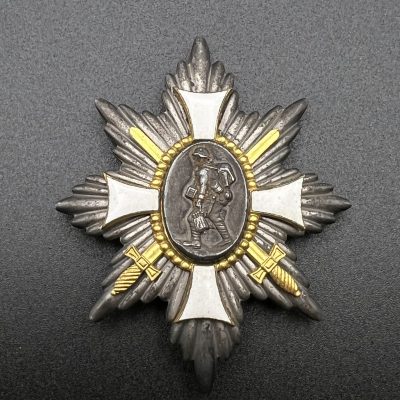
The official date of establishment for the German Field Honor Badge is considered to be 1923. It was introduced by the administration of one of the many post-war veterans’ organizations, Deutsches Feld-Ehrenzeichen e.V. (eingetragener Verein).
Every former frontline soldier had the right to acquire the badge. To do so, an application had to be submitted detailing the veteran’s combat service history. After a verification process, the veteran would receive an award certificate. This ordering service was also available by mail.
In addition to the badge itself, recipients could purchase presentation cases and richly decorated certificates. The first manufacturer of the award, Fahnen und Ordenfabrik M. Fleck & Sohn, based in Hamburg, independently designed both the badge and its overall presentation.
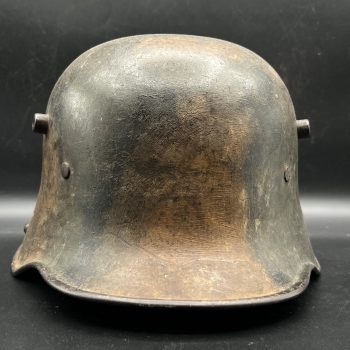
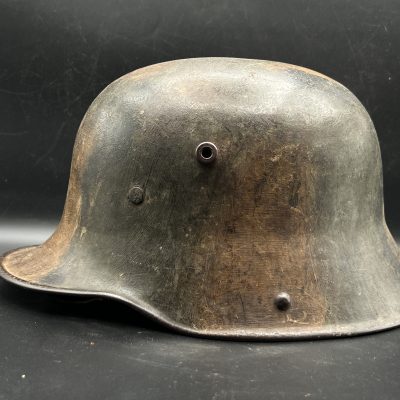
Excellent overall condition on this helmet. Features a standard camo pattern with colors of brown, green ad dark yellows. No dents and heavy damage, just expected wear for a helmet of this age. Interior is even better with all three liner pads intact which is quite rare as the tend to rot and fall out. Has a size stamping to the one side which is faint, but can just make it out. Nice WWI helmet with a great look about it.
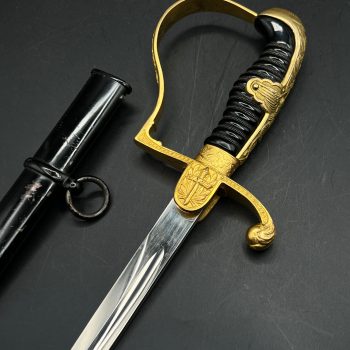
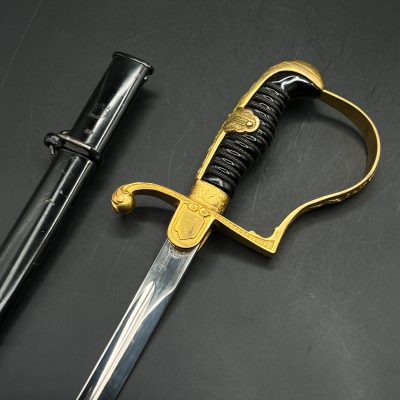
Officer parade weapons, revived following the restoration of the German armed forces, continued the proud traditions of the Imperial Army and the Reichswehr. Unlike the Army dagger model 1935, officer sabers were produced in numerous design variations by various Solingen manufacturers. Production of this type of weapon was discontinued in May 1943 due to wartime industrial demands; however, examples already in service continued to be worn with parade uniforms. In late 1944, the wearing of parade edged weapons was completely abolished, and officers were ordered to carry a pistol instead of a saber or dagger.
The blade bears the mark of the renowned Solingen firm F. W. Höller Waffenfabrik, founded in 1866 and officially registered with the Solingen authorities on 5 June 1883. From its founding, the company specialized in the production of edged weapons and cutlery. Throughout the late 19th century and during the First World War, the firm manufactured a wide range of military products, including bayonets, sabers, and swords. In 1905, the company registered its well-known trademarks: the thermometer image, as well as the figure of a man tipping his hat with the inscription “Hut ab!” (“Hats off!”). From 1914 to 1939, the firm was managed by Julius Küller. During the Third Reich period, Höller became one of the largest and most prolific edged weapons manufacturers in Solingen, specializing in a broad range of military products. In 1935, the company was located at Sonnenstraße 8, Solingen, and that same year received RZM license M7/33. Products were actively advertised in specialized journals and catalogs, showcasing an extensive assortment that included NSDAP and Wehrmacht daggers, swords, and bayonets. The firm also produced parade bayonets with high-quality etched blades. In 1941, Höller celebrated its 75th anniversary, promoting the Höller Model 21 sword as its flagship model. In June 1941, the company was assigned the K98 bayonet manufacturer letter code (fze). Following the end of the Second World War, under the ownership of Herr Grah, the firm continued operations, producing cutlery, kitchen and professional knives, swords, and scissors through the 1970s. The company was officially liquidated in December 1974. Particular collector value is added to this example by a rare decorative detail: an additional eagle on the grip backstrap, distinguishing this saber from standard production specimens.
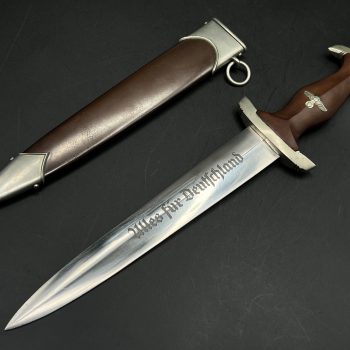
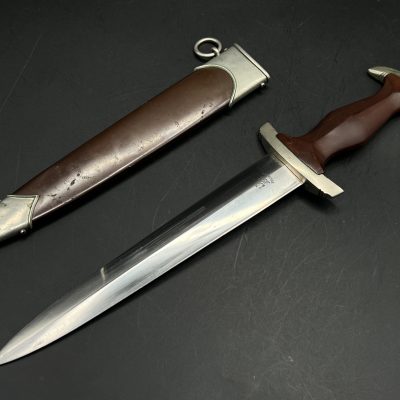
A service edged weapon of the SA (Sturmabteilung) storm troopers, adopted in 1933. The distinctively shaped blade with double-sided sharpening bears the legendary motto “Alles für Deutschland.” The handle is made of brown-colored wood and decorated with the SA emblem featuring an eagle; the metal scabbard is finished in the same brown tone.
The early type of SA/NSKK daggers was produced between 1933 and 1936 and is distinguished by a number of characteristic design features. The scabbard and handle fittings are made of nickel silver (German silver), which, combined with the high quality of component fitting and the anodized scabbard coating, sets these examples apart from later production runs. This dagger was manufactured by Stöcker & Co. SMF. Early examples are particularly prized by collectors due to their impeccable craftsmanship and historical significance as the first service daggers of the storm troopers.
A rarity rating of 5 out of 10 according to the Ralf Siegert classification indicates that such examples are relatively uncommon on the antiques market.
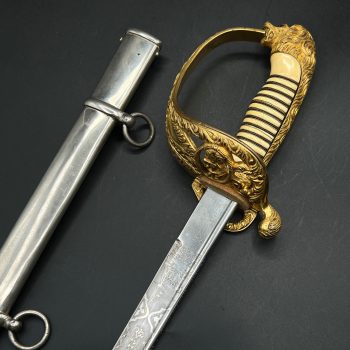
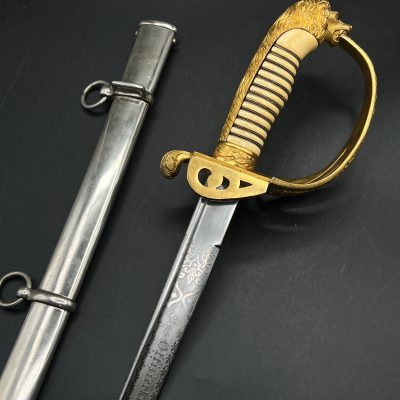
The naval saber was a mandatory attribute of the dress uniform of officers in the Kaiserliche Marine. During the period of Kaiser’s Germany, the imperial anchor beneath the Kaiser’s crown was characteristic in the design of the hilt. The classical variant featured a brass hilt, ivory grip, and a lion’s head with eyes of red and green color. The scabbard was typically made of black leather with brass fittings; steel scabbards are considerably rarer. Sabers were purchased by officers at their own expense, which resulted in numerous variations of execution. Standard and Damascus blades can be found, various hilt designs and decorative scabbard finishes, as well as several sizes ranging from light and elegant to large Grosse Pattern models. It is precisely this diversity of execution that makes naval sabers a particularly interesting independent field of collecting: collections can be built according to manufacturers, sizes, hilt types, blades, and finishing variations. Along with the dirk, the saber remained a symbol of officer status and the continuity of German naval weaponry traditions of the nineteenth century.
E. & F. Hörster, one of the largest Solingen manufacturers of naval edged weapons, operated from the nineteenth century and continued production during the Weimar Republic and the Third Reich. The firm produced high-quality naval sabers and dirks in various execution variants. Already before World War I, Hörster products were supplied not only for the German market but were also exported to other European countries, including the Russian Empire. Thanks to its long operational period, Hörster products allow one to trace the development of naval edged weapons from the Kaiser era to the Kriegsmarine.
Seebataillone represented naval infantry units of the Kaiserliche Marine. There were several marine battalions, and the custom-made edged weapons associated with them constitute a separate field of collecting German naval weaponry. A characteristic feature of such items is the combination of naval and infantry attributes. For example, an officer’s saber could feature a traditional naval hilt and blade but be equipped with steel infantry-type scabbards. Custom specimens frequently bear personal dedications from one officer to another or from the officer corps to a specific serviceman of a Seebataillon. In addition to officer sabers and other custom edged weapons, this group includes infantry-type bayonets for Mauser system rifles with Seebataillone designations and symbols. Most such items bear unit designations; however, named specimens also occur, representing particular collecting interest.
This saber features a characteristic openwork pierced hilt, presented in the catalogs of several manufacturers; however, it did not correspond to the established standard for Kaiserliche Marine edged weapons and was subsequently prohibited from being worn. It is precisely this unusual feature that makes such sabers particularly desirable among collectors today. Such specimens were predominantly ordered as presentation weapons, for example upon an officer’s transfer to another unit or upon his retirement from service, and served as an object of special pride for the owner. The present specimen is entirely original; the factory riveting of the hilt remains intact, the saber has not been disassembled, and retains its original configuration.