Login
Register
By clicking Login or Register, you agree that the images of Nazi symbols shown on alexmp.com are not propaganda of fascism, Nazism and are shown solely for historical, cognitive and scientific purposes.
Order a free call and our specialist will contact you shortly!
Contact us and we will get back to you shortly.
Error: Contact form not found.
We will get back to you shortly.
В честь запуска Энциклопедии мы рады предложить вам бесплатный доступ до 01.10.2026.
Будем рады вашим комментариям и предложениям!
Inspected and guaranteed by Alex Warstory.
For more details on AlexMP Guarantee, click [HERE]
Item guaranteed by a verified dealer.
Click [HERE] for full seller guarantee terms.
Sold without expert review or guarantees. No claims accepted post-sale.
Learn more [HERE]
Showing 145–160 of 197 results
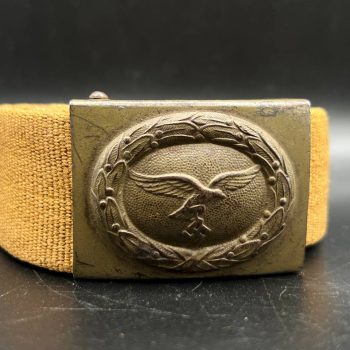
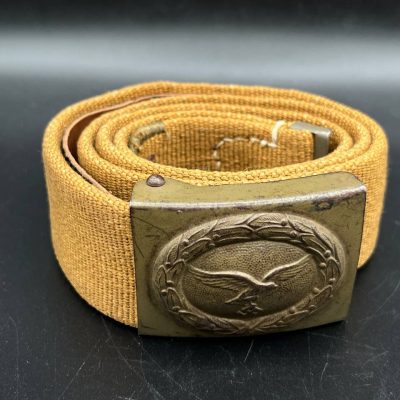
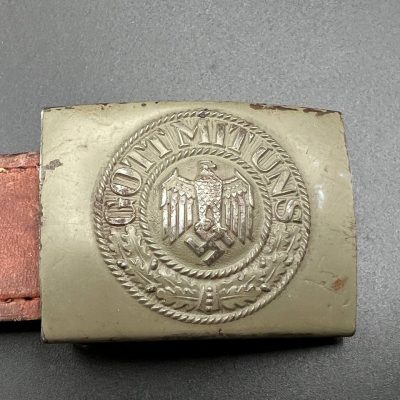
FiltersExtremely nice tropical set. The buckle has much of the original paint remaining and a fine detail to the front with just normal rub type wear to the high parts. Unmarked on the back and comes on the original gold/tan tropical belt. The belt is in fine condition as well and is marked as a size 95 with the RBN number on the other end. All machine sewn and shows no damage or staining. Excellent example.
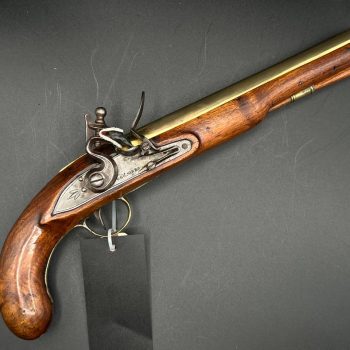
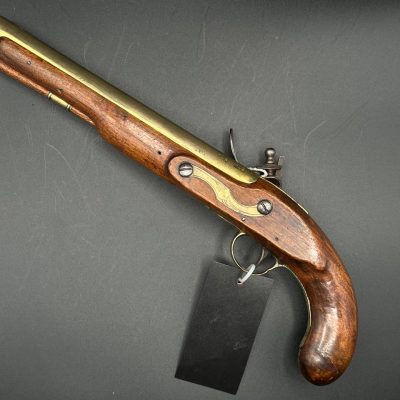
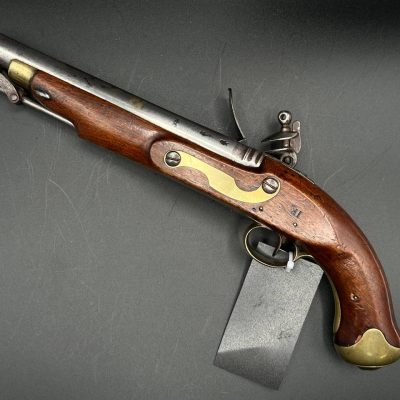
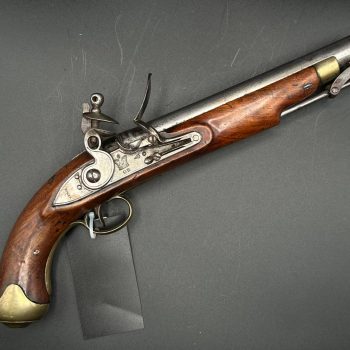
A Good Brass Barrel Brass Mounted English Flintlock Officer’s Pistol Circa 1812 By George Jones, Aston Row, Birmingham (1807-1817).
9 and 3/4 inch round brass barrel with Birmingham gunmakers proofs. .60 caliber.
Well signed bolted flat lock plate with line engraving. Swan neck cock line engraved en suite. Brass mounts. Triggerguard with acorn finial. Finely figured walnut fullstock Brass tipped wood ramrod. Overall in very fine original condition.
15 and 3/8th inches overall, this veteran of the Napoleonic War period is a most attractive flintlock officer’s pistol by a well known maker. The action is crisp on both half and full cock and the bore is fine.
A Good And Very Crisp Condition Napoleonic Period British New Pattern Light Dragoon Flintlock Pistol Circa 1805.
9 inch round barrel with molded breech. Stirrup rammer. Bolted British military lock struck with crown over “GR” for George III. Tail of the lock struck with “TOWER”. Military pattern brass mounts. Very fine condition walnut full stock stamped “IK”.
Barrel with military acceptance viewed and proofed stamps. Stock further stamped :”GR”. Action is excellent and bore is good. Stock very crisp and full dimension.
A really good example of this desirable British military flintlock pistol.
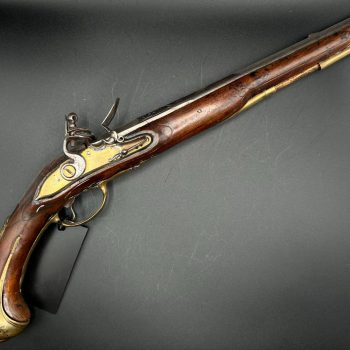
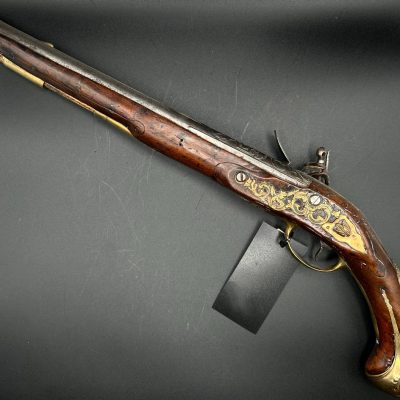
This is a very large Dutch Brass mounted holster pistol.
It features a chiselled barrel and the stock has light engraving that is quite well worn. The side plate has an elaborate replacement part of dubious aesthetic quality.
The pistol is approximately 65 caliber. The ramrod appears to be mediocre quality replacement and the forward ramrod pipe is possibly a replacement. The name on the lock is quite worn and not readable.
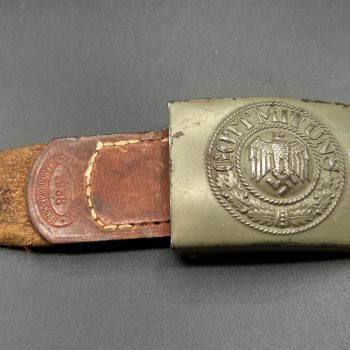
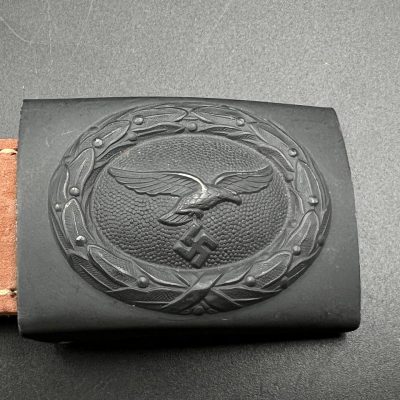
This is a very nice early tropical buckle which retains much of the original paint. Comes with the original leather tab that is dated 1938 and has the maker stamp as well. Hard to find these early models in this condition.
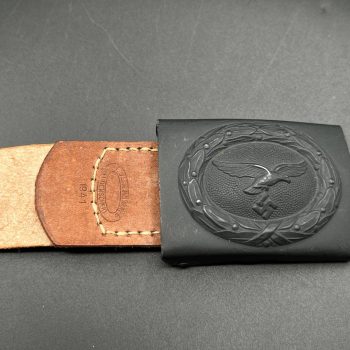
This buckle is in excellent condition with stunning dark blue paint. Has a brown leather tab which is nicely maker marked and dated 1941. Excellent example of this style buckle.
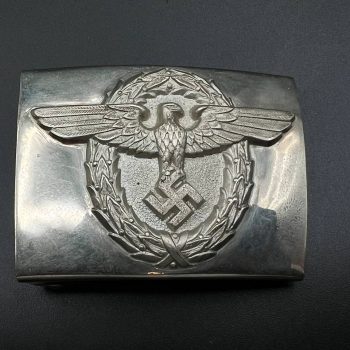
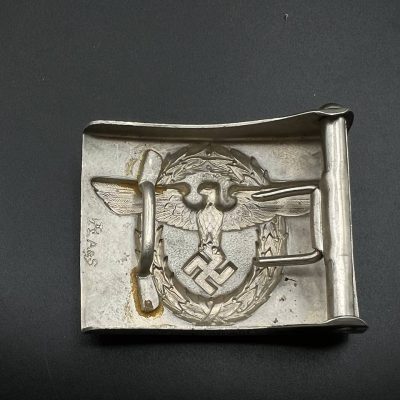
This is the rarest style of Police buckle you will find. Made by Assman as these always were, it features the Police style eagle with wreath as compared to the ” Gott Mit Uns” that you will normally find. All original and in outstanding condition for a true rare piece.
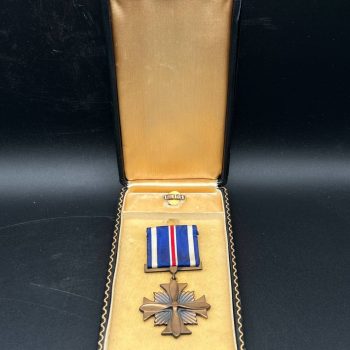
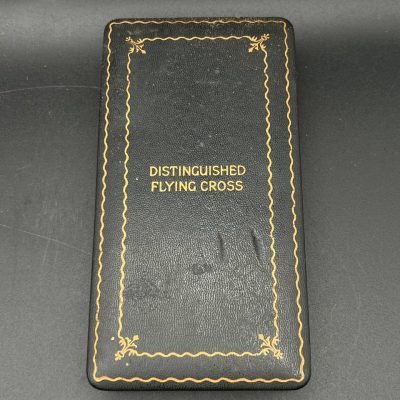
Original Distinguished Flying Cross (DFC) medal, established in 1926 to honor members of the U.S. Armed Forces for heroism or extraordinary achievement while participating in aerial flight.
The medal features a bronze cross with a silver propeller superimposed at the center. The ribbon is blue with white and red stripes.
The set includes:
• Full-size medal with ribbon;
• Service ribbon bar;
• Lapel pin for civilian wear;
• Original black leather presentation case with gold lettering “DISTINGUISHED FLYING CROSS.”
Manufactured during the late WWII to early Korean War period (circa 1945–1955).
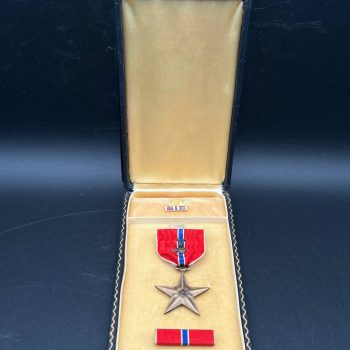
Original Bronze Star Medal, established in 1944 to recognize members of the U.S. Armed Forces for heroic or meritorious achievement in combat.
This example includes the “V” Device (Valor), awarded specifically for personal acts of bravery in battle.
The set consists of:
• Full-size medal with ribbon;
• Service ribbon bar;
• Lapel pin for civilian wear;
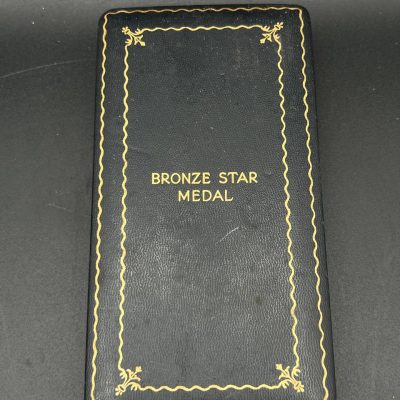
• Original WWII–Korean War era presentation case with gold lettering “BRONZE STAR MEDAL” on the lid.
The reverse of the medal reads “Heroic or Meritorious Achievement.” The ribbon is red with blue and white edges — the standard pattern for this decoration.
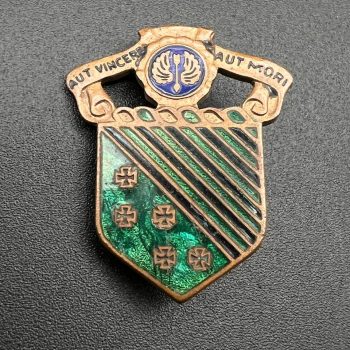
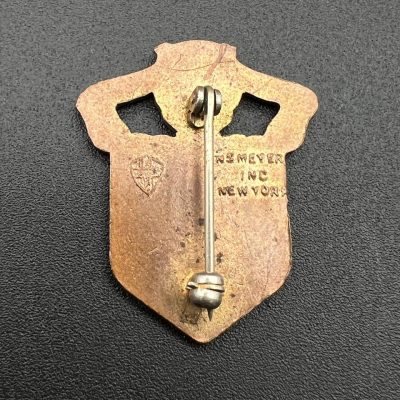
Original enamel Distinctive Unit Insignia (DUI) of a U.S. Army unit, manufactured by N.S. Meyer Inc., New York (1940s–1950s).
The shield is diagonally divided with green and black stripes; the green field features four crosses.
Above is a blue disc with a silver arrow between wings and the unit motto “AUT VINCERE AUT MORI” (“To conquer or die”).
Made of bronze with colored enamel, pin-back fastening, and the maker’s hallmark on the reverse.
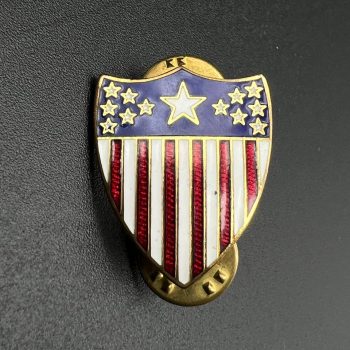
Enamel lapel pin in the shape of a shield with red and white vertical stripes and a blue upper field featuring a large white star surrounded by smaller stars.
Issued to members of the U.S. Army who were honorably discharged after World War II.
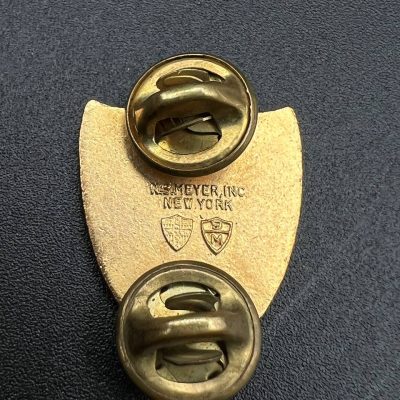
This example is an early postwar production by N.S. Meyer Inc., New York, featuring the company’s distinctive double-shield hallmark on the reverse.
Made of brass with two pin posts and brass clutch-back fasteners.
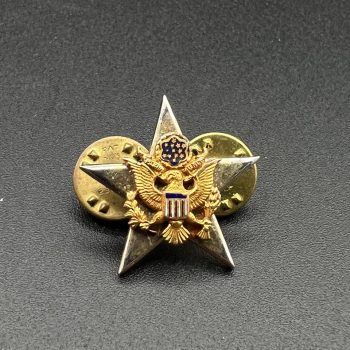
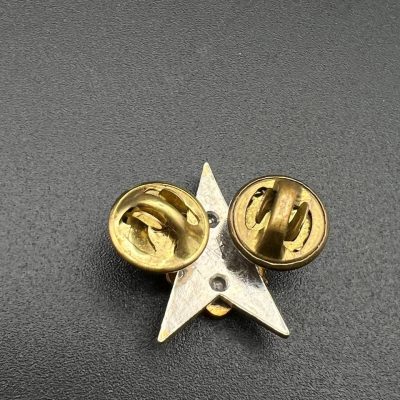
Emblem in the form of a silver five-pointed star with a gold-colored Great Seal of the United States — an eagle holding a shield, olive branch, and arrows. Worn on the collar or cap by U.S. Army officers and enlisted personnel during and after World War II (1940s–1950s).
The reverse side bears the manufacturer’s hallmark. Attachment by two pin posts with brass clutch-back fasteners.
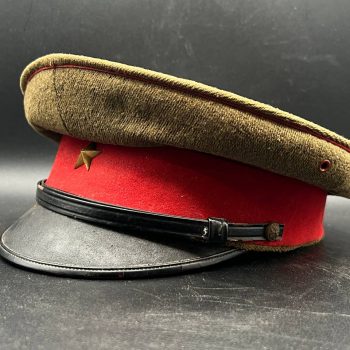
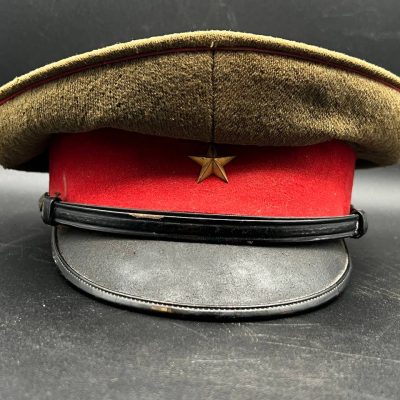
A wartime officer’s service visor cap of the Imperial Japanese Army (陸軍将校制帽, Rikugun Shōkō Seibō). Constructed in field khaki wool with the distinctive red band, denoting army service. The front displays the classic five-pointed star insignia, the standard emblem of the Imperial Japanese Army. Side buttons feature the traditional cherry blossom (sakura) motif, and the cap retains its original brown leather chinstrap secured with metal buttons.
Interior shows the expected period wear, with its original leather sweatband and lining still intact. The visor exhibits honest service use, with visible scuffs and patina consistent with age. Despite the wear, all original elements remain present, making this a desirable and authentic example of a WWII Japanese officer’s service cap.
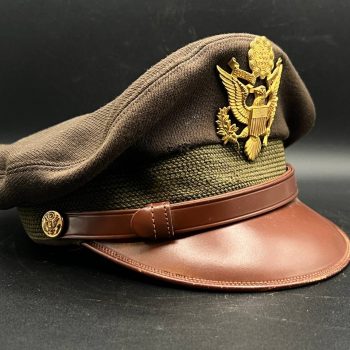
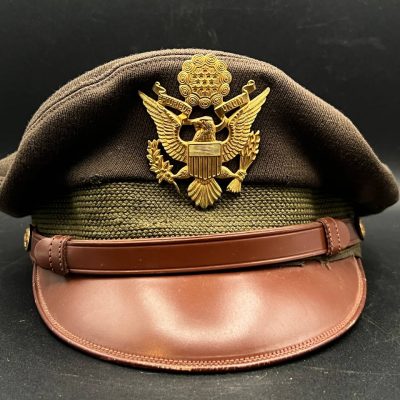
This visor cap was manufactured by Bancroft, model “Flighter”, one of the most popular among U.S. Army Air Forces officers during World War II. Its distinctive feature is the soft, unreinforced frame, which allowed it to be comfortably worn under aviation headsets and headphones. Because of this, it became widely known as the “crusher cap.”
The brown wool top is combined with an olive woven band, while the visor and chin strap are made of brown lacquered leatherette. On the front is the large gilt officer’s insignia of the U.S. Army — the eagle with shield, arrows, and olive branch, above which is the scroll with the motto E Pluribus Unum. On the sides are buttons with the Great Seal of the United States.
The interior retains the leather sweatband with the gold “Flighter by Bancroft” marking, along with the maker’s logo. Age-related wear is visible — flaking of the lining and scuffs, which is typical for original wartime examples.
This model is highly valued by collectors as one of the most iconic symbols of U.S. Army Air Forces officers in World War II, especially due to its strong association with bomber and fighter pilots.
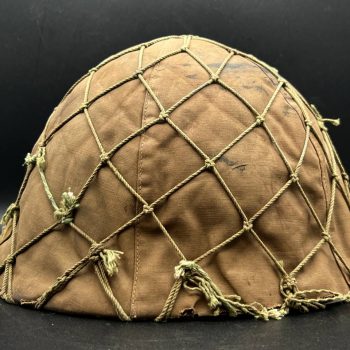
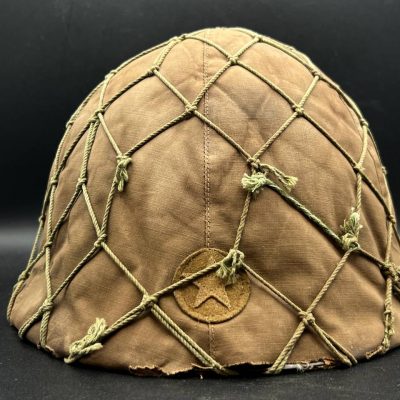
This piece is a classic Japanese Army Type 90 helmet from the World War II era, introduced in 1930 and remaining the standard protective gear of the Imperial Japanese Army until the end of the war in 1945.
The helmet is made of stamped steel with the typical brown-green factory paint and is fitted with its original leather liner consisting of three sections connected by a drawstring. The leather liner components are well preserved, along with the original fabric chinstrap. On the inside, there are Japanese kanji inscriptions — personal markings of the soldier or his unit.
The helmet comes with an original cloth cover in a sand-brown color, secured around the rim, with a camouflage rope net placed over it. On the front of the cover, the felt star insignia of the Imperial Japanese Army has been preserved.
The overall appearance is fully authentic, with clear signs of field use, which adds to the item’s historical and collector’s value.