Login
Register
By clicking Login or Register, you agree that the images of Nazi symbols shown on alexmp.com are not propaganda of fascism, Nazism and are shown solely for historical, cognitive and scientific purposes.
Order a free call and our specialist will contact you shortly!
Contact us and we will get back to you shortly.
Contact us and we will get back to you shortly.
Contact us and we will get back to you shortly.
Contact us and we will get back to you shortly.
Error: Contact form not found.
We will get back to you shortly.
В честь запуска Энциклопедии мы рады предложить вам бесплатный доступ до 01.10.2026.
Будем рады вашим комментариям и предложениям!
Inspected and guaranteed by Alex Warstory.
For more details on AlexMP Guarantee, click [HERE]
Item guaranteed by a verified dealer.
Click [HERE] for full seller guarantee terms.
Sold without expert review or guarantees. No claims accepted post-sale.
Learn more [HERE]


Showing 33–48 of 198 results
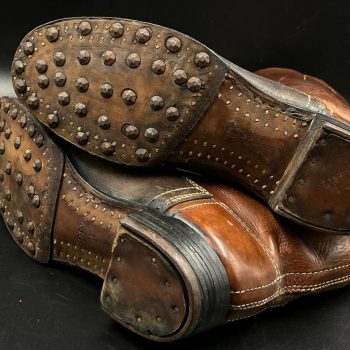
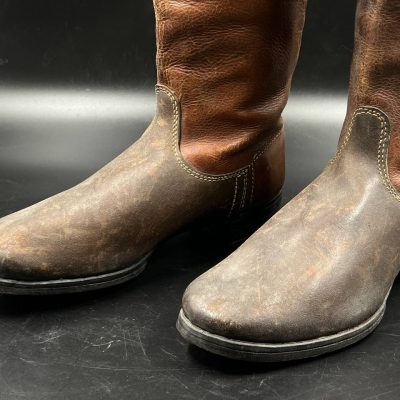
FiltersAuthentic WWII-era German Wehrmacht combat marching boots (Marschstiefel) for enlisted men and NCO rank. Classic “jackboot” style as issued to German infantry throughout the war. Original hobnail soles intact and complete. Excellent condition for age — a display-ready piece of genuine German militaria from the Second World War.
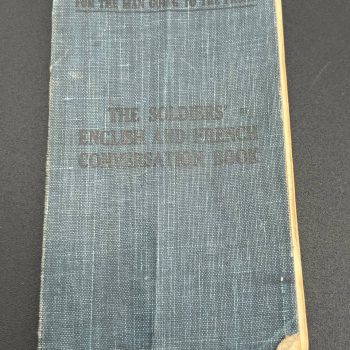
Original World War I military language handbook designed for British soldiers heading to the Western Front.
The upper cover inscription reads: “For the Man Going to the Front”.
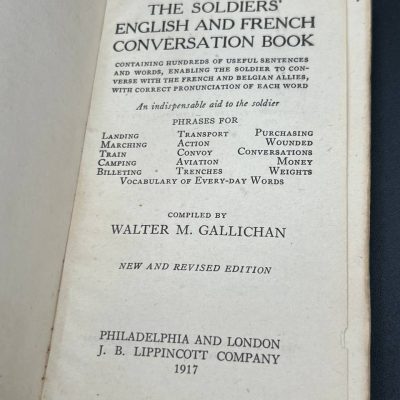
Compiled by Walter M. Gallichan and published by J. B. Lippincott Company (Philadelphia and London) in 1917, this New and Revised Edition contains hundreds of practical phrases and words enabling soldiers to communicate effectively with French and Belgian Allies during wartime.
The book includes sections on military operations (transport, trenches, action, wounded, billets, money, weights, etc.) as well as everyday vocabulary with phonetic pronunciation guides for English speakers.
Original blue cloth cover with black lettering, small pocket-sized format for field use — an authentic WWI-issued piece carried by Allied troops.
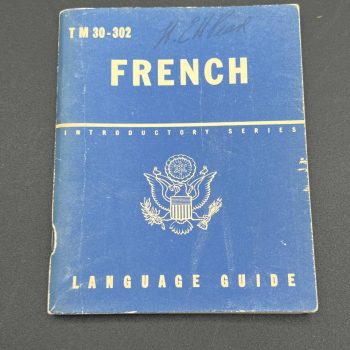
Original WWII-era U.S. War Department language manual, issued to American servicemen preparing for operations in France and French-speaking territories.
Official designation: TM 30-302, “French: A Guide to the Spoken Language”, published June 21, 1943 by the War Department, Washington, D.C.
This pocket-sized booklet was part of the Introductory Series Language Guides, prepared under the authority of General George C. Marshall, Chief of Staff, and Major General J.A. Ulio, The Adjutant General.
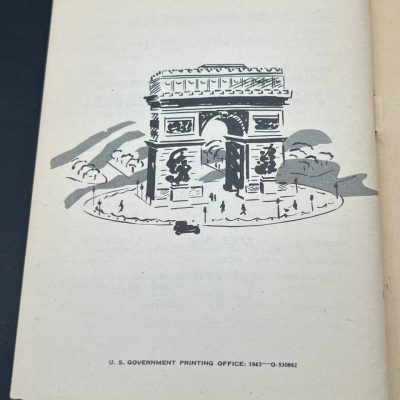
Printed by the U.S. Government Printing Office in 1943 (code: O-530662).
The manual includes basic grammar, pronunciation guides, and hundreds of practical phrases for field communication—covering topics such as food, transportation, medical aid, military instructions, and social interaction.
Illustrated with a rear drawing of the Arc de Triomphe, symbolizing the liberation of France.
Original blue softcover with the U.S. Great Seal and “TM 30-302” designation on the front. Typical pocket format used by GIs during the European campaign, especially around D-Day and the Normandy operations.
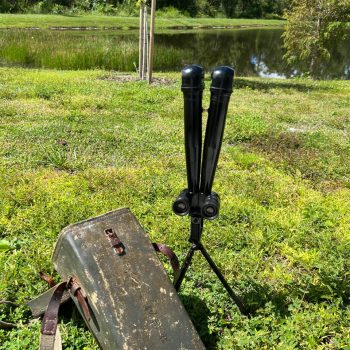
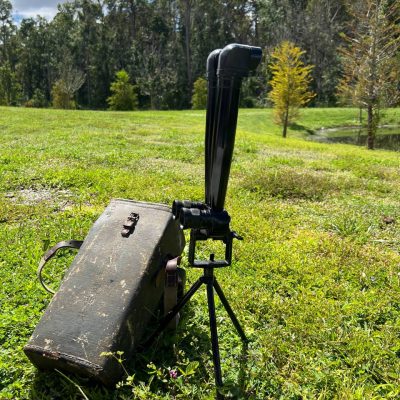
A genuine WW2 Imperial Japanese Army 8×6 Degree Scissor/Trench Binocular — this “periscope” style of optic was used throughout the war in many capacities, made of brass, aluminum, and steel. The angled eyepieces allow observation from a concealed position. Original black factory finish largely intact. Both sides of the optics are clear and crisp, with all adjustments operating smoothly. Includes original folding field tripod and canvas/leather carry case with original shoulder strap and kanji markings. A complete, functional set.
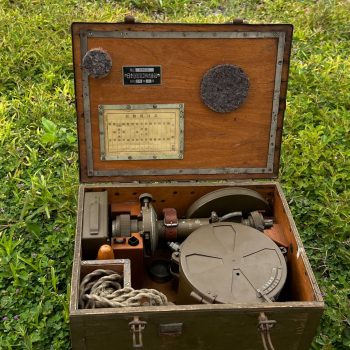
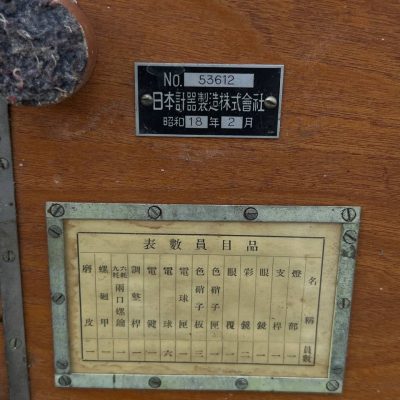
A precision optical surveying instrument of the Imperial Japanese Army, used for laying out permanent gun sites, airfields, and military installations — measuring precise horizontal and vertical angles for triangulation of defined targets and positions. Manufactured by Nihon Keiki Seizo Kabushiki Kaisha (Japan Instrument Mfg. Co.), dated Showa 18 Year 2 Month = February 1943. Serial number 53612 appears on both the instrument and the case tag. The instrument features a large red filter disc, precision optics, and fine adjustment mechanisms. Included: original metal lamp storage box with 6 original spare bulbs still in place, color filter glass, eyepiece, tools. The hardwood case has original metal edging, functioning latches, and a complete parts inventory plate inside the lid. An exceptional, largely complete WWII Japanese precision optical set.
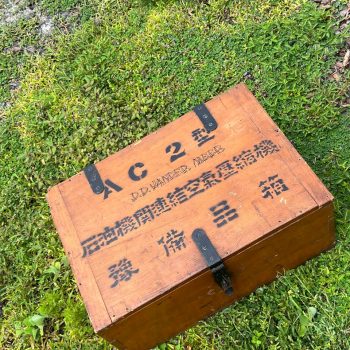
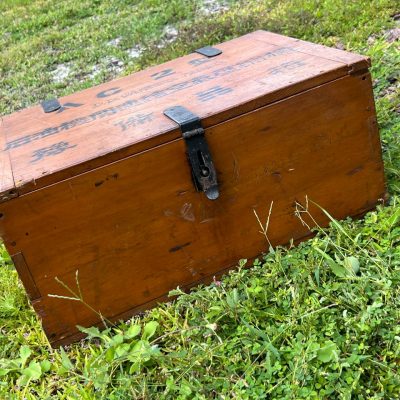
Rare and complete technical supply box from the Imperial Japanese Army, used to store spare parts and accessories for a field petroleum-powered air compressor, Type AC (石油空気圧縮ポンプ). The lid bears large stenciled kanji identifying the unit type. Inside the lid, an original Japanese parts layout diagram (配置表) on period paper is nailed in place, listing every component with its storage position — remarkably intact. Original wooden interior brackets/holders survive. Iron hinges and latches function. A penciled inscription “D.R. Vander Meer” identifies the American soldier who captured and brought home this item from the Pacific Theater. An exceptional research and display piece with full provenance.
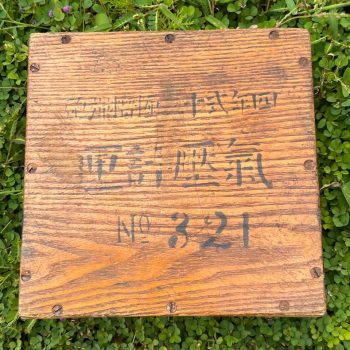
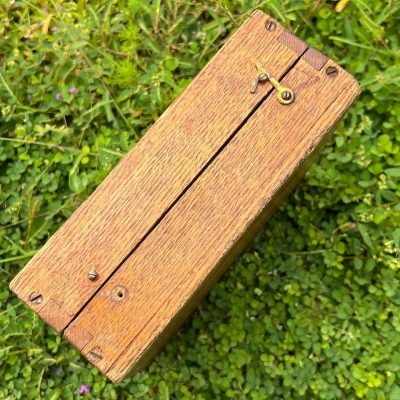
Oak wooden instrument case from the Imperial Japanese Army, stenciled in black with kanji markings indicating Type 40 (Meiji Year 40 = adopted 1907), instrument designation, and serial number No. 321. Features original brass hinges, brass latch, and green wool/felt interior lining. The instrument itself is absent. Solid construction with period-appropriate wear. A rare and desirable piece of Japanese militaria.
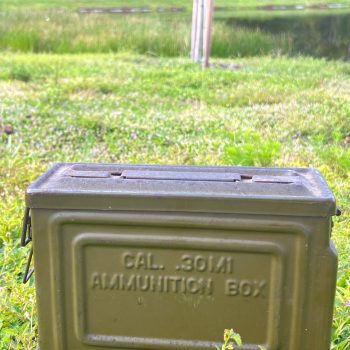
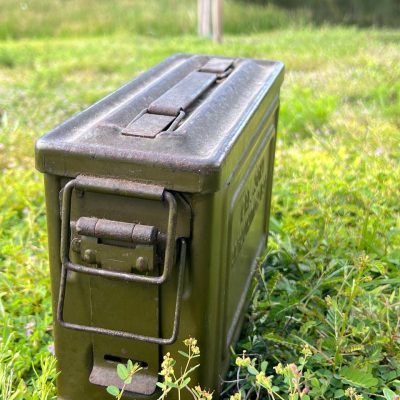
Original WWII U.S. Army steel ammunition can, Cal. .30 M1 pattern. The M1 steel ammo can was developed to deliver belts of 250 rounds of .30-06 for the M1917 Browning machine gun, replacing the earlier wooden box early in WWII. The box is embossed with concentric rectangles for strength and marked “Cal. .30 M1 Ammunition Box.” The manufacturer’s name — REEVES — is embossed on the hinge end above the U.S. Ordnance flaming bomb insignia. The hinged lid is fully functional. Condition: used, period-appropriate wear, empty interior. A genuine piece of American military history.
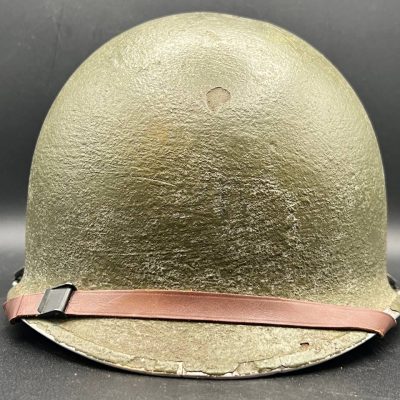
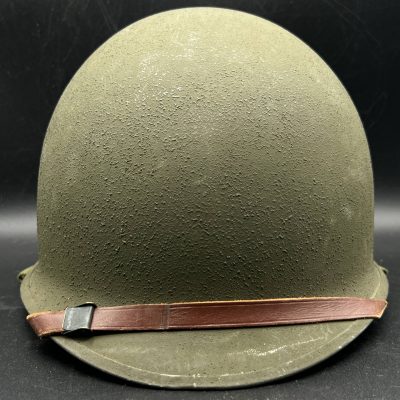
This is an original American M1 combat helmet, introduced in 1941 and used by the U.S. Army through World War II, the Korean War, and into the Vietnam era. The construction consists of a steel shell with rough olive-drab textured paint and a separate inner liner made of pressed fiber with webbing suspension and leather components. Characteristic features include swivel chinstrap bales, a web chinstrap with metal hardware, and a leather sweatband inside the liner.
The photos clearly show service wear: paint loss along the rim, preserved textured camouflage finish on the steel, and aging of the leather elements of the suspension. The liner is made of compressed fiber with the typical web crossband adjustment and a leather forehead pad.
The M1 helmet is one of the most iconic symbols of the American soldier during World War II, later conflicts in Korea and Vietnam, and remains a highly sought-after collectible piece of military history today.
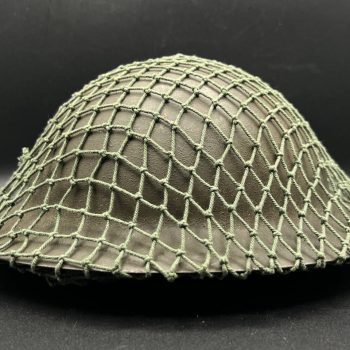
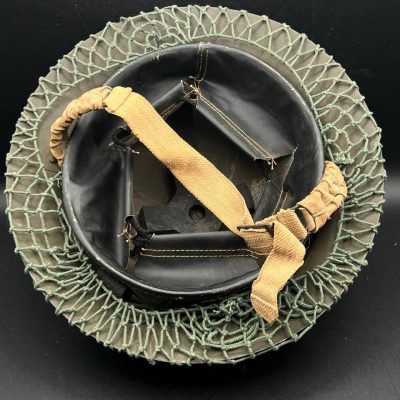
An original British Mk II steel helmet from the Second World War. This helmet features the classic “Brodie” shape with wide brim, finished in olive drab paint, and fitted with a camouflage net. The interior retains its later pattern liner with rubber crown pad and simple oilcloth and fabric components. The chinstrap is webbing type with spring clips attached to the shell.
The net, secured over the shell, was used both to reduce shine and to allow foliage or other materials to be added for camouflage.
Mk II helmets of this type were widely used by British and Commonwealth forces during World War II, in campaigns across Europe, Africa, and the Pacific. Today, examples complete with netting and original liner remain desirable collector’s pieces of wartime equipment.
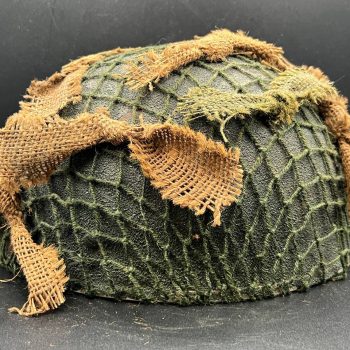
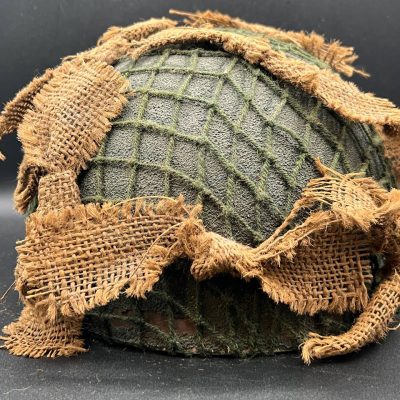
This is an original British paratrooper helmet (Airborne Helmet Mk II), as issued to airborne troops during the Second World War. Introduced in 1942, this model was specifically designed to provide improved protection and comfort for paratroopers during airborne operations.
The steel shell retains its matte olive finish and is fitted with a camouflage net enhanced with hessian scrim strips, used to break up the outline and reduce shine for better concealment in the field. The liner features the classic suspension system with a leather sweatband, web cross straps for size adjustment, and a felt crown pad for impact absorption. The chinstrap is the correct webbing type with the distinctive steel clip and hook fittings unique to airborne helmets.
The helmet shows honest service wear: the leather and webbing components display age and use, but the set remains complete and authentic. The presence of the net and hessian strips gives it a highly characteristic combat appearance, strongly associated with British airborne forces in Normandy and other key WWII campaigns.
Today, original Airborne Mk II helmets are considered highly desirable collector’s items, representing one of the most iconic pieces of British paratrooper equipment from World War II.
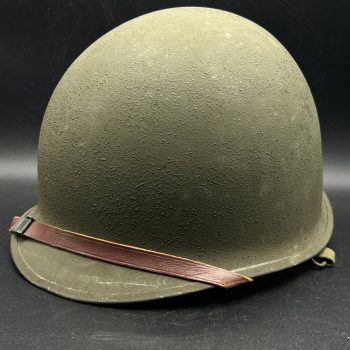
Original United States M1 steel helmet, WWII period.
Steel shell retains its original olive drab textured (“corked”) finish. Surface shows honest service wear and light scuffing consistent with field use. No post-war repaint visible.
Complete with WWII-era liner featuring khaki web suspension system and leather sweatband. Canvas chinstrap present with correct early-style hardware and darkened steel buckle. Interior components show age and use but remain structurally sound.
A classic WWII U.S. combat helmet suitable for any European or Pacific Theater display.
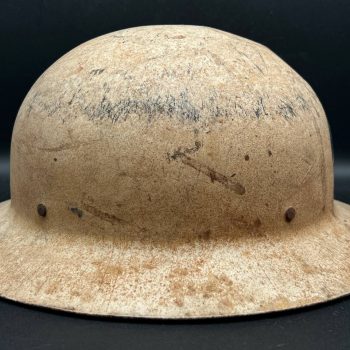
This is an original American Civil Defense helmet from the World War II era. It was produced on the basis of the M1917A1 steel helmet (“Kelly helmet”) and painted in a characteristic light shade. On the front, it bears a large colorful decal of the U.S. Office of Civilian Defense insignia – a blue circle with a white triangle and a red shield in the center.
Inside, the original markings are preserved: “PROPERTY OF U.S. GOVERNMENT O.C.D.” along with a serial number. The liner is made of textile webbing with leather reinforcements and an adjustable suspension system. The photographs show the typical paint darkening, signs of age, and surface wear, which add historical authenticity to the piece.
These helmets were used by U.S. Civil Defense personnel – including firefighters, rescue workers, medical staff, and police units – responsible for civilian protection during air raid alerts and drills in the 1940s.
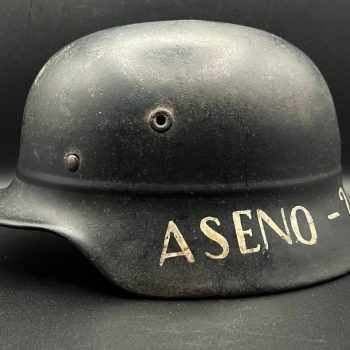
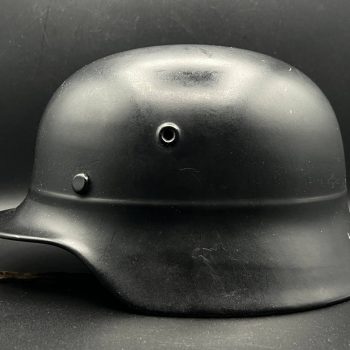
A well-presented example of the M35 Beaded Helmet – ET66, manufactured by ET and stamped ET66, with lot number 5064. This civil defense helmet retains much of its original paint
The steel shell is finished in black paint, a standard color for fire brigades and civil services. White alphanumeric markings (“ASENO-248”, “G.S.”) are painted on the sides and rear, indicating assignment to a specific unit or facility.
The shell is clearly stamped “ET66” (Eisenhüttenwerke Thale, size 66) and “5064” (lot number).
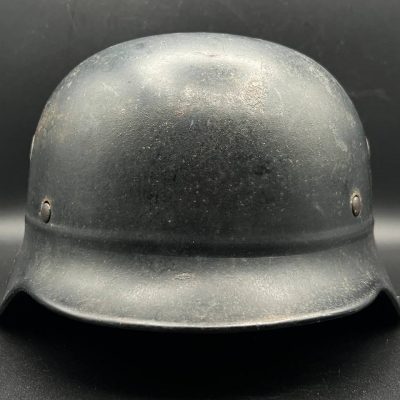
An original German Beaded helmet from the Third Reich period. Manufactured from steel based on the military M34/M35 helmet, it was adapted to meet the needs of civil defence and police.
The shell retains its ventilation holes and rivets, with the manufacturer’s stamp “ET64” indicating production by Eisenhüttenwerke Thale and a size 64 shell. An additional marking “692” is visible inside (batch number). The interior is fitted with the original leather liner with multiple tongues and the chinstrap.