Showing 49–64 of 72 results
Filters-
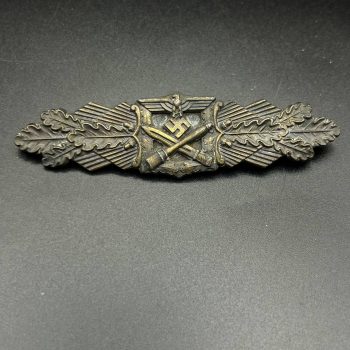
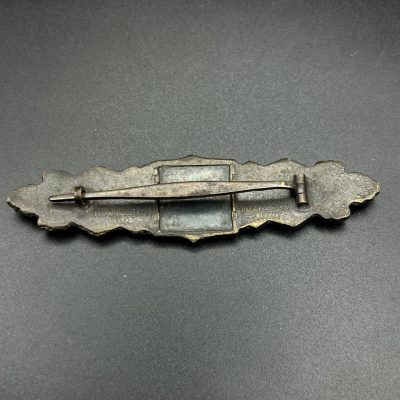
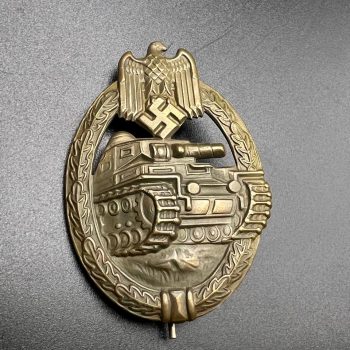
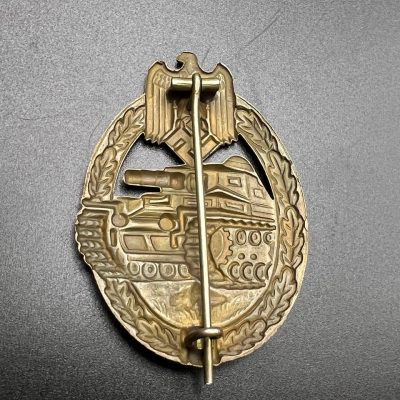
Panzer Assault Badge in Bronze (Lot: 1364)
Starting bid: $ 825An unmarked bronze Panzer Assault Badge, typical of private-maker production from the early wartime period. The badge features a sharply detailed depiction of a Panzer IV with well-defined tracks, road wheels, and turret, framed by a deep-relief laurel wreath. The bronze finish remains evenly preserved with a natural patina and no signs of cleaning.
The reverse shows the characteristic early hardware setup: tubular hinge, long curved pin, and a solid block catch—fully consistent with authentic early-to-mid war construction. Made of a heavy alloy with crisp detailing, free of repairs or damage. A strong collectible example of an bronze assault badge.
-
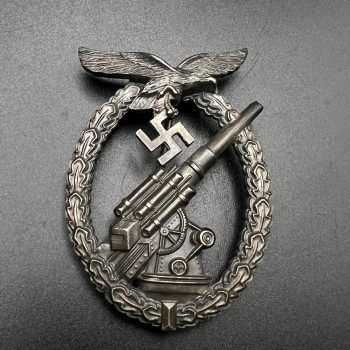
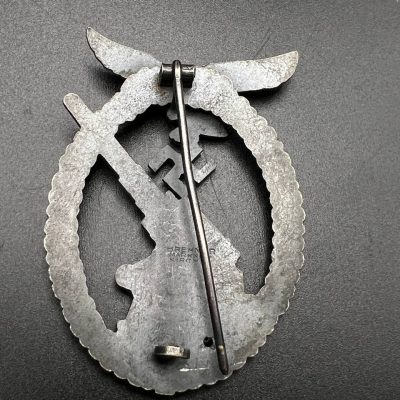
Luftwaffe Anti-Aircraft Badge, maker Brehmer (Lot: 1363)
Starting bid: $ 725Original Luftwaffe Anti-Aircraft Badge manufactured by Brehmer, Markneukirchen, a highly regarded and collectible maker. This example displays all the classic Brehmer features: a sharply detailed eagle with long, elegant wings, deeply cast 88 mm gun, and a well-defined oak-leaf wreath with crisp vein work.
The reverse shows the distinctive vertical maker’s mark “BREHMER / MARKNEUKIRCHEN”, fully consistent with authentic wartime production. The hardware is the early Brehmer style: tubular hinge, long straight pin, and a solid block catch—untouched and without repairs. The piece is made of high-quality alloy with natural grey patina, no damage, and excellent preservation of relief.
-
German Army Dagger, Model 1935 (nickel-silver fittings). [Gustav C. Spitzer]. (Lot: 1362)
Starting bid: $ 1,952Officially introduced on 4 May 1935 simultaneously with the restoration of the German armed forces, this dagger was intended for officers of the Army (Heer) and served as an integral part of dress and walking-out uniform. It was worn with the appropriate officer’s uniform and quickly became one of the main symbols of the Wehrmacht officer corps. The dagger was authorized for officers of all branches of the land forces, including general officers, and its production continued until 1942. Due to this lengthy manufacturing period, the Army dagger model 1935 became the most widely produced German officer’s dagger of the Third Reich era and remains today one of the most popular categories for collectors of German edged weapons.
The fittings made of nickel silver (German silver) are characteristic of early examples, typically manufactured prior to 1936. This specimen was crafted by the firm Gustav C. Spitzer. Owing to their limited production runs, high quality of manufacture, and distinguished appearance, such pieces are traditionally valued by collectors more highly than their later counterparts.
-
German Army Dagger, Model 1935 (nickel-silver fittings). [Carl Eickhorn]. (Lot: 1361)
Starting bid: $ 2,075This dagger was officially introduced on 4 May 1935, coinciding with the restoration of Germany’s armed forces. Intended for officers of the Army (Heer), it served as part of the dress and walking-out uniform and was worn with the corresponding officer’s attire. The dagger quickly became one of the principal symbols of the Wehrmacht officer corps. It was worn by officers of all branches of the ground forces, including general officers, and production continued until 1942. Due to this extended manufacturing period, the Army dagger became the most widely produced German officer’s dagger of the Third Reich era and remains today one of the most popular areas of German edged weapons collecting.
The fittings made of nickel silver (German silver) are characteristic of early examples, typically manufactured before 1936. Owing to their limited production numbers, superior craftsmanship, and distinguished appearance, such pieces are traditionally valued by collectors more highly than their later counterparts.
The Carl Eickhorn company was founded in Solingen in 1865 and became one of the largest edged weapons manufacturers in Germany. The trademark featuring a squirrel (Eichhörnchen) served as a guarantee of the highest quality products. During the Third Reich period, the firm produced a wide range of regulation edged weapons: daggers for all branches of service, SA, SS, NPEA, NSFK, and TeNo daggers, as well as dress daggers, sabres, and swords. Carl Eickhorn products are distinguished by superb steel quality and meticulous finishing, and they are highly prized by modern collectors.
-
German Army Dagger, Model 1935 (nickel-silver fittings). [Anton Wingen Jr]. (Lot: 1360)
Starting bid: $ 1,835Officially introduced on 4 May 1935 concurrently with the restoration of Germany’s armed forces, this dagger was intended for officers of the Army (Heer) and served as part of the dress and walking-out uniform, worn with the appropriate officer’s attire. The dagger quickly became one of the principal symbols of the Wehrmacht officer corps. It was worn by officers of all branches of the ground forces, including general officers, and production continued until 1942. Due to the extended period of manufacture, the Army dagger became the most widely produced German officer’s dagger of the Third Reich era and remains today one of the most popular collecting categories for German edged weapons.
The fittings made of nickel silver (German silver) are characteristic of early examples, generally produced before 1936. The present specimen was manufactured by the renowned Solingen firm Anton Wingen Jr. Owing to their limited production numbers, high quality of craftsmanship, and distinguished appearance, such pieces are traditionally valued by collectors more highly than their later counterparts.
-
German Army Dagger, Model 1935 (nickel-silver fittings). [Gebr Heller]. (Lot: 1359)
Starting bid: $ 1,955The official introduction of this pattern took place on 4 May 1935, coinciding with the restoration of Germany’s armed forces. The dagger was intended for officers of the Army (Heer) and constituted an integral component of dress and walking-out uniform, worn with the corresponding officer’s attire. Having quickly acquired the status of one of the principal symbols of the Wehrmacht officer corps, it was carried by officers of all branches of the land forces, including general officers. Production continued until 1942, making the Army dagger the most widely produced German officer’s dagger of the Third Reich period. Today it remains one of the most popular collecting areas within German edged weapons.
The fittings are executed in nickel silver (German silver) by the craftsmen of the firm Gebr Heller, characteristic of early examples generally manufactured prior to 1936. Owing to limited production runs, superior manufacturing quality, and distinguished appearance, such pieces are traditionally valued by collectors more highly than their later counterparts.
-
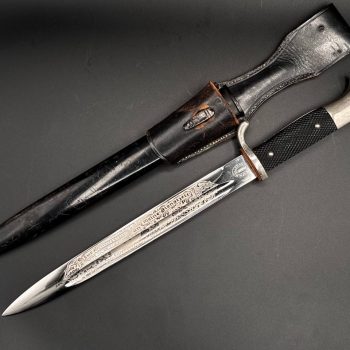
Etched Bayonet. [FW. Höller]. (Lot: 1352)
Wehrmacht dress bayonet complete with scabbard and frog. The blade is decorated with high-quality etching featuring the inscription “Zur Erinnerung an meine Dienstzeit” (“In Memory of My Service”), depictions of military equipment, and floral ornamentation. On one side of the blade ricasso, the manufacturer’s mark of F.W. Höller, Solingen is present, accompanied by the company’s trademark thermometer logo; the opposite side bears the retailer’s marking “Robert Kappe, Magdeburg.” The grip is crafted from black Bakelite with characteristic diamond-pattern checkering, and the fittings are nickel-plated. The grip backstrap is fitted with a red velvet insert.
-
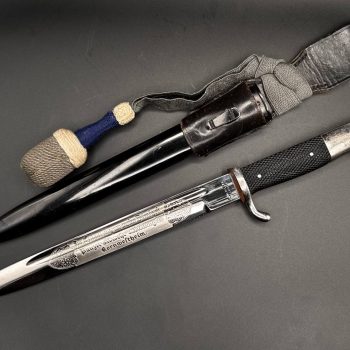
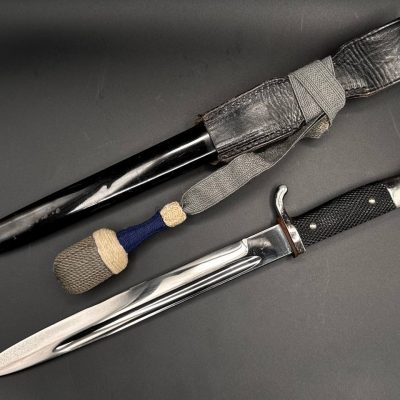
Etched Bayonet. (Lot: 1351)
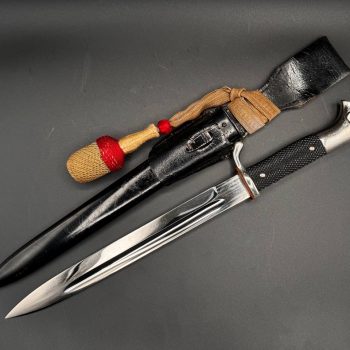
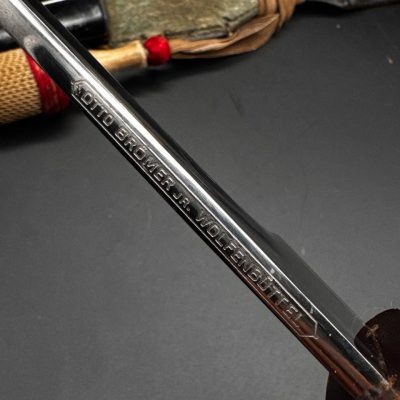
Wehrmacht dress bayonet complete with metal scabbard, leather frog, and sword knot. The blade, featuring two fullers, is adorned with high-quality etching bearing the inscription “Zur Erinnerung an meine Dienstzeit Panzer-Abwehr-Abteilung 25 Kornwestheim” (“In memory of my service in the 25th Anti-Tank Battalion, Kornwestheim”). The etching is framed by ornamental cartouches depicting the Imperial Eagle and an anti-tank gun. The blade ricasso bears the mark “Joh. Hiller Bad Cannstatt”. The grip is crafted from black Bakelite with characteristic diamond-pattern checkering; metal fittings are nickel-plated. This set holds considerable historical value due to its clear association with a specific military unit.
-
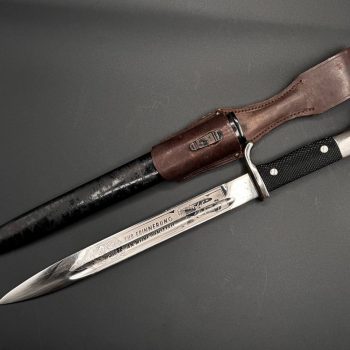
Etched Bayonet. [E.P.&S.]. (Lot: 1350)
Dress bayonet knife complete with metal scabbard and leather frog. The double-edged blade features fullers and is decorated with high-quality etching depicting aviation themes: a Luftwaffe aircraft with fuselage code and the commemorative inscription “Zur Erinnerung an meine Dienstzeit” (“In Memory of My Service”). The grip is made of black Bakelite with characteristic diamond-pattern checkering; metal fittings are nickel-plated. The blade ricasso bears the manufacturer’s mark “Siegfried Waffen, E. Pack & Söhne, Solingen” featuring the figure of Siegfried. This specimen is of particular collector interest due to the rare aviation-themed etching.
-
Etched Bayonet. [Robert Klaas]. Stamp – Robert Klaas. (Lot: 1349)
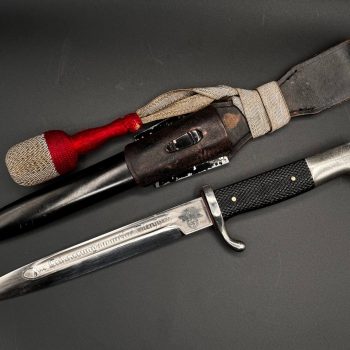
Wehrmacht dress bayonet-knife, complete with scabbard, leather frog, and sword knot with red tassel. The double-edged blade features fullers and is decorated with high-quality etching: one side displays the Imperial Eagle with swastika and a Gothic script inscription “Zur Erinnerung an meine Dienstzeit” (“In Memory of My Service”); the etching bears the marking “Ges. Gesch.” (registered design). The grip is executed with characteristic diamond-pattern checkering, secured with brass rivets. The blade ricasso bears a clear manufacturer’s mark of Robert Klaas, Solingen, featuring the company’s emblem.
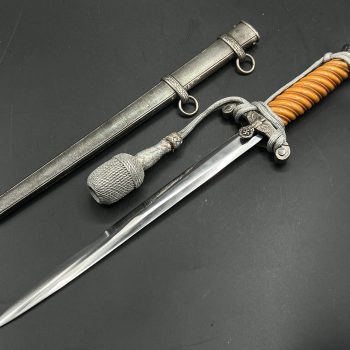
![German Army Dagger, Model 1935 (nickel-silver fittings). [Gustav C. Spitzer].](https://alexmp.com/wp-content/uploads/2026/08/1786283399870-s46108nq9z-400x400.jpeg)
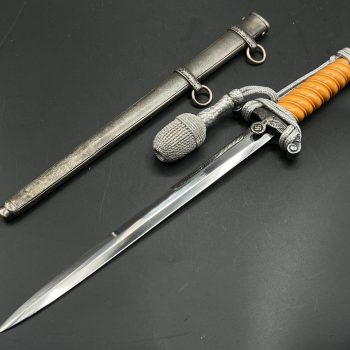
![German Army Dagger, Model 1935 (nickel-silver fittings). [Carl Eickhorn].](https://alexmp.com/wp-content/uploads/2026/08/1786282888986-eaqghbvlk6p-400x400.jpeg)
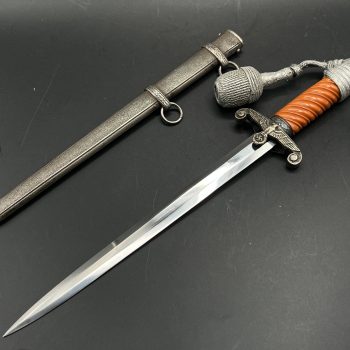
![German Army Dagger, Model 1935 (nickel-silver fittings). [Anton Wingen Jr].](https://alexmp.com/wp-content/uploads/2026/08/1786282483207-z308rppddc8-400x400.jpeg)
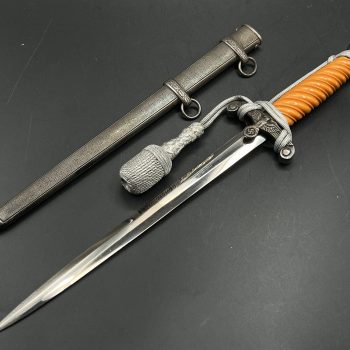
![German Army Dagger, Model 1935 (nickel-silver fittings). [Gebr Heller].](https://alexmp.com/wp-content/uploads/2026/08/1786282115364-u3256i4be47-400x400.jpeg)
![Etched Bayonet. [FW. Höller].](https://alexmp.com/wp-content/uploads/2026/08/1785959762436-cd6pk6twrcq-400x400.jpeg)
![Etched Bayonet. [E.P.&S.].](https://alexmp.com/wp-content/uploads/2026/08/1785959620748-lwesd7pxp28-400x400.jpeg)
![Etched Bayonet. [Robert Klaas]. Stamp – Robert Klaas.](https://alexmp.com/wp-content/uploads/2026/08/1785959531766-76hxrlh77lx-400x400.jpeg)
Sold at Blitz price
-
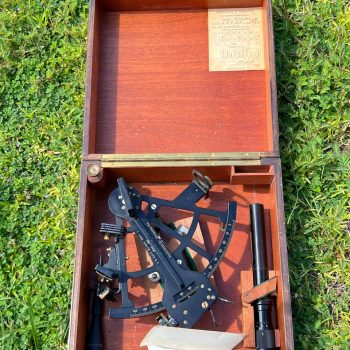
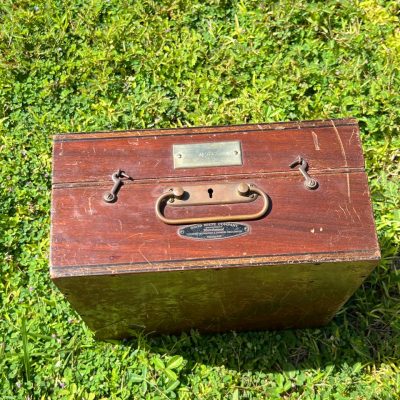
U.S. Navy Bureau of Navigation Mark II Sextant — David White Co., Milwaukee — Serial No. 647-1939 — With Original U.S. Naval Observatory Certificate of Inspection, dated August 15, 1941 (Lot: 1114)
Auction EndedThe Navy Mark II sextant by David White Company of Milwaukee was one of the principal instruments of U.S. Navy navigation throughout World War II. This example, serial number 647-1939, was inspected and certified by the U.S. Naval Observatory in Washington on August 15, 1941 — just four months before Pearl Harbor — making it a genuine pre-war/early-war service instrument. The limb reads to single degrees with drum micrometer to 1 minute, and vernier to 6 seconds of arc. Original mahogany dovetailed case with brass hardware and David White Company nameplate. Original inspection certificate with handwritten eccentricity corrections and inspector’s signature survives intact. Telescope present.
Product sold for blitz price: $ 665 -
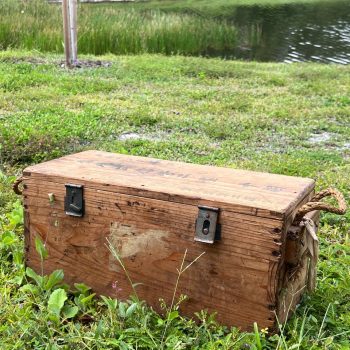
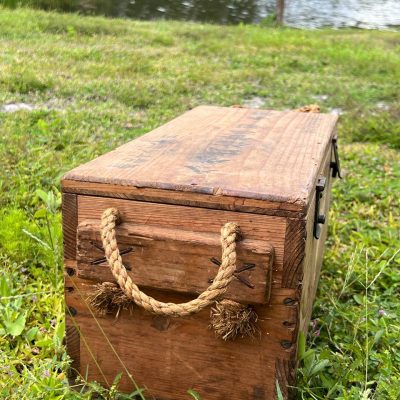
Imperial Japanese Army WWII Wooden Ammunition / Supply Crate, Showa 15 (1940), Original Rope Handles (Lot: 1068)
Auction EndedLarge field supply crate from the Imperial Japanese Army, dated to Showa Year 15 (1940). Lid bears hand-stenciled kanji markings indicating production year, arsenal or unit designation, and logistical data. Pine board construction with iron hardware and, notably, both original heavy rope carrying handles retained — a rare find, as these are almost always missing on surviving examples. Solid and display-ready. A compelling piece of Pacific Theater militaria.
Product sold for blitz price: $ 115 -
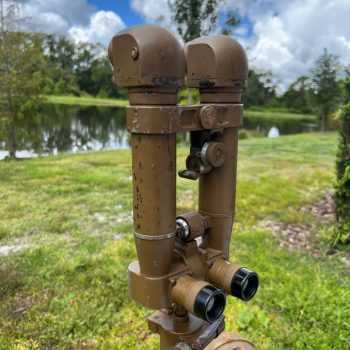
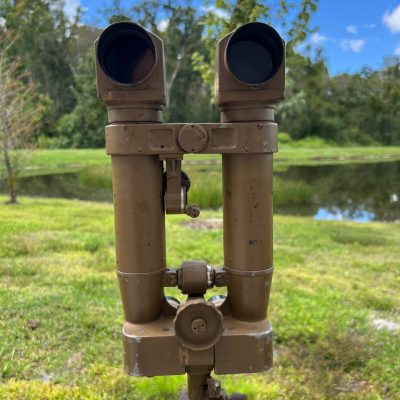
Imperial Japanese Army WWII 8×6.2° Artillery Stereoscopic Observation Binoculars — Serial No. 4021 — Complete Set with Brass Tripod, Metal Transport Case & Canvas Tripod Carrier No. 1902 (Lot: 1073)
Auction EndedA large-format precision artillery observation binocular of the Imperial Japanese Army, marked 8×6.2°, No. 4021 with Imperial Arsenal acceptance star stamp. This periscope-style instrument was used throughout the war by Battery Commanders for observation without exposure to enemy fire. Complete with adjustable-height tripod with matching serial number; tripod legs fold, extend, and lock in place. The instrument features precision azimuth and elevation adjustment dials with graduated scales. Included: original brass/aluminum field tripod with azimuth head, ribbed aluminum transport case, and canvas cylindrical tripod carrier marked No. 1902 with original straps. Optics clear on both sides.
Product sold for blitz price: $ 775