Showing 33–48 of 72 results
Filters-
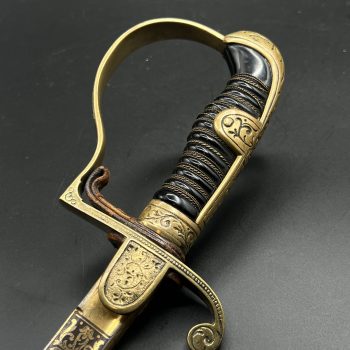
Honor Presentation Saber for Outstanding Marksmanship of the Oberkommando der Wehrmacht (OKW) 1930. [WKC]. (Lot: 1380)
Starting bid: $ 5,475Honorary Award Sabre “For Outstanding Achievements in Marksmanship” ranks among the most prestigious state awards of Germany in the period before 1939. Such sabres were presented to military personnel for outstanding results in marksmanship training and represented not a prize for placing in competition, but rather the sole honorary award for the best marksman of the competition. Unlike most richly decorated ceremonial sabres manufactured through private commissions, these blades were official state award weapons. Each was associated with a specific award presentation, making such items considerably rarer and more valuable to collectors. The tradition of such awards existed during the Reichswehr era and continued into the Wehrmacht period. OKW sabres were produced from 1935 to 1937 without the swastika, and from 1938 a new variant appeared featuring an eagle on the crossguard. All award sabres of this type were manufactured exclusively with Damascus steel blades. The blades featured rich etched ornamentation as well as inscriptions indicating the name, rank, and type of weapon with which outstanding results were demonstrated. Depending on the manufacturer and production period, the design could vary slightly. A common characteristic of original examples is also the presence of military acceptance stamps confirming their official state origin.
The year of the sabre’s production (1930) is attested by corresponding markings on the blade. Thus, this example dates to the Reichswehr period and was manufactured before the establishment of the Wehrmacht.
The manufacturer was WKC (Weyersberg, Kirschbaum & Cie), one of the oldest and most respected arms manufactories in Solingen, founded in 1883 through the merger of two historic production facilities. The company was a major supplier of edged weapons for the German army, producing army daggers and sabres of the highest quality bearing their distinctive mark. WKC products were distinguished by superb blade finishing, impeccable polishing, and precise conformity to regulation patterns, making them particularly valuable to collectors.
-
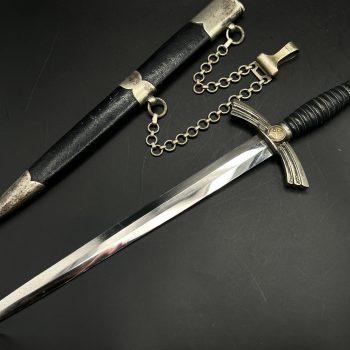
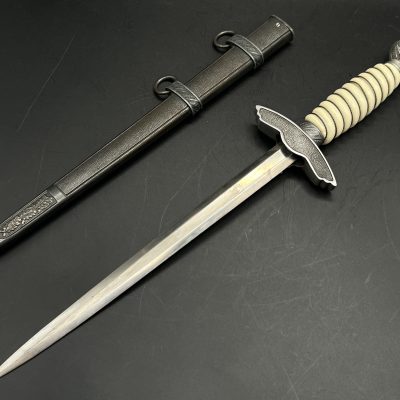
Luftwaffe Dagger, Model 1935 (nickel-silver fittings). [Stöcker & Co. SMF]. Stamp – SMF. (Lot: 1379)
Starting bid: $ 2,195Officially established on 10 March 1935 alongside the creation of the German Air Force, this dagger was intended for Luftwaffe career personnel in accordance with the established uniform regulations and represented the first official edged weapon of the new branch of the armed forces. Notably, the dagger’s design was based on the earlier Deutscher Luftsportverband (DLV) dagger, the German Air Sports Association, which in the early 1930s effectively served as a cover organization for training future Luftwaffe personnel. For this reason, the early Luftwaffe dagger retained many features of the DLV dagger and is considered a transitional model in the development of German aviation edged weapons.
The fittings made of nickel silver (German silver) are characteristic of early examples, typically manufactured before 1936. Due to limited production runs, high manufacturing quality, and distinguished appearance, such pieces are traditionally valued by collectors more highly than later variants.
The manufacturer was Stöcker & Co. SMF, a German metalworking company from Solingen that specialized in producing edged weapons for aviation organizations of the Third Reich. The firm produced daggers for the DLV, NSFK, and Luftwaffe, distinguished by the high quality of their blades and fittings. The blade bears the characteristic “SMF” mark, confirming the item’s origin.
-
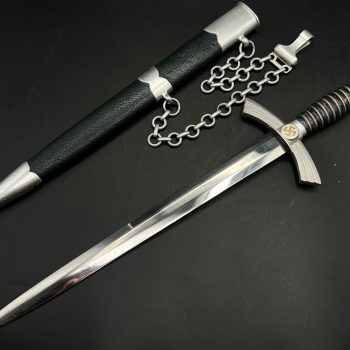
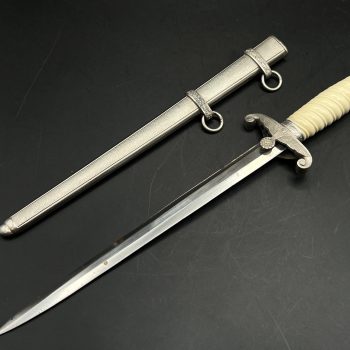
Luftwaffe Dagger, Model 1935 (1st Model). [Stöcker & Co. SMF]. (Lot: 1378)
Starting bid: $ 1,475Officially established on 10 March 1935 concurrently with the creation of the German Air Force, this dagger was intended for Luftwaffe career personnel in accordance with the established uniform regulations and represented the first official edged weapon of the new branch of the armed forces. Notably, the dagger’s design was based on the earlier Deutscher Luftsportverband (DLV) dagger, the German Air Sports Association, which in the early 1930s effectively served as a cover organization for training future Luftwaffe personnel. For this reason, the early Luftwaffe dagger retained many features of the DLV dagger and is considered a transitional model in the development of German aviation edged weapons.
Manufactured by Stöcker & Co., a German metalworking company from Solingen that produced edged weapons for aviation organizations of the Third Reich. The company specialized in the production of daggers for the DLV, NSFK, and Luftwaffe, distinguished by the high quality of their blades and fittings. Items were marked with the “SMF” stamp; this specimen belongs to the first model of daggers produced by this manufacturer.
-
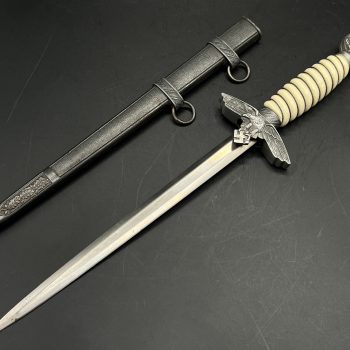
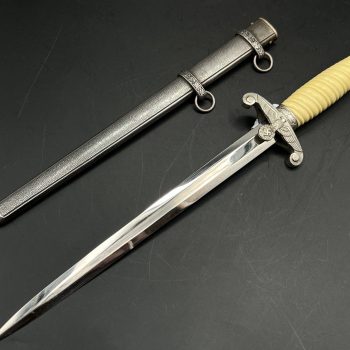
Luftwaffe Dagger, Model 1937 (2nd Model). (Lot: 1377)
Starting bid: $ 745A Luftwaffe officer’s dagger, Model 1937, complete with metal scabbard. The grip is crafted from white plastic featuring characteristic spiral fluting wrapped with twisted wire. The spherical pommel is adorned with a relief depiction of oak leaves with a gilded swastika at the center. The crossguard is designed in the form of a flying eagle clutching a swastika in its talons. The blade is steel, double-edged, with a diamond-shaped cross-section. The metal scabbard is fitted with two hanging bands with suspension rings, decorated with an oak leaf ornament. The scabbard tip is embellished with a relief depiction of oak leaves.
-
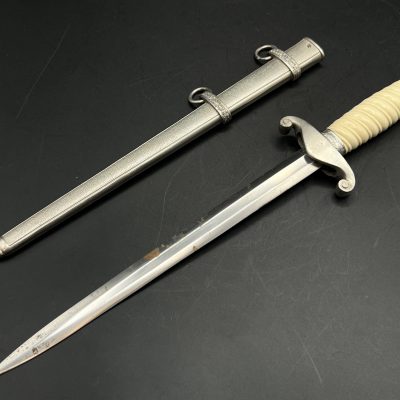
German Army Dagger, Model 1935 (Lot: 1376)
Starting bid: $ 655A Wehrmacht Army officer’s dagger, Model 1935, complete with metal scabbard. The grip is crafted from white celluloid featuring characteristic spiral fluting. The crossguard is adorned with a relief depiction of the Wehrmacht eagle with outstretched wings, clutching a swastika within an oak wreath. The pommel and guard ferrule are decorated with engraved oak leaf ornamentation. The metal scabbard has a textured surface and is fitted with two suspension rings featuring ornamented fittings. The blade displays traces of patina.
-
German Army Dagger, Model 1935 [Carl Julius Krebs]. (Lot: 1375)
Starting bid: $ 1,055Officially introduced on 4 May 1935 alongside the restoration of the German armed forces, this dagger was intended for officers of the Army (Heer) and served as an essential part of dress and walking-out uniform. The example presented here was manufactured by the firm Carl Julius Krebs. The dagger quickly became one of the principal symbols of the Wehrmacht officer corps and was worn with the appropriate officer’s uniform. It was used by officers of all branches of the ground forces, including general officers, and production continued until 1942. Owing to this extended period of manufacture, the Model 1935 Army dagger became the most widely produced German officer’s dagger of the Third Reich era and remains today one of the most popular areas of collecting German edged weapons.
-
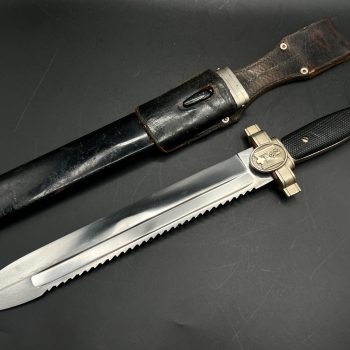
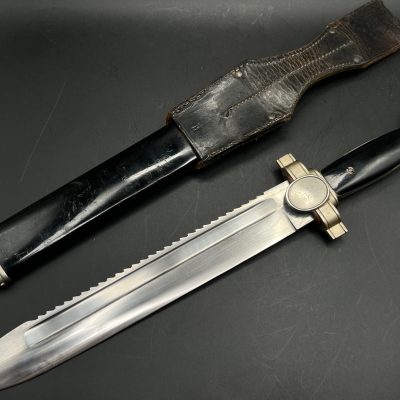
Hewer of an NCO of the German Red Cross (DRK), Model 1938 Stamp – Ges. Gesch.. (Lot: 1374)
Starting bid: $ 1,225A regulation edged weapon for non-commissioned officers of the DRK (Deutsches Rotes Kreuz) organization, representing a characteristic example with a blade featuring a saw back and a combat tip of specific form. The hanger was introduced following the large-scale reorganization of the German Red Cross in 1937 and the subsequent integration of the organization into the state structure of the Third Reich under the control of the Ministry of Internal Affairs. Official adoption occurred in 1938, which is reflected in the Nazi symbolism present in the design of this example.
The marking “Ges. Gesch.” stamped on the item is an abbreviation of the German “Gesetzlich Geschützt” (“Protected by Law”) and indicates patent protection of the object or its individual elements within German territory. Such markings were widely used on edged weapons of the Third Reich, predominantly on daggers and dirks of party and paramilitary organizations, denoting patented design solutions for hilts, scabbards, or decorative elements. The presence of the original marking attests to the authenticity of the item and its manufacture during the period when German patent legislation was in effect; this constitutes an important attribution criterion for collectors.
-
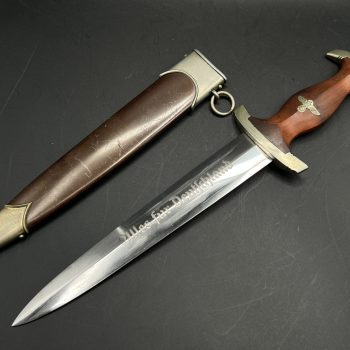
SA Service Dagger (Early type). [Gustav Wirth]. (Lot: 1373)
Starting bid: $ 2,675An early type of regulation edged weapon of the SA (Sturmabteilung) assault detachments, adopted in 1933. This specimen was manufactured by the Gustav Wirth workshop. The blade features a characteristic shape with double-edged sharpening and bears the famous motto “Alles für Deutschland.” The handle is made of brown wood, decorated with the SA emblem and eagle. The dagger comes complete with brown metal scabbard.
-
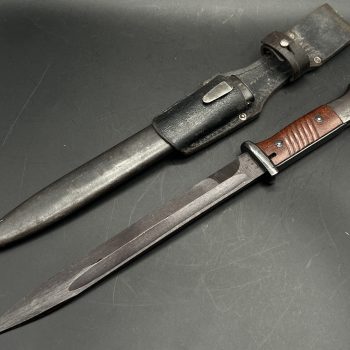
Mauser rifle bayonet (1934-1945). 1944 – crs 44. [P. Weyersberg]. Matching numbers. (Lot: 1372)
Starting bid: $ 485A true “calling card” of the German soldier during World War II, this bayonet model 1884/1898 was designed to accompany the legendary Mauser Gewehr 98 rifle. The modernized variant of the S84/98 model was mass-produced by the German arms industry and remained in service with the Wehrmacht throughout the entire period of World War II. This particular example dates to 1944, as evidenced by the “crs 44” marking belonging to the renowned manufacturer P. Weyersberg.
Matching serial numbers on the blade and scabbard confirm the original factory pairing since the time of manufacture; the corresponding markings indicate that these components have never been separated since leaving the production line. Such examples are encountered considerably less frequently due to combat losses and postwar reassembly, when bayonets and scabbards were often rematched from disparate parts. This is precisely why specimens with preserved matching numbers possess substantially higher collectible value and are of particular interest to serious collectors of military antiques.
-
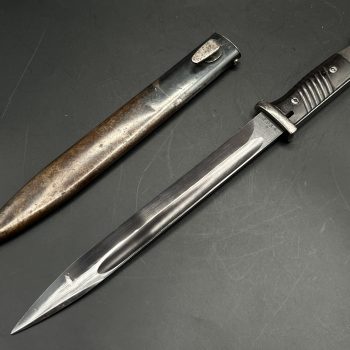
Mauser rifle bayonet (1934-1945). 1941 – ddl 41. [Jos Corts]. Matching numbers. (Lot: 1371)
Starting bid: $ 325A quintessential “calling card” of the German soldier during World War II, this bayonet model 1884/1898 represents a modernized variant of the S84/98, designed specifically to complement the legendary Mauser Gewehr 98 rifle. Manufactured in 1941 at the Jos Corts production facilities (marked ddl 41), this specimen was mass produced by the German arms industry and remained in service with the Wehrmacht throughout the entire Second World War period.
This particular example derives special collector value from its matching serial numbers, with corresponding markings on both the blade and scabbard, confirming their original pairing since the time of manufacture. Such bayonets are encountered considerably less frequently due to combat losses and postwar reassembly, when original sets were separated and mixed. The preservation of matching numbers indicates that the blade and scabbard have traveled their entire journey together, which substantially increases the appeal of this lot to serious collectors of military antiques.
-
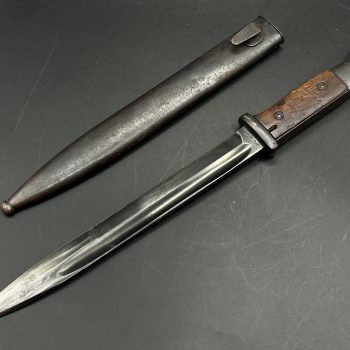
Mauser rifle bayonet (1934-1945). 1939 – Berg&Co 39. [Berg & Co]. Sharpened blade. Matching numbers. (Lot: 1370)
Starting bid: $ 245A legendary bayonet that became the true “signature weapon” of the German soldier during World War II. This modernized variant of the S84/98 bayonet was created specifically for use with the Mauser Gewehr 98 rifle and was mass-produced by the German weapons industry, remaining in service with the Wehrmacht throughout the entire war period.
The Berg&Co 39 marking indicates that the bayonet was manufactured in 1939. This particular date adds special value to the specimen: the year marking the beginning of World War II makes examples with such markings especially sought after among collectors.
The manufacturer, Berg & Co, was a German firm specializing in the production of edged weapons and bayonets in the late 19th and early 20th centuries. The company was located in Solingen, the traditional center of weapons manufacturing in Germany. The Berg & Co marking is found predominantly on bayonets produced under contract for the military department.
The blade was sharpened in field conditions to provide the bayonet with additional combat or utility functions, as most German bayonets were issued without factory sharpening and were intended primarily for thrusting. In the ground forces, such sharpening was officially prohibited. However, excavation results from former Luftwaffe positions show that bayonets with sharpened blades are found quite frequently, indicating the widespread practice of such field modifications among Luftwaffe personnel, particularly in paratrooper units.
Matching numbers on the blade and scabbard confirm their original pairing from the time of manufacture. Such specimens are encountered considerably less frequently due to combat losses and postwar reassembly, which significantly increases the collectible value of this example.
-
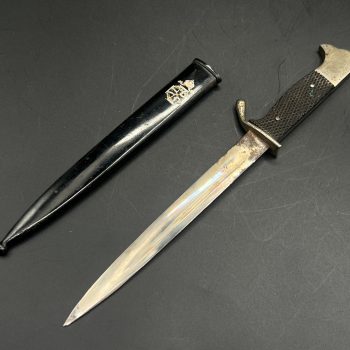
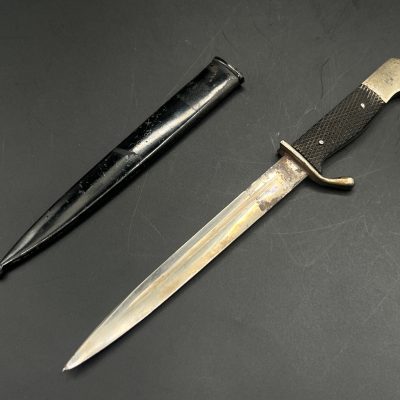
Miniature Dress Bayonet (image on the scabbard) Trench Bayonet-Dagger, World War I Pattern, Germany (Lot: 1369)
Starting bid: $ 275An elegant miniature replica of a dress bayonet, executed with meticulous attention to all structural elements of the original pattern. This item belongs to the category of collectible edged weapon miniatures, traditionally created as commemorative or presentation pieces, as well as for augmenting private collections.
Of particular interest is the scabbard, adorned with an engraved image, which lends this specimen an individual character and distinguishes it among standard miniaturs. Such decorative elements are encountered infrequently and substantially enhance the collectible value of the piece.
-
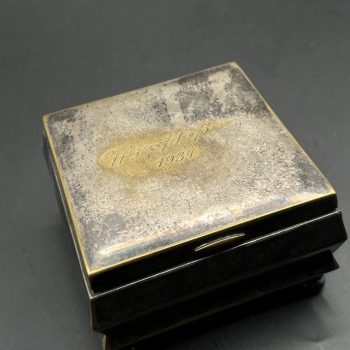
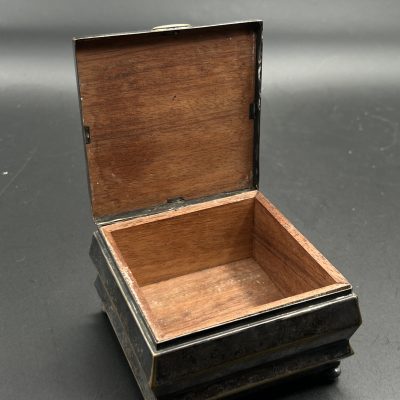
German Nickel-Silver tabletop box 1934 (Lot: 1368)
Starting bid: $ 185German nickel-silver tabletop box (cigarette casket) in the Art Deco style, featuring a wooden body clad in silver-plated metal. The lid is adorned with an engraved date 1934. The construction features a characteristic stepped design with a hinged flip-top lid, while the interior is finished in polished wood. Four ball-shaped feet provide stability to the piece. This box is of interest as an example of presentation items from the early Third Reich period.
-
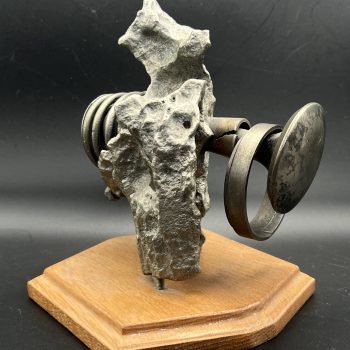
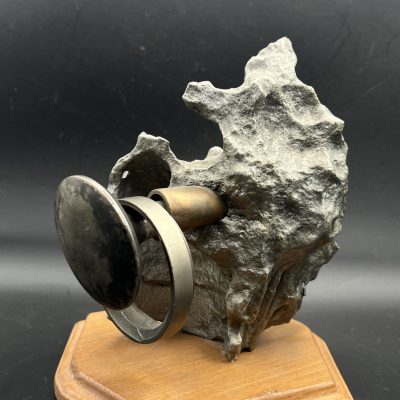
Fragment of a BMW 801 Aircraft Engine Cylinder from a Focke-Wulf Fw 190 Fighter, Mounted on a Stand (Lot: 1367)
Starting bid: $ 285A fragment of a BMW 801 aircraft piston engine cylinder, originally fitted to Focke-Wulf Fw 190 fighters. The assembly includes a piston with connecting rod, valve mechanism with springs, and a deformed aluminum cylinder block bearing characteristic traces of combat damage or crash impact. The shaped wooden stand has been crafted specifically for display purposes. Approximate dimensions of the fragment: 6 x 6 inches.
-
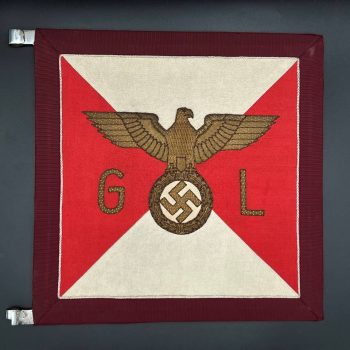
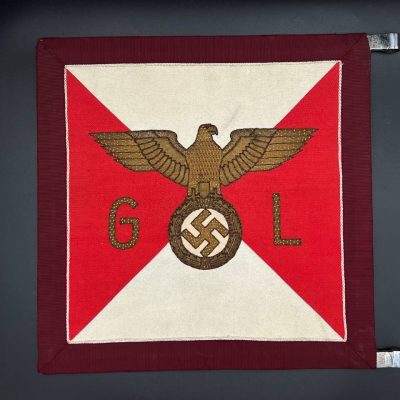
NSDAP Gauleiter Car Pennant (Gauleiter) (Lot: 1366)
Starting bid: $ 6,125Car pennant of a Gauleiter of the National Socialist German Workers’ Party (NSDAP). The square banner is made of high-quality textile with a characteristic design featuring red and white triangular sectors, bordered by a burgundy grosgrain ribbon. At the center is the party eagle with outstretched wings, clutching a wreath with a swastika in its talons, executed in fine gold bullion embroidery. On the sides, the letters ‘G’ and ‘L’ (abbreviation for Gauleiter) are embroidered. The pennant is equipped with original metal fittings for mounting on an automobile, one of which retains the marking ‘RZM 3/45’. An exceptionally rare item of high party rank in excellent condition.
-
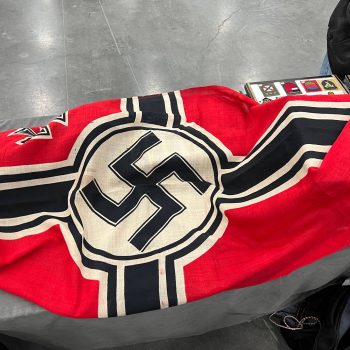
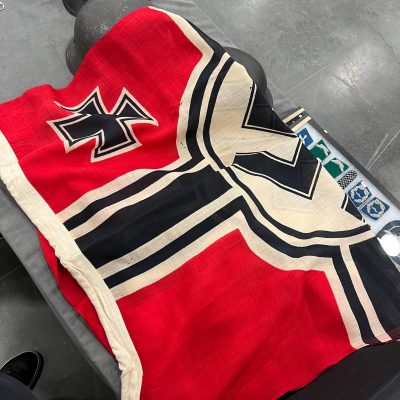
Kriegsmarine Naval Flag (Reichskriegsflagge), Size 100×170 cm (Lot: 1365)
Starting bid: $ 775A Third Reich naval flag (Reichskriegsflagge), used on Kriegsmarine vessels and shore installations. The flag is made of red fabric featuring the characteristic design: a white disc with swastika at the center, framed by black and white rays, with an Iron Cross positioned in the upper left corner. The white selvedge bears factory markings in Gothic script reading “Kriegsflg. 100×170,” indicating the type and size of the flag, along with a military acceptance stamp (Kriegsmarine-Abnahme). The flag retains its original braided loops for halyard attachment. Condition is good, with minor traces of storage.
![Honor Presentation Saber for Outstanding Marksmanship of the Oberkommando der Wehrmacht (OKW) 1930. [WKC].](https://alexmp.com/wp-content/uploads/2026/08/1786327324223-5t9w0mpjwk5-400x400.jpeg)
![Luftwaffe Dagger, Model 1935 (nickel-silver fittings). [Stöcker & Co. SMF]. Stamp – SMF.](https://alexmp.com/wp-content/uploads/2026/08/1786375507903-sde70nlaeh-400x400.jpeg)
![Luftwaffe Dagger, Model 1935 (1st Model). [Stöcker & Co. SMF].](https://alexmp.com/wp-content/uploads/2026/08/1786375138480-df0k9fohi59-400x400.jpeg)
![German Army Dagger, Model 1935 [Carl Julius Krebs].](https://alexmp.com/wp-content/uploads/2026/08/1786373962754-4ptduaaklpx-400x400.jpeg)
![SA Service Dagger (Early type). [Gustav Wirth].](https://alexmp.com/wp-content/uploads/2026/08/1786373444428-yew7601aybl-400x400.jpeg)
![Mauser rifle bayonet (1934-1945). 1944 – crs 44. [P. Weyersberg]. Matching numbers.](https://alexmp.com/wp-content/uploads/2026/08/1786373179110-p4pf7ebnlkk-400x400.jpeg)
![Mauser rifle bayonet (1934-1945). 1941 – ddl 41. [Jos Corts]. Matching numbers.](https://alexmp.com/wp-content/uploads/2026/08/1786372998080-bkxb01h38ts-400x400.jpeg)
![Mauser rifle bayonet (1934-1945). 1939 – Berg&Co 39. [Berg & Co]. Sharpened blade. Matching numbers.](https://alexmp.com/wp-content/uploads/2026/08/1786372862738-vfcy039rcte-400x400.jpeg)
Sold at Blitz price
-
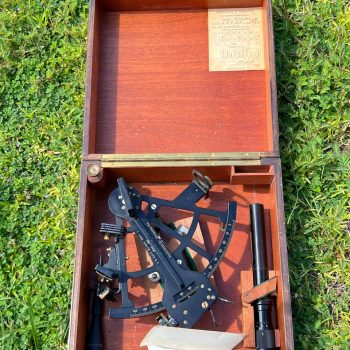
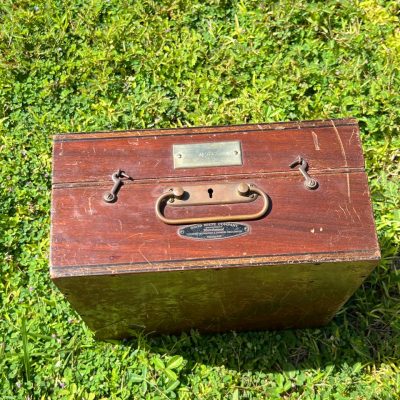
U.S. Navy Bureau of Navigation Mark II Sextant — David White Co., Milwaukee — Serial No. 647-1939 — With Original U.S. Naval Observatory Certificate of Inspection, dated August 15, 1941 (Lot: 1114)
Auction EndedThe Navy Mark II sextant by David White Company of Milwaukee was one of the principal instruments of U.S. Navy navigation throughout World War II. This example, serial number 647-1939, was inspected and certified by the U.S. Naval Observatory in Washington on August 15, 1941 — just four months before Pearl Harbor — making it a genuine pre-war/early-war service instrument. The limb reads to single degrees with drum micrometer to 1 minute, and vernier to 6 seconds of arc. Original mahogany dovetailed case with brass hardware and David White Company nameplate. Original inspection certificate with handwritten eccentricity corrections and inspector’s signature survives intact. Telescope present.
Product sold for blitz price: $ 665 -
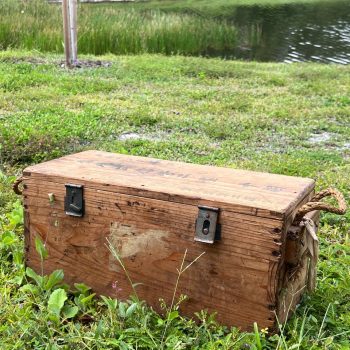
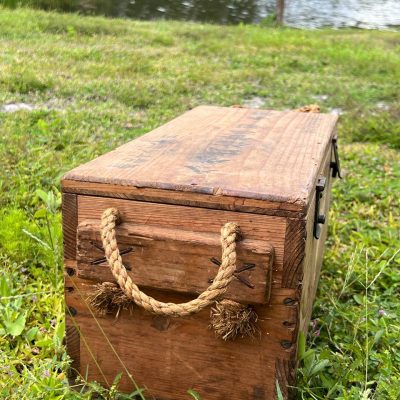
Imperial Japanese Army WWII Wooden Ammunition / Supply Crate, Showa 15 (1940), Original Rope Handles (Lot: 1068)
Auction EndedLarge field supply crate from the Imperial Japanese Army, dated to Showa Year 15 (1940). Lid bears hand-stenciled kanji markings indicating production year, arsenal or unit designation, and logistical data. Pine board construction with iron hardware and, notably, both original heavy rope carrying handles retained — a rare find, as these are almost always missing on surviving examples. Solid and display-ready. A compelling piece of Pacific Theater militaria.
Product sold for blitz price: $ 115 -
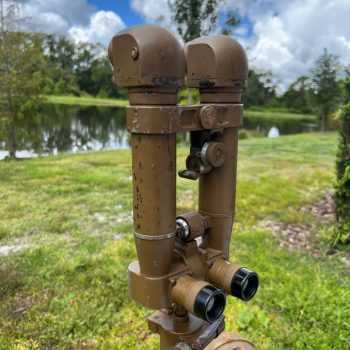
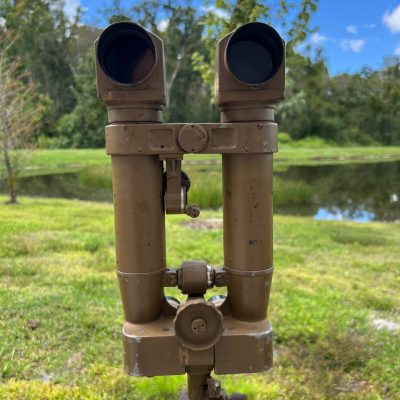
Imperial Japanese Army WWII 8×6.2° Artillery Stereoscopic Observation Binoculars — Serial No. 4021 — Complete Set with Brass Tripod, Metal Transport Case & Canvas Tripod Carrier No. 1902 (Lot: 1073)
Auction EndedA large-format precision artillery observation binocular of the Imperial Japanese Army, marked 8×6.2°, No. 4021 with Imperial Arsenal acceptance star stamp. This periscope-style instrument was used throughout the war by Battery Commanders for observation without exposure to enemy fire. Complete with adjustable-height tripod with matching serial number; tripod legs fold, extend, and lock in place. The instrument features precision azimuth and elevation adjustment dials with graduated scales. Included: original brass/aluminum field tripod with azimuth head, ribbed aluminum transport case, and canvas cylindrical tripod carrier marked No. 1902 with original straps. Optics clear on both sides.
Product sold for blitz price: $ 775