Showing 17–32 of 36 results
Filters-
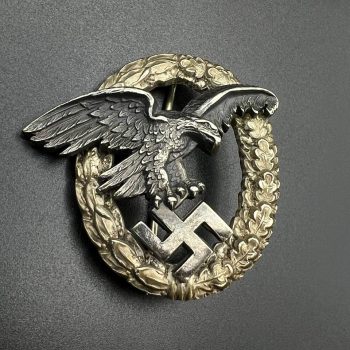
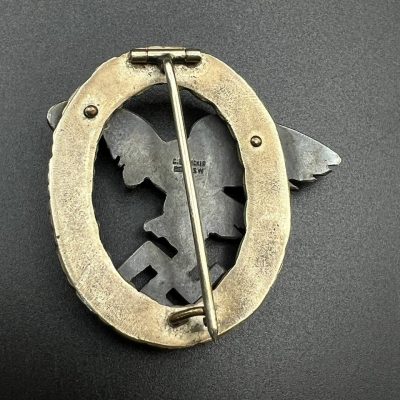
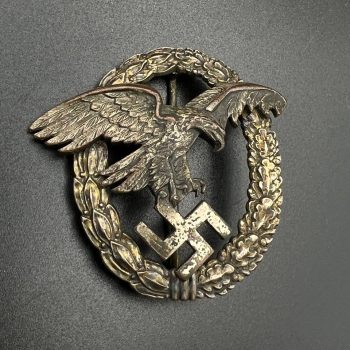
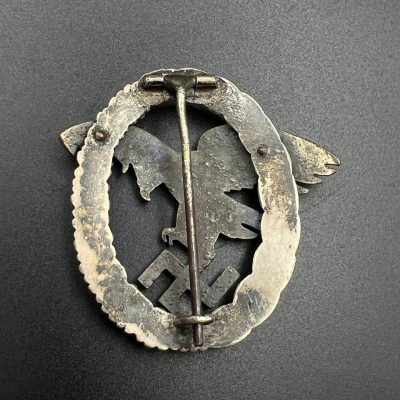
Observer Badge – Juncker (Lot: 1026)
Starting bid: $ 2,295Tombac metal, the eagle toned steel-gray, the wreath silver-plated with polished edges, reverse marked “C.E.Juncker Berlin SW”. Lightly worn.
The wearer was Oberleutnant Hans Keiper-Knorr, Reconnaissance Squadron 3./(H) 13 (1908 – 2001).
-
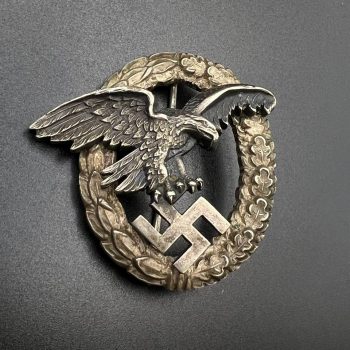
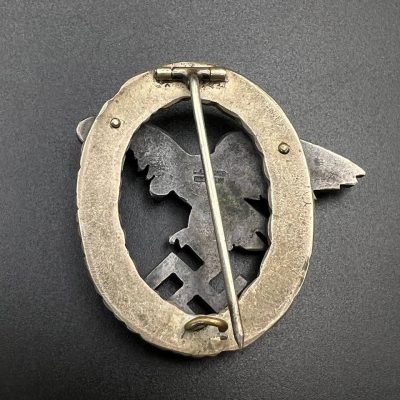
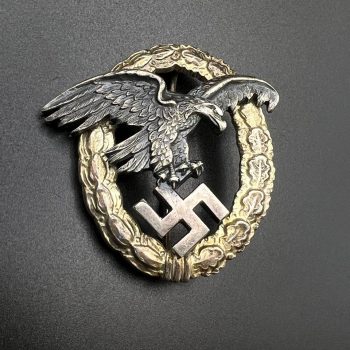
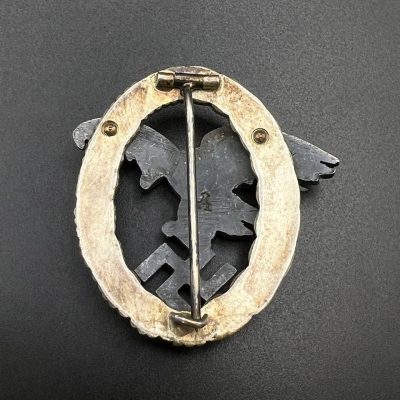
Observer Badge – Deumer 1st Pattern (Lot: 1027)
Starting bid: $ 1,895Tombac construction, circa 1936. Early flat manufacture by Deumer, Lüdenscheid. A badge worn over many years
-
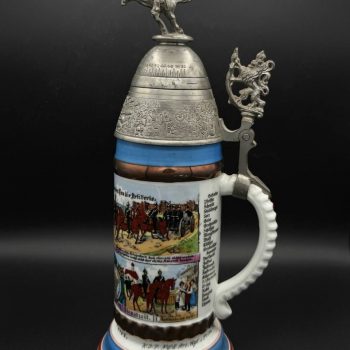
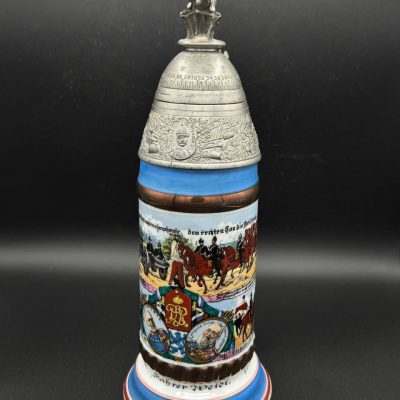
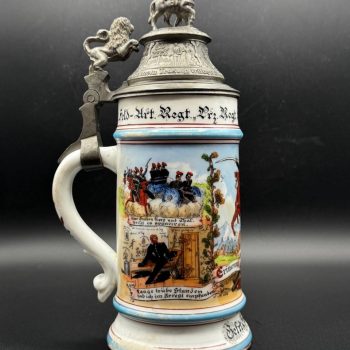
Bavarian Reservist Beer Stein – 3rd Field Artillery Regiment “Prinz Regent Luitpold von Bayern,” Fahrer Weidl, Munich 1903–1905 (Lot: 1035)
Starting bid: $ 650finely painted regimental stein commemorating the service of Driver Weidl with the 3rd Bavarian Field Artillery Regiment “Prince Regent Luitpold of Bavaria,” stationed in Munich, 1903–1905.
The body depicts vivid hand-painted artillery scenes — horse-drawn batteries charging into action, gun crews firing, and soldiers returning to the barracks. Center medallion features the crowned monogram “L” flanked by portraits of King Ludwig III and Prince Regent Luitpold.
Handle lists comrades-in-arms from the same battery. Pewter lid topped with a mounted cavalryman, richly engraved with battle motifs; thumb lift shaped as the Bavarian lion. Interior lithophane shows a soldier with cannon.
A beautiful and historically rich example of early 20th-century Bavarian military craftsmanship — vibrant, detailed, and full of regimental pride.
-
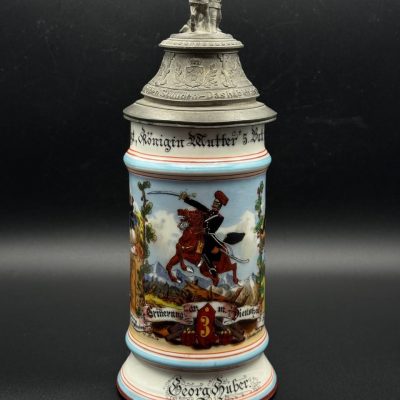
Bavarian Reservist Beer Stein – 2nd Field Artillery Regiment “Königin Mutter,” 5th Battery, Munich, 1900–1902. (Lot: 1039)
Starting bid: $ 600A fine early 20th-century regimental stein belonging to Georg Huber, commemorating his service with the 5th Battery, 2nd Bavarian Field Artillery Regiment “Königin Mutter”, stationed in Munich. The colorful hand-painted body features a cavalryman charging with drawn sabre against an Alpine backdrop, symbolizing Bavarian martial spirit. Surrounding panels depict gun crews in action and scenes of barracks life, with the inscription “Erinnerung an meine Dienstzeit” (“In memory of my service”).
The pewter lid bears a mounted cavalry figure and embossed Bavarian crest, with the motto “Mein Trost in trüben Stunden – Das hübsche Mäd’l aus Bayernland” (“My comfort in dark hours – the pretty girl from Bavaria”). Superb craftsmanship, vivid enamels, and early date (1900–02) make this an exceptional Munich-produced reservist stein of the “Königin Mutter” artillery regiment.
-
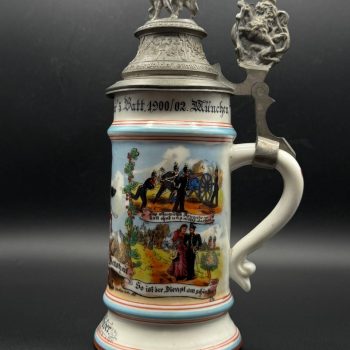
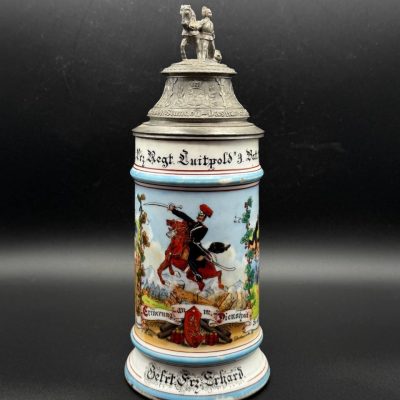
Bavarian Reservist Beer Stein – 2nd Field Artillery Regiment “Prinz Luitpold,” 3rd Battery, Munich, 1901–1904. (Lot: 1038)
Starting bid: $ 595Beautifully hand-painted regimental stein commemorating the service of Gefreiter Fritz Erhard with the 3rd Battery, 2nd Bavarian Field Artillery Regiment “Prinz Luitpold”, stationed in Munich. The front panel depicts a mounted artilleryman charging with sabre against an Alpine backdrop; side scenes show cannon drill, barracks life, and farewells in vibrant colors. Pewter lid features a sculpted horse and soldier, Bavarian crest reliefs, and the traditional toast “Mein Trost in trüben Stunden – Das hübsche Mäd’l aus Bayernland.”
A fine and expressive example of early 20th-century Bavarian craftsmanship, combining humor, color, and regimental pride.
-
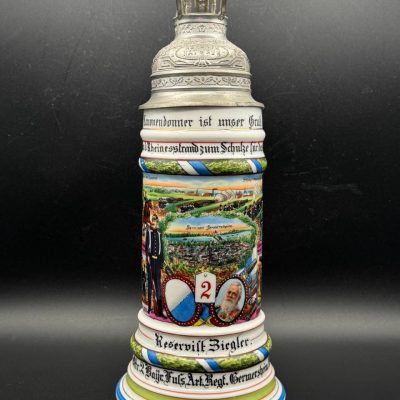
Bavarian Reservist Beer Stein, 5th Battery, 2nd Bavarian Foot Artillery Regiment, Germersheim, 1909–1911. (Lot: 1041)
Starting bid: $ 575A superb early 20th-century regimental stein commemorating the service of Reservist Ziegler with the 5th Battery of the 2nd Bavarian Foot Artillery Regiment stationed at Germersheim, on the Rhine. The richly hand-painted body depicts heavy artillery crews in training, horse teams in the field, and a panoramic view of the Germersheim fortress. The motto “Wir dienen am d. Rheinesstrand zum Schutze für das Vaterland” (“We serve on the banks of the Rhine for the defense of the Fatherland”) runs around the top border. The pewter lid features an artilleryman with a field gun and a Bavarian lion thumb lift, symbolizing the proud Bavarian artillery tradition.
An outstanding example of pre-WWI reservist craftsmanship, combining patriotic imagery, vivid color, and fine porcelain detail typical of 1900s regimental souvenirs.
-
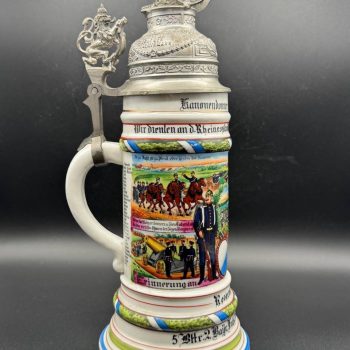
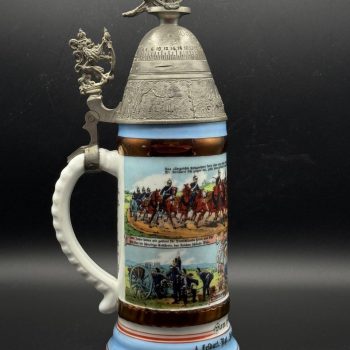
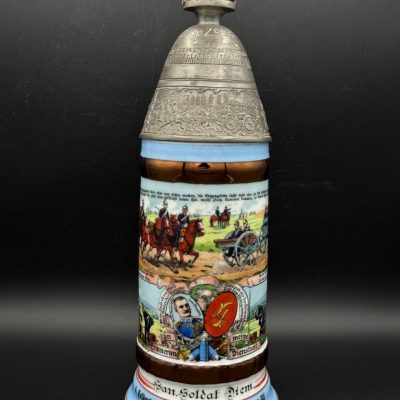
Bavarian Reservist Beer Stein – 4th Field Artillery Regiment “König,” 1st Battery, Augsburg, 1902–1903. (Lot: 1036)
Starting bid: $ 550A superb regimental stein commemorating the service of Sanitäts-Soldat Diem with the 4th Bavarian Field Artillery Regiment “König,” 1st Battery, stationed in Augsburg.
Vibrant hand-painted panels show galloping artillery teams and gun crews in action, framed by patriotic mottos such as “Two years we served for Germany’s peace and honor.” Pewter lid shaped like a shell, topped by a detailed cannon finial and relief war scenes. Handle with Bavarian lion thumb lift, interior lithophane depicting soldier and sweetheart.
An expressive and richly detailed early 1900s Bavarian stein — combining fine craftsmanship, color, and symbolism of artillery pride. -
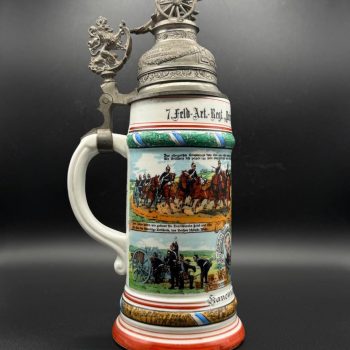
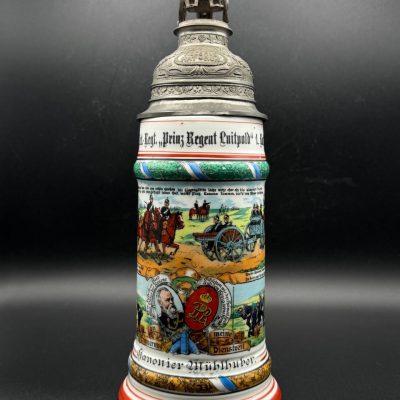
Bavarian Reservist Beer Stein – 7th Field Artillery Regiment “Prinzregent Luitpold,” 1st Battery, Munich, 1906–1908. (Lot: 1040)
Starting bid: $ 550A fine early 20th-century regimental stein belonging to Gunner Mühlhuber, commemorating his service in the 7th Field Artillery Regiment “Prinzregent Luitpold”, 1st Battery, based in Munich during 1906–1908. The hand-painted porcelain body vividly depicts mounted artillery units in training and gun crews in action, with the patriotic motto “Drei Jahre haben wir gedient für Deutschlands Fried’ und Ehr’” (“Three years we served for Germany’s peace and honor”).
The front features the crowned initials PL of Prince Regent Luitpold, surrounded by ornamental motifs and regimental banners. Pewter lid with artilleryman and cannon finial, Bavarian lion thumb lift, and lithophane inside showing the classic “soldier’s farewell” scene. Rich color, fine detail, and strong glaze make this an outstanding example of Munich-produced reservist art from the pre-WWI period.
-
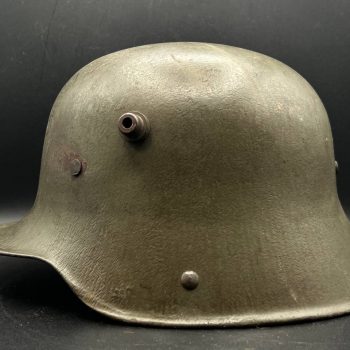
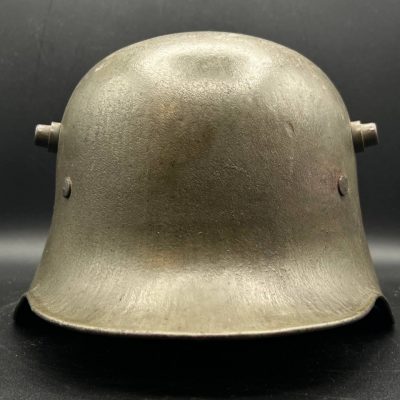
German M16 Stahlhelm – Early Type with Rare Complete Leather Band Liner, All Original Paint. Extremely rare! (Lot: 1033)
Starting bid: $ 1,245An exceptionally well-preserved German M16 combat helmet from the First World War, in a rare and highly desirable state of originality. This is an early-production example, easily identified by its large external lugs (“ventilation lugs”) designed both for airflow and to accommodate an additional brow plate.
The helmet retains 100% of its original field-gray textured paint, with a beautiful, untouched patina that speaks to its age and authenticity. Unlike later examples with replaced or refurbished interiors, this piece still contains its original leather liner band, complete with the three-pad leather system and remnants of the interior drawstring. The leather shows wear consistent with service use but remains stable and complete.
Maker’s mark and lot number are clearly visible inside the shell (stamped G62), confirming both the size and manufacturer. The split pins remain tight and untouched, further underlining the helmet’s originality.
Helmets of this type and condition are seldom encountered on the market, as most surviving examples were either repainted, reissued in WWII, or have suffered liner replacement. This untouched example represents a textbook collector’s piece.
-
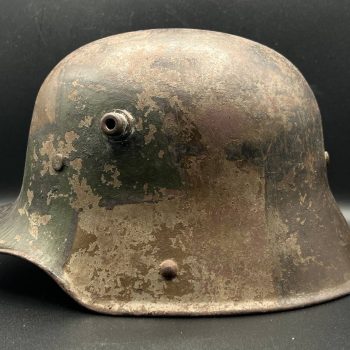
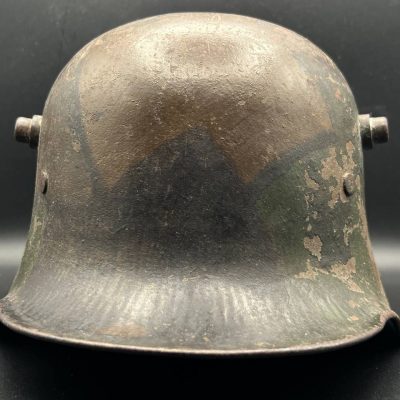
German M16 Steel Helmet with Camouflage Paint (Lot: 1032)
Starting bid: $ 995This is an original German M16 steel helmet from the First World War. The shell is made of steel with the characteristic outward vent lugs, which also served as fittings for the additional frontal armor plate (Stirnpanzer). The surface retains traces of the factory finish with an overpainted camouflage in the so-called Buntfarbenanstrich style — the typical multi-color pattern introduced in 1916, featuring green, ochre, and brown segments divided by black lines. The paint shows natural wear, confirming its authenticity.
Inside, the original leather liner, complete with its three leather pads and metal band, is preserved, along with the chinstrap. On the rear skirt of the shell, the stamped marking “G62” is visible, indicating the manufacturer and the shell size (62). Additional factory markings are also present on the interior.
Helmets of this type were introduced to the German Army in 1916, replacing the earlier leather Pickelhaube. Thanks to their strength and protective qualities, the M16 became a symbol of the German soldier of the First World War and served as the foundation for the entire line of steel helmets leading up to the M35 of the Second World War.