Login
Register
By clicking Login or Register, you agree that the images of Nazi symbols shown on alexmp.com are not propaganda of fascism, Nazism and are shown solely for historical, cognitive and scientific purposes.
Order a free call and our specialist will contact you shortly!
Contact us and we will get back to you shortly.
Contact us and we will get back to you shortly.
Contact us and we will get back to you shortly.
Contact us and we will get back to you shortly.
Error: Contact form not found.
We will get back to you shortly.
В честь запуска Энциклопедии мы рады предложить вам бесплатный доступ до 01.10.2026.
Будем рады вашим комментариям и предложениям!
Inspected and guaranteed by Alex Warstory.
For more details on AlexMP Guarantee, click [HERE]
Item guaranteed by a verified dealer.
Click [HERE] for full seller guarantee terms.
Sold without expert review or guarantees. No claims accepted post-sale.
Learn more [HERE]


Showing 1–16 of 26 results
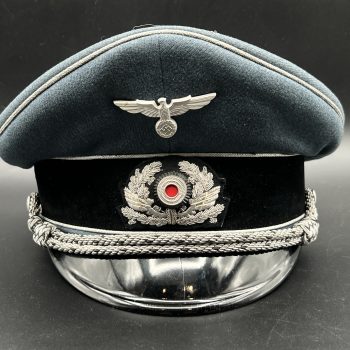
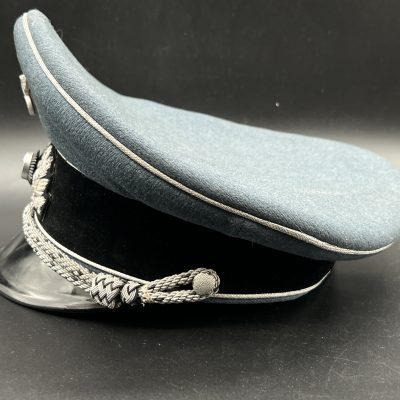
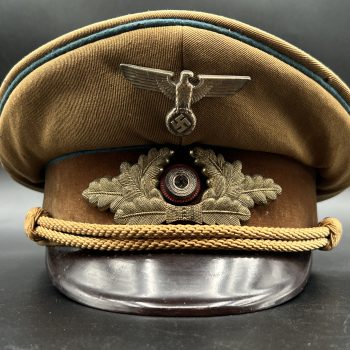
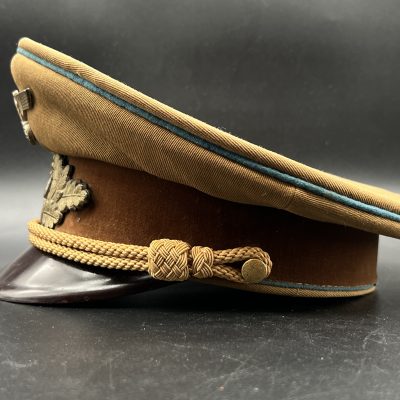
FiltersAn officer’s visor cap of German railway security from the period before 1945, representing a rare example of regulation headgear from a specialized service branch. Railway security personnel performed critical functions in ensuring the safety of transportation routes and protecting strategic transport infrastructure, which determined the special status of its personnel and the distinctive elements of their uniforms.
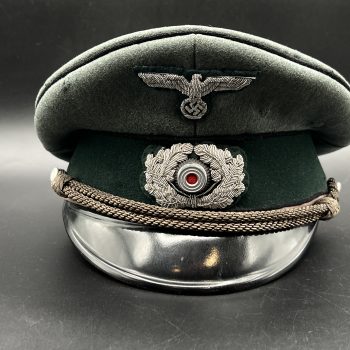
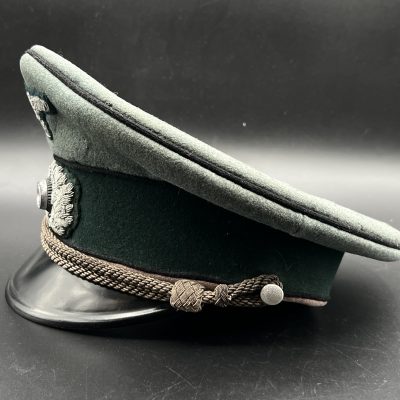
Fine example of a doeskin wool visor cap with black piping to the crown and bordering the bottle green central band. Bullion embroidered cap eagle and bullion cap wreath. Officers bullion cap cords. Interior with tan leather sweatband having perforated forehead section. Lining with celluloid diamond having tailors details of Ludwig Wörz. Some scattered moth nips but generally still a good example.
The piping on the cap shows a few minor moth nips, but retains nice blue color. Has the original RZM tag still intact with a clean satin lining. The visor shows the proper cross hatching pattern on the underside. The sweat diamond is missing and the entire cap shows a little sweat wear, but nothing to detracting. Overall nice lightly worn example of this style cap.
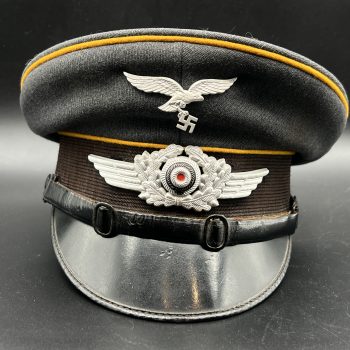
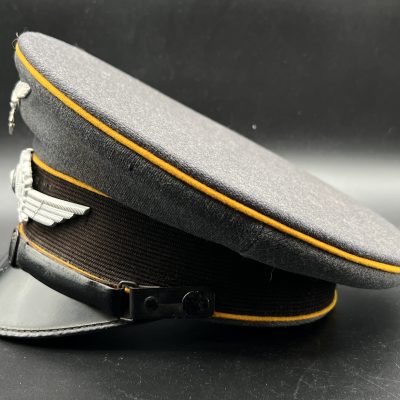
A Luftwaffe non-commissioned officer’s visor cap from the flying units of the Third Reich period. The crown is made of blue-gray wool cloth with golden-yellow piping (Waffenfarbe), indicating affiliation with flying personnel. The crown features a metal Luftwaffe eagle emblem with outstretched wings clutching a swastika. The band of dark brown ribbed galloon is adorned with a winged cockade featuring oak leaves and a central rosette in the national colors (black, white, red). The visor is made of black patent leather, and the chinstrap is leather with metal buttons. Good collectible condition with minor signs of use.
The shell of the helmet is perfect and it has a great look to it. The inside features a green satin lining, clean leather sweatband and has 2 stickers for makers marks. Has never been touched and is just a fine example.
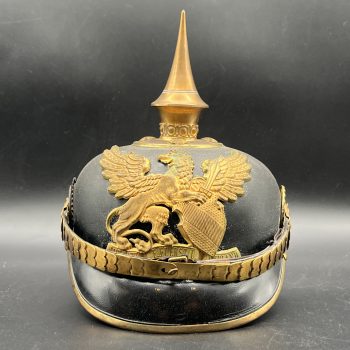
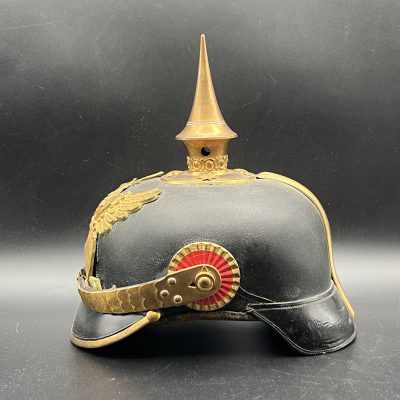
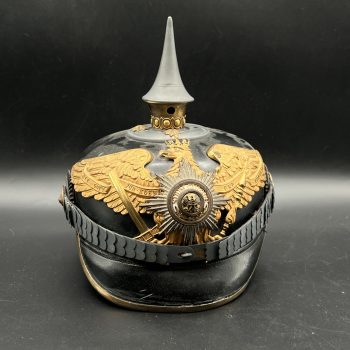
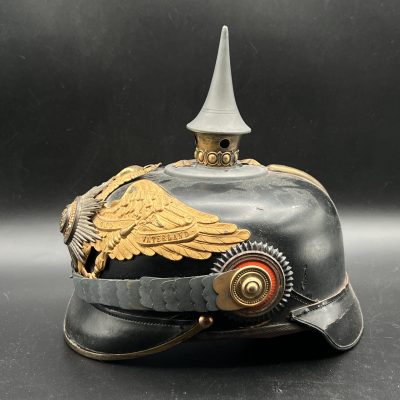
This late war guard officers helmet has the usual plated fittings with chinscale spike which have lost a lot of their gold. The eagle is still done in brass and then gilted and is in great condition as is the guardstar on the front. The helmet has no extra holes in it and has never been played with. Silkish liner with the normal leather sweatband. It is missing one of the stars that retains the spike to the helmet shell. It is most common to see helmets this vintage losing the gold much like the nazi period late war badges.
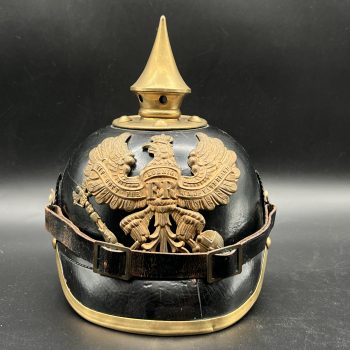
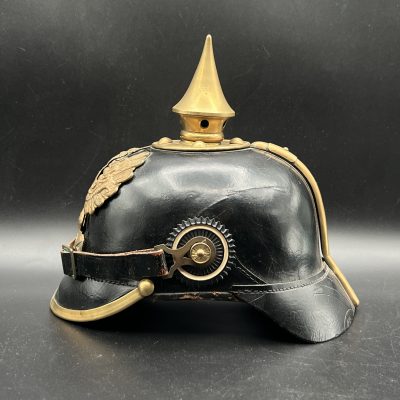
A leather helmet of the Prussian infantry featuring the characteristic pointed finial (spike) made of brass. The front plate depicts the Prussian eagle with spread wings, at the center of which is the royal cipher “FR” (Friedrich Rex) and the motto “Mit Gott für König und Vaterland” (“With God for King and Fatherland”). The helmet is complete with a brass spike on a cruciform base, cockades in imperial and Prussian colors on the sides, a leather chin strap with square brass buckles, and brass trim on the visor. A typical example of German army headgear from the First World War period, representing significant collector interest.
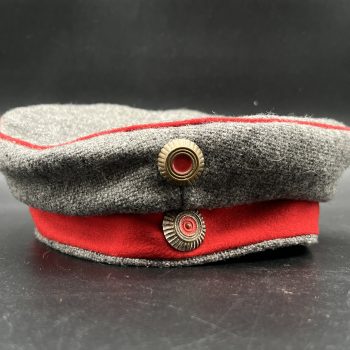
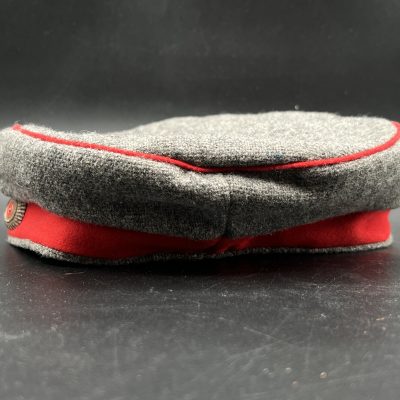
This cap is stunning for the age of it with nearly no wear and excellent color. Has a perfect cotton drill light interior and is marked as a size 57. Hard to find these caps in this type of condition.
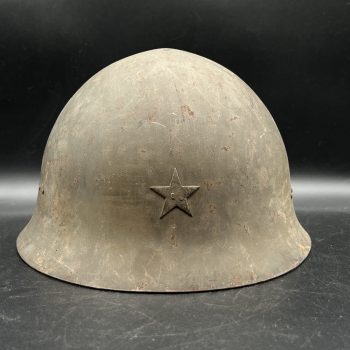
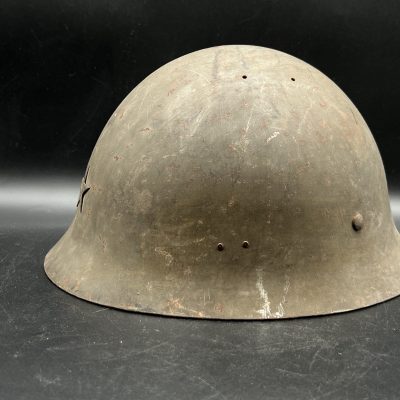
Stunning overall condition on this helmet with an original star insignia to the front and great painted finish and no dents or dings. The interior of the helmet is even nicer with a full liner and straps that have excellent Japanese markings. The liner even shows a bot of dried blood to the inside which really sets it apart from others. One of the nicer Japanese helmets we have ever seen.
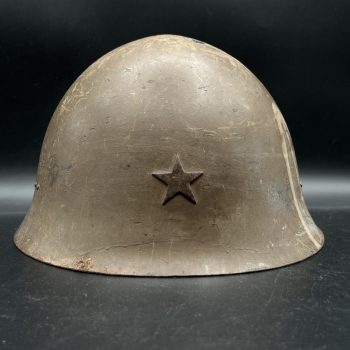
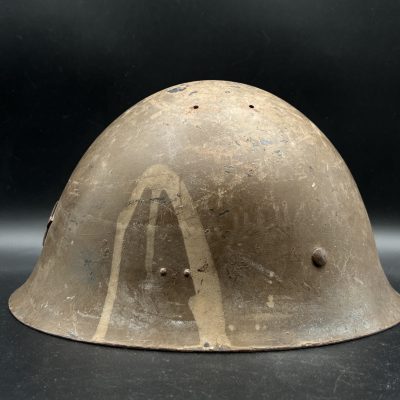
Clean overall condition and has a very interesting look about it. Exterior shows no damage to the shell and has a standard paint finish with a splash of different paint to the one side of a lighter color tan. Never seen this before on this style helmet. Has the star insignia present and in perfect condition. Interior is also very nice and shows blood splatter to the straps and liner. Has the proper drawstring and is marked at the back. Fine example of this style helmet.
This shako helmet has nice EM insignia, but has the upgraded bullion cockade and Officer scaled metal chinstrap. The body of the helmet has clean green wool with only a few moth type marks and the black leather shows some crazing. The interior of the helmet has the maker stamp of Robert Lubstein under the Erel company in the center. This one is also marked with a size of 57 1/8 on the rear part of the sweatband.
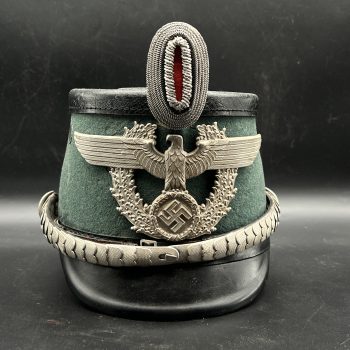
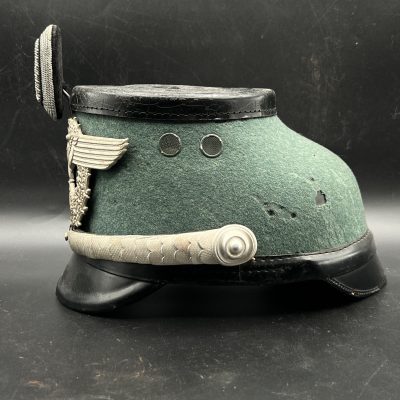
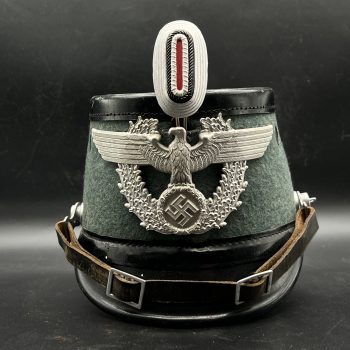
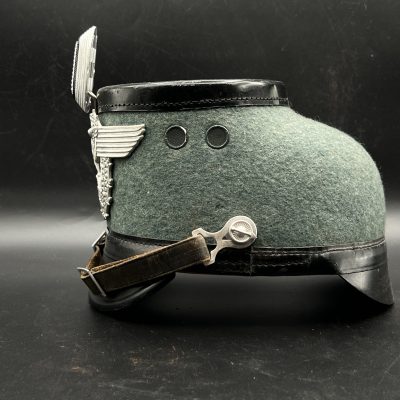
Parade shako (Tschako) for enlisted and non-commissioned officer personnel of the German Police (Ordnungspolizei), dating from the period 1936 to 1945. The crown is constructed from grey-green cloth in the regulation police shade, with the visor and band fashioned from black patent leather. The front displays a large aluminum police-pattern eagle clutching a swastika within an oak leaf wreath. Above the eagle is an oval cockade in national colors (white, red, and black), executed in twisted cord technique. Two ventilation holes with metal mesh screens are positioned on the sides. The chin strap is made of genuine leather with nickel-plated hardware. This item represents significant collector value as an example of regulation headgear worn by police formations of the Third Reich.
Stunning cutlass here which was made by Clemen & Jung. This one features a near flawless triple engraved and double proofed blade with hunting scenes to both sides. The grip plates are ivory models and have all 6 acorns still affixed. The gold on this cutlass rates about 95% with a bright finish. Has the deluxe model scabbard that fits the piece perfect and shows the same excellent condition. The piece also comes with the original forestry knot stied around the cross guard. Hard to find any flaws and would be very hard to find one nicer.
One of the nicer Forestry pieces we have come across in a long time. This is a deluxe model which shows extremely detailed engraving to the all fittings and even the scabbard. Blade is also marked by the distributer and has hunting scenes to both sides. The grip may be the most interesting part as it has all acorns present and a beautiful crest to the one side. Have never come across this before and it really makes this one stand out from others. Also comes with the original proper knot still tied. Overall a fine looking cutlass.
This cutlass is triple engraved with the usual hunt scene and is made by the maker Clemen & Jung. Blade is in exceptionally nice condition and the maker stamp is precisely hit into the center of the ricasso. Has a beautiful dogs eating the deer hooves crossguard. The clam shell has the dogs and stag scene engraved. Three acorns on the grip and a deluxe pommel cap. On the scabbard lug it shows a reposing grouse. On the reverse it is named to the original holder and dated 1933 and a comradeship gift to this individual and the town and region with a swaz engraved. Really stunning piece.
This cutlass is made by Alcoso and is in stunning condition. Retains about 98% of the original gold. Blade is triple engraved. The presentation side is for a shooting competition and dated 1936 and the reverse features the standard hunt scene. Outstanding presentation piece.
Officer parade weapons, revived following the restoration of the German armed forces, continued the proud traditions of the Imperial Army and the Reichswehr. Unlike the Army dagger model 1935, officer sabers were produced in numerous design variations by various Solingen manufacturers. Production of this type of weapon was discontinued in May 1943 due to wartime industrial demands; however, examples already in service continued to be worn with parade uniforms. In late 1944, the wearing of parade edged weapons was completely abolished, and officers were ordered to carry a pistol instead of a saber or dagger.
The blade bears the mark of the renowned Solingen firm F. W. Höller Waffenfabrik, founded in 1866 and officially registered with the Solingen authorities on 5 June 1883. From its founding, the company specialized in the production of edged weapons and cutlery. Throughout the late 19th century and during the First World War, the firm manufactured a wide range of military products, including bayonets, sabers, and swords. In 1905, the company registered its well-known trademarks: the thermometer image, as well as the figure of a man tipping his hat with the inscription “Hut ab!” (“Hats off!”). From 1914 to 1939, the firm was managed by Julius Küller. During the Third Reich period, Höller became one of the largest and most prolific edged weapons manufacturers in Solingen, specializing in a broad range of military products. In 1935, the company was located at Sonnenstraße 8, Solingen, and that same year received RZM license M7/33. Products were actively advertised in specialized journals and catalogs, showcasing an extensive assortment that included NSDAP and Wehrmacht daggers, swords, and bayonets. The firm also produced parade bayonets with high-quality etched blades. In 1941, Höller celebrated its 75th anniversary, promoting the Höller Model 21 sword as its flagship model. In June 1941, the company was assigned the K98 bayonet manufacturer letter code (fze). Following the end of the Second World War, under the ownership of Herr Grah, the firm continued operations, producing cutlery, kitchen and professional knives, swords, and scissors through the 1970s. The company was officially liquidated in December 1974. Particular collector value is added to this example by a rare decorative detail: an additional eagle on the grip backstrap, distinguishing this saber from standard production specimens.
A service edged weapon of the SA (Sturmabteilung) storm troopers, adopted in 1933. The distinctively shaped blade with double-sided sharpening bears the legendary motto “Alles für Deutschland.” The handle is made of brown-colored wood and decorated with the SA emblem featuring an eagle; the metal scabbard is finished in the same brown tone.
The early type of SA/NSKK daggers was produced between 1933 and 1936 and is distinguished by a number of characteristic design features. The scabbard and handle fittings are made of nickel silver (German silver), which, combined with the high quality of component fitting and the anodized scabbard coating, sets these examples apart from later production runs. This dagger was manufactured by Stöcker & Co. SMF. Early examples are particularly prized by collectors due to their impeccable craftsmanship and historical significance as the first service daggers of the storm troopers.
A rarity rating of 5 out of 10 according to the Ralf Siegert classification indicates that such examples are relatively uncommon on the antiques market.
The naval saber was a mandatory attribute of the dress uniform of officers in the Kaiserliche Marine. During the period of Kaiser’s Germany, the imperial anchor beneath the Kaiser’s crown was characteristic in the design of the hilt. The classical variant featured a brass hilt, ivory grip, and a lion’s head with eyes of red and green color. The scabbard was typically made of black leather with brass fittings; steel scabbards are considerably rarer. Sabers were purchased by officers at their own expense, which resulted in numerous variations of execution. Standard and Damascus blades can be found, various hilt designs and decorative scabbard finishes, as well as several sizes ranging from light and elegant to large Grosse Pattern models. It is precisely this diversity of execution that makes naval sabers a particularly interesting independent field of collecting: collections can be built according to manufacturers, sizes, hilt types, blades, and finishing variations. Along with the dirk, the saber remained a symbol of officer status and the continuity of German naval weaponry traditions of the nineteenth century.
E. & F. Hörster, one of the largest Solingen manufacturers of naval edged weapons, operated from the nineteenth century and continued production during the Weimar Republic and the Third Reich. The firm produced high-quality naval sabers and dirks in various execution variants. Already before World War I, Hörster products were supplied not only for the German market but were also exported to other European countries, including the Russian Empire. Thanks to its long operational period, Hörster products allow one to trace the development of naval edged weapons from the Kaiser era to the Kriegsmarine.
Seebataillone represented naval infantry units of the Kaiserliche Marine. There were several marine battalions, and the custom-made edged weapons associated with them constitute a separate field of collecting German naval weaponry. A characteristic feature of such items is the combination of naval and infantry attributes. For example, an officer’s saber could feature a traditional naval hilt and blade but be equipped with steel infantry-type scabbards. Custom specimens frequently bear personal dedications from one officer to another or from the officer corps to a specific serviceman of a Seebataillon. In addition to officer sabers and other custom edged weapons, this group includes infantry-type bayonets for Mauser system rifles with Seebataillone designations and symbols. Most such items bear unit designations; however, named specimens also occur, representing particular collecting interest.
This saber features a characteristic openwork pierced hilt, presented in the catalogs of several manufacturers; however, it did not correspond to the established standard for Kaiserliche Marine edged weapons and was subsequently prohibited from being worn. It is precisely this unusual feature that makes such sabers particularly desirable among collectors today. Such specimens were predominantly ordered as presentation weapons, for example upon an officer’s transfer to another unit or upon his retirement from service, and served as an object of special pride for the owner. The present specimen is entirely original; the factory riveting of the hilt remains intact, the saber has not been disassembled, and retains its original configuration.
The first official cold weapon of the Schutzstaffel, introduced in 1933 and created based on Swiss daggers of the 16th century, known as Holbein daggers. In appearance, it bore considerable resemblance to the SA dagger, adopted at approximately the same time. The blade bore the motto ‘Meine Ehre heißt Treue’ (‘My Honor is Called Loyalty’), which became one of the principal symbols of the SS. In the early years of the organization’s existence, the dagger was regarded not only as an element of uniform and a symbol of SS membership, but also as a personal cold weapon that its owner could use when necessary.
Early SS daggers produced before 1936 were distinguished by nickel-silver fittings on the hilt and scabbard, high quality of manufacture, and careful assembly of components. Scabbards typically featured an anodized finish, although original painted variants do occur. Blades most commonly bore a maker’s mark with the manufacturer’s name; early RZM stamps are occasionally encountered. From 1936 onward, the construction was gradually simplified; zinc, aluminum, and steel fittings for scabbards came into use, along with painted scabbards. Transitional stamps bearing the manufacturer’s logo and RZM code appeared, followed later by RZM stamps alone. Early daggers were produced in smaller quantities and typically saw longer periods of wear; consequently, specimens in mint and near-mint condition are extremely rare. Minor chips to the hilt and signs of use are quite normal for such pieces. Particular attention should be paid to restorations and later assembly; any such interventions are noted separately in the item description.
Robert Klaas ranks among the most sought-after manufacturers of German cold weapons by collectors. A characteristic feature of many Klaas products is their contrasting bluing and high quality of finish, thanks to which decorative elements often remain well-preserved to the present day. The firm operated in Solingen and produced dress and combat cold weapons, bayonets and fittings, and also participated in the manufacture of experimental samples for military industry. In 1944, the production facilities of Robert Klaas, like a significant portion of Solingen’s weapons industry, suffered damage as a result of Allied bombing.
The stamp ‘I’ on the reverse side of the lower crossguard indicates the SS distribution and inspection center in Munich. Such marking is characteristic of early daggers from the period 1933-1935 and represents an important feature of the initial SS dagger acceptance and distribution system.

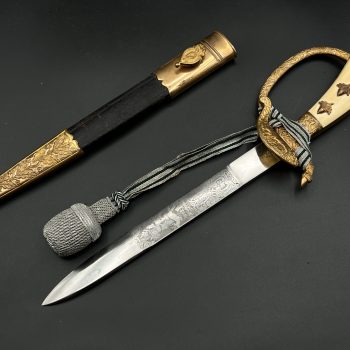
![Dagger for Members of the Reich Forestry Service (for Senior Forestry Officials). [Clemen & Jung]. Deluxe Hunting Hanger (Hirschfänger) with Leather Scabbard and Sword Knot](https://alexmp.com/wp-content/uploads/2026/10/1790925532341-ebq5k1258h-400x400.jpeg)
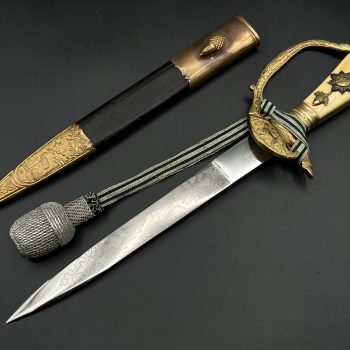
![Dagger for Members of the Reich Forestry Service (for Senior Forestry Officials). [Coppel Alexander {Alcoso} Solingen]. Deluxe](https://alexmp.com/wp-content/uploads/2026/10/1790925673344-h5mx356m7ap-400x400.jpeg)
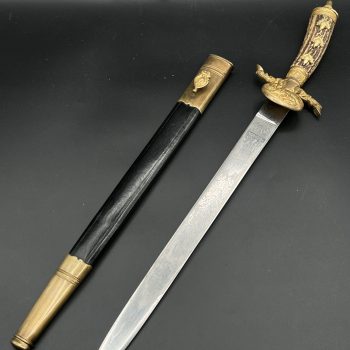
![Dagger for Hunters and Members of the Hunting Association [Clemen & Jung]. Presentation inscription](https://alexmp.com/wp-content/uploads/2026/10/1790927148476-y0iin8l21s8-400x400.jpeg)
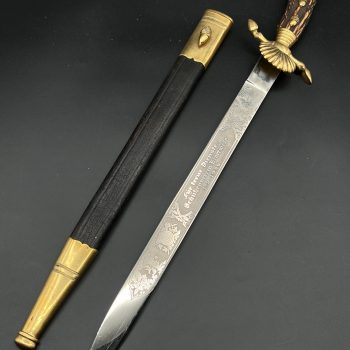
![Dagger for Hunters and Members of the Hunting Association [Coppel Alexander {Alcoso} Solingen]. Shooting Prize](https://alexmp.com/wp-content/uploads/2026/10/1790927027800-o9cxpa32v3q-400x400.jpeg)
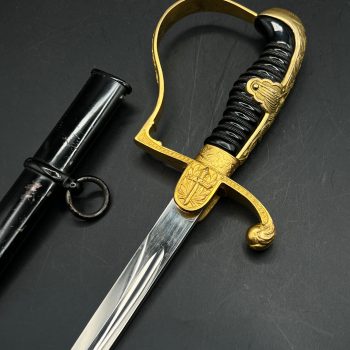
![Officer sword of Third Reich [FW. Höller]. With an additional eagle on the back of the grip](https://alexmp.com/wp-content/uploads/2026/09/1789686494288-yzkbrfazvk-400x400.jpeg)
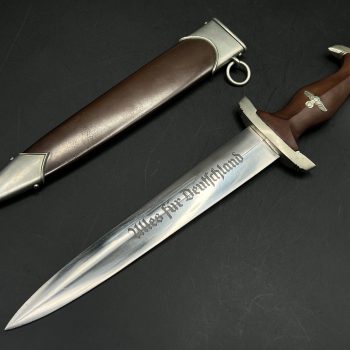
![SA Service Dagger (Early type). [Stöcker & Co. SMF]. Rarity 6/10](https://alexmp.com/wp-content/uploads/2026/09/1789687669012-dhjyhj17vk-400x400.jpeg)
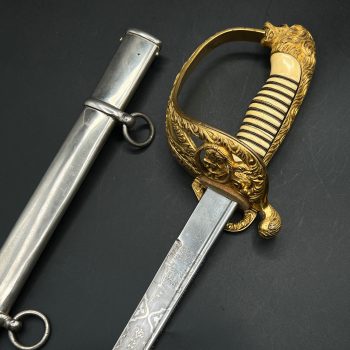
![Imperial German Navy Officer’s Sword [E. & F. Horster]. Marine Corps (Seebataillon)](https://alexmp.com/wp-content/uploads/2026/09/1789686030894-wm81ct25z8n-400x400.jpeg)
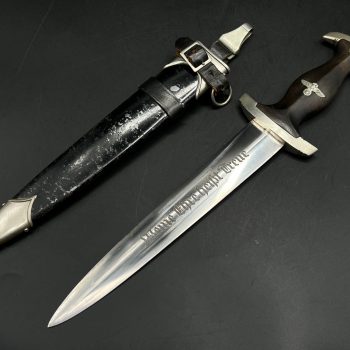
![SS Dagger, Model 1933. (Early type). [Robert Klaas]. Stamp – I. SS ID Number](https://alexmp.com/wp-content/uploads/2026/09/1789683422849-4z7tl53pjc7-400x400.jpeg)