Showing 1–16 of 24 results
Filters-
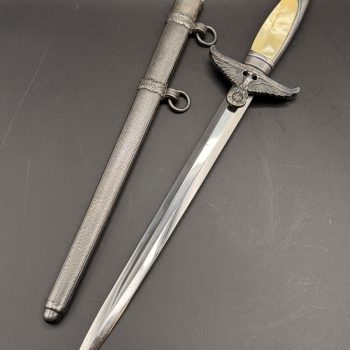
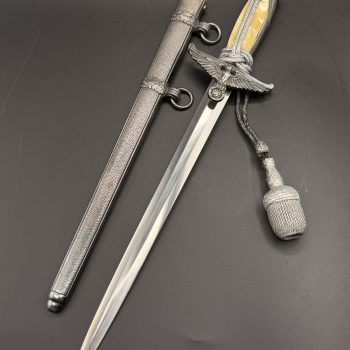
Government Official’s Dagger Model 1938 [Carl Eickhorn]. (Lot: 1306)
Starting bid: $ 10,495Luftwaffe officer’s dagger, Model 1937, complete with metal scabbard featuring the characteristic ‘fish skin’ texture. The grip is crafted from yellowish celluloid, with aluminum fittings. The crossguard is designed in the form of an eagle with outstretched wings, bearing a swastika within a wreath. The pommel is executed as a stylized eagle’s head. The blade bears the manufacturer’s mark, ‘Original Eickhorn Solingen,’ depicting a squirrel holding a sword. The scabbard is fitted with two hangers with suspension rings.
-
HIitler Youth Leader dagger [E. & F. Horster]. (Lot: 1305)
Starting bid: $ 9,355A dirk in excellent condition, with its original hanger, representing a rare example of regulation edged weapon issued to the leadership of the Hitler Youth. Introduced in 1937, this type of dirk was intended exclusively for leaders of the youth organization and differed significantly from the mass-produced knives of ordinary HJ members. Its ornate design and prestigious status distinguished it among other uniform elements, emphasizing the owner’s position within the organization’s hierarchy.
Hitler Youth leader dirks were produced in considerably smaller quantities than standard knives, which from the outset determined their special place among German regulation edged weapons of the Third Reich period. Today, original examples, particularly those retaining their hangers and in a high state of preservation, are among the rarest and most sought-after pieces by collectors.
The blade was manufactured by E. & F. Horster, a firm founded in Solingen in 1850 by brothers Emil and Friedrich Horster. The company specialized in the production of military blades and was one of the leading suppliers of edged weapons for the German army, producing officer sabers, swords, bayonets, and daggers for various branches of service. During the Third Reich period, the firm actively manufactured regulation edged weapons for the Wehrmacht, Luftwaffe, and NSDAP party organizations. Blades by E. & F. Horster are distinguished by their high-quality steel and meticulous finish, making them valuable collectibles.
-
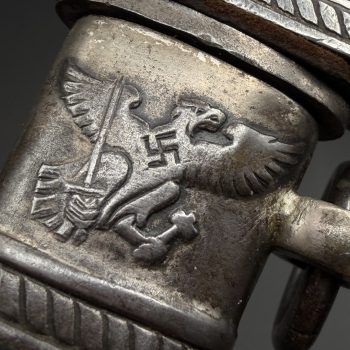
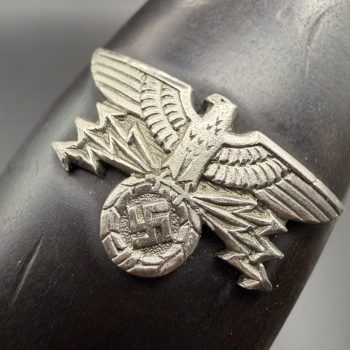
Postschutz Leader Dagger, Model 1939 [Paul Weyersberg]. Mint. (Lot: 1303)
Starting bid: $ 7,750The dagger was introduced in 1939 and formed part of the regulation uniform worn by the leadership personnel of the Deutsche Postschutz. This paramilitary service of the German Reich Postal Service (Deutsche Reichspost) was responsible for the protection of postal and telecommunications facilities. Intended for Postschutz leaders, the dagger was produced in relatively limited numbers and is today considered one of the rarer types of edged weapons from the Third Reich period.
This example was manufactured by Paul Weyersberg & Co. of Solingen. The firm was a German edged weapons manufacturer that produced a wide range of military and dress edged weapons, including bayonets, sabers, swords, and daggers. Paul Weyersberg products were supplied to various military, government, and Party organizations throughout Germany. Examples of the firm’s work are encountered from the Imperial German and Weimar Republic periods as well as the Third Reich era. Under the RZM system, the company was assigned the code M7/43, while the wartime manufacturer’s code crs was also used. The firm’s products are also commonly encountered with the maker’s marking “Paul Weyersberg & Co. Solingen.”
The exceptional Mint condition of this example makes it a remarkable rarity even among the relatively small number of surviving specimens. The blade retains its original factory polish with no traces of corrosion or scratches. The nickel-plated fittings show virtually no wear, while the grip and scabbard retain an exceptionally well-preserved, near-pristine appearance. The absence of signs of use, improper storage, or restoration places this dagger among the highest levels of preservation encountered in German edged weapons manufactured before 1945, giving it exceptional collector appeal.
-
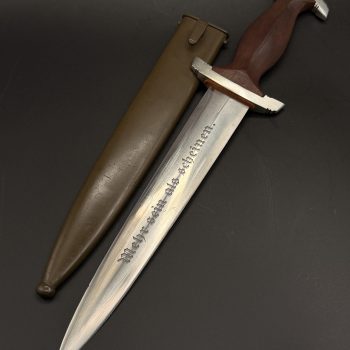
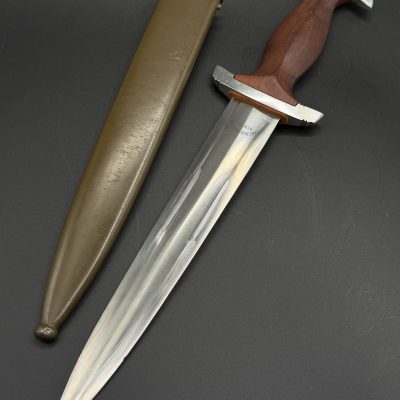
NPEA Student Dagger 1935 Karl Burgsmuller Berlin. Manufacturer’s stamp. Mint. (Lot: 1302)
Starting bid: $ 7,195The blade bears the motto “Mehr sein als scheinen” (“To be better than to seem”), as well as the manufacturer’s mark with the inscription “Karl Burgsmüller Berlin-Charlottenburg 5.” The dagger for students of Nationalpolitische Erziehungsanstalten (NPEA, also known as Napola) was introduced in 1935 for pupils of national political educational institutions. These schools were established in Germany beginning in 1933 and were intended to train future cadres for state, military, and party apparatus. The daggers were supplied to educational institutions centrally and issued to students to be worn with their uniforms.
The Berlin firm Karl Burgsmüller was an official supplier of edged weapons for NPEA schools and was associated with the centralized supply of regulation weapons to these institutions. Production of individual components may have been carried out by other Solingen enterprises, while Burgsmüller served as the official supplier. Due to this supply system, the name Karl Burgsmüller is firmly associated primarily with NPEA daggers and represents one of the most characteristic markings found on original specimens.
The impeccable preservation of this specimen allows it to be classified in the highest condition category of Mint, which is exceptionally rare for German edged weapons from the period prior to 1945. The dagger has retained its original factory blade polish, intact nickel plating, and pristine appearance of the grip and scabbard without wear marks, scratches, or traces of corrosion. The absence of signs of use, improper storage, or restoration determines the maximum collectible value of this item.
-
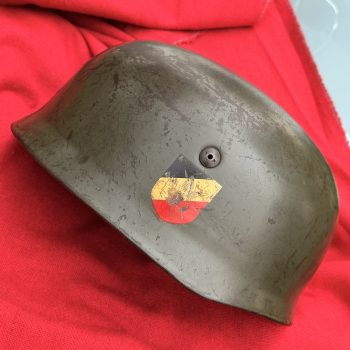
Double Decal Helmet for German Paratroopers [M38] Luftwaffe. (Lot: 1312)
Starting bid: $ 25,000This Fallschirmjäger M38 paratrooper steel helmet with two original decals represents a rare example of early production, retaining its original factory finish and both insignia in untouched condition.
The M38 design was developed specifically for Luftwaffe airborne units and differed fundamentally from standard army steel helmets. The significantly shortened brim and compact dome shape reduced the likelihood of snagging on parachute equipment elements and minimized air resistance during the jump. Since German paratroopers jumped wearing their steel helmets, the M38 had to provide protection not only in combat but also during the descent and landing itself. To achieve this, a special internal system was developed featuring shock-absorbing elements designed to cushion impact loads and prevent head injuries. Another distinctive feature was the complex system of chin and retention straps, which provided considerably more secure helmet fixation compared to standard infantry models and prevented the helmet from shifting or coming off during the jump and landing. The preservation of the original liner and complete strap assembly is particularly significant when evaluating a collectible example. The M38 was not merely a piece of personal armor; it simultaneously served as part of the paratrooper’s specialized jump equipment. Its design combined combat protection requirements with the specific demands of airborne operations, making the M38 one of the most technically distinctive and recognizable German steel helmets of the Second World War period.
Early German steel helmets of the Third Reich period originally featured two decals, placed on both sides of the dome. One indicated affiliation with the respective branch of armed forces or organization (in this case, the Luftwaffe), while the second represented the national insignia in German flag colors. With the outbreak of war, the use of the second decal was gradually discontinued, as the bright insignia served as a revealing element and did not meet frontline operational requirements. During the war, many early double-decal helmets were repainted, received additional camouflage finishes, or had one or both decals removed. A significant number of helmets were also lost or destroyed directly during combat operations. For this reason, original double-decal helmets that have retained their initial factory finish and both decals are encountered considerably less frequently today than later single-decal and no-decal variants. Particular collector value is attached to untouched examples on which the second decal has survived completely or nearly completely and has not been concealed by later paint, removed, or restored.
-
Government Official’s Dagger Model 1938 [Coppel Alexander {Alcoso} Solingen]. (Lot: 1307)
Starting bid: $ 9,375The Government Official’s Dagger (Staatsbeamten-Dolch) was introduced in 1938 and was intended for senior German government officials as part of the prescribed formal uniform. It reflected the status of its wearer and his position within the German state administrative system, serving less as a practical weapon than as a symbol of rank and position within the hierarchy of the Third Reich.
The blade was manufactured by Alexander Coppel & Co., widely known under the Alcoso trademark, derived from the name Alexander Coppel Solingen. The company was founded in Solingen in 1821 and was one of the city’s oldest manufacturers of edged weapons. The firm produced a wide range of edged weapons, including bayonets, sabers, swords, and daggers, fulfilling both military and government contracts. Several variations of the company’s maker marks can be found on its products.
The crossguard takes the form of a stylized German national eagle, one of the distinctive features of this type of dagger. A closely related but separate type was the Diplomatic Corps Dagger (Diplomatendolch), intended for members of the German diplomatic service. Despite the overall similarity of the two models, the Government Official’s Dagger and Diplomatic Corps Dagger can be distinguished by the direction in which the eagle’s head faces on the crossguard.
-
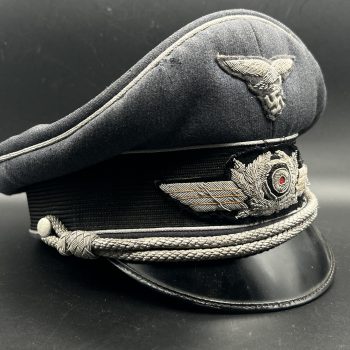
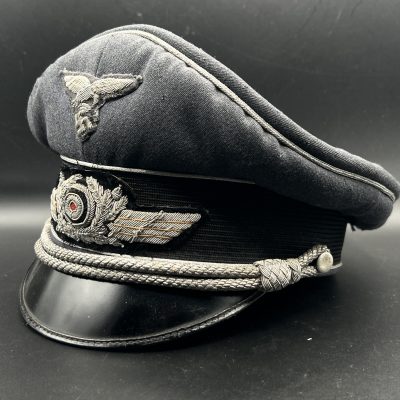
Visor Cap Luftwaffe. (Lot: 1313)
Starting bid: $ 700A Luftwaffe officer’s visor cap crafted from blue-grey wool cloth, featuring the characteristic silver piping along the crown and band. The crown is adorned with a Luftwaffe eagle embroidered in silver bullion, clutching a swastika in its talons. The band displays an officer’s cockade framed by oak leaves with wings, executed in hand embroidery using silver and gold-colored thread. The visor is constructed of black lacquered leather. The chinstrap consists of double silver braid with aluminum buttons featuring a pebbled surface. The cap exhibits signs of wear on the upper portion of the crown.
-
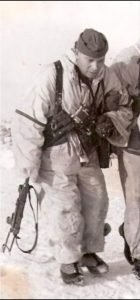
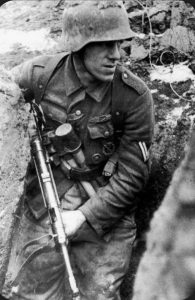
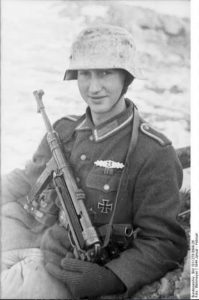
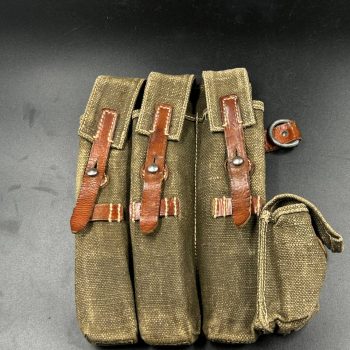
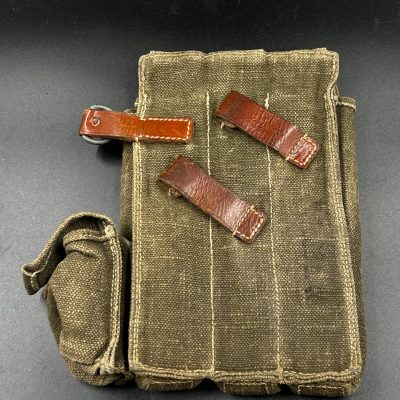
MP38/40 Submachine Gun Magazine Pouch. Wehrmacht and Waffen-SS. (Lot: 1317)
Starting bid: $ 1,750Rare MP38/40 magazine pouch for Wehrmacht and Waffen-SS in excellent condition.
.

-
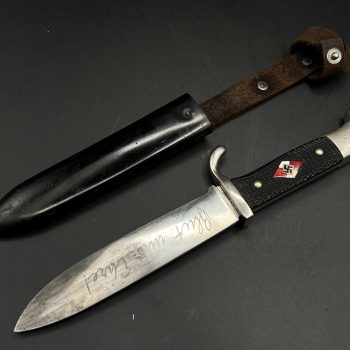
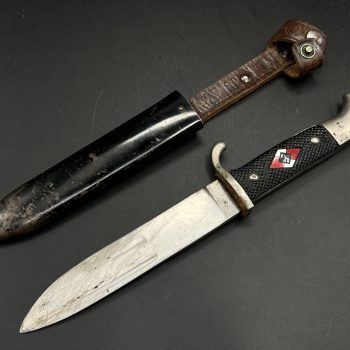
HITLER YOUTH KNIFE (Early type). [Tiger]. Stamp – Tiger. (Lot: 1318)
Starting bid: $ 1,745A Hitler Youth knife complete with metal scabbard and leather hanger. The handle features characteristic diamond-pattern checkering and is adorned with an enameled HJ emblem in red, white, and black tones depicting a swastika. The blade is etched with the motto “Blut und Ehre!” (“Blood and Honor!”). On the reverse side of the blade, there is a manufacturer’s mark from Tiger Solingen featuring a tiger image and the inscription “Gesetzl. Geschützt” (legally protected). This specimen belongs to an early production type, manufactured prior to the introduction of the RZM licensing system.
-
HITLER YOUTH KNIFE (RZM type). [Arthur Schüttelhofer & Co]. Stamp – M7/13. (Lot: 1319)
Starting bid: $ 555This Hitler Youth organization knife belongs to the RZM type category, which determines its characteristic features and marking method. The blade bears the stamp M7/13, replacing the traditional manufacturer’s designation. This coding system was introduced by the Reichszeugmeisterei (the Imperial Equipment Office of the NSDAP) for standardization and quality control of party edged weapons. Items in this category are distinguished by more unified execution compared to earlier examples bearing open manufactory stamps.
RZM type daggers and knives represent a separate category of German edged weapons from the Third Reich period. Instead of traditional manufacturer stamps, they were marked with a special RZM code and an assigned producer number. This approach allowed the Imperial Equipment Office to exercise centralized control over the production of party weapons and equipment.
The code M7/13 corresponds to the company Arthur Schüttelhofer & Co, which fulfilled orders for youth knives under a government contract.
![Government Official’s Dagger Model 1938 [Carl Eickhorn].](https://alexmp.com/wp-content/uploads/2026/07/1784345984685-fobnru7jv2-400x400.jpeg)
![HIitler Youth Leader dagger [E. & F. Horster].](https://alexmp.com/wp-content/uploads/2026/07/1784345458986-rtuscvn6xdi-400x400.jpeg)
![Postschutz Leader Dagger, Model 1939 [Paul Weyersberg]. Mint.](https://alexmp.com/wp-content/uploads/2026/07/img_0666-400x400.jpeg)
![Double Decal Helmet for German Paratroopers [M38] Luftwaffe.](https://alexmp.com/wp-content/uploads/2026/07/1784344537198-49dcj699d1j-400x400.jpeg)
![Government Official’s Dagger Model 1938 [Coppel Alexander {Alcoso} Solingen].](https://alexmp.com/wp-content/uploads/2026/07/1784345124370-e3699ewkdvq-400x400.jpeg)
![HITLER YOUTH KNIFE (Early type). [Tiger]. Stamp – Tiger.](https://alexmp.com/wp-content/uploads/2026/08/1785522406807-wor3jw2s8gp-400x400.jpeg)
![HITLER YOUTH KNIFE (RZM type). [Arthur Schüttelhofer & Co]. Stamp – M7/13.](https://alexmp.com/wp-content/uploads/2026/08/1785522856239-fnhxydjbzb9-400x400.jpeg)
Sold at Blitz price
-
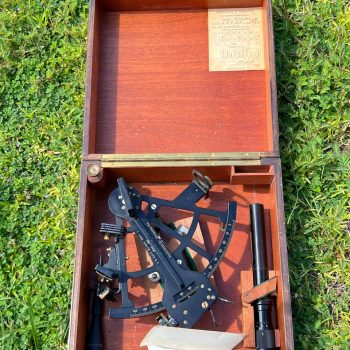
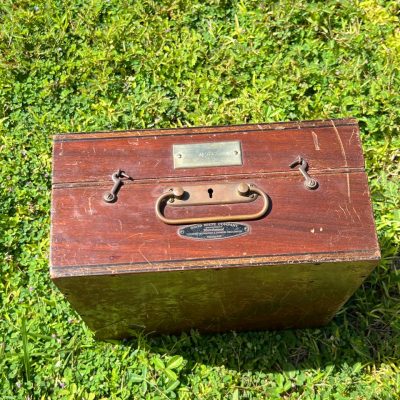
U.S. Navy Bureau of Navigation Mark II Sextant — David White Co., Milwaukee — Serial No. 647-1939 — With Original U.S. Naval Observatory Certificate of Inspection, dated August 15, 1941 (Lot: 1114)
Auction EndedThe Navy Mark II sextant by David White Company of Milwaukee was one of the principal instruments of U.S. Navy navigation throughout World War II. This example, serial number 647-1939, was inspected and certified by the U.S. Naval Observatory in Washington on August 15, 1941 — just four months before Pearl Harbor — making it a genuine pre-war/early-war service instrument. The limb reads to single degrees with drum micrometer to 1 minute, and vernier to 6 seconds of arc. Original mahogany dovetailed case with brass hardware and David White Company nameplate. Original inspection certificate with handwritten eccentricity corrections and inspector’s signature survives intact. Telescope present.
Product sold for blitz price: $ 665 -
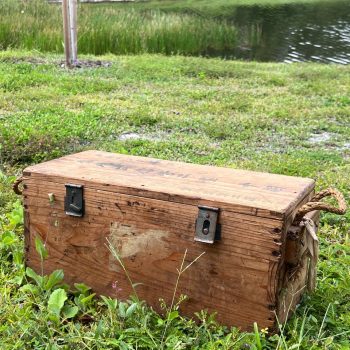
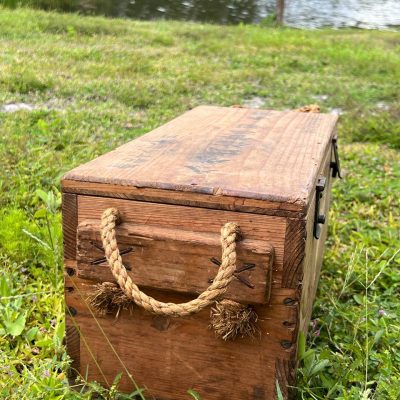
Imperial Japanese Army WWII Wooden Ammunition / Supply Crate, Showa 15 (1940), Original Rope Handles (Lot: 1068)
Auction EndedLarge field supply crate from the Imperial Japanese Army, dated to Showa Year 15 (1940). Lid bears hand-stenciled kanji markings indicating production year, arsenal or unit designation, and logistical data. Pine board construction with iron hardware and, notably, both original heavy rope carrying handles retained — a rare find, as these are almost always missing on surviving examples. Solid and display-ready. A compelling piece of Pacific Theater militaria.
Product sold for blitz price: $ 115 -
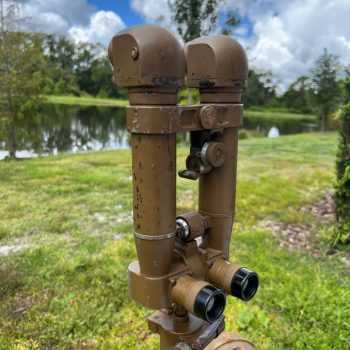
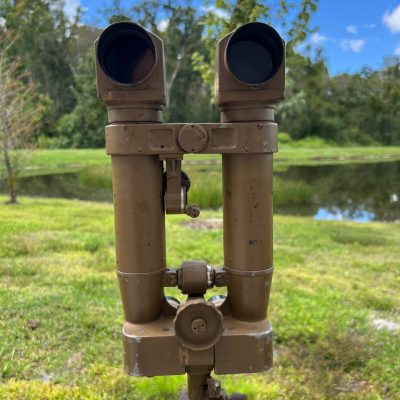
Imperial Japanese Army WWII 8×6.2° Artillery Stereoscopic Observation Binoculars — Serial No. 4021 — Complete Set with Brass Tripod, Metal Transport Case & Canvas Tripod Carrier No. 1902 (Lot: 1073)
Auction EndedA large-format precision artillery observation binocular of the Imperial Japanese Army, marked 8×6.2°, No. 4021 with Imperial Arsenal acceptance star stamp. This periscope-style instrument was used throughout the war by Battery Commanders for observation without exposure to enemy fire. Complete with adjustable-height tripod with matching serial number; tripod legs fold, extend, and lock in place. The instrument features precision azimuth and elevation adjustment dials with graduated scales. Included: original brass/aluminum field tripod with azimuth head, ribbed aluminum transport case, and canvas cylindrical tripod carrier marked No. 1902 with original straps. Optics clear on both sides.
Product sold for blitz price: $ 775