By clicking Login or Register, you agree that the images of Nazi symbols shown on alexmp.com are not propaganda of fascism, Nazism and are shown solely for historical, cognitive and scientific purposes.
Request a callback
Order a free call and our specialist will contact you shortly!
Ask a question
Contact us and we will get back to you shortly.
Request a Blitz Price
Contact us and we will get back to you shortly.
Request a price
Contact us and we will get back to you shortly.
Offer your blitz price
Contact us and we will get back to you shortly.
Error: Contact form not found.
Request a subscription
We will get back to you shortly.
Subscription
В честь запуска Энциклопедии мы рады предложить вам бесплатный доступ до 01.10.2026. Будем рады вашим комментариям и предложениям!
Cavalry edged weapons of the German Empire were intended for officers and enlisted men of dragoon, cuirassier, uhlan, hussar, and other cavalry regiments, remaining in service until the end of the First World War in 1918. This category includes sabers, pallasches, and other examples of bladed weapons that formed an integral part of German cavalry equipment. The presented German saber, dating to before 1918, serves as an excellent example of officer armament from the Imperial period.
The most distinctive feature of many officer cavalry sabers is the pommel in the form of a lion’s head, one of the most recognizable symbols of German edged weapons from the Imperial period. This model gained widespread use in German armies of the 19th century, particularly among cavalry and infantry officers, and to this day remains a desirable acquisition for serious collectors.
The firm M. Neumann, Berlin was a German supplier of military equipment and edged weapons in the late 19th and early 20th centuries. The enterprise was located in Berlin and supplied sabers, pallasches, bayonets, and other military items for the German army, earning a reputation as a reliable manufacturer of quality officer weapons.
A coat of arms on the blade or hilt of a German saber indicates that the weapon belonged to a member of a noble house or aristocratic family. Such examples were made to individual order and were frequently embellished with a motto, initials, or a crown of the appropriate rank. The presence of a family coat of arms significantly enhances the historical and collectible value of the piece, as in certain cases it allows identification of the specific owner and tracing of the weapon’s provenance.
The blade is forged from Damascus steel and decorated with ornamental etching and gilding. This combination of materials and techniques is characteristic of the most prestigious examples of ceremonial and presentation edged weapons, making this specimen particularly attractive to discerning connoisseurs of German military antiques.
Honorary Award Sabre “For Outstanding Achievements in Marksmanship” ranks among the most prestigious state awards of Germany in the period before 1939. Such sabres were presented to military personnel for outstanding results in marksmanship training and represented not a prize for placing in competition, but rather the sole honorary award for the best marksman of the competition. Unlike most richly decorated ceremonial sabres manufactured through private commissions, these blades were official state award weapons. Each was associated with a specific award presentation, making such items considerably rarer and more valuable to collectors. The tradition of such awards existed during the Reichswehr era and continued into the Wehrmacht period. OKW sabres were produced from 1935 to 1937 without the swastika, and from 1938 a new variant appeared featuring an eagle on the crossguard. All award sabres of this type were manufactured exclusively with Damascus steel blades. The blades featured rich etched ornamentation as well as inscriptions indicating the name, rank, and type of weapon with which outstanding results were demonstrated. Depending on the manufacturer and production period, the design could vary slightly. A common characteristic of original examples is also the presence of military acceptance stamps confirming their official state origin.
The year of the sabre’s production (1930) is attested by corresponding markings on the blade. Thus, this example dates to the Reichswehr period and was manufactured before the establishment of the Wehrmacht.
The manufacturer was WKC (Weyersberg, Kirschbaum & Cie), one of the oldest and most respected arms manufactories in Solingen, founded in 1883 through the merger of two historic production facilities. The company was a major supplier of edged weapons for the German army, producing army daggers and sabres of the highest quality bearing their distinctive mark. WKC products were distinguished by superb blade finishing, impeccable polishing, and precise conformity to regulation patterns, making them particularly valuable to collectors.
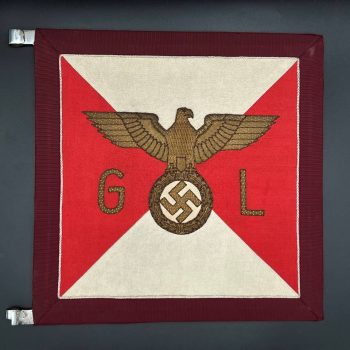
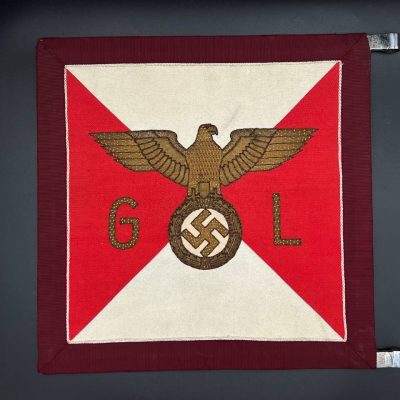
Car pennant of a Gauleiter of the National Socialist German Workers’ Party (NSDAP). The square banner is made of high-quality textile with a characteristic design featuring red and white triangular sectors, bordered by a burgundy grosgrain ribbon. At the center is the party eagle with outstretched wings, clutching a wreath with a swastika in its talons, executed in fine gold bullion embroidery. On the sides, the letters ‘G’ and ‘L’ (abbreviation for Gauleiter) are embroidered. The pennant is equipped with original metal fittings for mounting on an automobile, one of which retains the marking ‘RZM 3/45’. An exceptionally rare item of high party rank in excellent condition.
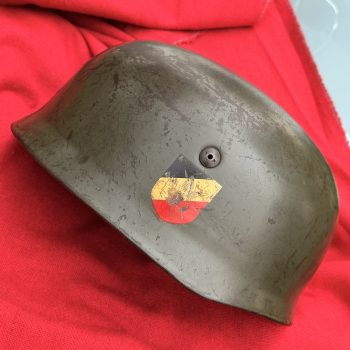
This Fallschirmjäger M38 paratrooper steel helmet with two original decals represents a rare example of early production, retaining its original factory finish and both insignia in untouched condition.
The M38 design was developed specifically for Luftwaffe airborne units and differed fundamentally from standard army steel helmets. The significantly shortened brim and compact dome shape reduced the likelihood of snagging on parachute equipment elements and minimized air resistance during the jump. Since German paratroopers jumped wearing their steel helmets, the M38 had to provide protection not only in combat but also during the descent and landing itself. To achieve this, a special internal system was developed featuring shock-absorbing elements designed to cushion impact loads and prevent head injuries. Another distinctive feature was the complex system of chin and retention straps, which provided considerably more secure helmet fixation compared to standard infantry models and prevented the helmet from shifting or coming off during the jump and landing. The preservation of the original liner and complete strap assembly is particularly significant when evaluating a collectible example. The M38 was not merely a piece of personal armor; it simultaneously served as part of the paratrooper’s specialized jump equipment. Its design combined combat protection requirements with the specific demands of airborne operations, making the M38 one of the most technically distinctive and recognizable German steel helmets of the Second World War period.
Early German steel helmets of the Third Reich period originally featured two decals, placed on both sides of the dome. One indicated affiliation with the respective branch of armed forces or organization (in this case, the Luftwaffe), while the second represented the national insignia in German flag colors. With the outbreak of war, the use of the second decal was gradually discontinued, as the bright insignia served as a revealing element and did not meet frontline operational requirements. During the war, many early double-decal helmets were repainted, received additional camouflage finishes, or had one or both decals removed. A significant number of helmets were also lost or destroyed directly during combat operations. For this reason, original double-decal helmets that have retained their initial factory finish and both decals are encountered considerably less frequently today than later single-decal and no-decal variants. Particular collector value is attached to untouched examples on which the second decal has survived completely or nearly completely and has not been concealed by later paint, removed, or restored.
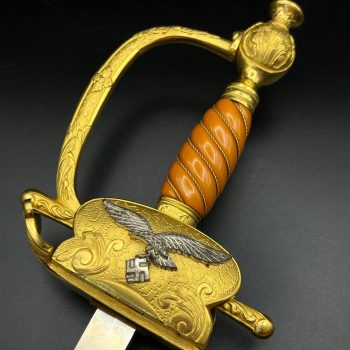
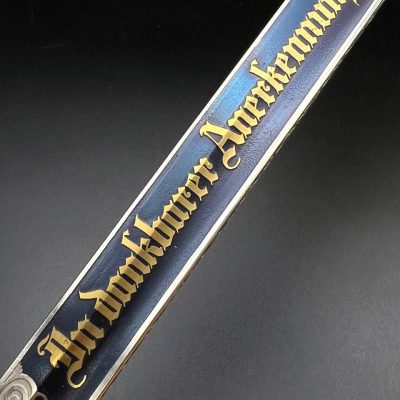
This is the classic version manufactured by Carl Eickhorn Solingen. The hilt fittings in fire-gilt non-ferrous metal, the grip mounts hand-decorated. On the obverse quillon, the separately applied silver-plated Luftwaffe national eagle, triple-riveted. The grip in amber color with gilt wire wrap. Straight nickel-plated and etched blade with fullers on both sides, gilt dedication on the obverse “In dankbarer Anerkennung” (In Grateful Recognition), on the reverse “Der Oberbefehlshaber der Luftwaffe – Hermann Göring” (The Commander-in-Chief of the Luftwaffe – Hermann Göring), each gilt with blued background. On the ricasso with maker’s mark “Original Eickhorn Solingen”. Black leather scabbard with gilt mounts, reverse side clamped.
Only very lightly worn, the original gilding of the fittings over 95% intact, the blade in mint condition. A very well-preserved piece.
Generalleutnant Walter Heling, born 1887 in Belgrad and missing since May 12, 1942 at Kharkov, was Luftwaffe commander in Stade, Jütland, Flensburg from the beginning of the war. Later Commander of Luftwaffe Construction Brigade VI during Operation Barbarossa.



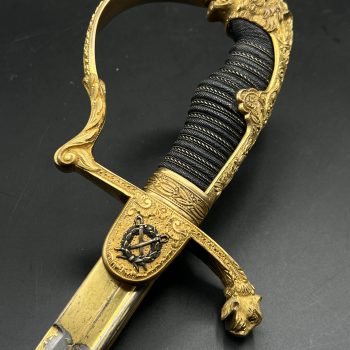
![German Sword, pre-1918 Cavalry. Lion head [M. Neumann Berlin] Family Coat of Arms. Damascus steel, etching, gilding.](https://alexmp.com/wp-content/uploads/2026/08/1786327259162-s0zmv22ljzb-400x400.jpeg)
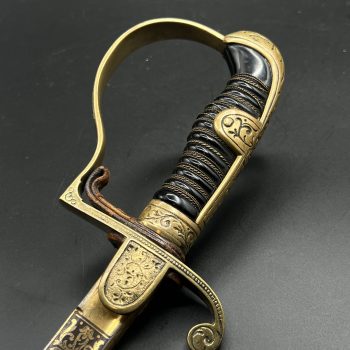
![Honor Presentation Saber for Outstanding Marksmanship of the Oberkommando der Wehrmacht (OKW) 1930. [WKC].](https://alexmp.com/wp-content/uploads/2026/08/1786327324223-5t9w0mpjwk5-400x400.jpeg)
![Double Decal Helmet for German Paratroopers [M38] Luftwaffe.](https://alexmp.com/wp-content/uploads/2026/07/1784344537198-49dcj699d1j-400x400.jpeg)