Login
Register
By clicking Login or Register, you agree that the images of Nazi symbols shown on alexmp.com are not propaganda of fascism, Nazism and are shown solely for historical, cognitive and scientific purposes.
Order a free call and our specialist will contact you shortly!
Contact us and we will get back to you shortly.
Contact us and we will get back to you shortly.
Contact us and we will get back to you shortly.
Contact us and we will get back to you shortly.
Error: Contact form not found.
We will get back to you shortly.
В честь запуска Энциклопедии мы рады предложить вам бесплатный доступ до 01.10.2026.
Будем рады вашим комментариям и предложениям!
Inspected and guaranteed by Alex Warstory.
For more details on AlexMP Guarantee, click [HERE]
Item guaranteed by a verified dealer.
Click [HERE] for full seller guarantee terms.
Sold without expert review or guarantees. No claims accepted post-sale.
Learn more [HERE]


Showing 1–16 of 34 results
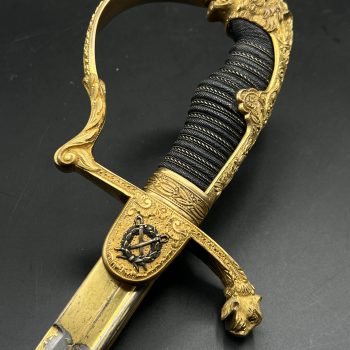
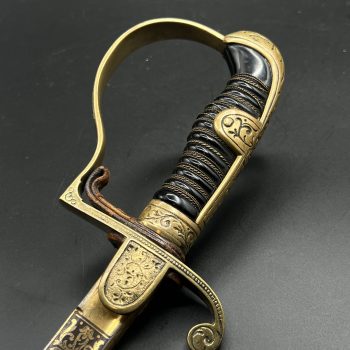
FiltersCavalry edged weapons of the German Empire were intended for officers and enlisted men of dragoon, cuirassier, uhlan, hussar, and other cavalry regiments, remaining in service until the end of the First World War in 1918. This category includes sabers, pallasches, and other examples of bladed weapons that formed an integral part of German cavalry equipment. The presented German saber, dating to before 1918, serves as an excellent example of officer armament from the Imperial period.
The most distinctive feature of many officer cavalry sabers is the pommel in the form of a lion’s head, one of the most recognizable symbols of German edged weapons from the Imperial period. This model gained widespread use in German armies of the 19th century, particularly among cavalry and infantry officers, and to this day remains a desirable acquisition for serious collectors.
The firm M. Neumann, Berlin was a German supplier of military equipment and edged weapons in the late 19th and early 20th centuries. The enterprise was located in Berlin and supplied sabers, pallasches, bayonets, and other military items for the German army, earning a reputation as a reliable manufacturer of quality officer weapons.
A coat of arms on the blade or hilt of a German saber indicates that the weapon belonged to a member of a noble house or aristocratic family. Such examples were made to individual order and were frequently embellished with a motto, initials, or a crown of the appropriate rank. The presence of a family coat of arms significantly enhances the historical and collectible value of the piece, as in certain cases it allows identification of the specific owner and tracing of the weapon’s provenance.
The blade is forged from Damascus steel and decorated with ornamental etching and gilding. This combination of materials and techniques is characteristic of the most prestigious examples of ceremonial and presentation edged weapons, making this specimen particularly attractive to discerning connoisseurs of German military antiques.
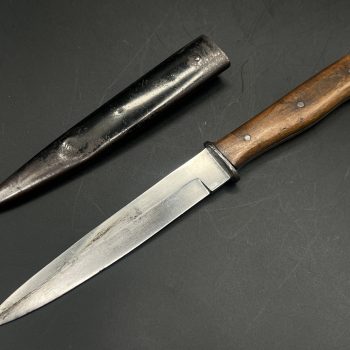
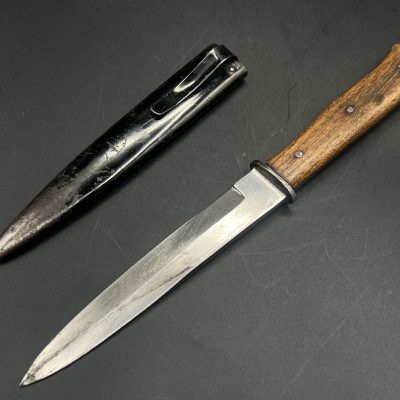
The Nahkampfmesser combat knife, Model 1942, was officially adopted by the German armed forces in 1942. It was intended for use by military personnel across various branches of service and was distinguished by its simple, robust, and technologically efficient design.
Unlike ceremonial edged weapons, the Nahkampfmesser was an exclusively utilitarian item. It served as a combat knife, a tool for fieldwork, and an element of the soldier’s individual equipment.
The Nahkampfmesser was manufactured by numerous German enterprises; however, maker’s marks on the blades are encountered extremely rarely.
During excavations at Second World War battle sites, Nahkampfmesser knives are regularly discovered both along the lines of direct combat engagement and among the personal effects of military personnel. However, examples in good or excellent condition are extremely rare, as these knives continued to be widely used by the civilian population after the war, resulting in significant wear and loss of their original condition.
Honorary Award Sabre “For Outstanding Achievements in Marksmanship” ranks among the most prestigious state awards of Germany in the period before 1939. Such sabres were presented to military personnel for outstanding results in marksmanship training and represented not a prize for placing in competition, but rather the sole honorary award for the best marksman of the competition. Unlike most richly decorated ceremonial sabres manufactured through private commissions, these blades were official state award weapons. Each was associated with a specific award presentation, making such items considerably rarer and more valuable to collectors. The tradition of such awards existed during the Reichswehr era and continued into the Wehrmacht period. OKW sabres were produced from 1935 to 1937 without the swastika, and from 1938 a new variant appeared featuring an eagle on the crossguard. All award sabres of this type were manufactured exclusively with Damascus steel blades. The blades featured rich etched ornamentation as well as inscriptions indicating the name, rank, and type of weapon with which outstanding results were demonstrated. Depending on the manufacturer and production period, the design could vary slightly. A common characteristic of original examples is also the presence of military acceptance stamps confirming their official state origin.
The year of the sabre’s production (1930) is attested by corresponding markings on the blade. Thus, this example dates to the Reichswehr period and was manufactured before the establishment of the Wehrmacht.
The manufacturer was WKC (Weyersberg, Kirschbaum & Cie), one of the oldest and most respected arms manufactories in Solingen, founded in 1883 through the merger of two historic production facilities. The company was a major supplier of edged weapons for the German army, producing army daggers and sabres of the highest quality bearing their distinctive mark. WKC products were distinguished by superb blade finishing, impeccable polishing, and precise conformity to regulation patterns, making them particularly valuable to collectors.
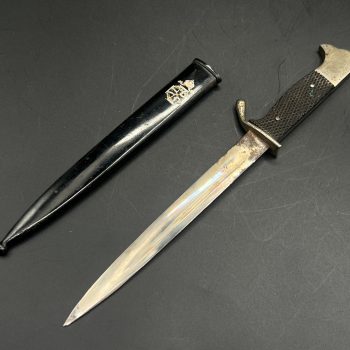
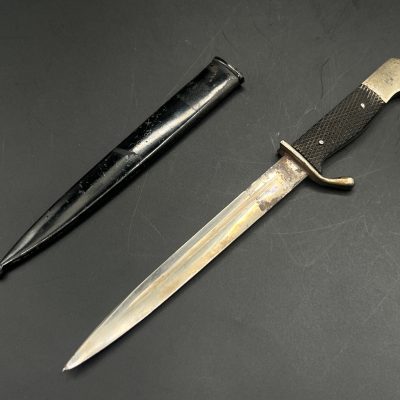
An elegant miniature replica of a dress bayonet, executed with meticulous attention to all structural elements of the original pattern. This item belongs to the category of collectible edged weapon miniatures, traditionally created as commemorative or presentation pieces, as well as for augmenting private collections.
Of particular interest is the scabbard, adorned with an engraved image, which lends this specimen an individual character and distinguishes it among standard miniaturs. Such decorative elements are encountered infrequently and substantially enhance the collectible value of the piece.
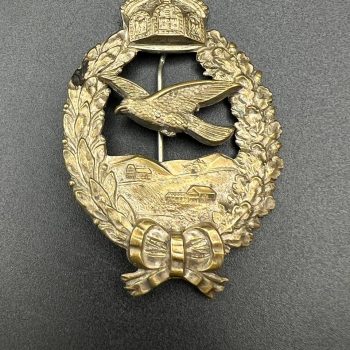
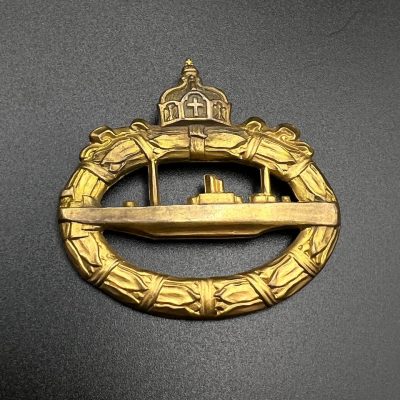
Base metal hollow embossed and silver-plated. The cross on the Imperial Orb is missing!
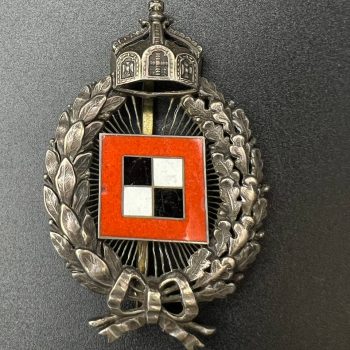
See Carsten Baldes “Abzeichen und Ehrenpreise der Fliegertruppe 1913 bis 1920” on page 294.
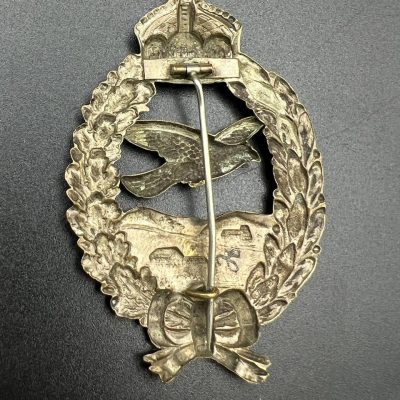
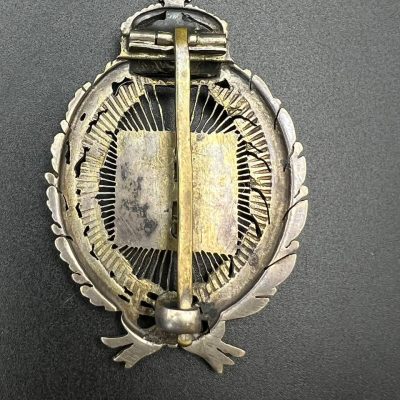
This is an extravagant special manufacture by the firm “C.E. Juncker Berlin”. Silver, hollow embossed, on reverse with ray plate, without maker’s mark. The badge was completely hand-sawed and openwork after completion: the crown, the surrounding laurel/oak leaf wreath with bow, as well as the ray plate behind the enameled field! Worn piece, on reverse with wide pin. In good condition, with very attractive patina.
A most exceptional piece, certainly worn by an extravagant officer. A unique item!
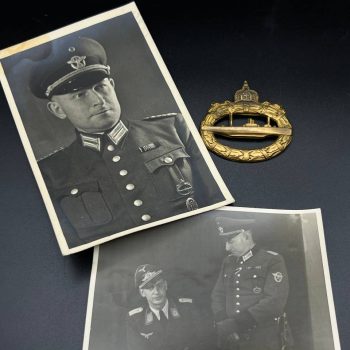
hollow embossed and gold-plated, thin horizontal pin on reverse, privately purchased piece from the 1920s. Accompanied by 2 photographs of a police officer in the rank of Major. Notation on reverse: “Flensburg 16.10.38 zur lieben Erinnerung, Adolf”
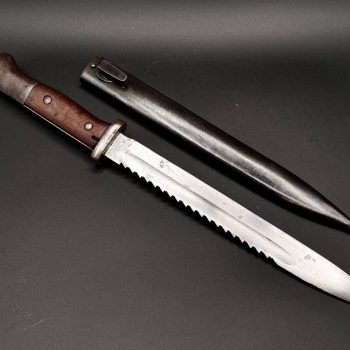
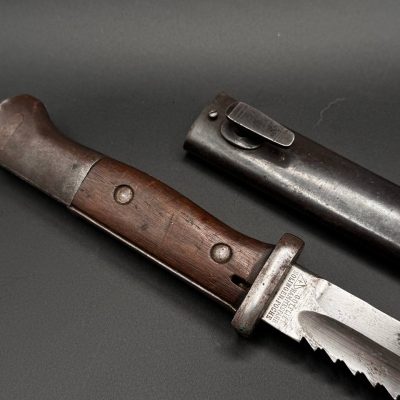
A stunning near-mint sawback bayonet (Sägerückenbajonett) for the Mauser 98 rifle from WWI! Blade uncleaned, manufacturer’s mark “Gottlieb Hammesfahr Solingen” — crisp and clear. Complete with original scabbard. Extremely rare in such condition!
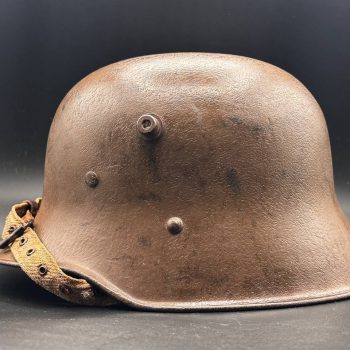
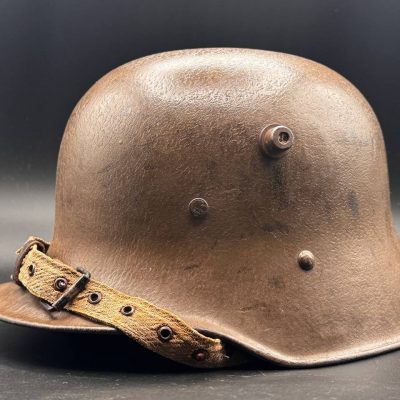
Genuine Austro-Hungarian Stahlhelm, Model M17, of the First World War. Austria-Hungary used the German M16 but produced its own M17 version, and this example shows all the correct Austrian markers.
The key indicators of Austrian manufacture are the cloth (web) chinstrap with leather tabs and roller buckle, and the chinstrap attachment set higher on the dome than on German shells. The dome retains its characteristic side ventilation lugs (Hörner), which also served as the mounting points for the armored brow plate. The warm brown surface tone is consistent with the Austrian Isonzo-braun finish.
An important dating detail: the cloth chinstrap points to wartime production of 1917 to 1918. Later, postwar Austrian helmets of this type used a leather chinstrap, so a complete web chinstrap marks this as a genuine wartime piece rather than an interwar one. Inside, it retains the complete original three-pad leather liner with its drawstring, a feature frequently missing or replaced on surviving helmets. The liner carries a size stamp reading 64.
Provenance: the helmet is accompanied by an old collector tag stating that it was brought back from France in November to December 1918, and named to William Joseph Tobiska. In keeping with the period, the tag calls the helmet German: the American soldier did not distinguish the Austrian pattern from the German one, which is typical of war souvenirs and only underlines the authenticity of the story.
Condition: an honest, untouched example with a textured surface, light oxidation, and wear consistent with a century old combat item. Offered exactly as found, a genuine WWI Austro-Hungarian helmet with complete liner, original wartime web chinstrap, and a named bring back provenance.
Please review all photos closely, they form part of the description. Worldwide shipping.
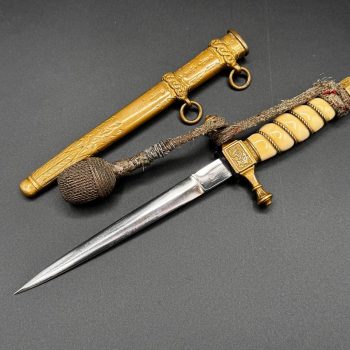
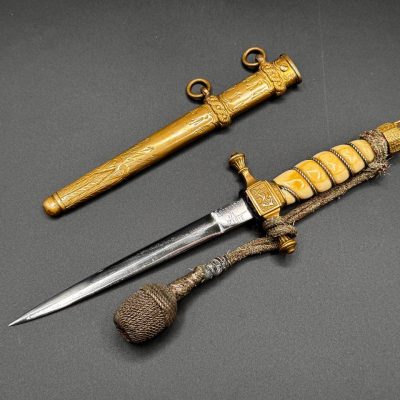
A miniature naval officer’s dagger of the Imperial German Navy (Kaiserliche Marine). Ivory grip with wire wrapping, pommel in the form of an imperial crown. Crossguard with relief anchor motif. Double-edged blade with engraved inscription «EBERHARD s/l. MARIE» — a personal dedication. Includes a miniature knot. A rare personalized Imperial period example.
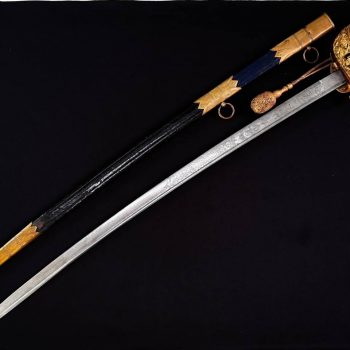
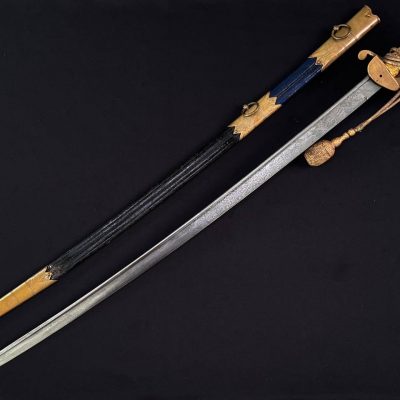
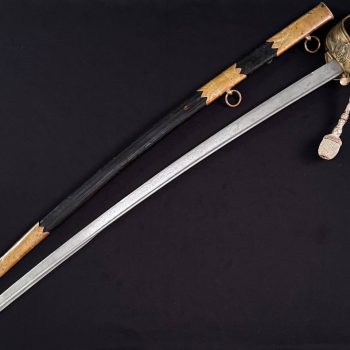
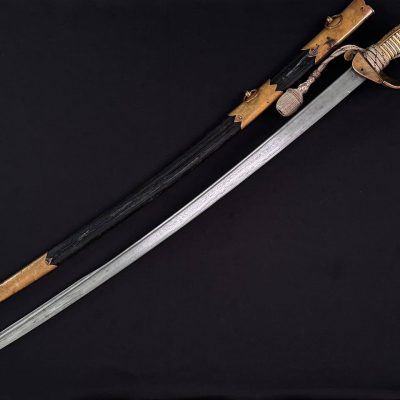
A dress officer’s sword of the Imperial German Navy (Kaiserliche Marine) in an oversized (große Ausführung) variant — the blade is noticeably broader and the grip larger than the standard regulation pattern. This bespoke specification, together with the exceptional quality of the mounts, points to a privately commissioned piece made for an officer of considerable means. complete with a leather scabbard and a gold-colored officer’s sword knot. The hilt is gilt, of openwork design, featuring the characteristic lion’s head pommel and a guard cup adorned with a relief depiction of an anchor surmounted by a crown, floral motifs, and rosettes. The grip is fashioned from ivory with horizontal fluting and wire wrapping. The blade is from multi-layered Damascus steel. The flats feature rich etched ornamentation with floral motifs and the retailer’s inscription “Waarenhaus für Armee & Marine in Berlin.” The scabbard is leather-mounted with gilt brass fittings, comprising a locket with shaped cutout, a middle band with suspension ring, and a chape with foliate ornamentation. An exceptionally rare example of dress naval officer’s weaponry of the highest quality from the German Empire period. 100% original piece.
A parade officer’s saber of the Imperial German Navy from the Kaiserreich period. The hilt is crafted from ivory featuring a characteristic fluted surface, with a pommel in the form of a sculptural lion’s head displaying a finely detailed mane and red eyes. The brass bowl guard is adorned with a relief depiction of the Imperial Crown and anchor. The crossguard bears the owner’s name “Victor Schütze” engraved in Gothic script. The Damascus blade is in excellent condition and features a Damascus pattern with two maker’s marks on the ricasso. Similar examples are known with markings applied to both sides of the ricasso. The blade is notably wide, broader than those typically encountered on this saber pattern, giving the piece a particularly impressive appearance. The hilt fittings are free of any significant defects. The reverse side of the scabbard has a separated seam where the stitching has come undone, but this does not detract from the overall presentation of the piece. Overall, this is a very well-preserved collectible example. The saber is named, adding significant historical interest and desirability for collectors.
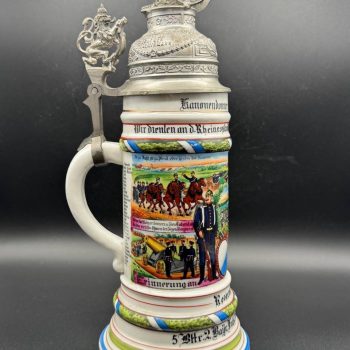
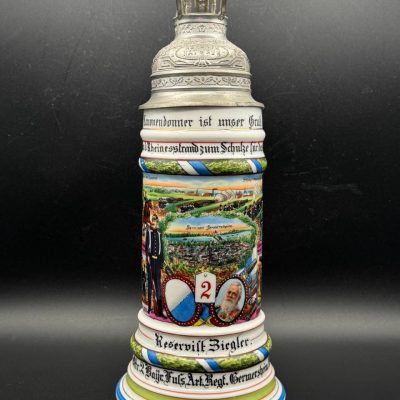
A superb early 20th-century regimental stein commemorating the service of Reservist Ziegler with the 5th Battery of the 2nd Bavarian Foot Artillery Regiment stationed at Germersheim, on the Rhine. The richly hand-painted body depicts heavy artillery crews in training, horse teams in the field, and a panoramic view of the Germersheim fortress. The motto “Wir dienen am d. Rheinesstrand zum Schutze für das Vaterland” (“We serve on the banks of the Rhine for the defense of the Fatherland”) runs around the top border. The pewter lid features an artilleryman with a field gun and a Bavarian lion thumb lift, symbolizing the proud Bavarian artillery tradition.
An outstanding example of pre-WWI reservist craftsmanship, combining patriotic imagery, vivid color, and fine porcelain detail typical of 1900s regimental souvenirs.
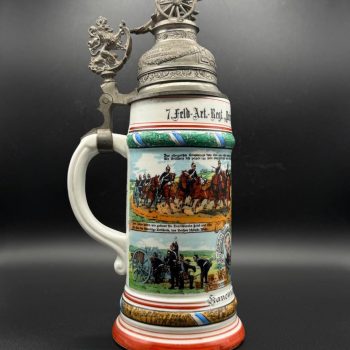
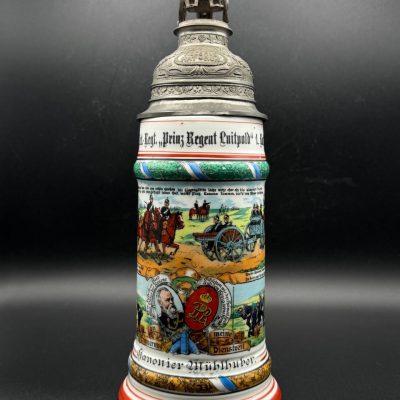
A fine early 20th-century regimental stein belonging to Gunner Mühlhuber, commemorating his service in the 7th Field Artillery Regiment “Prinzregent Luitpold”, 1st Battery, based in Munich during 1906–1908. The hand-painted porcelain body vividly depicts mounted artillery units in training and gun crews in action, with the patriotic motto “Drei Jahre haben wir gedient für Deutschlands Fried’ und Ehr’” (“Three years we served for Germany’s peace and honor”).
The front features the crowned initials PL of Prince Regent Luitpold, surrounded by ornamental motifs and regimental banners. Pewter lid with artilleryman and cannon finial, Bavarian lion thumb lift, and lithophane inside showing the classic “soldier’s farewell” scene. Rich color, fine detail, and strong glaze make this an outstanding example of Munich-produced reservist art from the pre-WWI period.
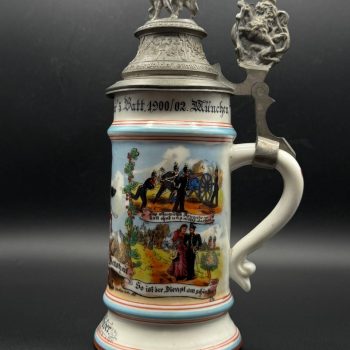
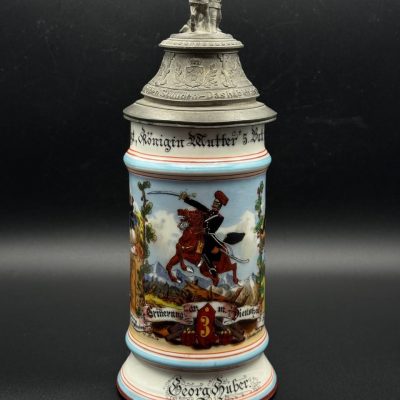
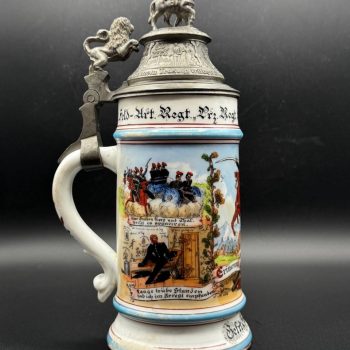
A fine early 20th-century regimental stein belonging to Georg Huber, commemorating his service with the 5th Battery, 2nd Bavarian Field Artillery Regiment “Königin Mutter”, stationed in Munich. The colorful hand-painted body features a cavalryman charging with drawn sabre against an Alpine backdrop, symbolizing Bavarian martial spirit. Surrounding panels depict gun crews in action and scenes of barracks life, with the inscription “Erinnerung an meine Dienstzeit” (“In memory of my service”).
The pewter lid bears a mounted cavalry figure and embossed Bavarian crest, with the motto “Mein Trost in trüben Stunden – Das hübsche Mäd’l aus Bayernland” (“My comfort in dark hours – the pretty girl from Bavaria”). Superb craftsmanship, vivid enamels, and early date (1900–02) make this an exceptional Munich-produced reservist stein of the “Königin Mutter” artillery regiment.
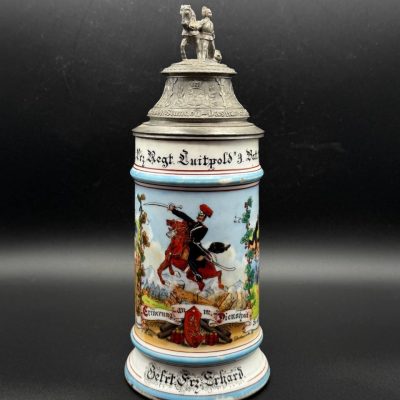
Beautifully hand-painted regimental stein commemorating the service of Gefreiter Fritz Erhard with the 3rd Battery, 2nd Bavarian Field Artillery Regiment “Prinz Luitpold”, stationed in Munich. The front panel depicts a mounted artilleryman charging with sabre against an Alpine backdrop; side scenes show cannon drill, barracks life, and farewells in vibrant colors. Pewter lid features a sculpted horse and soldier, Bavarian crest reliefs, and the traditional toast “Mein Trost in trüben Stunden – Das hübsche Mäd’l aus Bayernland.”
A fine and expressive example of early 20th-century Bavarian craftsmanship, combining humor, color, and regimental pride.

![German Sword, pre-1918 Cavalry. Lion head [M. Neumann Berlin] Family Coat of Arms. Damascus steel, etching, gilding.](https://alexmp.com/wp-content/uploads/2026/08/1786327259162-s0zmv22ljzb-400x400.jpeg)
![Honor Presentation Saber for Outstanding Marksmanship of the Oberkommando der Wehrmacht (OKW) 1930. [WKC].](https://alexmp.com/wp-content/uploads/2026/08/1786327324223-5t9w0mpjwk5-400x400.jpeg)