Login
Register
By clicking Login or Register, you agree that the images of Nazi symbols shown on alexmp.com are not propaganda of fascism, Nazism and are shown solely for historical, cognitive and scientific purposes.
Order a free call and our specialist will contact you shortly!
Contact us and we will get back to you shortly.
Contact us and we will get back to you shortly.
Contact us and we will get back to you shortly.
Contact us and we will get back to you shortly.
Error: Contact form not found.
We will get back to you shortly.
В честь запуска Энциклопедии мы рады предложить вам бесплатный доступ до 01.10.2036.
Будем рады вашим комментариям и предложениям!
Inspected and guaranteed by Alex Warstory.
For more details on AlexMP Guarantee, click [HERE]
Item guaranteed by a verified dealer.
Click [HERE] for full seller guarantee terms.
Sold without expert review or guarantees. No claims accepted post-sale.
Learn more [HERE]


Showing 193–208 of 684 results
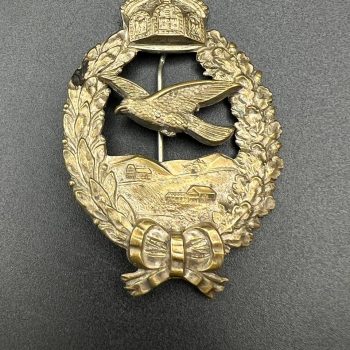
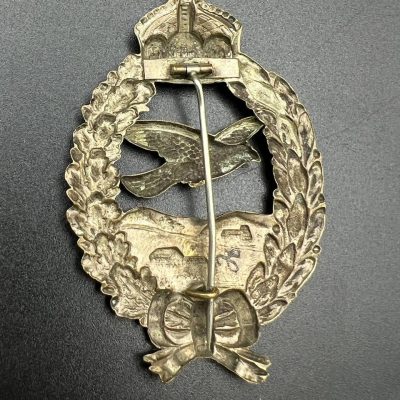
FiltersBase metal hollow embossed and silver-plated. The cross on the Imperial Orb is missing!
See Carsten Baldes “Abzeichen und Ehrenpreise der Fliegertruppe 1913 bis 1920” on page 294.
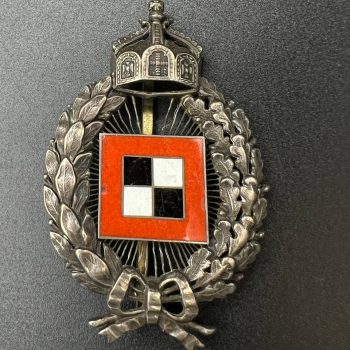
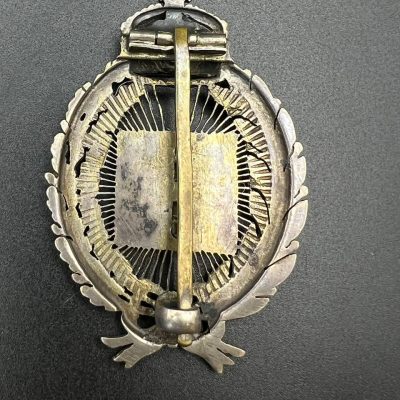
This is an extravagant special manufacture by the firm “C.E. Juncker Berlin”. Silver, hollow embossed, on reverse with ray plate, without maker’s mark. The badge was completely hand-sawed and openwork after completion: the crown, the surrounding laurel/oak leaf wreath with bow, as well as the ray plate behind the enameled field! Worn piece, on reverse with wide pin. In good condition, with very attractive patina.
A most exceptional piece, certainly worn by an extravagant officer. A unique item!
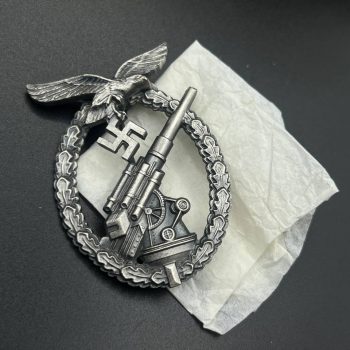
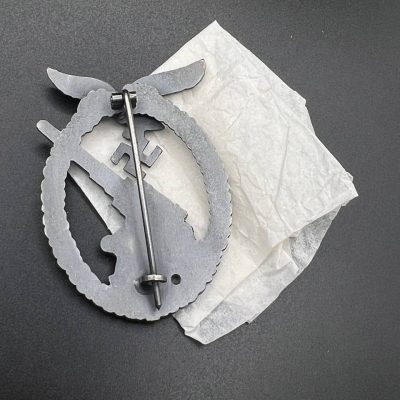
Non-ferrous metal, reverse without maker’s mark, unworn condition in original wrapping paper. In absolutely mint condition.
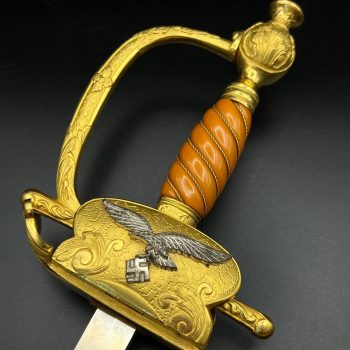
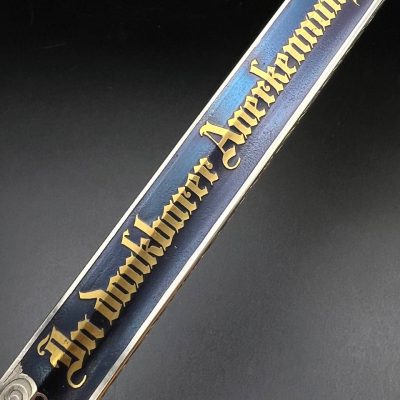
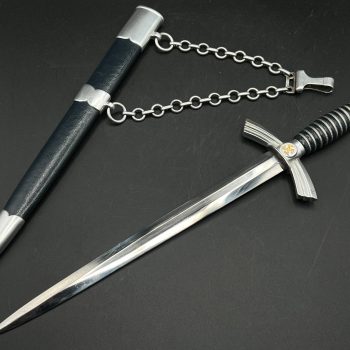
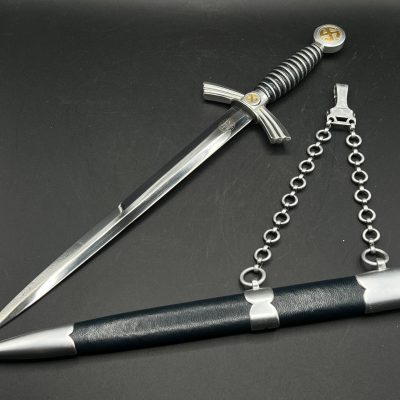
This is the classic version manufactured by Carl Eickhorn Solingen. The hilt fittings in fire-gilt non-ferrous metal, the grip mounts hand-decorated. On the obverse quillon, the separately applied silver-plated Luftwaffe national eagle, triple-riveted. The grip in amber color with gilt wire wrap. Straight nickel-plated and etched blade with fullers on both sides, gilt dedication on the obverse “In dankbarer Anerkennung” (In Grateful Recognition), on the reverse “Der Oberbefehlshaber der Luftwaffe – Hermann Göring” (The Commander-in-Chief of the Luftwaffe – Hermann Göring), each gilt with blued background. On the ricasso with maker’s mark “Original Eickhorn Solingen”. Black leather scabbard with gilt mounts, reverse side clamped.
Only very lightly worn, the original gilding of the fittings over 95% intact, the blade in mint condition. A very well-preserved piece.
Generalleutnant Walter Heling, born 1887 in Belgrad and missing since May 12, 1942 at Kharkov, was Luftwaffe commander in Stade, Jütland, Flensburg from the beginning of the war. Later Commander of Luftwaffe Construction Brigade VI during Operation Barbarossa.
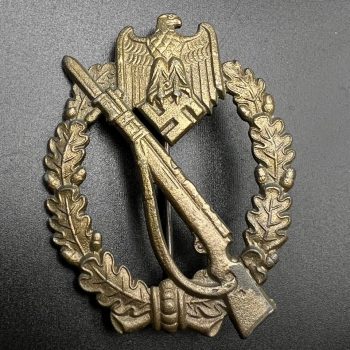
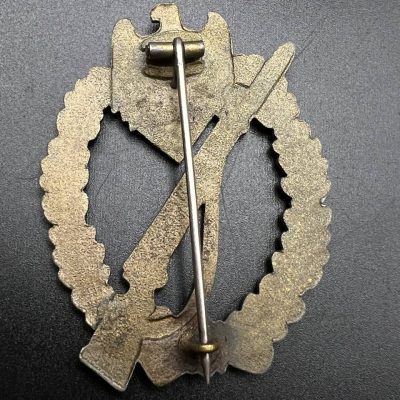
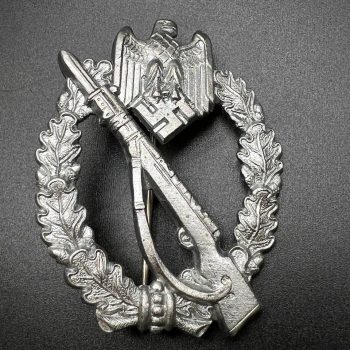
An unmarked Infantry Assault Badge in Bronze, with the strong relief and pronounced detailing typical of pre- and early wartime manufacture. The oak-leaf wreath features deep, well-defined veins, while the eagle and rifle show crisp lines consistent with high-quality early private makers.
The reverse displays the correct early hardware setup: tubular hinge, long slim pin, and a solid cast catch, all untouched and free of repairs. The bronze finish remains evenly preserved with natural patina and no signs of cleaning. A well-preserved collectible example with sharp relief and intact original hardware.
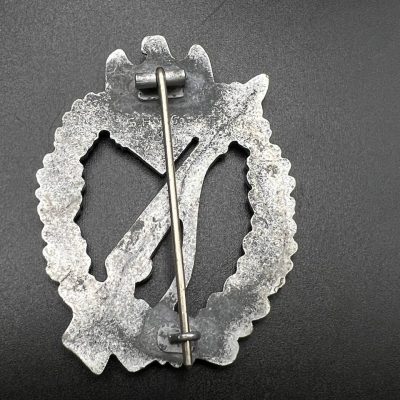
An original Infantry Assault Badge in Silver manufactured by Schauerte & Hohfeld, marked S.H.u.Co. 41 on the reverse. This is a classic late-war zinc example from the maker, known for its distinctive eagle with broad wings, sharply detailed oak-leaf wreath, and characteristic rifle profile.
The reverse features a clean, well-struck maker’s mark. Hardware is textbook for S.H.u.Co.: tubular hinge, long straight pin, and solid cast catch, all matching original wartime construction with no repairs. The silver finish shows typical zinc-era wear, yet the badge retains strong relief and clean details.
Overall, a solid collectible piece with natural patina and fully original hardware.
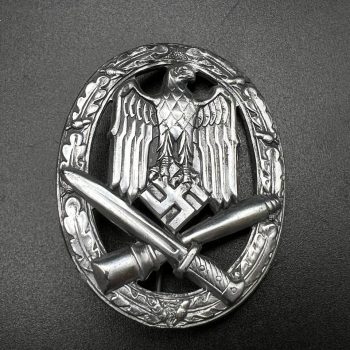
General Assault Badge, featuring the typical light silvered finish and strong relief associated with late production. The eagle, grenade head, and crossed bayonet elements remain sharply defined, with a natural uncleaned patina across the surface.
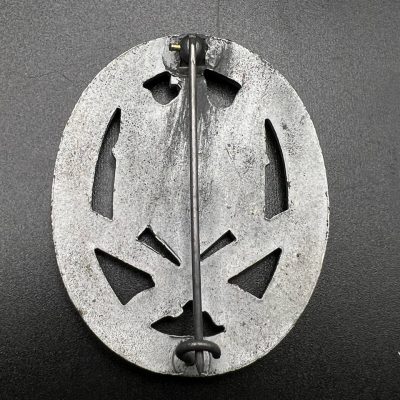
The reverse displays the textbook late hardware configuration: a long narrow pin, tubular hinge, and a solid cast catch. The rear cut-outs are cleanly executed and match the form seen on authentic unmarked badges from late-war manufacturers.
Overall condition is good and fully original, with crisp details and untouched hardware.
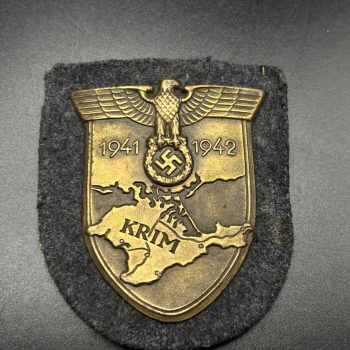
An original 1941–1942 Crimea Shield (Krimschild), produced as a solid brass stamped badge with strong, well-defined relief. The eagle, dates, and Crimea map are crisp, with a natural aged patina and no signs of restoration. The bronze finish is partially retained, typical for worn period examples.
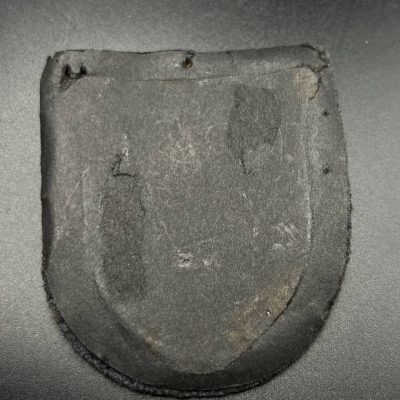
The shield is mounted on its correct dark-grey wool backing with internal cardboard stiffener, matching authentic wartime construction. The reverse shows period attachment marks, consistent with actual wear on the uniform. Overall condition is very good, with original materials fully intact.
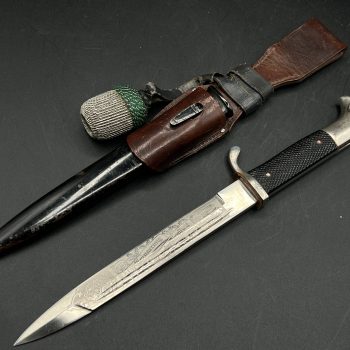
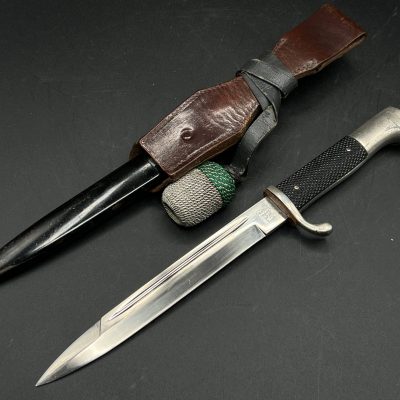
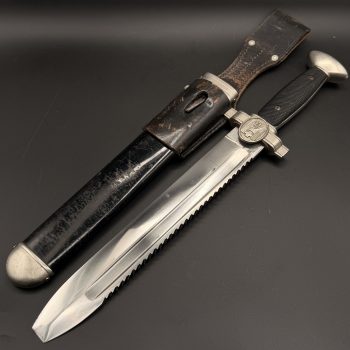
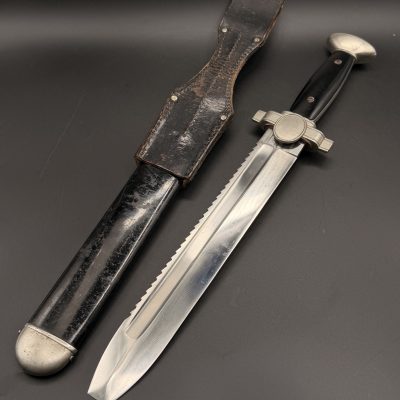
A regulation edged weapon for NCO personnel of the DRK (Deutsches Rotes Kreuz) organization, distinguished by its characteristic blade featuring a saw back and a specially shaped combat point. These design features rendered the hanger a functional tool suitable not only for ceremonial wear but also for practical field applications.
The item bears the marking “Ges. Gesch.” — an abbreviation of the German “Gesetzlich Geschützt” (“Protected by Law”), indicating patent protection of the item or its components within German territory. This marking was widely applied to Third Reich edged weapons, predominantly on daggers and dirks of party and paramilitary organizations, denoting patented design solutions for hilts, scabbards, or decorative elements. The presence of the original marking attests to the item’s authenticity and its manufacture during the period when German patent legislation was in effect, constituting an important attribution criterion for collectors.
The hanger was introduced following the reorganization of the German Red Cross in 1937 and its integration into the state structure of the Third Reich under the control of the Ministry of the Interior. The adoption of this pattern in 1938 was reflected in the National Socialist symbolism of its design, characteristic of all organizations incorporated into the party-state hierarchy of that period.
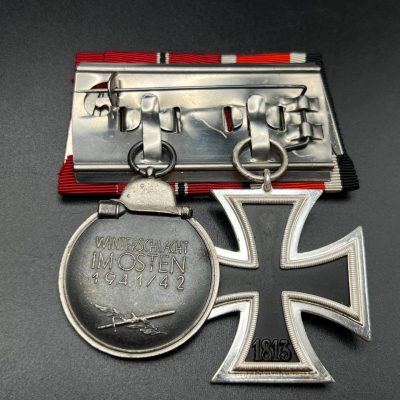
A two-place medal bar from the Third Reich period, fitted with the Iron Cross 2nd Class 1939 and the Eastern Front Medal 1941/42 (Ostmedaille). The bar features a metal back plate and neatly folded ribbons.
The suspension ring of the Iron Cross is marked “100”, identifying the maker as Rudolf Wächter, München. The ring of the Eastern Front Medal bears the mark “88”, corresponding to Gustav Brehmer, Markneukirchen.
Both decorations show honest age patina; the EK2 enamel remains excellent with no damage, and the Ostmedaille retains strong details. Ribbons are vivid and intact. A well-assembled and representative medal bar.
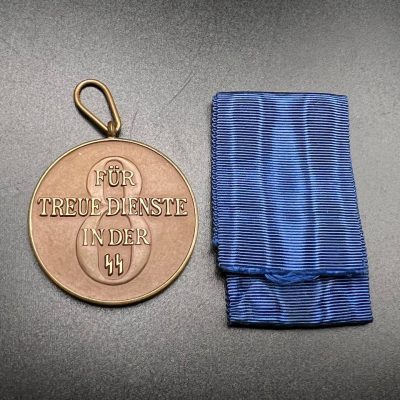
An original SS Long Service Medal, awarded for eight years of faithful service. The piece is struck in bronze with its characteristic matte brown finish. The obverse features a large swastika with a central SS rune wreath, rendered in detailed relief.
The reverse bears the inscription FÜR TREUE DIENSTE IN DER SS with sharp lettering and an even background. The suspension loop is correctly formed, separately made and soldered—fully consistent with authentic wartime production.
The medal comes with its original deep-blue ribbon of correct weave, well preserved with no fraying. Overall condition is very good, showing natural patina and crisp details without signs of cleaning or repair.
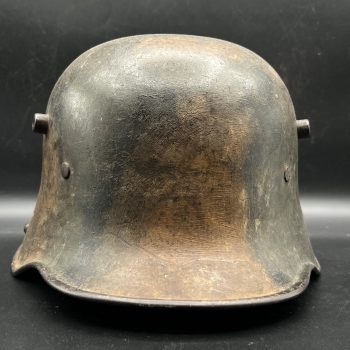
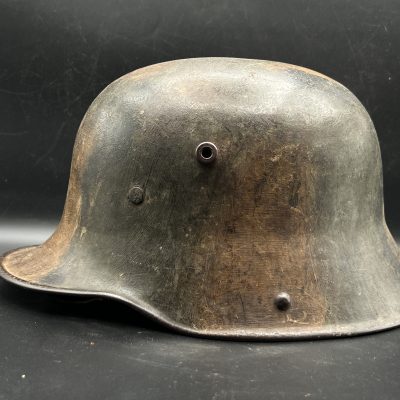
Excellent overall condition on this helmet. Features a standard camo pattern with colors of brown, green ad dark yellows. No dents and heavy damage, just expected wear for a helmet of this age. Interior is even better with all three liner pads intact which is quite rare as the tend to rot and fall out. Has a size stamping to the one side which is faint, but can just make it out. Nice WWI helmet with a great look about it.
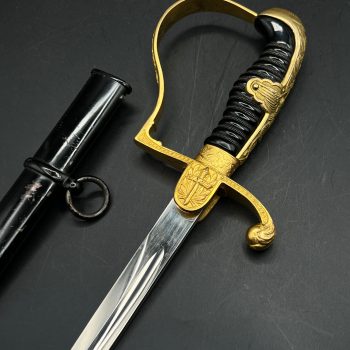
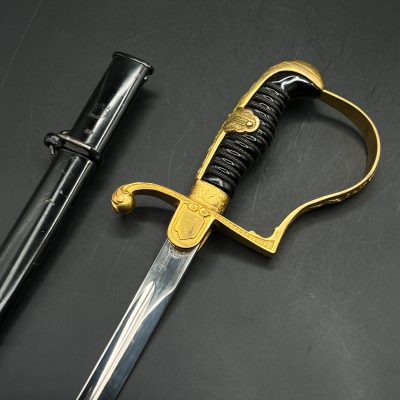
Officer parade weapons, revived following the restoration of the German armed forces, continued the proud traditions of the Imperial Army and the Reichswehr. Unlike the Army dagger model 1935, officer sabers were produced in numerous design variations by various Solingen manufacturers. Production of this type of weapon was discontinued in May 1943 due to wartime industrial demands; however, examples already in service continued to be worn with parade uniforms. In late 1944, the wearing of parade edged weapons was completely abolished, and officers were ordered to carry a pistol instead of a saber or dagger.
The blade bears the mark of the renowned Solingen firm F. W. Höller Waffenfabrik, founded in 1866 and officially registered with the Solingen authorities on 5 June 1883. From its founding, the company specialized in the production of edged weapons and cutlery. Throughout the late 19th century and during the First World War, the firm manufactured a wide range of military products, including bayonets, sabers, and swords. In 1905, the company registered its well-known trademarks: the thermometer image, as well as the figure of a man tipping his hat with the inscription “Hut ab!” (“Hats off!”). From 1914 to 1939, the firm was managed by Julius Küller. During the Third Reich period, Höller became one of the largest and most prolific edged weapons manufacturers in Solingen, specializing in a broad range of military products. In 1935, the company was located at Sonnenstraße 8, Solingen, and that same year received RZM license M7/33. Products were actively advertised in specialized journals and catalogs, showcasing an extensive assortment that included NSDAP and Wehrmacht daggers, swords, and bayonets. The firm also produced parade bayonets with high-quality etched blades. In 1941, Höller celebrated its 75th anniversary, promoting the Höller Model 21 sword as its flagship model. In June 1941, the company was assigned the K98 bayonet manufacturer letter code (fze). Following the end of the Second World War, under the ownership of Herr Grah, the firm continued operations, producing cutlery, kitchen and professional knives, swords, and scissors through the 1970s. The company was officially liquidated in December 1974. Particular collector value is added to this example by a rare decorative detail: an additional eagle on the grip backstrap, distinguishing this saber from standard production specimens.
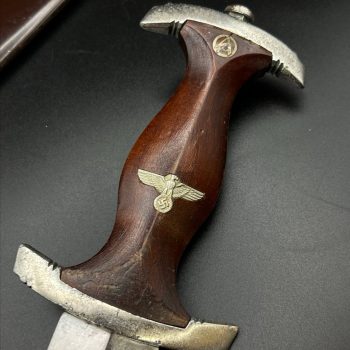
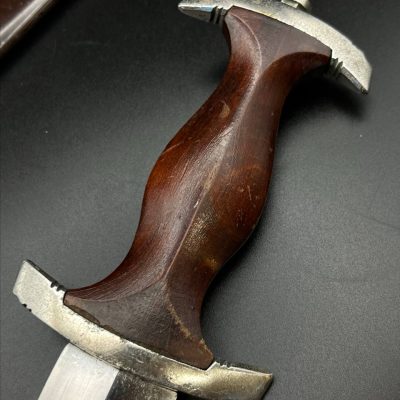
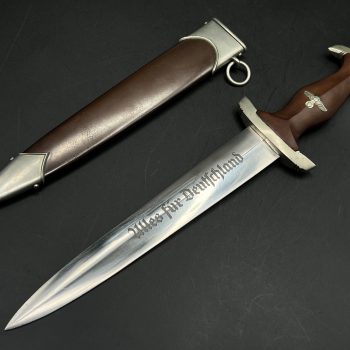
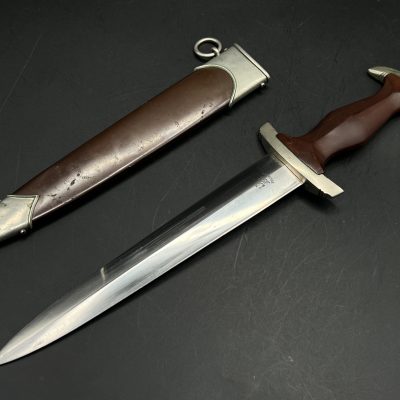
A service edged weapon of the SA (Sturmabteilung) storm troopers, adopted in 1933. The distinctively shaped blade with double-sided sharpening bears the legendary motto “Alles für Deutschland.” The handle is made of brown-colored wood and decorated with the SA emblem featuring an eagle; the metal scabbard is finished in the same brown tone.
The early type of SA/NSKK daggers was produced between 1933 and 1936 and is distinguished by a number of characteristic design features. The scabbard and handle fittings are made of nickel silver (German silver), which, combined with the high quality of component fitting and the anodized scabbard coating, sets these examples apart from later production runs. This dagger was manufactured by Stöcker & Co. SMF. Early examples are particularly prized by collectors due to their impeccable craftsmanship and historical significance as the first service daggers of the storm troopers.
A rarity rating of 5 out of 10 according to the Ralf Siegert classification indicates that such examples are relatively uncommon on the antiques market.
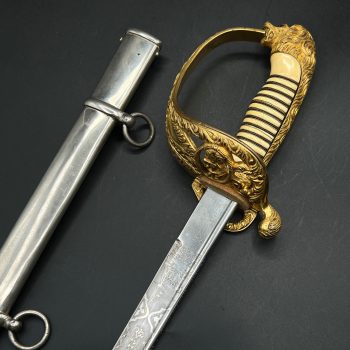
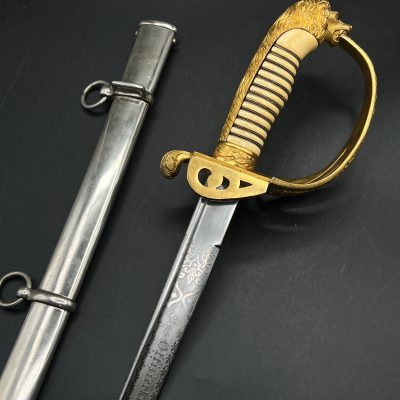
The naval saber was a mandatory attribute of the dress uniform of officers in the Kaiserliche Marine. During the period of Kaiser’s Germany, the imperial anchor beneath the Kaiser’s crown was characteristic in the design of the hilt. The classical variant featured a brass hilt, ivory grip, and a lion’s head with eyes of red and green color. The scabbard was typically made of black leather with brass fittings; steel scabbards are considerably rarer. Sabers were purchased by officers at their own expense, which resulted in numerous variations of execution. Standard and Damascus blades can be found, various hilt designs and decorative scabbard finishes, as well as several sizes ranging from light and elegant to large Grosse Pattern models. It is precisely this diversity of execution that makes naval sabers a particularly interesting independent field of collecting: collections can be built according to manufacturers, sizes, hilt types, blades, and finishing variations. Along with the dirk, the saber remained a symbol of officer status and the continuity of German naval weaponry traditions of the nineteenth century.
E. & F. Hörster, one of the largest Solingen manufacturers of naval edged weapons, operated from the nineteenth century and continued production during the Weimar Republic and the Third Reich. The firm produced high-quality naval sabers and dirks in various execution variants. Already before World War I, Hörster products were supplied not only for the German market but were also exported to other European countries, including the Russian Empire. Thanks to its long operational period, Hörster products allow one to trace the development of naval edged weapons from the Kaiser era to the Kriegsmarine.
Seebataillone represented naval infantry units of the Kaiserliche Marine. There were several marine battalions, and the custom-made edged weapons associated with them constitute a separate field of collecting German naval weaponry. A characteristic feature of such items is the combination of naval and infantry attributes. For example, an officer’s saber could feature a traditional naval hilt and blade but be equipped with steel infantry-type scabbards. Custom specimens frequently bear personal dedications from one officer to another or from the officer corps to a specific serviceman of a Seebataillon. In addition to officer sabers and other custom edged weapons, this group includes infantry-type bayonets for Mauser system rifles with Seebataillone designations and symbols. Most such items bear unit designations; however, named specimens also occur, representing particular collecting interest.
This saber features a characteristic openwork pierced hilt, presented in the catalogs of several manufacturers; however, it did not correspond to the established standard for Kaiserliche Marine edged weapons and was subsequently prohibited from being worn. It is precisely this unusual feature that makes such sabers particularly desirable among collectors today. Such specimens were predominantly ordered as presentation weapons, for example upon an officer’s transfer to another unit or upon his retirement from service, and served as an object of special pride for the owner. The present specimen is entirely original; the factory riveting of the hilt remains intact, the saber has not been disassembled, and retains its original configuration.