By clicking Login or Register, you agree that the images of Nazi symbols shown on alexmp.com are not propaganda of fascism, Nazism and are shown solely for historical, cognitive and scientific purposes.
Request a callback
Order a free call and our specialist will contact you shortly!
Ask a question
Contact us and we will get back to you shortly.
Request a Blitz Price
Contact us and we will get back to you shortly.
Request a price
Contact us and we will get back to you shortly.
Offer your blitz price
Contact us and we will get back to you shortly.
Error: Contact form not found.
Request a subscription
We will get back to you shortly.
Subscription
В честь запуска Энциклопедии мы рады предложить вам бесплатный доступ до 01.10.2036. Будем рады вашим комментариям и предложениям!
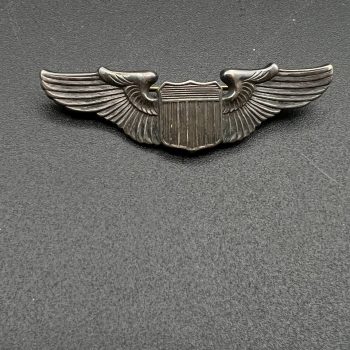
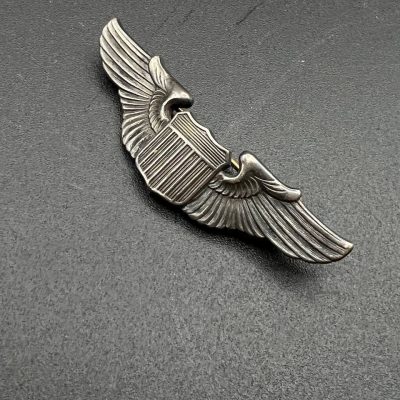
Original WWII U.S. Army Air Corps pilot wings. Made of sterling silver, clearly marked STERLING on the reverse. Small size (approx. 2 inches wide) with the classic design — central shield with vertical stripes and outstretched wings. Worn by pilots and cadets of the U.S. Army Air Forces during the 1940s. Good condition with attractive age patina.
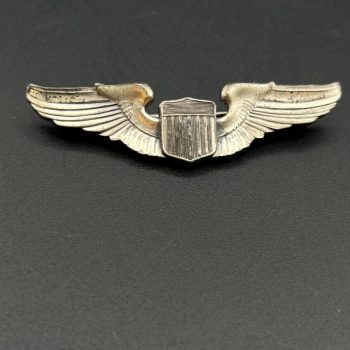
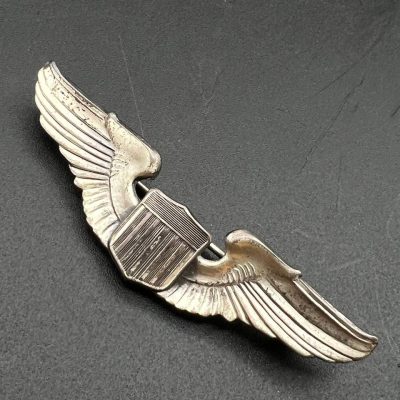
Original pilot wings of the US Army Air Forces from World War II. Made of sterling silver (stamped STERLING on the reverse). Classic design with outstretched wings and a US shield at the center. Size approx. 3 inches (about 7.5 cm). Pin-back fastening.
These wings were awarded to USAAF pilots upon completion of flight training and remained a symbol of status and qualification.
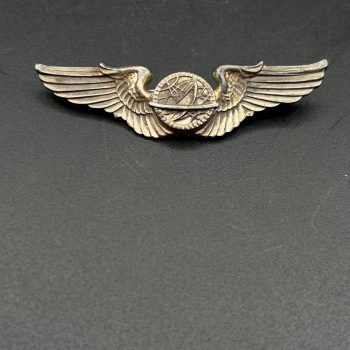
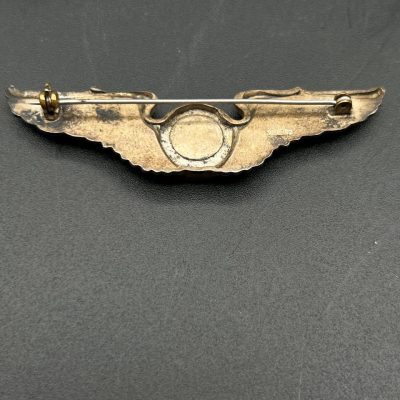
Original World War II Navigator Wings of the U.S. Army Air Forces.
• Material: Sterling silver (marked “Sterling” on the reverse).
• Design: Classic winged badge with central disk featuring a sextant and globe motif.
• Mount: Long pinback on reverse.
• Standard size ~3 inches (approx. 7.5 cm).
• Likely manufactured by one of the known wartime contractors (Amcraft, Gemsco, etc.).
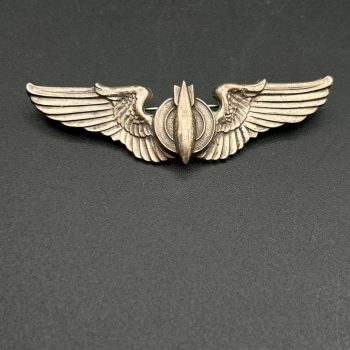
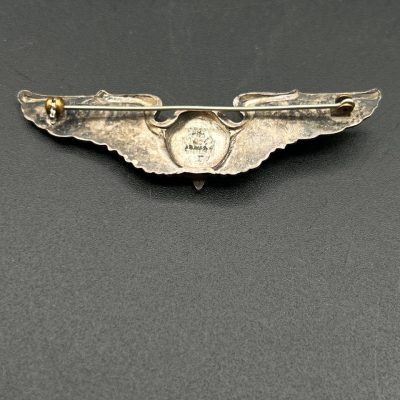
Original set of U.S. Army Air Force Bombardier Wings from World War II. Manufactured by AMCRAFT, marked “STERLING” on the reverse, indicating .925 silver. Classic design featuring outstretched wings with a bomb emblem in the center. The reverse side retains its functional pin-back fastening.
These wings were awarded to graduates of bombardier schools who successfully completed their training in the U.S. Army Air Forces. A highly recognizable and collectible badge among WWII U.S. aviation insignia.
Condition: Good, with natural age patina and wear. All parts are original.
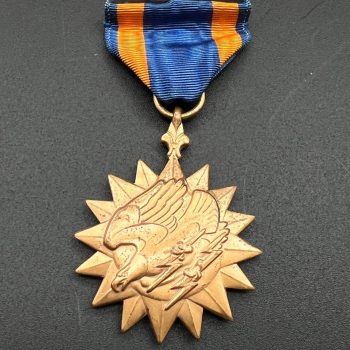
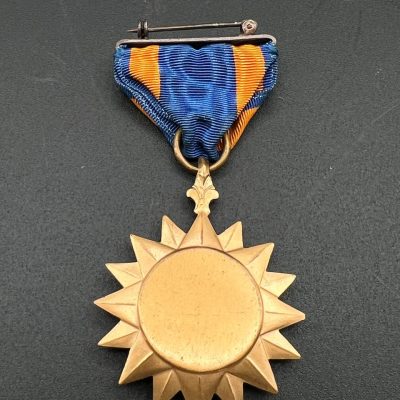
Original American Air Medal from World War II. Established in 1942 to recognize military personnel for heroism and outstanding achievements during aerial operations.
No.18973
The obverse depicts an eagle in flight clutching lightning bolts against a radiant sun — a symbol of the speed and power of aviation. The reverse is plain, without inscriptions. The ribbon is blue with orange central and edge stripes, mounted on its original pinback.
This is an authentic wartime issue, with attractive patina and honest wear, fully consistent with period production.
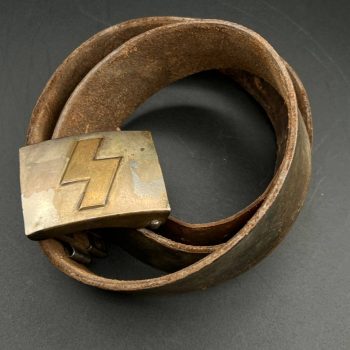
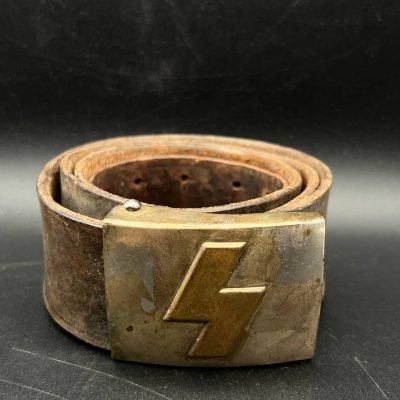
Leather belt with an original Deutsches Jungvolk (DJ) buckle from the Third Reich period. The buckle is made of aluminum (or zinc, depending on the series) with a raised “Sieg Rune” (lightning bolt) — the distinctive symbol of the DJ youth organization, part of the Hitlerjugend. The reverse of the buckle shows the typical stamped construction and fittings. The leather belt is in worn condition and measures approximately 70 cm in length.
Such items are considered relatively rare and are highly sought after by collectors of Third Reich youth organization memorabilia.
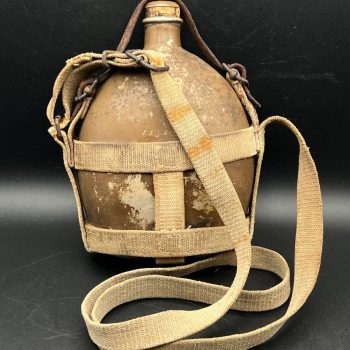
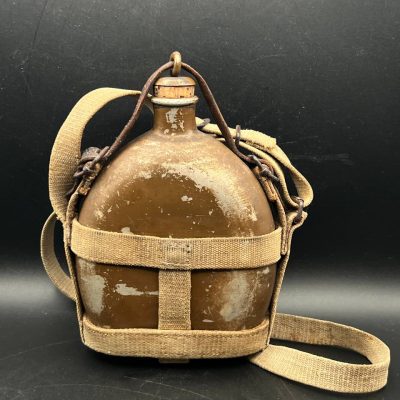
An original Imperial Japanese Army infantry canteen from World War II.
• Metal body in brown paint with visible period wear.
• Wooden stopper with original leather retaining strap.
• Characteristic cross-strap web harness with shoulder strap.
• Metal loop and ring for suspension.
• Japanese kanji markings and unit/number still visible on the body.
These canteens were standard issue for Japanese infantry across all Pacific war fronts. This example remains in authentic field-used condition, complete with its original straps and fittings.
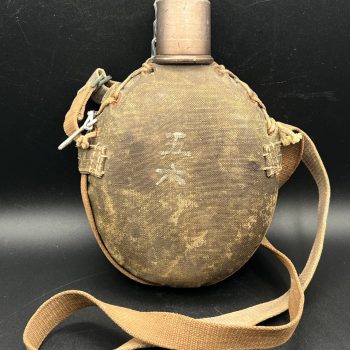
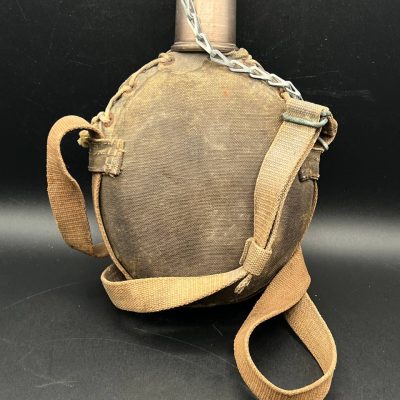
Original soldier’s canteen of the Imperial Japanese Army from World War II. • Aluminum body with a khaki cloth cover secured by lacing. • Metal cup-cap with screw top, attached by chain. • Cotton web shoulder strap. • On the cover, white painted kanji 正大 (likely the owner’s name), a typical personalization practice in the Japanese army. A complete field canteen set showing strong service use, yet retaining all original elements. Widely issued to Japanese infantrymen on all Pacific war fronts.
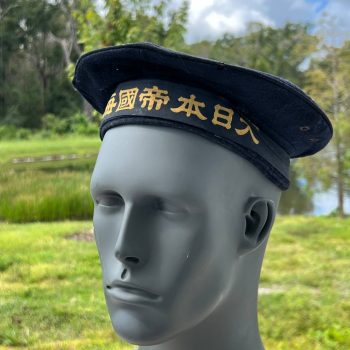
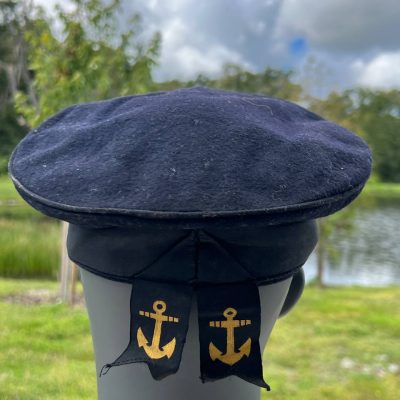
An original enlisted man’s cap from the Imperial Japanese Navy during World War II.
• The dark blue tally bears gilt characters 大日本帝國海軍 (Dai Nippon Teikoku Kaigun – “Great Imperial Japanese Navy”).
• At the back are the traditional streamers with gold anchors.
• Inside remains the cloth label with kanji fields for the sailor’s name, issue date, and naval district/arsenal.
Constructed of dark blue wool with a sweatband. A well-preserved example for its age, with clear inscriptions and original ribbons intact.
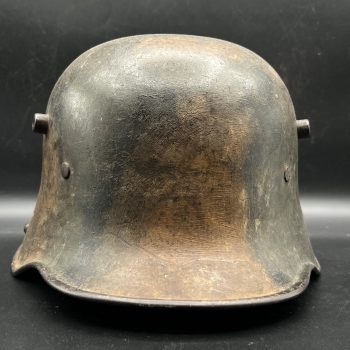
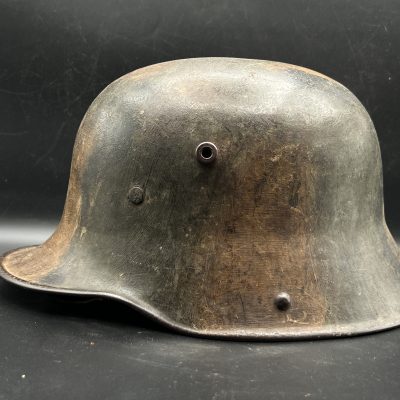
Excellent overall condition on this helmet. Features a standard camo pattern with colors of brown, green ad dark yellows. No dents and heavy damage, just expected wear for a helmet of this age. Interior is even better with all three liner pads intact which is quite rare as the tend to rot and fall out. Has a size stamping to the one side which is faint, but can just make it out. Nice WWI helmet with a great look about it.
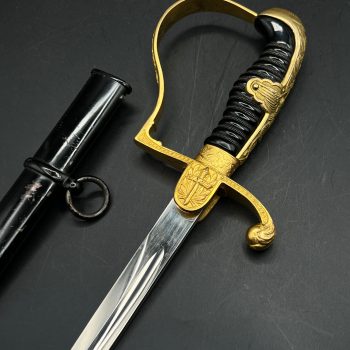
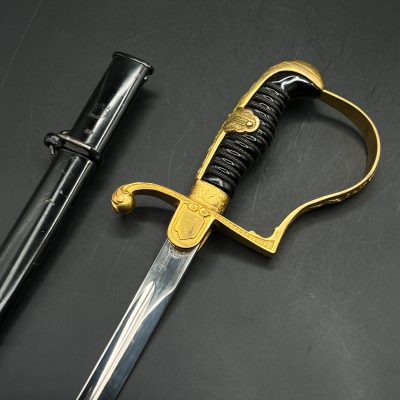
Officer parade weapons, revived following the restoration of the German armed forces, continued the proud traditions of the Imperial Army and the Reichswehr. Unlike the Army dagger model 1935, officer sabers were produced in numerous design variations by various Solingen manufacturers. Production of this type of weapon was discontinued in May 1943 due to wartime industrial demands; however, examples already in service continued to be worn with parade uniforms. In late 1944, the wearing of parade edged weapons was completely abolished, and officers were ordered to carry a pistol instead of a saber or dagger.
The blade bears the mark of the renowned Solingen firm F. W. Höller Waffenfabrik, founded in 1866 and officially registered with the Solingen authorities on 5 June 1883. From its founding, the company specialized in the production of edged weapons and cutlery. Throughout the late 19th century and during the First World War, the firm manufactured a wide range of military products, including bayonets, sabers, and swords. In 1905, the company registered its well-known trademarks: the thermometer image, as well as the figure of a man tipping his hat with the inscription “Hut ab!” (“Hats off!”). From 1914 to 1939, the firm was managed by Julius Küller. During the Third Reich period, Höller became one of the largest and most prolific edged weapons manufacturers in Solingen, specializing in a broad range of military products. In 1935, the company was located at Sonnenstraße 8, Solingen, and that same year received RZM license M7/33. Products were actively advertised in specialized journals and catalogs, showcasing an extensive assortment that included NSDAP and Wehrmacht daggers, swords, and bayonets. The firm also produced parade bayonets with high-quality etched blades. In 1941, Höller celebrated its 75th anniversary, promoting the Höller Model 21 sword as its flagship model. In June 1941, the company was assigned the K98 bayonet manufacturer letter code (fze). Following the end of the Second World War, under the ownership of Herr Grah, the firm continued operations, producing cutlery, kitchen and professional knives, swords, and scissors through the 1970s. The company was officially liquidated in December 1974. Particular collector value is added to this example by a rare decorative detail: an additional eagle on the grip backstrap, distinguishing this saber from standard production specimens.
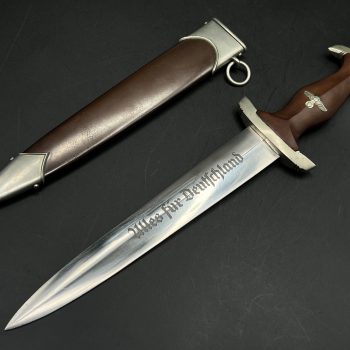
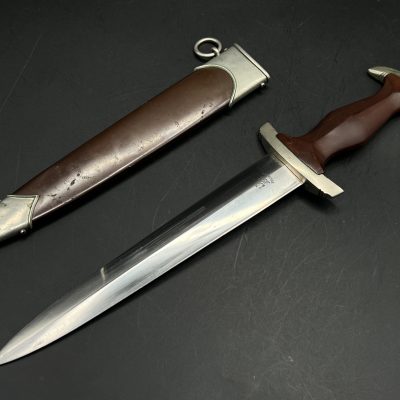
A service edged weapon of the SA (Sturmabteilung) storm troopers, adopted in 1933. The distinctively shaped blade with double-sided sharpening bears the legendary motto “Alles für Deutschland.” The handle is made of brown-colored wood and decorated with the SA emblem featuring an eagle; the metal scabbard is finished in the same brown tone.
The early type of SA/NSKK daggers was produced between 1933 and 1936 and is distinguished by a number of characteristic design features. The scabbard and handle fittings are made of nickel silver (German silver), which, combined with the high quality of component fitting and the anodized scabbard coating, sets these examples apart from later production runs. This dagger was manufactured by Stöcker & Co. SMF. Early examples are particularly prized by collectors due to their impeccable craftsmanship and historical significance as the first service daggers of the storm troopers.
A rarity rating of 5 out of 10 according to the Ralf Siegert classification indicates that such examples are relatively uncommon on the antiques market.
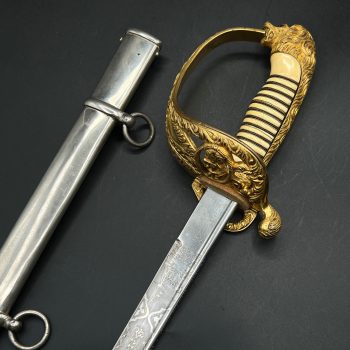
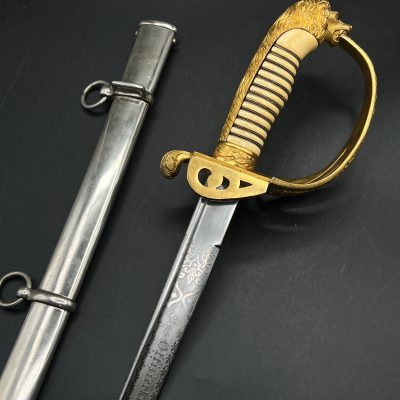
The naval saber was a mandatory attribute of the dress uniform of officers in the Kaiserliche Marine. During the period of Kaiser’s Germany, the imperial anchor beneath the Kaiser’s crown was characteristic in the design of the hilt. The classical variant featured a brass hilt, ivory grip, and a lion’s head with eyes of red and green color. The scabbard was typically made of black leather with brass fittings; steel scabbards are considerably rarer. Sabers were purchased by officers at their own expense, which resulted in numerous variations of execution. Standard and Damascus blades can be found, various hilt designs and decorative scabbard finishes, as well as several sizes ranging from light and elegant to large Grosse Pattern models. It is precisely this diversity of execution that makes naval sabers a particularly interesting independent field of collecting: collections can be built according to manufacturers, sizes, hilt types, blades, and finishing variations. Along with the dirk, the saber remained a symbol of officer status and the continuity of German naval weaponry traditions of the nineteenth century.
E. & F. Hörster, one of the largest Solingen manufacturers of naval edged weapons, operated from the nineteenth century and continued production during the Weimar Republic and the Third Reich. The firm produced high-quality naval sabers and dirks in various execution variants. Already before World War I, Hörster products were supplied not only for the German market but were also exported to other European countries, including the Russian Empire. Thanks to its long operational period, Hörster products allow one to trace the development of naval edged weapons from the Kaiser era to the Kriegsmarine.
Seebataillone represented naval infantry units of the Kaiserliche Marine. There were several marine battalions, and the custom-made edged weapons associated with them constitute a separate field of collecting German naval weaponry. A characteristic feature of such items is the combination of naval and infantry attributes. For example, an officer’s saber could feature a traditional naval hilt and blade but be equipped with steel infantry-type scabbards. Custom specimens frequently bear personal dedications from one officer to another or from the officer corps to a specific serviceman of a Seebataillon. In addition to officer sabers and other custom edged weapons, this group includes infantry-type bayonets for Mauser system rifles with Seebataillone designations and symbols. Most such items bear unit designations; however, named specimens also occur, representing particular collecting interest.
This saber features a characteristic openwork pierced hilt, presented in the catalogs of several manufacturers; however, it did not correspond to the established standard for Kaiserliche Marine edged weapons and was subsequently prohibited from being worn. It is precisely this unusual feature that makes such sabers particularly desirable among collectors today. Such specimens were predominantly ordered as presentation weapons, for example upon an officer’s transfer to another unit or upon his retirement from service, and served as an object of special pride for the owner. The present specimen is entirely original; the factory riveting of the hilt remains intact, the saber has not been disassembled, and retains its original configuration.